“It is not the man who is the strongest, but the woman who is the cleverest.”
— Spoken by Laura, highlighting her manipulative intelligence.

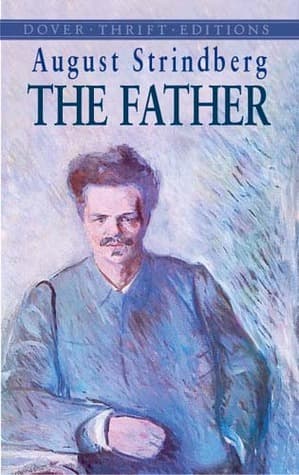
Sign in to track this book
A captain's wife manipulates him into questioning his paternity, leading to his mental collapse and loss of identity.
Captain Adolf, a cavalry officer and scientist, discusses his daughter Bertha's education with the new Doctor and his wife, Laura. Adolf wants Bertha to live in the city and study art. Laura insists she stay home and be raised in her own faith, not Adolf's more secular beliefs. The Doctor, at first neutral, soon gets involved in their arguments. Adolf also learns that the wet nurse, Margaret, has spread rumors that he is not Bertha's biological father. This accusation, initially minor, deeply troubles Adolf and sets the stage for his growing conflict with Laura, as he sees it as an attack on his authority and sanity.
After the talk about Bertha's future, Laura skillfully manipulates Adolf. She pretends to worry about his health, suggesting he might be overworking. Then she subtly brings up the rumor of Bertha's illegitimacy, feigning distress that anyone could think such a thing. Adolf, already bothered by Margaret's earlier hint, becomes more agitated. Laura's plan is to create doubt and paranoia without directly accusing him, making him question his own sanity and grasp on reality. She knows that by making him uncertain about fatherhood, she can weaken his position and control over Bertha.
Adolf learns that his scientific research, which he largely funded himself, has been rejected. This professional setback is a major blow to his self-esteem and financial stability. He invested his intellect and money into this work, and its failure leaves him feeling vulnerable. Laura, instead of offering support, uses this moment to advance her agenda, suggesting his scientific work is impractical and bad for the family. This supports her idea that he is unstable and cannot make good decisions, especially about Bertha's future.
Laura openly tells the Doctor that Adolf has a mental illness, citing his strange behavior and the research failure. She strategically places a letter, supposedly from Adolf, implying he sent a large sum of money to an unknown person. This further suggests his irrationality. Adolf, hearing parts of these talks and finding the letter, becomes extremely paranoid. He starts to question his own memory and sanity, a direct result of Laura's psychological attacks. The Doctor, influenced by Laura's consistent portrayal of Adolf, begins to consider medical intervention.
Pushed to the edge by Laura's constant gaslighting and the rumors about Bertha, Adolf confronts Laura in a fit of rage. He accuses her of being a vampire and threatens her with a burning lamp. This violent outburst gives Laura the 'proof' she needs to convince the Doctor and the Pastor that Adolf is insane and dangerous. His loss of control, though provoked, confirms the story Laura has carefully built, sealing his fate as a madman in the eyes of others.
Bertha, caught between her parents' growing conflict, is deeply upset. She loves her father but is constantly influenced by her mother's manipulative stories. Laura uses Bertha's affection and fear to her advantage, making Bertha feel responsible for her father's supposed madness and encouraging her to side with her mother. Bertha's eventual decision to align with Laura, even if reluctantly, is a devastating blow to Adolf. He sees it as the ultimate betrayal and the loss of his only true connection. This further isolates him and reinforces his feeling of being utterly alone.
The Doctor, having seen Adolf's increasingly strange behavior and influenced by Laura's persistent accounts, talks with the Pastor. Laura presents her carefully chosen evidence, painting Adolf as a dangerous lunatic. Despite Adolf's passionate and clear arguments, his outbursts and Laura's 'proof' lead the Doctor to conclude that Adolf is mentally unstable and needs confinement. The Doctor's diagnosis is a crucial moment, providing the official reason for Laura to take full control of Adolf's affairs and Bertha's upbringing, effectively removing Adolf.
In a cruel turn, Margaret, the wet nurse who once cared for Adolf, helps Laura subdue him. She approaches Adolf with feigned sympathy, offering to help him with his coat. As he struggles, she skillfully slips a straitjacket onto him, trapping him. Adolf, weakened and confused, realizes her betrayal too late. This physical restraint, arranged by Laura through someone from his past, symbolizes his complete loss of power. It is the final, humiliating step in his downfall, cementing his helplessness.
Trapped in the straitjacket, Adolf's mind further unravels. He rants about the injustices he has suffered, the cruelty of women, and the impossibility of knowing paternity. His earlier scientific reason is completely replaced by paranoia and despair. He experiences vivid hallucinations and increasingly confused thoughts, fully embodying the madness Laura had so carefully created for him. His once powerful intellect is now fragmented, a tragic result of the psychological torture he endured. He collapses, physically and mentally broken, his spirit utterly crushed.
Adolf, completely defeated and broken, dies in the straitjacket, collapsing into Margaret's arms. Laura stands victorious, having achieved her goal of completely discrediting and incapacitating her husband. With Adolf gone, she has full control over Bertha's upbringing, the family finances, and her own life. The play ends with Laura's triumph, a chilling victory achieved through psychological manipulation and the destruction of her husband. Bertha, now solely under her mother's influence, faces a future shaped by this brutal marital battle.
The Protagonist
Adolf descends from a rational, authoritative figure into a paranoid, delusional, and ultimately broken man, stripped of his identity and sanity by his wife's manipulations.
The Antagonist
Laura successfully executes her plan to strip Adolf of his power and sanity, achieving complete control over her daughter and household, demonstrating an unwavering resolve.
The Supporting
Bertha starts as an innocent and loving daughter, but is gradually forced to choose sides, ultimately aligning with her mother due to fear and manipulation.
The Supporting
The Doctor moves from an objective observer to a tool in Laura's scheme, providing the medical justification for Adolf's confinement.
The Supporting
The Pastor consistently sides with his sister, Laura, against Adolf, providing a moral and familial bulwark for her actions.
The Supporting
Margaret transforms from a seemingly innocuous servant to a direct participant in Adolf's physical restraint and ultimate defeat.
The Mentioned
Nöjd's story remains a static example, serving as a thematic precursor to Adolf's own struggle.
The play's main theme is the destructive conflict between men and women, especially in marriage. Laura and Adolf engage in a relentless power struggle, with Laura using psychological manipulation and social expectations to dismantle Adolf's authority and sanity. Adolf, representing male intellect and patriarchal power, is systematically undermined by Laura's cleverness. This theme appears in their disputes over Bertha's education, Adolf's scientific work, and his paternity. The play shows marriage as a battlefield where one sex must dominate the other, leading to the destruction of the weaker party.
“You are like a vampire sucking the life out of me!”
The question of paternity is Laura's main weapon against Adolf. The play explores how fatherhood is inherently unknowable, contrasting it with the certainty of motherhood. The rumor that Adolf might not be Bertha's biological father, though never proven, drives Adolf to madness. This uncertainty challenges his identity, his rights as a father, and his hold on reality. It shows how a basic biological truth, or the lack of it, can be used to destroy a man's life and authority, making paternity a key weakness for men in the patriarchal structure.
“How can I know I am the father?”
Adolf, a scientist, represents reason, logic, and a desire for objective truth. Laura, however, acts through emotion, intuition, and calculated manipulation. The play shows how inadequate reason is when faced with subtle psychological warfare. Adolf's attempts to use logic and facts to defend himself fail against Laura's emotional appeals, gaslighting, and the strategic planting of doubt. This theme illustrates how subjective perception and emotional manipulation can overpower objective truth, leading to a rational mind's downfall and the triumph of cunning over intellect.
“You can never tell a woman the truth.”
The play is about power dynamics within a marriage. Laura's ultimate goal is to seize control: over Bertha's upbringing, the household, and Adolf's sanity. She does this by systematically disempowering Adolf, taking away his authority, his reputation, and his mental stability. The power struggle is not open physical violence but a subtle, psychological war that leaves Adolf completely broken. This theme reveals how power can be exerted through non-physical means, using weaknesses and social biases to achieve complete dominance.
“I have taken the power, and I regret nothing.”
Laura's psychological manipulation to make Adolf doubt his own sanity.
Laura systematically uses gaslighting throughout the play to undermine Adolf's perception of reality. She denies events, twists his words, and plants seeds of doubt about his memory and mental state. For example, she feigns concern for his 'overwork' while subtly introducing the paternity rumor, or orchestrates 'evidence' like the letter about the missing money. This constant psychological assault makes Adolf question his own sanity, an essential step in Laura's plan to have him declared insane and gain full control over their daughter and finances.
A physical symbol of Adolf's complete loss of freedom and sanity.
The straitjacket is a powerful symbolic object in the play. It represents Adolf's complete physical and mental subjugation. Its appearance signifies the culmination of Laura's psychological warfare, as it is the final, tangible means by which Adolf is stripped of his autonomy and confined as a 'madman.' The act of being tricked into wearing it by his former wet nurse, Margaret, adds a layer of cruel irony and betrayal, emphasizing his utter helplessness and the finality of his defeat at the hands of women.
A rumor used as a psychological weapon to destroy Adolf's identity and sanity.
The rumor, initially spread by the wet nurse Margaret, that Captain Adolf might not be Bertha's biological father, serves as the central psychological weapon in Laura's arsenal. She expertly amplifies this doubt, knowing that the inherent unknowability of paternity for men is a profound vulnerability. This rumor directly attacks Adolf's identity as a father, his patriarchal rights, and his sense of self-worth. It fuels his paranoia and contributes significantly to his mental breakdown, proving to be far more damaging than any direct accusation could have been.
A symbol of Adolf's explosive rage and a turning point in Laura's plan.
Adolf's act of threatening Laura with a burning lamp is a pivotal moment. It symbolizes his complete loss of rational control and his descent into a primal, violent rage, directly provoked by Laura's manipulations. For Laura, this outburst is not a threat but a strategic opportunity; it provides the 'proof' she needs to convince the Doctor and the Pastor that Adolf is indeed a danger and mentally unstable. It is the visible manifestation of the madness she has carefully engineered, solidifying his diagnosis and sealing his fate.
“It is not the man who is the strongest, but the woman who is the cleverest.”
— Spoken by Laura, highlighting her manipulative intelligence.
“The child is the worst enemy of the marriage.”
— The Captain's bitter reflection on the role of children in marital strife.
“You have sucked my soul out of me, and then you have thrown it away.”
— The Captain's accusation towards Laura, expressing his emotional depletion.
“One must choose between being a man or a father.”
— The Captain's dilemma as he feels his identity as a man is threatened by his role as a father.
“You are a woman, and that is your strength.”
— The Doctor observing Laura's inherent power.
“To be married is to live in a perpetual state of war.”
— A general sentiment reflecting the intense conflict within the marriage.
“My brain is dissolving, my thoughts are running out.”
— The Captain's descent into mental distress.
“Love is a game, and the woman always wins.”
— A cynical view on the dynamics of love and power between sexes.
“You cannot fight a ghost.”
— The Captain's frustration at fighting an enemy (Laura's subtle manipulation) that he cannot grasp.
“The strongest man is he who can bear the most.”
— The Nurse's observation on enduring suffering, often in the context of the Captain.
“Tell me, is there a God?”
— The Captain's desperate cry for meaning or justice amidst his torment.
“It is a struggle for life and death, and only one can survive.”
— The Captain's stark view of his marriage with Laura.
“The greatest tragedy is not to die, but to be born.”
— A nihilistic view on existence, possibly from the Captain's perspective.
“You have planted a doubt in my soul, and it has grown into a tree.”
— The Captain's lament about Laura's insinuation of his not being the father, which consumes him.
Ready to see how well you understood this book? Take our interactive quiz with 10 questions.
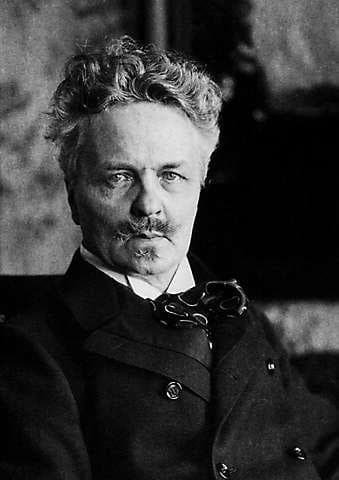
Johan August Strindberg was a Swedish playwright, novelist, poet, essayist and painter. A prolific writer who often drew directly on his personal experience, Strindberg wrote more than sixty plays and more than thirty works of fiction, autobiography, history, cultural analysis, and politics during his career, which spanned four decades. A bold experimenter and iconoclast throughout, he explored a wide range of dramatic methods and purposes, from naturalistic tragedy, monodrama, and history plays, to his anticipations of expressionist and surrealist dramatic techniques. From his earliest work, Strindberg developed innovative forms of dramatic action, language, and visual composition. He is considered the "father" of modern Swedish literature and his The Red Room (1879) has frequently been described as the first modern Swedish novel. In Sweden, Strindberg is known as an essayist, painter, poet, and especially as a novelist and playwright, but in other countries he is known mostly as a playwright.

Ashley Antoinette
4.6

Mark McDonald
4.4
Luo Guanzhong
4.4

Mia McKenzie
4.3

Dorothy Parker
4.3

Joaquim Maria Machado de Assis
4.3

James Thurber
4.2

Terry Kay
4.2