“The only thing that really matters is money, and in order to get money, one must be practical.”
— The narrator's initial cynical reflection on modern life.

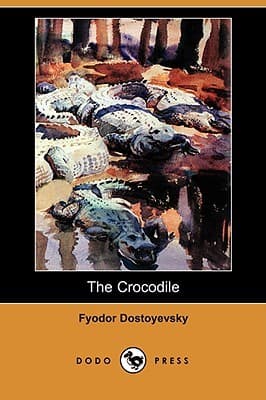
Fyodor Dostoyevsky (2014)
Genre
Fiction
Reading Time
45 min
Key Themes
See below
Sign in to track this book
A pompous civil servant is swallowed by a crocodile and continues to lecture from its belly, forcing his wife and friends to navigate absurd bureaucracy and public indifference.
The story begins with the narrator joining his friend Ivan Matveitch and Ivan's wife, Elena Ivanovna, at an arcade to see a new crocodile. Ivan Matveitch, a quiet government official, is at first unsure but agrees because of Elena Ivanovna's curiosity. The German owner, Karlchen, proudly shows off his crocodile, calling it a scientific wonder. Elena Ivanovna wants to see the crocodile fed, despite Ivan Matveitch's discomfort and the narrator's warnings about the animal's danger. The mood is a mix of mild amusement and growing unease about the exotic creature.
While watching, Ivan Matveitch, seemingly wanting a closer look or to please his wife, approaches the crocodile's cage. Suddenly, the crocodile lunges and swallows him whole. The event is quick and shocking, leaving Elena Ivanovna and the narrator stunned. Karlchen, the German owner, is at first more worried about damage to his crocodile and financial loss than about Ivan Matveitch's fate. The immediate aftermath is a mix of panic, disbelief, and a strange concern for the crocodile's health, showing how absurd the situation is.
To everyone's surprise, Ivan Matveitch speaks from inside the crocodile's belly, confirming he is alive and relatively comfortable. He describes the inside as a warm, dark, and surprisingly roomy rubber bag. Instead of being upset, Ivan Matveitch quickly adjusts to his strange situation and begins to see it as a unique chance for philosophical thought and social comment. He rejects the idea of being cut out, fearing it would harm the crocodile and thus his unique 'position.' His immediate change from victim to intellectual observer is a dark and funny twist in the story.
Karlchen, the German owner, cares mostly about the money involved. He fears that harming the crocodile to get Ivan Matveitch out would ruin his business and that the creature might die from indigestion. He does not want to cut the crocodile open, valuing his exotic exhibit over human life. He also worries about public opinion and legal problems. His wife, a practical and sharp woman, is also very concerned about their income and urges Karlchen to find a solution that protects their investment, further showing the materialistic and absurd parts of the situation.
Elena Ivanovna, Ivan Matveitch's wife, is less worried about her husband's physical state than about the social embarrassment and trouble his situation causes her. She worries about what people will say and how her reputation will be affected by having a husband living inside a crocodile. She wants him to be taken out but also thinks about making money from his unique fame. Her immediate thoughts turn to fashion, social visits, and the perceived scandal, rather than real distress or a desire for his immediate rescue, showing her superficiality and the societal values being made fun of.
From inside the crocodile, Ivan Matveitch begins to talk about his ideas on economics, social reform, and humanity's future. He believes his unique spot gives him an unmatched view, free from outside distractions and biases. He sees himself as a new kind of prophet, a 'living exhibit' who can give deep insights. He even thinks about starting a new journal or publishing his ideas from inside the crocodile, believing his situation will attract huge public interest and give his statements great weight. He dismisses the idea of being freed, as it would lessen his unique status.
The narrator, the only seemingly sensible character, repeatedly tries to talk sense into Ivan Matveitch, Elena Ivanovna, and the German owner. He suggests practical solutions, like cutting open the crocodile, but his efforts are met with resistance, indifference, or absurd counter-arguments. He is frustrated by Ivan Matveitch's new philosophical passion, Elena Ivanovna's social worries, and Karlchen's financial concerns. His attempts to bring common sense to the situation are always stopped, showing the widespread irrationality and self-interest of the other characters and the story's satirical nature.
News of Ivan Matveitch living inside the crocodile quickly spreads, making the arcade a popular place. People come to see the 'talking crocodile' and hear Ivan Matveitch's statements. His unique situation becomes a sensation, drawing crowds and creating curiosity. This public interest further strengthens Ivan Matveitch's belief in his importance and the value of his new platform. The public's morbid curiosity and willingness to accept the absurd situation without question further show the story's satirical criticism of society's superficiality and its embrace of novelty over real meaning.
The question of Ivan Matveitch's official status as a government employee becomes a topic of bureaucratic discussion. His superiors are unsure how to classify a civil servant who is alive and well but living inside a crocodile. Concerns arise about his salary, pension, and the example this unusual situation sets. The bureaucratic confusion highlights how rigid and absurd official systems are when faced with something completely outside their normal rules, further showing the satirical comment on government and social structures.
By the end of the story, Ivan Matveitch is fully committed to his new life inside the crocodile. He is comfortable, well-fed (presumably by the owner who feeds the crocodile), and sure that he is about to become a famous intellectual and social reformer. He sees no reason to be taken out, believing his unique position gives him unmatched authority and insight. He imagines a future where people will come from far and wide to ask him for advice, the 'Crocodilian Oracle,' solidifying his change from a normal official to an absurd, self-important philosopher, forever trapped but happy in his strange fame.
The Protagonist
Transforms from an unremarkable civil servant into a self-proclaimed intellectual and social reformer, contentedly living inside a crocodile.
The Supporting
Remains consistently self-absorbed, using her husband's bizarre fate as a means to enhance her social standing.
The Supporting
Begins as a curious observer, becomes increasingly frustrated by the absurdity, but ultimately remains a helpless witness.
The Supporting
Remains consistently focused on profit and the welfare of his crocodile, seeing Ivan Matveitch's situation as a business opportunity.
The Supporting
Remains a steadfast advocate for their business interests and the preservation of the crocodile.
The Mentioned
Remains an animal, serving as a catalyst for human absurdity, its health and existence becoming a point of contention.
Dostoyevsky mocks the irrationality and self-importance in society, especially in government and intellectual groups. The idea of a man living comfortably and philosophizing inside a crocodile is absurd, yet the characters react with a strange logic that puts surface concerns over real human suffering. Ivan Matveitch's bosses discuss his job status while he is inside the animal, showing how rigid and ridiculous official systems are. This theme is clear when Ivan Matveitch claims his unique position lets him speak with unmatched authority, and the public easily believes him.
“What, in fact, is a civil servant? A civil servant is a part of the state. If the state is swallowed by a crocodile, then I, as a part of the state, am also swallowed by a crocodile.”
The story strongly criticizes the widespread materialism and self-interest of the characters. Karlchen, the German owner, cares only about the crocodile's financial worth and potential lost income, showing no real concern for Ivan Matveitch's life. Elena Ivanovna, Ivan's wife, worries more about her social standing and how her husband's problem affects her reputation than his actual well-being. Ivan Matveitch himself, once inside, puts his new intellectual fame before his freedom. This theme appears in Elena's immediate thoughts about how to use the situation for social gain.
“My wife! My wife! Oh, my God! What will people say? And how am I to go into society now?”
Dostoyevsky makes fun of how shallow intellectual pursuits and public opinion are. Ivan Matveitch, an ordinary civil servant, suddenly believes himself a deep philosopher simply because of his strange location. He spouts grand, but empty, theories from inside the crocodile, and the public, drawn by the novelty, takes him seriously. This shows how easily public discussion can be swayed by sensationalism rather than real meaning, and how people can mistake a unique platform for true insight. The public's interest in the 'talking crocodile' shows their shallow engagement with ideas.
“From here, from the belly of the crocodile, I shall give forth a new direction to social science, and preach a new morality!”
Despite being physically enclosed, Ivan Matveitch experiences deep isolation, both physically and mentally. He is cut off from the outside world, yet he sees this isolation as a way to achieve intellectual purity. However, his family and friends are equally isolated from him, unable to truly connect or understand his strange situation. The narrator's inability to reason with anyone, and the characters' self-centered responses, highlight a broader societal isolation where people are separated by their own obsessions and cannot truly understand or help each other. Ivan's comfort in his isolation, rather than distress, further emphasizes this theme.
“You see, my friend, from this unique position, I can observe humanity without prejudice, without the distortions of earthly concerns.”
The use of humor, irony, exaggeration, or ridicule to expose and criticize people's stupidity or vices.
Dostoyevsky employs satire extensively to critique various aspects of 19th-century Russian society, including bureaucracy, intellectualism, materialism, and social conventions. The central premise—a man living and philosophizing inside a crocodile—is inherently satirical. The characters' reactions, from Elena Ivanovna's concern for social appearances to Karlchen's focus on profit, are exaggerated to highlight their absurdity and moral failings. The story uses humor to point out the irrationality and superficiality that govern human behavior and societal structures.
Humor derived from the juxtaposition of rational thought with irrational situations.
The entire narrative is built on an absurd premise: a man is swallowed by a crocodile, yet remains alive, comfortable, and begins to philosophize from within. The humor arises from the characters' attempts to apply conventional logic and social norms to this utterly illogical situation. Ivan Matveitch's calm acceptance and even enthusiasm for his predicament, coupled with the mundane concerns of his wife and the proprietor, create a darkly comedic and unsettling effect, challenging the reader's expectations of reality and reason.
The crocodile represents foreignness, the exotic, and a means of societal critique.
The crocodile functions as a powerful symbol. Initially, it represents the exotic and the foreign, a curiosity brought into Russian society. However, it quickly transforms into a symbol of the absurd and a catalyst for exposing human folly. It becomes Ivan Matveitch's 'prison' and his 'platform' simultaneously. Its digestive system, rather than being a place of horror, becomes a comfortable, insulated space, symbolizing how individuals can become trapped by their own self-importance and societal expectations, even finding comfort in their confinement.
A narrator who is a character in the story but primarily observes and comments rather than driving the plot.
The unnamed narrator's role is crucial in establishing the satirical tone and framing the events for the reader. As Ivan Matveitch's friend, he is present for the initial incident and attempts to offer rational solutions. However, he remains largely an observer, helpless to change the course of events or the characters' absurd reactions. His frustration and common-sense perspective serve as a foil to the irrationality of the other characters, making him the reader's surrogate in witnessing the unfolding absurdity and providing a critical lens on the events.
“The only thing that really matters is money, and in order to get money, one must be practical.”
— The narrator's initial cynical reflection on modern life.
“Science, you see, is now on the highroad. It's only a question of time before we discover everything.”
— The German's enthusiastic, if naive, belief in scientific progress.
“But the fact is, the Crocodile is a capitalist, and he will devour me whole, and then digest me, and then excrete me.”
— Ivan Matveich's initial, somewhat humorous, assessment of his predicament.
“The main thing is to keep up appearances and not to let anyone know what's really going on.”
— The wife's concern for social standing and reputation.
“It's all a matter of speculation, my dear, a matter of pure speculation.”
— The narrator discussing the financial implications of Ivan Matveich's situation.
“Indeed, I am now in a position to observe life from an entirely new point of view.”
— Ivan Matveich's surprisingly philosophical take on being inside the crocodile.
“He thinks he's a genius because he's been swallowed by a crocodile. What nonsense!”
— The wife's exasperation with Ivan Matveich's newfound sense of importance.
“The public is always ready for something new, something sensational.”
— The narrator's understanding of public interest and media.
“Why, this is nothing less than a new social question!”
— Ivan Matveich declaring his situation a matter of profound societal importance.
“One must always think of the profit, my friend, always of the profit.”
— The narrator's persistent focus on financial gain.
“He will be a living lecture, a walking, talking, breathing phenomenon!”
— The narrator envisioning Ivan Matveich's potential as an attraction.
“Oh, Russia, Russia! What wonders you still hold in store for us!”
— A sarcastic remark reflecting on the bizarre events unfolding in Russia.
“It's all very well to talk about principles, but in practice, one must be flexible.”
— The pragmatic approach to solving the crocodile dilemma.
“And so, my dear, the world goes on, no matter what happens to individuals.”
— The narrator's concluding thought on the indifference of the world.
Ready to see how well you understood this book? Take our interactive quiz with 10 questions.

Fyodor Mikhailovich Dostoevsky, sometimes transliterated as Dostoyevsky, was a Russian novelist, short story writer, essayist and journalist. Numerous literary critics regard him as one of the greatest novelists in all of world literature, as many of his works are considered highly influential masterpieces.

Ashley Antoinette
4.6

Mark McDonald
4.4
Luo Guanzhong
4.4

Mia McKenzie
4.3

Dorothy Parker
4.3

Joaquim Maria Machado de Assis
4.3

James Thurber
4.2

Terry Kay
4.2