“The Earthman's brain was a mass of twisted, illogical, emotional prejudices.”
— Elijah Baley's internal thoughts on Earthmen's distrust of Spacers.

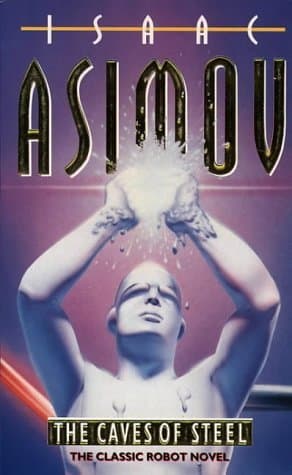
Isaac Asimov (1953)
Genre
Mystery / Science Fiction
Reading Time
246 min
Key Themes
See below
Sign in to track this book
In a future where humanity is split between an overcrowded Earth and advanced Spacer colonies, a xenophobic detective must overcome his prejudice to partner with a humanoid robot—who uncannily resembles the murder victim—to solve a crime that threatens to ignite an interstellar war.
The story begins with Detective Elijah Baley, an Earthman in the crowded Cities, called to the Commissioner's office. He learns of Dr. Roj Nemennuh Sarton's murder. Sarton was a Spacer working on advanced robotics in Spacetown, the extraterrestrial area outside New York City. The circumstances are unusual: Dr. Sarton was killed by a blaster inside a locked room, with no obvious killer. Commissioner Enderby, pressured by the Spacers, assigns Baley to the case, which makes Baley uncomfortable. Baley, like most Earthmen, distrusts Spacers and their robots, seeing them as symbols of Earth's stagnation and Spacer superiority. This assignment forces him to work with the people he dislikes.
Baley goes to Spacetown, an unfamiliar place for him, where he meets Dr. Han Fastolfe, a Spacer roboticist. Fastolfe tells Baley that his partner will be R. Daneel Olivaw, a humanoid robot. To Baley's shock, R. Daneel is an exact copy of the murdered Dr. Sarton, designed to look human. This complicates the investigation for Baley, who struggles with the resemblance and his bias against robots. R. Daneel, with his logical and emotionless manner, starts observing Baley's reactions, setting up their difficult partnership. Their first interactions show Baley's clear hostility and Daneel's detached, analytical responses.
Baley and Daneel begin their investigation in Spacetown. They interview Spacers, including Dr. Fastolfe and others who knew Dr. Sarton, but find suspicion and uncooperativeness from the Spacers, who see Earthmen as inferior. Baley's Earthman habits, like needing open air and disliking the Spacers' clean environment, cause problems. He struggles to accept Daneel as a partner, constantly testing the robot's abilities and 'humanity.' Daneel, in turn, carefully records Baley's emotional responses and illogical ideas, often correcting him with cold logic. Their different views on humanity, robots, and the crime create immediate tension and intellectual debates.
During their investigation, Baley focuses on the blaster and how it was used. He learns that the blaster was Spacer-made and could only be fired by a Spacer. This rules out robots as direct killers due to the Three Laws of Robotics, which prevent them from harming humans. Baley also realizes the blaster was found in Dr. Sarton's hand, suggesting he might have fired it himself or that it was placed there after death. This detail is important because it implies a human killer or a complex manipulation of the scene. The Three Laws are constantly discussed, as they are the basis of robot-human interaction and the core of the mystery.
The story sometimes shifts to Baley's personal life in the Earth Cities, showing the contrast between his crowded, regulated life and the Spacers' spacious one. His wife, Jessie, and son, Bentley, appear, showing the social pressures and prejudices of Earth society. Jessie is initially wary of Baley's involvement with Spacers and robots, reflecting common Earthman fears. Bentley, however, is interested in robots, representing a younger generation's potential openness. These glimpses into Baley's home life emphasize Earth's overpopulation, its reliance on synthetic foods, and the widespread xenophobia towards Spacers, adding to the novel's social commentary and explaining Baley's internal struggles.
Baley considers that the killer might be a 'humanoid' robot, indistinguishable from a human, like Daneel. This idea disturbs him, challenging his basic understanding of human identity and the security of the Three Laws. Dr. Fastolfe explains 'C/Fe' (Carbon/Iron), the biological and mechanical parts that separate humans from robots, and the difficulty of creating a truly undetectable humanoid. Baley struggles with the idea: if a robot could pass for human, then the murder could have been committed by a robot, potentially bypassing the Three Laws by not being recognized as a robot by the victim or witnesses. This thought leads to deep discussions between Baley and Daneel.
As the investigation continues, anti-Spacer feelings on Earth grow, fueled by fear of robot numbers and Spacer influence. Riots break out in the City, threatening Baley's area. This unrest adds more pressure to Baley's work; he must navigate the political situation and protect Daneel from the angry Earth people. The riots highlight the deep social tensions and the fragile balance between Earth and Spacer societies. Baley faces the possibility of widespread violence and the fragility of order, making him question the real source of danger—the murder itself or the social unrest it causes.
Baley, following a feeling, revisits the shoe shop near Spacetown's entrance, believing a witness might have seen something. He finds Francis Clousarr, an anti-robot activist. Clousarr says he saw Dr. Sarton shortly before his death and mentions Sarton's 'glazed' eyes, which Baley initially ignores. However, after more thought and discussion with Daneel, Baley understands the importance of this detail. 'Glazed eyes' could mean Dr. Sarton was already dead or unable to move when seen, or that something unusual was happening with his vision, leading Baley to rethink the murder's timeline and method. This clue helps break the stalled investigation.
Through careful thought, Baley realizes that 'glazed eyes' meant Dr. Sarton was wearing contact lenses to manipulate perception. He confronts Commissioner Enderby, revealing that Enderby is the killer. Enderby, an extreme anti-robot activist, tried to destroy Dr. Sarton's humanoid robot research, believing it threatened Earth. He accidentally killed Sarton with the blaster and then, in a panic, tried to frame a robot by manipulating the scene and using contact lenses to make it seem Sarton was alive when he was already dead. Enderby's motive came from his deep fear of robots and his desire to stop Spacer influence, leading to a tragic, misguided act.
With Enderby's confession, the murder case is closed. Baley and Daneel solved the mystery, despite their initial dislike and many challenges. The experience changes Baley, who starts to overcome some of his biases against robots and Spacers, recognizing Daneel's valuable intelligence and loyalty. Dr. Fastolfe, grateful for Baley's work, suggests a future where Earthmen and Spacers might cooperate more, possibly with Earthmen colonizing new worlds. Baley returns to his life in the City, but with a new view and growing respect for R. Daneel Olivaw, hinting at their future work together and the changing relationship between humans and robots.
The Protagonist
Baley begins as a xenophobic Earthman but gradually learns to respect and even trust R. Daneel Olivaw, overcoming his deep-seated prejudices.
The Deuteragonist
Daneel remains largely unchanged in his core programming but develops a deeper understanding of human complexities through his interactions with Baley.
The Supporting
Fastolfe remains consistent in his beliefs, successfully using the murder investigation to further his agenda of Earth-Spacer cooperation.
The Antagonist
Enderby is revealed as the murderer, driven by his extreme anti-robot ideology, and is ultimately exposed and arrested.
The Supporting
Jessie's initial fear of robots and Spacers softens slightly as she witnesses Elijah's changing perspective and the positive outcome of the investigation.
The Supporting
Bentley remains a minor character, but his curiosity about robots hints at a future generation less bound by prejudice.
The Mentioned
Sarton's impact is primarily through his death, which sets the entire narrative in motion.
The Supporting
Clousarr's role is primarily to provide a critical piece of evidence, representing the broader anti-robot sentiment.
The novel explores prejudice and xenophobia through Earthmen's distrust of Spacers and robots. Elijah Baley shows this, initially disliking R. Daneel Olivaw and suspecting Spacers. The crowded, isolated Earth Cities create a deep fear of the 'Other,' causing social stagnation and violence, as seen in the anti-Spacer riots. Spacers, in turn, look down on Earthmen. The murder itself comes from Commissioner Enderby's strong anti-robot prejudice, showing how fear and ignorance can lead to destructive acts. The novel suggests that such prejudices hinder progress and understanding.
“Prejudice is a great time-saver. It enables you to form opinions without bothering to get the facts.”
Asimov explores what it means to be human through Baley and R. Daneel's relationship. Daneel's perfect humanoid form challenges Baley's definitions of humanity, making him question if emotions and biology are the only factors. The 'C/Fe' (Carbon/Iron) concept highlights physical differences, but Daneel's logic and adherence to the Three Laws often seem more 'moral' than human actions. The novel asks if a machine, by perfectly mimicking human form and function, can blur identity lines, and if humanity's future might involve accepting, not fearing, advanced artificial intelligence.
“It is not the physical resemblance that makes a man human, but his capacity for understanding and his adherence to the three laws.”
The contrast between the overpopulated, claustrophobic, and stagnant Earth Cities and the spacious, advanced, and expanding Spacer worlds is a central theme. Earth's society is shown as inward-looking, afraid of change, and reliant on recycling and synthetic foods. This stagnation contrasts with the Spacers' drive to colonize new planets and develop advanced robotics. Dr. Fastolfe supports Earth's expansion, believing it is the only way for humanity to survive. The murder investigation helps Baley consider this broader societal conflict and the need to break free from Earth's self-imposed limits.
“Earth must expand, or it will die.”
Asimov's Three Laws of Robotics are not just plot devices; they are a core theme. They govern robot behavior and are constantly used and tested in the mystery. The murder's impossibility for a robot (due to the First Law against harming humans) drives much of the early investigation. The ethical effects of these laws, especially when a robot looks human, are explored. The laws are a moral framework for artificial intelligence, raising questions about responsibility, free will, and the potential for unintended results, even when designed for good. They are both a safeguard and a restriction, shaping the future of human-robot interaction.
“A robot may not injure a human being or, through inaction, allow a human being to come to harm.”
The interaction between Elijah Baley's human emotions, biases, and occasional illogical jumps, and R. Daneel Olivaw's pure logic creates a central thematic contrast. Baley struggles with prejudice, anger, and discomfort, while Daneel acts only on facts and deduction. Their partnership shows the strengths and weaknesses of both problem-solving approaches. While Daneel provides strong analytical power, Baley's 'human' insights, hunches, and understanding of human psychology are crucial in solving the case. The novel suggests that a balance of logic and emotion might be the most effective way to handle complex challenges.
“Your emotions, Baley, are a most confusing and inefficient method of arriving at a conclusion.”
A classic mystery trope where the murder victim is found in an apparently impenetrable space.
The central mystery of Dr. Sarton's murder is presented as a classic locked-room scenario. Dr. Sarton is found dead in his private laboratory in Spacetown, a room that was sealed and seemingly impossible for an intruder to enter or exit without detection. This device immediately establishes a high level of intrigue and challenges the detectives, Elijah Baley and R. Daneel Olivaw, to think outside conventional explanations. The solution ultimately involves a clever manipulation of perception and the victim's own actions, rather than a magical disappearance of the killer, making the reveal all the more satisfying and logical within the story's context.
Elijah Baley's prejudiced perspective subtly influences the reader's initial understanding.
While not a fully unreliable narrator in the sense of deliberately misleading, Elijah Baley's deep-seated prejudices against Spacers and robots function as a subtle form of unreliability. His internal monologues and initial interpretations of events are heavily colored by his xenophobia and fear, leading him to dismiss certain possibilities or misinterpret actions. This forces the reader to filter information through Baley's biased lens, mirroring his journey of overcoming those biases. As Baley slowly learns to trust R. Daneel and understand Spacer culture, the reader's own understanding of the world and the crime similarly shifts, making the character's growth integral to the narrative's unfolding.
A set of ethical guidelines governing robot behavior, central to the mystery's premise.
Asimov's Three Laws of Robotics are not merely background lore; they are a fundamental plot device that dictates the parameters of the murder investigation. The First Law, which prevents a robot from harming a human, immediately rules out a robot as the direct killer, forcing Baley to consider more complex human motives or manipulations. The laws create specific constraints and logical puzzles within the mystery, such as how a robot could be involved if not as the direct assailant, or how a human might exploit the laws. They serve as both a safety net and a constant source of tension, as the possibility of a robot circumventing them looms large.
A robot indistinguishable from a human, blurring the lines of identity and suspicion.
R. Daneel Olivaw's nature as a perfectly humanoid robot is a crucial plot device. His exact resemblance to the murdered Dr. Sarton immediately raises suspicion and discomfort for Baley, making him a walking, talking clue. This device allows Asimov to explore themes of identity, humanity, and prejudice. It also creates a unique challenge for the investigation: if a robot can pass for human, then any human could potentially be a robot, and vice versa. This blurs the lines of who could have committed the murder and introduces the unsettling possibility of robots operating outside human detection, adding layers of psychological tension to the mystery.
“The Earthman's brain was a mass of twisted, illogical, emotional prejudices.”
— Elijah Baley's internal thoughts on Earthmen's distrust of Spacers.
“It is a poor thing to wish for a thing and then not to be willing to work for it.”
— R. Daneel Olivaw's observation on human desire and effort.
“There was no crime without motive. And no murder without a motive that was strong.”
— Baley's detective principle applied to the murder investigation.
“Logic is an excellent tool, but it is not the only one.”
— Baley reflecting on the limitations of pure logic in human affairs.
“The Earthman lived in caves of steel and thought he was free.”
— A Spacer's perspective on the enclosed, controlled lives of Earth's population.
“Fear can be a very powerful motive.”
— Baley considering the potential motives behind the murder.
“A robot is not a man. A robot cannot kill a man.”
— A fundamental belief held by Earthmen regarding the Three Laws of Robotics.
“The greatest enemy of truth is not the lie, but the myth.”
— Baley's musing on the pervasive nature of societal beliefs.
“He was a man of the Caves, and the Caves were home.”
— Baley's deep-seated connection to his enclosed, underground city.
“No man is an island, entire of itself; every man is a piece of the continent, a part of the main.”
— A philosophical quote Baley recalls, emphasizing human interconnectedness.
“Curiosity is a human trait, not a robotic one.”
— Baley's distinction between human and robotic behavior.
“The future is not something that happens to us, but something we make.”
— A theme explored through the conflict between Earthmen and Spacers.
“There are no insoluble problems, only problems for which we have not yet found the solution.”
— Baley's optimistic view on challenges, even daunting ones.
“The truth is often inconvenient, but it is never irrelevant.”
— Baley's commitment to uncovering the facts, regardless of their implications.
Ready to see how well you understood this book? Take our interactive quiz with 10 questions.
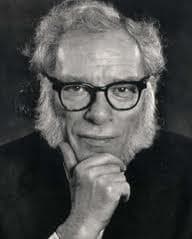
Isaac Asimov was an American writer and professor of biochemistry at Boston University. During his lifetime, Asimov was considered one of the "Big Three" science fiction writers, along with Robert A. Heinlein and Arthur C. Clarke. A prolific writer, he wrote or edited more than 500 books. He also wrote an estimated 90,000 letters and postcards. Best known for his hard science fiction, Asimov also wrote mysteries and fantasy, as well as much non-fiction.