“The world is not a safe place for women. It never was.”
— Reflection on the post-apocalyptic setting where a plague has killed most women.

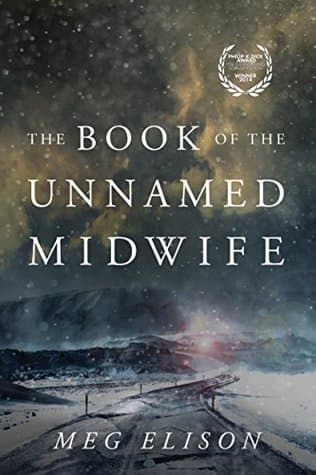
Meg Elison (2014)
Genre
Science Fiction
Reading Time
300 min
Key Themes
See below
Sign in to track this book
After a plague kills most women, a disguised midwife navigates a brutal world of desperate men, determined to reclaim humanity's future.
The protagonist, an unnamed midwife, wakes up in an empty hospital, confused and weak. She soon learns that a devastating plague, called 'The Great Death,' has swept the globe, killing almost all women and children, and many men. The world she knew is gone, replaced by quiet and decay. She finds a journal and starts writing her own entries to record her survival and observations. Realizing she is vulnerable as a lone woman, she shaves her head, puts on men's clothes, and pretends to be a man to navigate the dangerous new world. Her first goal is simply to survive and find a safe place, scavenging for supplies and avoiding other survivors, especially groups of men.
Disguised as 'John,' the midwife travels north, thinking colder climates might offer better chances of survival or fewer people. She meets isolated men, some hostile, some uncaring. She learns to be careful, often sneaking away or escaping quickly. She briefly travels with a man named Ben, sharing food and company, but they go their separate ways. Her journey involves constant watchfulness and the struggle for basic needs. She sees the harsh reality of the post-plague world: abandoned cars, empty towns, and the constant threat of violence from desperate male survivors who see women as property or a means to an end.
The midwife eventually finds a working farm run by a group of men, including a kind man named Michael. She keeps her disguise, offering her skills as a laborer. However, when one of the few surviving women on the farm, a pregnant woman named Mary, goes into labor, the midwife has to reveal who she really is and her skills. She successfully delivers the baby, a girl, but Mary dies in childbirth, a common and sad result of the plague's lasting effects. This event confirms her role as a midwife in this new world, and the men, though surprised, accept her. The baby, named Rose, is one of the rare new lives.
At the farm, the midwife finds some stability. She takes primary care of baby Rose, forming a strong bond with the infant. She also observes the men's struggles with sadness, loneliness, and the new social structure. The farm becomes a temporary safe place, but the midwife feels a need to continue her journey. She learns more about the plague's terrible impact on reproduction: most surviving women cannot have children, and those who can get pregnant face very high death rates for both mother and child. This grim reality shapes her understanding of humanity's uncertain future and her own unique value.
Despite the farm's relative safety, the midwife decides to leave, feeling a need to find other women and understand the wider world. She entrusts Rose to Michael and the other men, promising to return. Her journey leads her into more dangerous areas, where she encounters the 'Brotherhood of Man,' an organized, military group of men who hunt and enslave surviving women, forcing them into breeding camps. She sees firsthand the brutal control and dehumanization of women, which strengthens her resolve to stay free and to help others if she can, though she must continue to hide her identity.
After barely escaping the Brotherhood, the midwife eventually finds a hidden community of women living independently, fiercely protecting their freedom. Here, she takes off her male disguise and is welcomed by women like Sara, who share trauma and a desire for self-determination. Her midwifery skills become very valuable, as she cares for the few pregnant women and helps manage the community's health. She learns about their struggles with infertility, illness, and the constant threat from male groups. This community gives her a sense of belonging and purpose beyond just survival, confirming her identity as a healer and guide.
Inspired by rumors and a faint hope, the midwife joins a small group of women going east, believing there might be answers or even a cure for the plague's devastating effects on reproduction. This journey is dangerous, marked by scarcity, encounters with dangerous men, and the constant emotional toll of seeing a broken world. She continues to write in her journal, thinking about humanity, gender, and survival. The journey shows a shift from individual survival to a group search for understanding and the possible rebuilding of society.
The journey does not produce a miraculous cure or a clear explanation for the plague. Instead, they find more evidence of humanity's collapse and fragmented attempts at rebuilding. The midwife accepts that there may be no easy answers. However, her experiences strengthen her belief that her role as a midwife, a keeper of knowledge, and a helper of new life (however rare and difficult) is important. She understands that humanity's future, if it has one, depends not on finding a cure, but on adapting, preserving knowledge, and building new communities. She returns to the women's community, or perhaps starts a new journey, with a renewed sense of purpose, ready to guide and care for the fragile remains of humanity.
The Protagonist
From a fearful, solitary survivor, she evolves into a purposeful leader and a symbol of hope, embracing her unique role in a decimated world.
The Supporting
Remains largely static, representing a temporary connection in a transient world.
The Supporting
He maintains his compassionate nature, becoming a guardian for new life and a symbol of enduring humanity.
The Supporting
Her brief appearance serves as a tragic example of the plague's reproductive consequences.
The Supporting
As an infant, she represents the potential for humanity's rebirth, a symbol of hope rather than an active character.
The Supporting
Remains a steadfast leader, embodying the strength and autonomy of women in the new world.
The Antagonist
Functions as a constant oppressive force, representing the dangers of a world without societal order and respect for women.
The midwife's journey is about building a new identity in a broken world. She first pretends to be a man ('John') to survive, hiding who she really is. But through her experiences, especially after delivering Rose and finding the women's community, she reclaims and accepts her identity as a woman and a midwife. Her journal entries show this inner struggle and change, as she moves from just surviving to understanding her unique and important role in humanity's possible rebirth. This theme explores how a crisis can remove old identities and force the creation of new, more real ones.
“I am a woman, and I am a midwife. These are the things I know to be true. The rest is just a costume.”
The novel clearly shows humanity close to extinction because of the plague. The scarcity of women and the danger of childbirth show how uncertain the future is. Yet, among the desolation, there are acts of kindness, attempts at community (like Michael's farm or the women's community), and the lasting hope represented by baby Rose. The midwife's existence, and her determination to record and help, points to an inherent human strength, a drive not just to survive, but to rebuild and understand, even when facing huge challenges.
“We are a species that forgets easily, and rebuilds. We are a species that remembers, and rebuilds anyway.”
The plague completely changes gender roles and power. With women being very scarce, they are both respected and treated brutally. The midwife's male disguise is a direct response to this new, dangerous hierarchy where women are seen as goods. The Brotherhood of Man shows extreme patriarchal control, while the women's community shows a clear rejection of these power dynamics, aiming for female independence. The novel explores how social structures collapse and reform, often along gender lines, and the violence and potential for exploitation that occur when such imbalances happen.
“In the new world, a woman is either a queen or a slave. There is no in-between, unless you make it yourself.”
The midwife's journal is a main part of the story. It is a record of a lost world and a guide for a possible future. Her careful observations of the plague's effects, the surviving communities, and her own thoughts highlight the value of knowledge in a world without institutions. Her midwifery skills are a form of inherited knowledge, vital for survival. The act of writing becomes an act of hope, preserving memory and understanding for those who might come later, and laying the foundation for a new history.
“I write so that someone, someday, might understand what happened, and what it meant to be alive when the world died.”
Motherhood, in its traditional sense, is a main, yet tragic, theme. The plague makes childbirth deadly, and surviving women are rare. The midwife's job is to help with this dangerous process, often resulting in loss. Her strong bond with baby Rose, who is not her biological child, shows a broader sense of nurturing and shared responsibility for the few remaining children. This theme goes beyond biological motherhood to the idea that humanity itself needs to be nurtured and guided back to health, with the midwife acting as a symbolic mother figure for the struggling species.
“To bring a child into this world now is an act of defiance, a prayer, a miracle.”
The story is told through the midwife's personal journal entries.
The entire novel is presented as the journal entries of the unnamed midwife. This device provides an intimate, subjective, and deeply personal account of the apocalypse. It allows the reader direct access to the protagonist's thoughts, fears, observations, and evolving philosophies, enhancing the sense of isolation and internal struggle. The fragmented, episodic nature of journal entries also mirrors the brokenness of the world, while the act of writing itself becomes a symbolic act of preserving humanity and seeking meaning amidst chaos.
The protagonist's use of male clothing and a male name for survival.
The midwife's decision to shave her head, wear men's clothes, and adopt the name 'John' is a crucial plot device. It directly addresses the extreme gender imbalance and the dangers faced by women in the post-plague world. This disguise allows her to move more freely and safely, avoiding capture and exploitation by predatory men. It also creates internal conflict, as she grapples with suppressing her true identity, and highlights the stark realities of gender-based power dynamics that have emerged.
The apocalyptic event that decimated humanity and altered reproductive capabilities.
The plague, referred to as 'The Great Death,' is the central inciting incident and ongoing environmental factor of the novel. It serves as the primary antagonist, a silent, pervasive force that has reshaped the world. Its specific impact – killing most women and children, and making childbirth deadly for survivors – is a key plot driver, creating the scarcity of women and the desperate struggle for reproduction that defines the new society. It's a device that establishes the rules of the new world and the stakes for humanity's survival.
A core societal condition driving plot and character motivations.
Beyond the plague itself, the extreme scarcity of women and children is a fundamental plot device that dictates the entire social and political landscape of the novel. It drives the midwife's need for disguise, the predatory behavior of groups like the Brotherhood, the protective instincts of others, and the profound value placed on any new life. This scarcity creates the central conflict of humanity's potential extinction and elevates the midwife's role to one of immense, almost sacred, importance.
The infant girl represents fragile hope and the future of humanity.
Baby Rose, the first successful delivery by the midwife in the post-plague world, functions as a powerful symbol. She embodies the fragile hope for humanity's continuation and the possibility of rebirth. Her existence, despite the tragic loss of her mother, motivates characters like Michael and gives the midwife a tangible reason to continue her work. Rose is not merely a character but a living symbol of what is at stake and what humanity is fighting to preserve.
“The world is not a safe place for women. It never was.”
— Reflection on the post-apocalyptic setting where a plague has killed most women.
“I am the unnamed midwife. I am the one who remembers.”
— The protagonist's declaration of her role in preserving knowledge.
“In the absence of law, men make their own.”
— Observation on the breakdown of society and rise of violence.
“A baby is a hope, but also a target.”
— Comment on the dangers faced by infants and mothers in the new world.
“I trade in secrets and survival. That's all there is left.”
— The midwife's pragmatic approach to navigating the wasteland.
“Grief is a luxury we can't afford. Not anymore.”
— Reflection on the emotional toll of constant loss and survival.
“Every story I hear is a lesson in how to stay alive.”
— The midwife's method of learning from others' experiences.
“Men fear what they cannot control, and women have become the ultimate mystery.”
— Analysis of gender dynamics in the plague-ravaged world.
“I carry the past in my bag, and the future in my hands.”
— Metaphor for the midwife's role in preserving knowledge and aiding births.
“Survival is not just about staying alive. It's about staying human.”
— Philosophical musing on the meaning of survival in dire circumstances.
“In this broken world, a kind word is a weapon.”
— Observation on the power of compassion amidst brutality.
“I have seen the end of the world, and it is a lonely place.”
— Personal reflection on the isolation of the post-apocalyptic landscape.
“Hope is a seed. You have to plant it in the dark.”
— Metaphor for maintaining hope in desperate times.
“The silence of the world is louder than any scream.”
— Description of the eerie quiet after most of humanity has died.
Ready to see how well you understood this book? Take our interactive quiz with 10 questions.

Biography coming soon.