“Through all the employments of life, Each master of a trade, Some villainous, some honest, strives To make his fortune paid.”
— Opening lines of the play, setting the cynical tone.

Sign in to track this book
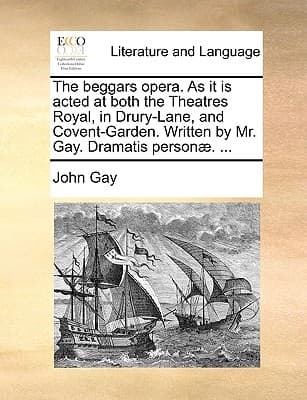
In 18th-century London, a charming highwayman navigates love, betrayal, and corrupt justice, set to popular ballads.
The opera begins in Peachum's house. He is listing his gang's earnings from crimes. He worries about the risks of their job, especially that his associates might become informers. He is a cynical man, focused more on profit and survival than on morals. His wife, Mrs. Peachum, joins him, and they talk about their daughter, Polly. Mrs. Peachum worries Polly is too naive and might fall for a man, naming Captain Macheath. Peachum is horrified at the idea of Polly marrying a man who could be hanged, losing his valuable asset. Unknown to them, Polly has already secretly married Macheath, a fact she tells the audience aside.
Polly, after telling the audience about her marriage, confronts her parents. They are furious when they hear the truth. Peachum and Mrs. Peachum see the marriage as a financial disaster, as Macheath's money would be tied up and possibly lost. They immediately plan to have Macheath arrested and executed. They believe that if he is hanged, Polly, as his widow, would inherit his estate, which they could then control. Their cold planning shows their mercenary nature. Macheath, unaware of their plots, arrives to visit Polly, expressing his love for her and hopes for their future, not knowing the danger from his new in-laws.
Polly, torn between her love for Macheath and her parents, warns Macheath of the plot against him. She urges him to run, which he reluctantly does, promising to return for her. Soon after, Macheath finds himself in a tavern with women of ill repute, including Lucy Lockit, daughter of the Newgate Prison jailer, and other women from his past. Despite his recent marriage, Macheath flirts and sings to these women. Unknown to him, this gathering is a trap set by Peachum and Lockit. The women, jealous and wanting a reward, help capture him, leading to his arrest and imprisonment in Newgate.
Macheath is brought to Newgate Prison, run by the corrupt jailer, Lockit. There, he meets Lucy Lockit, who is enraged to find he married Polly Peachum. Lucy believes Macheath promised to marry her and sees Polly as a rival. She expresses her fury and feeling of betrayal, showing the complex state of Macheath's love life. Macheath, always charming, tries to calm Lucy, denying his marriage to Polly and trying to win her back. He is good at manipulating women, but his lies only make his situation worse, as Lucy's jealousy becomes a threat to his freedom and life.
Polly Peachum, heartbroken by Macheath's imprisonment, visits him in Newgate. Her arrival causes a furious fight with Lucy Lockit, who is still with Macheath. The two women argue bitterly, each claiming Macheath's love. Macheath, caught between them, tries to soothe both, showing his dishonest nature. He denies his marriage to Polly in front of Lucy, then, when Lucy is gone, tells Polly he loves her. This scene shows Macheath's lack of loyalty and his ability to change his affections to fit his immediate needs, further trapping him in his romantic web.
Despite her initial anger, Lucy Lockit, still having feelings for Macheath and perhaps swayed by his charm, helps him escape from Newgate Prison. She gives him the means to unlock his chains and flee, much to her father, Lockit's, annoyance. Lockit cares more about the financial loss of the escape. Macheath enjoys a short period of freedom, but his luck runs out. He is again betrayed and recaptured, this time by members of his own gang who want the reward for his arrest. He returns to Newgate, his situation worse than before, facing execution.
With Macheath back in prison, the rivalry between Polly and Lucy grows. Lucy, consumed by jealousy and sure that Polly blocks her happiness with Macheath, tries to poison her. She offers Polly a poisoned drink, pretending to make up. However, Macheath, seeing the scene, steps in just in time, knocking the drink from Polly's hand. This moment shows the extreme measures Lucy will take to remove her rival and highlights the dangerous results of Macheath's unfaithfulness. The incident further complicates the relationships between the three characters, adding life-or-death stakes to their romantic triangle.
While Macheath waits for his fate, Peachum and Lockit, partners in crime and corruption, start to distrust each other. Both are greedy and self-serving, seeing a chance to gain from the other's downfall. They make accusations and threats, each revealing the other's illegal dealings and planning to expose them. Their mutual betrayal shows the widespread corruption in the legal and criminal worlds. This subplot demonstrates that loyalty is fleeting in their world, and even close alliances break easily for money or self-preservation, mirroring Macheath's betrayals.
Macheath is brought to court and sentenced to death. As he waits for execution, many women from his past appear, each claiming to be his wife and asserting their right to mourn him. This includes Polly, Lucy, Jenny Diver, Suky Tawdry, and others. Each woman presents her case, showing Macheath's many romantic relationships and broken promises. This scene emphasizes Macheath's promiscuous nature and the results of his actions. It also satirizes the sentimental parts of traditional opera where a hero usually has one true love. The number of his 'wives' makes his situation even more absurd.
As Macheath prepares for execution, the Player and Beggar, who have been telling and commenting on the play, intervene. The Player argues that an opera must have a happy ending for its hero. He states that Macheath, despite his crimes, cannot die. Macheath is then pardoned and set free. He chooses to marry Polly, declaring his love for her. The Beggar, however, notes the lack of fair justice, suggesting that in real life, such a rogue would be hanged. This ending critiques the artificiality of opera and offers a cynical comment on justice and morality, implying that the wealthy and charming often escape consequences that affect the less fortunate.
The Protagonist/Anti-hero
Macheath faces capture and the threat of execution multiple times, but ultimately escapes due to a meta-theatrical intervention, revealing the artificiality of justice in his world.
The Supporting
Polly endures betrayal and rivalry for Macheath, ultimately marrying him, but her romantic ideals are continually challenged by the harsh realities of their world.
The Antagonist
Peachum remains consistently self-serving and manipulative, his character undergoing no moral transformation.
The Supporting
Lucy experiences the emotional turmoil of Macheath's betrayal and jealousy, culminating in a violent act, but ultimately loses Macheath to Polly.
The Supporting
Lockit remains a corrupt and self-serving figure, eventually turning on his partner Peachum, demonstrating the lack of loyalty in their world.
The Supporting
Mrs. Peachum remains consistently cynical and self-interested, an unwavering partner in her husband's schemes.
The Mentioned
The Beggar serves as a framing device, his perspective remaining consistent throughout the opera.
The Mentioned
The Player's role is to represent and enforce theatrical conventions, leading to the forced happy ending.
The Supporting
Jenny Diver's role is to contribute to Macheath's downfall and highlight his promiscuity, her character remaining consistent.
The opera critiques corruption, suggesting that 'respectable' people like Peachum and Lockit are as criminal, if not more so, than the highwaymen they condemn. Peachum's business of informing on his own gang for profit, and Lockit's manipulation of justice in Newgate, show how the legal system itself is corrupt. The play blurs the lines between criminals and law enforcers, implying both are driven by greed and self-interest. The 'morality' shown by characters like Peachum is a thin cover for their greed, as seen when they plan Macheath's execution for his money while condemning his 'immorality.'
“A lawyer is an honest employment, so is mine. We are both for taking off the incumbrances of the law.”
Love is shown as inconsistent and often about transactions, easily overshadowed by personal gain or jealousy. Macheath's many romantic ties with Polly, Lucy, and other women highlight his promiscuity and lack of real commitment. Polly's naive love for Macheath contrasts with her parents' cynical views, who see her marriage as a financial disaster. Lucy's love for Macheath quickly turns to vengeful jealousy, leading her to try murder. Betrayal is common, not only in Macheath's relationships but also among criminal associates like Peachum and Lockit, who easily turn on each other for profit. This suggests loyalty is rare in this world.
“How happy could I be with either, were t'other dear charmer away!”
The opera satirizes 18th-century English society, especially its upper classes and politicians. By presenting criminals as heroes and heroines, and giving them the refined language and music of Italian opera, Gay mocks the pretentiousness and moral hypocrisy of the elite. The similarities between Peachum's criminal business and government ministers, or between Macheath's gang and political groups, are clear. The play suggests corruption is not just in lower society but throughout all levels, with the 'respectable' often being the most morally bankrupt, while the 'beggars' are simply more honest about their flaws.
“Through all the employments of life, Each neighbor abuses his brother; Whore and rogue they call husband and wife: All professions be-rogue one another.”
The play's meta-theatrical parts, especially the Beggar and Player's intervention at the end, show the artificiality of dramatic rules and the often-unrealistic endings of traditional opera. By forcing a happy ending for Macheath, the play directly challenges the audience's expectation of fair justice. The Beggar's comment that 'in real life, a highwayman would be hanged' highlights the satirical point: justice is often random or manipulated, especially for those with charm or connections. This device critiques not only art's conventions but also the perceived 'justice' of the real world, where outcomes are rarely fair or logical.
“But, as the current of the Play has hitherto run pretty strongly for Macheath, that the historical impartiality of the Beggar might not be suspected, I must have him make an escape.”
The play self-consciously refers to itself as a play, with characters discussing its conventions and structure.
The opera employs meta-theatricality through the characters of the Beggar and the Player, who frame the narrative and comment on its progress. They appear at the beginning and end, discussing the 'rules' of opera and the audience's expectations. This device allows Gay to directly satirize the conventions of traditional Italian opera, such as the need for a happy ending for the hero, and to offer a commentary on the moral implications of the story. It breaks the fourth wall, reminding the audience that they are watching a performance and inviting them to critically engage with the themes and form of the work.
The opera uses the form and conventions of serious Italian opera to mock society, politics, and the genre itself.
John Gay uses parody by adopting the musical and dramatic structure of serious Italian opera (aria, recitative, and stock character types) but applies them to the low-life criminal underworld. This juxtaposition creates a satirical effect, as the 'noble' sentiments and elaborate musical forms are used to express the base desires and corrupt dealings of thieves and prostitutes. This device serves to mock the pretentiousness of Italian opera, while simultaneously satirizing the moral hypocrisy of contemporary English society, drawing parallels between criminals and the 'respectable' upper classes and politicians.
The opera places refined operatic forms alongside the crude realities of the criminal underworld.
This device is central to the opera's satirical power. By setting the story in the squalid world of highwaymen, fences, and jailers, and having these characters sing in the style of grand opera, Gay creates a stark and humorous contrast. The elegant arias and duets, typically associated with noble heroes and heroines, are performed by morally bankrupt characters discussing betrayal, theft, and execution. This juxtaposition highlights the moral decay of society, suggesting that the 'low' characters are merely more honest about their vices than their 'high' counterparts, and implicitly critiques the artificiality and moral blindness of high culture itself.
The audience is often aware of information or character intentions that the characters themselves are not.
Dramatic irony is frequently used, particularly in Macheath's romantic entanglements and the plots against him. For example, the audience knows of Polly's secret marriage and her parents' plot to have Macheath hanged before Macheath himself does. Similarly, Macheath's attempts to charm and manipulate Lucy are ironic to the audience, who know of his marriage to Polly and his general philandering. This device enhances the satirical tone, allowing the audience to feel superior to the deluded characters and to appreciate the full extent of the hypocrisy and deception unfolding on stage.
“Through all the employments of life, Each master of a trade, Some villainous, some honest, strives To make his fortune paid.”
— Opening lines of the play, setting the cynical tone.
“The wretch who starves, and steals to live, Hath my compassion and my pity.”
— Peachum reflecting on the plight of the poor, while planning to betray them.
“How happy could I be with either, Were t'other dear charmer away!”
— Macheath's famous dilemma between Polly Peachum and Lucy Lockit.
“A woman knows how to be a mother and a wife, but a man knows how to be a father and a husband.”
— Mrs. Peachum's observation on gender roles and domesticity.
“If laws were made for every degree, To curb vice in the great as well as me, The poor man then would have as good a cause, As those in velvet gowns, and golden gauze.”
— A general reflection on the inequality of justice.
“The world is a pretty thing, and so are the women in it.”
— Macheath expressing his general appreciation for life and women.
“Money, wife, is the true source of happiness and content in this world.”
— Peachum's pragmatic view on wealth.
“When a man is in love, he is not himself.”
— Lucy Lockit lamenting Macheath's fickle affections.
“The very best things in life are free.”
— A somewhat ironic statement given the play's focus on money and gain.
“Courage, brother, and be of good cheer.”
— A common phrase of encouragement among the characters, often before committing a crime.
“I hope you will be more faithful to me than you have been to your other wives.”
— Polly to Macheath, highlighting his reputation.
“Our prisons are so full of rogues that an honest man can hardly find room.”
— A satirical jab at the state of the justice system and widespread crime.
“To be hanged, drawn, and quartered, that's what I expect.”
— Macheath contemplating his likely fate.
“The greatest villains often make the best husbands.”
— Mrs. Peachum's cynical view on marital prospects.
“The world, my dear, is a game of chance.”
— Peachum advising Polly on the nature of life.
Ready to see how well you understood this book? Take our interactive quiz with 10 questions.

Biography coming soon.
Ashley Antoinette
4.6

Mark McDonald
4.4
Luo Guanzhong
4.4

Mia McKenzie
4.3
Dorothy Parker
4.3
Joaquim Maria Machado de Assis
4.3
James Thurber
4.2
Terry Kay
4.2