BookBrief
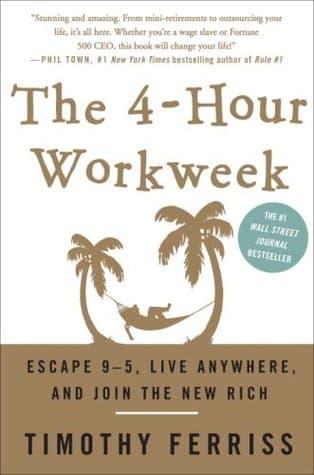
The 4-Hour Workweek cover
Archivist's Choice

The 4-Hour Workweek

Timothy Ferriss (2006)

Genre

Business / Productivity / Entrepreneurship / Finance / Self-Help

Reading Time

240 min

Key Themes

See below

Track Your Reading

Sign in to track this book

Learn how to leave the traditional work-life by creating automated income, outsourcing tasks, and taking 'mini-retirements' to live a life of freedom and adventure, all while working only four hours a week.

Core Idea

The idea of working a 9-to-5 for 40 years to retire at 65 is outdated. Instead, people can live as 'The New Rich' by designing their lives for maximum freedom (time, location), automation, and income. This means working smarter, not harder. It involves cutting unproductive tasks, automating income through 'muses' (small businesses), outsourcing personal and work tasks, and taking 'mini-retirements' throughout life, rather than waiting for one big retirement. The main point is that wealth is not just about how much money you make, but about how much you make per hour and the freedom that gives you.
Reading time
240 min
Difficulty
Medium
✓ Read this if...
You're tired of the traditional 9-to-5, dream of location independence, want to start an online business with minimal effort, or are looking for practical strategies to outsource tasks and create automated income.
✗ Skip this if...
You prefer a stable corporate career, are looking for deep academic research on productivity, or are unwilling to challenge conventional work ethics and embrace unconventional lifestyle design.

Core idea

The central argument and framework that powers the entire book.

The idea of working a 9-to-5 for 40 years to retire at 65 is outdated. Instead, people can live as 'The New Rich' by designing their lives for maximum freedom (time, location), automation, and income. This means working smarter, not harder. It involves cutting unproductive tasks, automating income through 'muses' (small businesses), outsourcing personal and work tasks, and taking 'mini-retirements' throughout life, rather than waiting for one big retirement. The main point is that wealth is not just about how much money you make, but about how much you make per hour and the freedom that gives you.

At a glance

Reading time

240 min

Difficulty

Medium

Read this if...

You're tired of the traditional 9-to-5, dream of location independence, want to start an online business with minimal effort, or are looking for practical strategies to outsource tasks and create automated income.

Skip this if...

You prefer a stable corporate career, are looking for deep academic research on productivity, or are unwilling to challenge conventional work ethics and embrace unconventional lifestyle design.

Key Takeaways

1

The New Rich vs. The Deferred Life Plan

Redefining wealth as time and mobility, not just money.

Quote

The New Rich (NR) are those who abandon the deferred-life plan and instead create luxury lifestyles in the here and now by mastering the new currencies: time and mobility.

Ferriss introduces the 'New Rich' as an alternative to the traditional 'deferred-life plan,' where people work hard for decades for retirement. The New Rich focus on 'lifestyle design,' aiming to maximize experiences and personal freedom now, not later. This is not about being a millionaire, but about having the flexibility to do what you want, when you want, from anywhere. It is a big change from the common idea that hard work means putting off enjoyment. Instead, it suggests a life rich in time, mobility, and personal satisfaction, ...

Supporting evidence

Ferriss's own lifestyle, traveling the world, racing motorcycles, and dancing tango, exemplifies the New Rich. He contrasts this with the typical corporate drone who waits until 65 to live.

Apply this

Challenge the assumption that you must work 40+ years before enjoying life. Identify how you can integrate 'mini-retirements' and location independence into your current career or business, even if it's in small steps.

new-richdeferred-life-planlifestyle-designtime-mobility
2

D.E.A.L.: The Four-Step Blueprint

Deconstruct, Eliminate, Automate, Liberate your way to freedom.

Quote

The 4-Hour Workweek is not about being lazy. It is about the intelligent application of the DEAL formula: Definition, Elimination, Automation, and Liberation.

Ferriss summarizes his method with the acronym: D.E.A.L. This system offers a clear path to the New Rich lifestyle. 'Definition' means clarifying your goals and fears, and setting clear targets. 'Elimination' focuses on cutting out unnecessary tasks, using the 80/20 rule and selective ignorance. 'Automation' involves building systems and outsourcing tasks to create passive income and free up your time. Lastly, 'Liberation' means gaining true mobility and leaving the traditional office, allowing you to live and work from anywhere. Each...

Supporting evidence

The entire book is structured around these four pillars, with dedicated sections and actionable advice for each. For example, the 'Elimination' section details the low-information diet and the 80/20 principle.

Apply this

Apply the DEAL framework to your current work. First, define what a 'dream day' looks like. Then, identify tasks to eliminate. Next, brainstorm what can be automated or outsourced. Finally, consider how you can achieve location independence.

deal-formuladefinitioneliminationautomationliberation
3

The 80/20 Rule & Selective Ignorance

Focus on high-impact activities and filter out distractions.

Quote

Slow down and remember this: Most things make no difference. Being busy is a form of laziness – lazy thinking and indiscriminate action.

One of Ferriss's most effective ideas is applying the Pareto Principle (80/20 rule) to productivity: 80% of your results come from 20% of your efforts. He tells readers to find and focus only on these high-impact activities, removing the rest. Along with this is 'selective ignorance,' which means purposely ignoring information not essential to your immediate, high-impact goals. This includes avoiding news, most emails, and unnecessary meetings. The goal is to avoid 'information overload' and the 'busy trap,' freeing up mental space an...

Supporting evidence

Ferriss recounts his own experience drastically reducing email checking and news consumption, leading to increased productivity and reduced stress. He cites Vilfredo Pareto's original observation about 80% of land in Italy being owned by 20% of the population.

Apply this

Audit your daily tasks for one week. Identify the 20% of tasks that yield 80% of your results. Then, create a 'not-to-do' list and implement a 'low-information diet' by limiting news, social media, and email checks to specific, short blocks.

pareto-principle80-20-ruleselective-ignorancelow-information-dietbusy-trap
4

Outsourcing Your Life with VAs

Leverage virtual assistants for mundane and time-consuming tasks.

Quote

Never automate something that can be eliminated, and never delegate something that can be automated or streamlined. Otherwise, you're just automating and delegating a mess.

Ferriss supports the use of virtual assistants (VAs) as a key part of the 'Automation' stage. He suggests outsourcing not just business tasks, but also personal errands and administrative duties (e.g., scheduling, paying bills, research). The main point is to start small, with clear, repeatable instructions, and to use VAs from countries with lower labor costs, making it very affordable. This frees up a lot of personal time, letting the person focus on high-value, enjoyable activities. It effectively buys back hours of their life for ...

Supporting evidence

Ferriss details his own experiments with VAs, having them manage everything from travel bookings to sending gifts to family members, often for as little as $5 per hour from places like India.

Apply this

Identify one or two recurring personal or professional tasks that take up significant time but don't require your unique skills (e.g., scheduling, online research). Document the process, then hire a VA for a trial period to handle these tasks.

virtual-assistantoutsourcingdelegationautomationtime-management
5

Creating Automated 'Muses'

Develop passive income streams that run without constant supervision.

Quote

The goal is to create a muse: an automated vehicle for generating income that can run on autopilot.

A 'muse' is Ferriss's term for an automated income system, usually a small, niche business that makes money with little ongoing effort. He outlines a process for creating these: finding a niche market, quickly testing if a product will sell (often with presales or simple websites), and then automating the sales and delivery. The ideal muse is a digital product or a highly specialized physical product with low overhead and high profit margins. This idea is central to gaining financial freedom and taking 'mini-retirements,' because it s...

Supporting evidence

Ferriss describes creating several muses, including selling a supplement online and a digital course, demonstrating how to identify a profitable niche and automate the sales funnel.

Apply this

Brainstorm niche interests or problems you understand well. Research potential 'micro-products' (e.g., an e-book, a specialized online course, a unique physical product) that could solve these problems. Use online tools to test demand before investing heavily in creation.

musepassive-incomeniche-businessautomationproduct-testing
6

Mini-Retirements & Lifestyle Design

Integrate frequent breaks and travel throughout your life, not just at the end.

Quote

Why wait until 65 to retire when you can have mini-retirements every few years? The goal is to distribute recovery and adventure throughout life.

The idea of 'mini-retirements' directly counters the deferred-life plan. Instead of saving all travel and leisure for old age, Ferriss suggests taking longer breaks (1-6 months) throughout your working life. These are not just vacations; they are chances to experience new cultures, learn new skills, or follow passions without the pressure of returning to daily work. This approach recognizes that life is unpredictable. Spreading rich experiences throughout your life is a more satisfying and secure strategy than relying on a distant, un...

Supporting evidence

Ferriss himself takes frequent mini-retirements, using them to learn tango in Argentina, race motorcycles in Europe, and ski in the Andes, showcasing how these experiences are integrated into his productive life.

Apply this

Start planning your first mini-retirement. Even if it's just a month, research destinations, costs, and how you could make your work remote or automate it during that period. Discuss the possibility with your employer if applicable, focusing on performance-based arrangements.

mini-retirementlifestyle-designtravelwork-life-balancedeferred-life-plan
7

Relative vs. Absolute Income

Measure wealth by purchasing power and freedom, not just raw numbers.

Quote

The New Rich realize that absolute income means little. It is relative income that matters, which is measured by time (hourly wage) and location independence.

Ferriss makes an important difference between absolute income (the total money earned) and relative income (income compared to time worked and local cost of living). Earning $100,000 in New York City while working 80 hours a week is less 'rich' than earning $50,000 while working 10 hours a week from a low-cost country like Thailand. The latter provides much more time and mobility, which are the real measures of the New Rich. This way of thinking encourages people to optimize for lifestyle benefits rather than just higher salaries. It ...

Supporting evidence

Ferriss contrasts a high-earning Wall Street banker working 80+ hours with someone earning less but living in a low-cost country, working fewer hours, and enjoying greater freedom.

Apply this

Calculate your effective hourly wage by dividing your total income by actual hours worked. Then, research the cost of living in places you'd like to live. Compare your current 'relative income' with what it could be if you optimized for time and location.

relative-incomeabsolute-incomepurchasing-powerhourly-wagelocation-independence
8

Training Your Boss & Remote Work

Negotiate flexible work arrangements based on performance, not presence.

Quote

The goal is to demonstrate that your output is not dependent on your physical presence in the office.

For employees, Ferriss offers a step-by-step guide to working remotely. This involves proving your value through better productivity, then suggesting a trial period of remote work. The focus is on performance, not hours spent in the office. This strategy emphasizes building trust and showing that working remotely actually improves output. It is about 'training your boss' to value results over being physically present. If successful, this can lead to full location independence, even without quitting your job, embodying the 'blue-chip e...

Supporting evidence

Ferriss outlines a detailed email script and a phased approach for proposing remote work to a boss, starting with a short trial period and emphasizing measurable results.

Apply this

Identify a project where you can significantly over-deliver. Once completed, propose a short, trial period of working remotely (e.g., one day a week), clearly outlining how you'll maintain or improve productivity and communication.

remote-workperformance-over-presencenegotiationlocation-independenceblue-chip-escape-artist
9

Filling the Void & Meaningful Life

Discover purpose beyond work once financial freedom is achieved.

Quote

If you have all the time and money in the world, what do you do? Most people don't know, and that's a problem.

A key, often overlooked part of the New Rich lifestyle is what to do after gaining freedom from the 9-to-5. Ferriss warns against the 'void' that can appear when work is removed. He stresses that true fulfillment comes from pursuing passions, learning, and contributing. He tells readers to think deeply about their purpose and what truly excites them beyond money. This involves self-improvement, creative activities, or charity work, ensuring that the liberated life is not just free from work, but rich in meaning and personal growth. It...

Supporting evidence

Ferriss shares anecdotes of people who achieve financial freedom only to feel lost or bored, leading them back to traditional work. He suggests creating a 'dreamline' to articulate what you would do with unlimited time and money.

Apply this

Create a 'dreamline' with 3-5 things you would do if time and money were no object. For each, identify one small, actionable step you can take *this week* to move towards it, demonstrating that these dreams don't have to wait for full liberation.

filling-the-voidpurposemeaningful-lifepersonal-growthhedonistic-adaptation

Critical analysis

Notable Quotes

Slow down and remember this: Most of what we say and do is not essential. If you can eliminate it, you'll have more time and more tranquility. Ask yourself at every moment, 'Is this necessary?'

Emphasizing the importance of identifying and eliminating non-essential tasks to create more time and peace.

The New Rich (NR) are those who abandon the deferred-life plan and create luxury lifestyles in the present using the currencies of the new rich: time and mobility.

Defining the core concept of the 'New Rich' as individuals prioritizing time and mobility over traditional wealth accumulation.

To 5x your output, you don't need to work 5x longer. You need to work 5x smarter.

Highlighting the principle that increased productivity comes from efficiency and strategy, not just more hours.

Doing less is not laziness. Doing less is the path of the productive.

Challenging the conventional view that constant activity equals productivity, advocating for focused effort.

For all of the most important things, the timing is always wrong. Waiting for a good time to quit your job? The stars will never align and the traffic lights of life will never all be green at the same time.

Encouraging action despite imperfect circumstances, discouraging procrastination by waiting for ideal conditions.

What you do is infinitely more important than how you do it.

Stressing the importance of choosing the right tasks and priorities over merely optimizing the execution of less impactful ones.

The fishing is best where the fewest go.

Suggesting that the greatest opportunities often lie in less competitive or unconventional areas.

Focus on being productive instead of busy.

Distinguishing between genuine productivity and simply being occupied, advocating for results-oriented work.

Develop the habit of asking yourself 'If I only did one thing today, what would be the biggest impact?'

A technique for identifying the most crucial task each day to maximize impact.

Lack of time is a lack of priorities.

Arguing that feeling overwhelmed by a lack of time is often a symptom of poor prioritization.

The goal is to create a business that serves your life, not a life that serves your business.

A foundational principle of lifestyle design, where business is a tool for personal freedom.

Most people are fast to stop working and slow to start. I am fast to start and slow to stop.

A personal productivity philosophy emphasizing taking immediate action and persevering.

People are fond of saying, 'If you want something done right, do it yourself.' This is a recipe for mediocrity. The person who says this is often the most overworked and least effective person in the room.

Challenging the common wisdom about self-reliance, advocating for delegation and leveraging others' expertise.

The fact that you are not where you want to be should be enough motivation.

A straightforward call to action, using dissatisfaction with the current situation as a driver for change.

Quiz

Test Your Knowledge

Ready to see how well you understood this book? Take our interactive quiz with 10 questions.

10
Questions
~5
Minutes
?
Best Score

Key Questions (FAQ)

The 4-Hour Workweek is a guide to escaping the traditional 9-to-5 grind by leveraging automation, outsourcing, and strategic lifestyle design. It teaches readers how to create a luxury lifestyle by focusing on time and mobility, rather than just accumulating wealth for a deferred retirement.

About the author