Objects: The Abstract Introduction
The first section, 'Objects,' offers abstract, non-linear descriptions of common items like a 'red stamp,' 'a box,' 'a plate,' and 'a little piece of string.' Stein uses language in a new way, focusing on sensory qualities, textures, and associations of these objects, not their usual meanings or uses. The descriptions are often circular, repetitive, and lack traditional grammar. This asks the reader to see the objects in a new way. For example, a 'plate' is not just a dish but 'a silver brown silver,' focusing on color and material over use. This section sets the book's experimental style and its move away from usual narrative or descriptive writing. It invites a new look at how language relates to reality.
Food: Sensory Exploration of Consumption
After 'Objects,' the 'Food' section continues the language experimentation, applying it to various food items and eating. Stein explores items like 'roastbeef,' 'mutton,' ''milk,' and 'sugar,' not through recipes or typical descriptions, but through their textures, colors, sounds, and the feelings they cause. For instance, 'roroastbeef' might be described with rhythmic repetitions and sensory details that show its essence, not its cooking. The language becomes more abstract, using alliteration, assonance, and disjointed phrases to create a strong, almost synesthetic experience of food. This section further blurs the lines between subject and object, focusing on the immediate, subjective experience of perception, not objective reality.
Rooms: The Internal Landscape of Domesticity
The book ends with 'Rooms,' where Stein looks at interior spaces and their contents. Unlike a usual architectural description, 'Rooms' presents impressions and observations about domestic settings. These often have psychological depth and personal association. The descriptions are not of specific rooms with clear uses, but instead create feelings, colors, light, and the presence or absence of things in a space. For instance, a 'chair' or 'table' might appear as a fixed point in many sensations. This section often has longer, though still abstract, passages, hinting at human presence and interaction in these spaces, even if the 'characters' are absent. The language remains challenging, requiring the reader to actively build meaning from the fragments.
A Challenge to Conventional Meaning
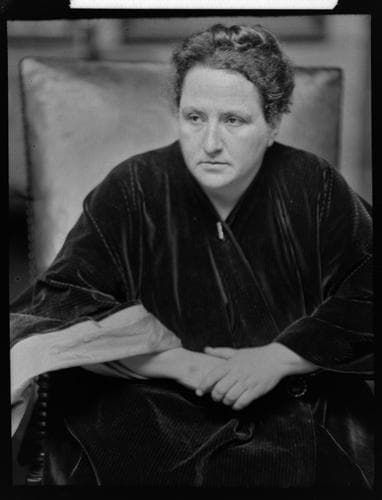
Across all three sections — 'Objects,' 'Food,' and 'Rooms' — Gertrude Stein's main 'plot' is taking apart conventional meaning and perception. There is no overall narrative in the usual sense, no characters, and no linear progression of events. Instead, the 'action' is the reader's engagement with the text. Stein's language forces a new look at how words relate to the world. She uses repetition, breaks, and unexpected pairings to strip words of their usual associations. This invites a fresh, often disorienting, encounter with the mundane. The book's 'plot' is an intellectual and sensory journey, where the reader must constantly find new ways to understand and interpret the seemingly simple subjects presented.
The Absence of Traditional Plot and Character
A key part of 'Tender Buttons' is its deliberate lack of traditional plot, character development, or setting. Stein does not focus on telling a story about people or events. Instead, she explores the nature of language itself and how it shapes our view of reality. The 'scenes' are not dramatic incidents but language experiments. There are no named characters, and any implied 'speaker' is an impersonal observer, only seeing and describing. The book's 'world' is the inner world of language. Here, objects, foods, and rooms become ways to play with language and to question the act of naming and knowing. This absence of traditional narrative elements is central to its modernist goal.
Repetition and Variation as Structural Principles
One of the main structural ideas throughout 'Tender Buttons' is the extensive use of repetition, often with small changes. Words, phrases, and even whole sentences are repeated, but rarely exactly the same way. This creates a rhythmic, chant-like quality, like music or abstract art. For instance, a phrase describing a color might appear in different places, subtly changing its meaning or feel. This method makes the reader slow down. They must consider each word's sound and individual impact, rather than quickly looking for a usual meaning. Repetition also shows language as a material, drawing attention to the words themselves as objects, not just clear ways to convey ideas. It is a way of 'insisting' on presence.
Focus on Sensory Perception and Abstraction
Throughout 'Tender Buttons,' Stein always puts immediate sensory perception — sight, touch, taste, and sound — before intellectual or conceptual understanding. Descriptions are often fragmented. They focus on color, texture, shape, and movement, not the object's use or history. For example, a 'chair' might be described by its 'dark wood' and 'shine' rather than its purpose for sitting. This approach aims to free perception from the limits of usual thought and language. It lets the reader experience the world more directly, without filters. The abstraction in her language mirrors the abstract art movements of her time. It asks viewers/readers to find meaning in non-representational forms.
The Reader's Active Role in Meaning-Making
The 'plot' of 'Tender Buttons' also involves the reader's active effort to understand the text. Because traditional narrative signs are missing, the reader cannot passively receive information. Instead, they must actively engage with the language, make connections between different phrases, and find personal meaning in the abstract descriptions. This participatory aspect is a central 'event' of the book. Meaning is not pre-made. It comes from the interaction between the text and the individual reader's mind. This makes each reading a unique experience, a journey of discovery and interpretation, not just understanding a pre-determined story.
Challenging Gender and Domesticity
While not directly political, 'Tender Buttons' can be seen as quietly questioning common ideas about gender and domesticity, especially in the 'Food' and 'Rooms' sections. By using her radical language approach for traditionally 'feminine' subjects like cooking and household interiors, Stein reclaims and re-thinks these spaces. She elevates the ordinary to a subject of deep language and philosophical inquiry, removing sentimental or practical associations. The 'plot' here is a quiet revolution. The domestic sphere becomes a place for avant-garde artistic expression, not just a background for traditional stories. This re-framing implicitly questions the societal expectations and limits placed on women in the early 20th century.
A Legacy of Linguistic Innovation
The main 'plot' of 'Tender Buttons' is its own existence as a key modernist work and its lasting impact on how language is understood and used. Its publication was a radical break from literary norms, causing both confusion and admiration. The book's 'story' is about how it was received and its role in shaping 20th-century poetry and prose. It 'acts' as a way to start new ways of reading, writing, and perceiving. By breaking down usual grammar and meaning, Stein opened new possibilities for literary expression. She showed that language could be an end in itself, a material to be shaped and explored, not just a tool for information or narrative. Its 'ending' is an ongoing discussion about words' limits and potential.