“Time is the longest distance between two places.”
— Chance Wayne reflects on his lost youth and the passage of time.

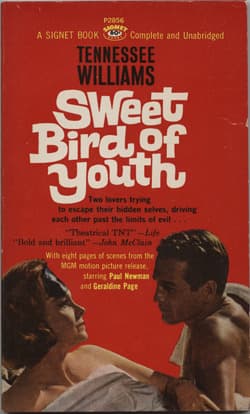
Tennessee Williams (1959)
Genre
Fiction
Reading Time
175 min
Key Themes
See below
Sign in to track this book
A faded golden boy returns to his Southern hometown, clutching a desperate, aging movie star and a fragile dream of lost love, only to confront the violent reckoning of his past.
The play opens in a luxurious hotel room in St. Cloud, Florida. Chance Wayne, a handsome but aging gigolo, is traveling with Alexandra Del Lago, a once-famous movie star now dealing with alcoholism, drug addiction, and the reality of her fading career. Alexandra, using the name Princess Kosmonopolis, is on the run from a disastrous film comeback attempt, convinced she has made a terrible flop. Chance, who has been her lover and companion, has brought her to his hometown with a desperate plan: to use her influence and money to launch his own acting career and to reclaim his lost love, Heavenly Finley, daughter of the powerful Boss Finley. Alexandra is initially resistant to staying, wanting to escape her perceived failure, but Chance manipulates her into remaining.
Chance, with a hopeful delusion, tries to contact Heavenly Finley. He speaks to Aunt Nonnie, Heavenly's aunt and his former caregiver. Aunt Nonnie reveals that Heavenly has undergone a hysterectomy because of a venereal disease Chance unknowingly transmitted to her years ago. This news shatters Chance's romanticized image of their past and his future with Heavenly. Aunt Nonnie also warns him about Boss Finley, Heavenly's father, who has vowed revenge on Chance for corrupting his daughter and for his past actions in town. Chance is shaken but still clings to a desperate hope, trying to downplay the severity of the news to himself and Alexandra.
While Chance is preoccupied with Heavenly, Alexandra receives a phone call that changes everything. Her agent, George Scudder, informs her that her latest film, which she believed was a catastrophic failure, is a huge success. This news revitalizes Alexandra, restoring her confidence and sense of self-worth. She quickly sheds her 'Princess Kosmonopolis' persona, eager to return to Hollywood and reclaim her career. With her newfound power, she sees Chance for what he is: a washed-up gigolo clinging to a past that no longer exists. She is now less willing to indulge his fantasies or finance his acting ambitions, though she still feels some pity for him.
Boss Finley, a powerful, corrupt, and racist politician, holds a rally in St. Cloud. He uses the platform to express hateful rhetoric, appealing to the prejudices of the crowd. During the rally, he publicly denounces Chance Wayne, accusing him of corrupting his daughter, Heavenly, and of being a 'degenerate.' Finley makes thinly veiled threats against Chance, promising violent retribution. His son, Tom Jr., and his henchman, Scotty, are present, reinforcing the danger Chance is in. The rally shows the oppressive and conservative atmosphere of St. Cloud, a contrast to the glamorous world Chance wants.
Heavenly Finley, pale and fragile, appears in Chance's hotel room. She confirms the tragic details of her hysterectomy, her voice filled with bitterness and a lingering, desperate love for Chance. She confesses that her father, Boss Finley, forced her to undergo the operation after blaming Chance for her illness. Heavenly expresses her deep unhappiness and the impact of Chance's abandonment on her life. Despite her suffering, she cannot entirely sever her emotional ties to him, creating a complex dynamic of love, resentment, and shared despair. Her presence shows the irreversible damage caused by their past relationship.
As the situation grows more serious, Chance tries to flee St. Cloud. He tries to get money from Alexandra, but she, now rejuvenated by her success, is less inclined to help him escape the consequences of his actions. She offers him a way out, but it involves him leaving St. Cloud immediately and permanently. Chance, however, is too caught in his delusions and his desire to see Heavenly one last time. His efforts to leave are blocked by Boss Finley's men, who are looking for him. Trapped and out of options, Chance realizes his escape is futile and begins to accept his impending fate.
Alexandra Del Lago, having regained her status and power, prepares to leave St. Cloud for New York and her return to Hollywood. She makes a final offer to Chance: to take him with her as her kept man, acknowledging his beauty but also his limitations. Chance, however, refuses. He has made a decision, influenced by his conversation with Heavenly and a growing sense of responsibility. He chooses to stay and face Boss Finley's men, accepting the brutal punishment that awaits him as a form of penance for the harm he inflicted upon Heavenly and for his own wasted life. Alexandra departs, leaving Chance alone to confront his destiny.
In the play's climax, Chance Wayne is left in his hotel room, awaiting Boss Finley's henchmen. He knows what is coming: castration, a brutal act of vengeance for his actions against Heavenly. He delivers a final, desperate monologue, reflecting on his wasted youth, his lost dreams, and the destructive nature of time. He removes his shirt, symbolically baring himself for the impending violence. The stage directions indicate that the men arrive, but the actual act of violence is not shown. The audience is left to imagine the horror, emphasizing the irreversible consequences of Chance's choices and the cruelty of the world he inhabits.
The Protagonist
Chance descends from deluded hope to a stark realization of his failures, ultimately choosing a form of self-sacrifice.
The Supporting
Alexandra transforms from a despairing, drug-addled recluse to a revitalized, confident star.
The Antagonist
Boss Finley remains a static character, a force of vengeful, oppressive power throughout the play.
The Supporting
Heavenly is a static character, already broken by past events, serving as a catalyst for Chance's eventual acceptance of his fate.
The Supporting
Tom Jr. remains a static, menacing figure, a tool of his father's vengeance.
The Supporting
Aunt Nonnie's role is primarily to deliver crucial exposition and moral commentary, remaining a static figure.
The Mentioned
Not applicable as he is a mentioned character.
The Supporting
Scotty is a static character, serving as a physical manifestation of the threat to Chance.
The play explores the destructive nature of clinging to past glories and the futility of escaping time. Chance Wayne is an example, obsessed with his youthful beauty and a romanticized past with Heavenly, ignoring his current reality as a failed actor and gigolo. Alexandra Del Lago also deals with this, initially believing her career is over and her beauty faded. Both characters confront the truth that youth is fleeting and dreams, if not actively pursued, can become self-delusion. Chance's ultimate self-sacrifice is a final, desperate attempt to reclaim meaning from his wasted life.
“''Time is the only enemy... We're always running away from it, and it always catches us.''”
Tennessee Williams exposes the corruption and moral hypocrisy in the American South, particularly through Boss Finley. Finley, a self-proclaimed man of God and a political leader, preaches racial hatred and moral rectitude while orchestrating violence and controlling his family through fear. His public image hides his brutal, private actions, such as forcing Heavenly's hysterectomy. This theme shows how power can be used to enforce a twisted moral code, destroying individual lives while claiming to uphold societal values. St. Cloud is a symbol of this moral decay.
“''I'm a man of God! I'm a consecrated Christian and a consecrated public servant!''”
The play portrays the exploitation of both men and women for sexual and financial gain, and the restrictive gender roles of the era. Chance Wayne, as a gigolo, exploits older women like Alexandra for money and connections, while also being exploited for his youth and beauty. Heavenly Finley is a victim of both Chance's recklessness and her father's control; her body is a battleground for male honor. Women in the play are often seen as objects to be controlled, protected, or used, showing a society where female agency is limited. The tragic consequences of these dynamics, for Heavenly, are central to the play's emotional impact.
“''I don't ask you to love me, Princess. I just ask you to let me be with you.''”
The past weighs heavily on every character, dictating their present circumstances and future prospects. Chance Wayne's past actions with Heavenly, his abandonment, and the venereal disease he transmitted, directly lead to her suffering and Boss Finley's vengeful pursuit. Alexandra Del Lago's past failures and successes in Hollywood define her identity and anxieties. The play shows that one cannot truly escape the consequences of their history, especially when those actions have caused harm to others. The inability to move on from the past, whether through regret or obsession, leads to tragic outcomes for many characters.
“''The past is not a package you can put away.''”
Represents the relentless march of age and the dwindling opportunities for characters.
Throughout the play, references to time, clocks, and the aging process are prevalent, particularly for Chance and Alexandra. Chance is acutely aware of his fading youth and the ticking clock on his acting aspirations, while Alexandra constantly battles the fear of irrelevance due to her age. The 'sweet bird of youth' itself is a metaphor for fleeting beauty and opportunity. This pervasive symbolism underscores the characters' desperation to either halt or reverse time, ultimately highlighting its unstoppable and destructive power, especially for those whose identities are tied to their physical appearance or past glories.
An alter ego used by Alexandra Del Lago to cope with her perceived failure and identity crisis.
Alexandra Del Lago adopts the false identity of 'Princess Kosmonopolis' as a psychological defense mechanism. This persona allows her to distance herself from her perceived professional failure and personal despair. It is a fabricated reality, a shield against the harsh truths of her life. The shedding of this persona, when she learns of her film's success, signifies her reclaiming of her true identity and power, demonstrating the psychological impact of fame and the fragility of self-worth in the entertainment industry. It highlights the theme of illusion versus reality.
Builds suspense and emphasizes the brutal, unseen consequences of the characters' actions.
Tennessee Williams frequently uses offstage violence and heavy foreshadowing to create a sense of impending doom. Boss Finley's threats against Chance are made publicly, and the audience is made aware of the specific, brutal punishment awaiting him. The actual act of castration is never shown onstage, but the anticipation and the implied horror are far more impactful. This technique heightens the psychological tension, allowing the audience to imagine the brutality, and emphasizes the irreversible nature of the consequences without explicitly depicting graphic acts, making the ending more chilling and profound.
Creates an atmosphere of decay, violence, and moral corruption in St. Cloud, Florida.
The setting of St. Cloud, Florida, functions as a classic Southern Gothic environment. It is a place of faded grandeur, moral decay, and simmering violence, dominated by the corrupt figure of Boss Finley. The oppressive heat, the underlying racism, and the grotesque elements of retribution (like the threat of castration) are all hallmarks of this genre. The setting is not merely a backdrop but an active force, contributing to the characters' entrapment and illustrating the societal pressures and hypocrisies that ultimately destroy them. It enhances the themes of corruption and the inescapable past.
“Time is the longest distance between two places.”
— Chance Wayne reflects on his lost youth and the passage of time.
“I don't ask for your pity, but just for your understanding—not even that—no. Just for your recognition of me in you, and the enemy, time, in us all.”
— Chance Wayne pleads with Heavenly Finley, acknowledging their shared struggles.
“The human animal is a beast that dies and if he's got money he buys and buys and buys and I think the reason he buys everything he can buy is that in the back of his mind he has the crazy hope that one of his purchases will be life everlasting!”
— Princess Kosmonopolis (Alexandra Del Lago) muses on materialism and mortality.
“We're all of us sentenced to solitary confinement inside our own skins, for life!”
— Princess Kosmonopolis expresses her sense of isolation and existential despair.
“I've been to the top and I've been to the bottom, and believe me, the bottom is better.”
— Princess Kosmonopolis compares her experiences of fame and downfall.
“You see, I don't have a home. I have a place to stay.”
— Chance Wayne reveals his rootlessness and lack of stability.
“The only thing worse than a liar is a liar that's also a hypocrite!”
— Boss Finley condemns hypocrisy, ironically reflecting his own corrupt nature.
“I'm not a young man anymore, but I'm not an old one either. I'm in that no-man's-land between the two.”
— Chance Wayne describes his precarious stage in life, clinging to fading youth.
“Life is all memory, except for the one present moment that goes by you so quick you hardly catch it going.”
— Princess Kosmonopolis reflects on the fleeting nature of the present.
“I've always depended on the kindness of strangers.”
— Though famously from 'A Streetcar Named Desire', this line is echoed in themes of dependency in the play.
“The world is a violent and cruel place, and the only way to survive in it is to be violent and cruel yourself.”
— Boss Finley justifies his ruthless behavior and political machinations.
“You can't beat time, but you can beat the clock if you try.”
— Chance Wayne expresses a desperate, futile hope to outrun aging and consequences.
“I'm not a has-been. I'm a will-be.”
— Princess Kosmonopolis defiantly claims her potential for a comeback.
“The past is the present, isn't it? It's the future, too.”
— Chance Wayne grapples with how past actions haunt his current life and prospects.
Ready to see how well you understood this book? Take our interactive quiz with 10 questions.
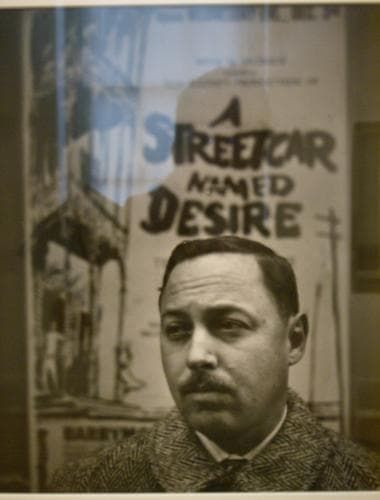
Thomas Lanier Williams III, known by his pen name Tennessee Williams, was an American playwright and screenwriter. Along with contemporaries Eugene O'Neill and Arthur Miller, he is considered among the three foremost playwrights of 20th-century American drama.

Ashley Antoinette
4.6

Mark McDonald
4.4
Luo Guanzhong
4.4

Mia McKenzie
4.3

Dorothy Parker
4.3

Joaquim Maria Machado de Assis
4.3

James Thurber
4.2

Terry Kay
4.2