“Lenny Abramov. Forty-something. Not bad. Not good. I’m an average guy. An average guy in a world that has no place for average guys.”
— Lenny's self-introduction and reflection on his place in society.

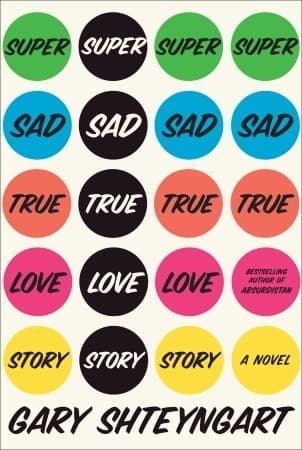
Gary Shteyngart (2001)
Genre
Science Fiction / Romance
Reading Time
7-8 hours
Key Themes
See below
Sign in to track this book
In a near-future America collapsing under credit crises and digital oversharing, an analog man clinging to books and diaries falls for a ruthlessly modern woman, hoping their improbable love can redeem a world obsessed with immortality and instant gratification.
Lenny Abramov, a middle-aged man working for Post-Human Services, stays in Rome and records his thoughts in a physical diary – a relic in his future world. He meets Eunice Park, a young Korean-American woman who recently graduated from Elderbird College. Despite their age difference, different interests (Lenny loves books, Eunice is obsessed with her 'appa' device and its constant data streams), and Eunice's initial dismissiveness, they begin a romantic relationship. Lenny is immediately smitten, captivated by her beauty and modern sensibilities. Eunice tolerates him, often criticizing his outdated habits and appearance.
Upon their return to the United States, Lenny and Eunice find the country in advanced decay. The American dollar is collapsing, replaced by Chinese yuan as the main currency. Social unrest is common, with frequent riots and the National Guard patrolling the streets of New York City. The government, now called the Bipartisan Consolidation, controls people through widespread surveillance and credit-based social ranking. Lenny's job at Post-Human Services, which offers immortality to the ultra-rich, highlights the extreme wealth gap. Eunice, meanwhile, navigates this world with her 'appa' constantly streaming her 'GlobalTeens' feed, her attention often divided and her empathy seemingly diminished by the pervasive digital culture.
Lenny's old-world values and love for 'printed, bound media artifacts' clash constantly with the hyper-technological, image-obsessed society and Eunice's embrace of it. He feels irrelevant, his physical diary a source of amusement or disdain to others. Eunice, influenced by her friends and the pervasive 'apparat' culture, often critiques Lenny's appearance, his 'low credit' score, and his general lack of 'hotness' and 'sustainability.' Their intimacy is often interrupted by her need to check her 'appa' or broadcast their interactions. Lenny tries to connect with her on a deeper, emotional level, but the digital noise and societal pressures create a significant barrier.
Lenny lives with his aging, perpetually angry Russian immigrant father, Vlad, and his critical mother. Both struggle with their place in disintegrating American society. Vlad, a former janitor, often expresses dissatisfaction with Lenny's life choices and America's decline, comparing it unfavorably to their past in the Soviet Union. Lenny also regularly visits his older brother, Noah, a successful but cynical businessman who has adapted better to the new economic realities. These family interactions provide a backdrop of historical disillusionment and a contrast to Lenny's attempts to maintain genuine human connection.
Through Eunice's appa entries and fragmented conversations, her difficult family history is revealed. Her father, a traditional Korean immigrant, struggled to adapt to American life and suffered a mental breakdown. Her mother, a devout Christian, blames Eunice for her father's problems and holds her to impossibly high standards. Eunice's younger sister, Judy, is a devout Christian who embodies the obedience Eunice rejects. This background shows Eunice's emotional guardedness, her pursuit of superficial validation through the 'appa', and her deep anxieties about her identity and future, hinting at a vulnerability beneath her assertive exterior.
The economic crisis worsens dramatically, leading to widespread food shortages, hyperinflation, and a complete collapse of public services. Riots become more frequent and violent, with the 'Asshats' – a group of anti-government rebels – gaining traction. New York City is under martial law, with military checkpoints and constant surveillance. The 'Bipartisan Consolidation' government tightens its grip, and the threat of a Chinese takeover becomes more apparent. Lenny observes these events with growing dread, documenting the disintegration of his world in his diary, while Eunice and her friends remain largely detached, consuming these events as digital spectacle.
With New York City descending into anarchy and the 'Bipartisan Consolidation' collapsing, the city becomes unlivable. Lenny and Eunice, along with Lenny's family and a few friends, decide to leave. They travel to a rural commune established by some of Lenny's acquaintances. This commune, a self-sustaining community trying to live off the grid and reject past technological excesses, offers a stark contrast to their former urban existence. Here, the emphasis is on manual labor, resourcefulness, and a return to basic human interaction, forcing both Lenny and Eunice to confront their dependencies and values in a new way.
Life in the commune is challenging, requiring physical labor and communal living. Initially, Eunice struggles, missing her 'appa' and the constant stream of information. Gradually, the forced disconnection from technology begins to affect her. She starts to engage more with her surroundings and with Lenny, showing glimpses of genuine emotion and vulnerability. She learns practical skills, participates in community life, and her reliance on external validation diminishes. This period marks a significant change in her character, as she begins to value intrinsic human connection over superficial digital interaction, drawing closer to Lenny.
The fragile peace of the commune is threatened by encroaching Chinese influence, as they begin to consolidate power over the former United States. Chinese soldiers and officials are seen nearby, signaling the end of any independent American existence. The commune members live under constant threat, their resources dwindling. During this period, Lenny and Eunice's bond strengthens, their love deepening amidst the surrounding chaos. However, their newfound happiness is tragically short-lived as external forces finally close in, leading to a devastating confrontation that shatters their fragile world.
The novel concludes with Lenny's final diary entry. It is a poignant reflection on the events that happened, the loss of Eunice, and the complete collapse of the world he knew. Despite the overwhelming despair, Lenny's entry holds hope. He clings to the memory of his love for Eunice, the genuine connection they forged in the face of societal disintegration, and the value of his physical diary. His final words emphasize the enduring human spirit and the importance of love and memory, even in a world where everything else has been stripped away, leaving a powerful, melancholic story of a 'super sad true love story.'
The Protagonist
Lenny begins as an isolated observer, struggling to adapt. He finds profound love and connection with Eunice, ultimately affirming the value of human emotion and memory amidst societal collapse.
The Love Interest / Deuteragonist
Eunice evolves from a digitally detached, superficial individual to someone capable of deep emotional connection, shedding her technological dependencies and embracing authenticity.
The Supporting
Vlad remains largely static, a consistent voice of cynicism and nostalgia for a bygone era, reflecting the pervasive disillusionment of the older generation.
The Supporting
Noah's arc is less about transformation and more about illustrating a different path of adaptation and survival in the collapsing world, remaining largely consistent in his pragmatic cynicism.
The Supporting
Vishnu remains largely static, serving as a representation of the pervasive digital addiction and superficiality of the younger generation, reinforcing Eunice's initial worldview.
The Supporting
Lorrie's arc is minor; she serves as a stable, empathetic presence for Lenny, providing a brief respite from his emotional struggles.
The Supporting
Judy remains a consistent character, serving as a foil to Eunice and representing a traditional, faith-based response to the chaotic world.
The Mentioned
Joshie has no arc; he functions as a recurring reference point in Eunice's digital life.
The novel shows a future where pervasive technology, especially the 'appa' device, has eroded genuine human connection. Characters like Eunice and Vishnu are constantly distracted by their devices, prioritizing 'credit' scores, 'hotness' ratings, and public broadcasting over authentic emotional engagement. Lenny, with his physical diary, contrasts sharply, longing for meaningful intimacy that the digital world seems to prevent. The frequent interruptions during conversations, the performative nature of relationships, and the inability to simply 'be' with another person without external validation all highlight this profound societal loss. The commune, later in the book, tries to reverse this trend by forcing a return to face-to-face interaction.
“A world where intimacy was not only impossible but probably illegal.”
Shteyngart paints a bleak picture of America's future, marked by economic collapse, environmental degradation, and political instability. The dollar is worthless, replaced by Chinese yuan; riots are common; and the government, the 'Bipartisan Consolidation,' governs through constant surveillance and credit scores. This theme is explored through New York's crumbling infrastructure, food shortages, and eventual martial law. The external decay mirrors the internal decay of human values and intellectual life, as literacy declines and historical knowledge fades. The novel suggests a future where America has lost its identity and sovereignty, becoming a mere shadow of its former self, indebted to China.
“America was a nation of twenty-year-olds in debt up to their eyeballs, who couldn't read a newspaper but knew the complete works of Britney Spears.”
Against the backdrop of a superficial, forgetful society, the novel champions the importance of authenticity, personal narrative, and memory. Lenny's physical diary is the central symbol of this theme; it is a defiant act of preserving individual thought and history in a world that prioritizes fleeting digital updates. His love for books, or 'printed, bound media artifacts,' further emphasizes his commitment to enduring knowledge and deep reflection. Eunice's journey, from digital addiction to a more genuine connection with Lenny in the commune, shows a gradual embrace of authenticity. The ultimate tragedy highlights that even if the world collapses, the memory of love and true human experience holds value.
“I will go on writing in this diary, though it is nothing but a printed, bound media artifact, and I am nothing but a printed, bound media artifact.”
At its heart, the novel is a love story set in a dystopian future, exploring whether genuine love can survive, or even thrive, amidst despair. Lenny's 'super sad true love story' with Eunice is central to this. Their relationship faces challenges – their age difference, their contrasting values, and the constant interference of technology and societal pressures. Yet, as the external world crumbles, their bond strengthens, offering a glimmer of hope and human resilience. The 'super sad' aspect comes from the tragic context, where even profound love cannot ultimately save them from societal collapse, making their connection both beautiful and heartbreaking.
“In a time without standards or stability, in a world where single people can determine a dating prospect's 'hotness' and 'sustainability' with the click of a button... there is still value in being a real human being.”
The novel explores the complexities of identity, especially for immigrant communities, in a rapidly changing America. Lenny, as the son of Russian immigrants, grapples with his 'old world' sensibilities and his place in a country that is losing its own identity. His father, Vlad, often reflects on America's 'failure' compared to his Soviet past. Eunice, a Korean-American, navigates her traditional family's expectations against the pressures of a hyper-modern, individualistic, and often superficial American youth culture. Her struggle with her mother and sister, and her initial reliance on external validation, highlight the difficulty of forging an authentic identity when caught between cultural traditions and a decaying, image-obsessed society.
“My father always said America would be a great place to live if only it wasn't for the Americans.”
A physical, handwritten journal serving as a first-person narrative and a symbol of obsolescence.
Lenny's diary is a central plot device, providing the reader with his intimate, unfiltered perspective on the dystopian world. It serves as a stark contrast to the ubiquitous digital 'appa' devices, symbolizing a longing for authenticity, personal history, and deep reflection in an age of fleeting digital content. The diary entries are often interspersed with Eunice's 'appa' streams, highlighting the narrative and thematic clash between old and new. It allows the reader to experience Lenny's internal struggles, his love for Eunice, and his observations of societal decay, becoming a poignant testament to a lost way of life and the power of individual memory.
A ubiquitous, transparent, all-in-one personal media device that facilitates constant surveillance and social media interaction.
The 'appa' device is the primary technological plot device, shaping nearly every aspect of the characters' lives, particularly Eunice's. It functions as a transparent smartphone, social media aggregator ('GlobalTeens'), credit score tracker, and constant source of information and distraction. It enables pervasive surveillance by the 'Bipartisan Consolidation' and drives the superficiality of social interactions, with constant 'hotness' and 'sustainability' ratings. The 'appa' is crucial for showing the erosion of privacy, the addiction to digital validation, and the pervasive lack of genuine human connection, acting as a direct antagonist to Lenny's traditional values.
A social ranking system based on financial status, physical health, and perceived social value.
The credit score and 'sustainability' ratings are key societal plot devices that dictate social standing, economic opportunity, and even romantic prospects. Characters are constantly aware of their own and others' scores, which influence everything from access to services to perceived attractiveness. This system highlights the extreme social stratification and the commodification of human worth in the dystopian future. It creates constant anxiety, especially for Lenny with his 'low credit,' and drives many of Eunice's initial superficial judgments, underscoring the novel's critique of capitalism taken to its extreme and the dehumanizing effects of constant external evaluation.
The economic plot device signifying America's loss of global power and sovereignty.
The collapse of the American dollar, replaced largely by the Chinese yuan, is a pivotal plot device representing America's economic and political downfall. This financial ruin directly leads to widespread poverty, social unrest, and the eventual Chinese influence over the former United States. It creates the backdrop for the dystopian setting and fuels much of the characters' anxieties and struggles, from their inability to afford basic necessities to the constant threat of a complete Chinese takeover. This device grounds the speculative fiction in a plausible, albeit extreme, economic reality, making the societal decay feel more immediate and impactful.
“Lenny Abramov. Forty-something. Not bad. Not good. I’m an average guy. An average guy in a world that has no place for average guys.”
— Lenny's self-introduction and reflection on his place in society.
“I often think about how much I loved her. How I wanted to be with her for the rest of my life. How I pictured us growing old together, watching her get more beautiful with every passing year. And how I knew, even then, that it would never happen.”
— Lenny's poignant thoughts on his love for Eunice, tinged with a sense of predetermined loss.
“The future is just a bunch of people living in the present, but with slightly different gadgets.”
— Lenny's cynical view on technological progress and human nature.
“Every day is a struggle to maintain my analog soul in a digital world.”
— Lenny's internal conflict and resistance against the pervasive digital culture.
“I’m like a dinosaur, a relic from a bygone era, wandering through a landscape that no longer understands me.”
— Lenny's feeling of being out of place and obsolete in a rapidly changing world.
“The only thing that's real anymore is what you project.”
— A commentary on the superficiality and constructed reality of the future society.
“Love is not a data point. It’s a messy, illogical, irrational thing that defies all algorithms.”
— Lenny's reflection on the nature of love in a data-driven society.
“We are all just trying to connect, even when the connections are meaningless.”
— A general observation about human desire for connection in a fragmented world.
“Sometimes I think the whole world is just a giant advertising campaign for itself.”
— Lenny's cynical view of consumerism and the pervasive nature of advertising.
“The past is a foreign country; they do things differently there. But the future is an alien planet, and they don't do anything at all.”
— A twist on a famous saying, reflecting on the profound disconnect with the future.
“Every conversation is a performance, every interaction a transaction.”
— A description of the superficial and transactional nature of social relations in the book's setting.
“Perhaps all love stories are super sad, because they all end.”
— A philosophical musing on the inherent tragedy of love and relationships.
“I just want to be seen. Not through a screen, not through a profile, but really seen.”
— Lenny's yearning for genuine human connection and visibility beyond digital interfaces.
“The only thing that never changes is change itself. And fear. Fear never changes.”
— A reflection on the constant flux of the world and the enduring human emotion of fear.
Ready to see how well you understood this book? Take our interactive quiz with 10 questions.

Biography coming soon.