“There was in this man a incredible gentleness, a shyness almost, and a profound understanding of the wild things.”
— Describing Philip Rhayader, the recluse artist.

Sign in to track this book
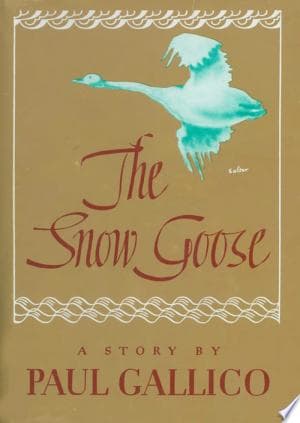
On the desolate Essex marshes, a reclusive, disfigured artist and a young girl form an unlikely friendship over a wounded snow goose, a bond that grows as war approaches and culminates in a heroic act at Dunkirk.
Philip Rhayader, a painter with a disfigured hand and shoulder, lives in an abandoned lighthouse on the desolate Essex coast. Society shuns him due to his appearance, so he lives alone, painting the wild landscape and its migratory birds. Gulls, curlews, and geese are his only companions. He has a gentle spirit, despite his outward appearance, and feels a deep connection to the natural world, which he paints skillfully. His life is peaceful but very isolated, following nature's rhythms instead of human interaction.
One bleak November afternoon, a small, timid girl named Fritha, from a nearby fishing village, comes to Rhayader's lighthouse. She carries a large, pure white snow goose with a broken, bleeding wing. Fritha, initially afraid of the reclusive artist due to local superstitions, gathers the courage to ask for his help. Rhayader, despite usually avoiding people, is moved by the girl's compassion and the bird's injury. He gently takes the goose, understanding its need for care, and begins to tend to its wound, creating the first link between his solitary world and another person.
Rhayader carefully cares for the wounded snow goose, which Fritha names 'Canada' because of its origins. He splints its wing and gives it a safe place in his studio. Fritha, overcoming her shyness, starts visiting regularly, bringing food for the bird and watching Rhayader's gentle care. Through their shared concern for Canada, a quiet understanding develops between the disfigured artist and the young girl. Fritha learns that beneath his rough exterior, Rhayader is deeply kind. Rhayader finds a quiet companionship he had long missed. The goose slowly recovers with their combined attention.
As spring nears, Canada's wing heals, and it regains its strength. The snow goose, now fully recovered, begins to show its wild instincts, wanting the open sky and the call of its kind. One morning, it flies off, circling the lighthouse before heading north to its breeding grounds. Fritha and Rhayader watch it leave with a mix of joy for its freedom and sadness at its absence. Its departure leaves a noticeable quiet in the lighthouse, showing the bond they had formed with the bird, and with each other through it. They now share a common experience and a quiet hope for its return.
Each autumn, as cold winds sweep across the Essex marshes, Fritha and Rhayader wait for Canada's return. And each year, the magnificent white bird reappears, sometimes alone, sometimes with a mate. Its faithful migration becomes a symbol of their lasting friendship. Fritha, now a young woman, continues her visits to the lighthouse, not out of duty but genuine affection and companionship. Rhayader, in turn, finds quiet joy in her presence and in the shared anticipation of Canada's arrival. The lighthouse, once a lonely place, becomes a haven of quiet understanding and shared natural wonder.
As years pass, the peaceful rhythm of the Essex marshes is broken by the distant rumblings of World War II. News of the conflict reaches even the secluded lighthouse, bringing an unsettling tension. The familiar sight of migrating birds is sometimes overshadowed by military aircraft. The war, initially a distant threat, begins to get closer, changing the landscape and the lives of those who live there. The natural world, which had been a source of comfort and constancy, now feels vulnerable to the destructive forces of human conflict.
In 1940, a year of increasing conflict, Canada, along with other migratory birds, leaves the marshes earlier than usual. Rhayader and Fritha see their early flight as an instinctive response to the growing unrest and danger of the war. The birds, sensing the changing atmosphere, leave their usual wintering grounds, leaving an eerie silence. This early departure is a clear sign of the approaching crisis, showing that even the natural world is affected by human conflict and its disruption.
The urgent call for all available boats to help evacuate British and French soldiers stranded at Dunkirk reaches Rhayader. Despite his reclusive nature and physical disfigurement, a deep sense of duty and patriotism makes him respond. He prepares his small, sturdy fishing boat, 'The Snow Goose,' for the dangerous journey across the English Channel. Fritha watches him go, her heart heavy with worry, yet understanding why he must go. Rhayader, once an outcast, now acts as an Englishman, sailing toward an unknown and dangerous fate.
Amidst the chaos, bombing, and desperation on the beaches of Dunkirk, Rhayader steers his small boat through the dangerous waters. He tirelessly ferries exhausted, wounded soldiers from the shore to larger evacuation ships, making repeated trips under heavy fire. His disfigured appearance, once a reason for being shunned, goes unnoticed or is ignored in the face of his heroic actions. He shows selfless courage, risking his life repeatedly to save others, driven by a deep humanity that goes beyond his physical challenges and past isolation. His boat, 'The Snow Goose,' becomes a symbol of hope in despair.
On his final trip to the beaches, as 'The Snow Goose' is full of rescued soldiers, Rhayader's boat is hit by enemy fire. He dies instantly, becoming one of Dunkirk's many unsung heroes. However, at the moment of his death, a single, pure white snow goose, clearly Canada, is seen circling high above the battle's chaos, a beacon of peace and enduring spirit against the backdrop of war. Its presence is a poignant farewell to the man who saved it and who, in turn, found a connection to humanity through it. The goose then flies away, a solitary white speck against the darkening sky.
Back in the Essex marshes, Fritha waits anxiously for Rhayader's return, but he never comes. News of the Dunkirk evacuation brings no comfort, only confirmation of many losses. Fritha continues her watch at the lighthouse, now a monument to absence. That autumn, Canada returns, circling the empty lighthouse. It lands, and for many winters after, it continues to return, a solitary white presence in the marshes. Fritha, now an old woman, still visits the lighthouse, finding comfort in the goose's faithful return, a living link to her cherished memories of Rhayader and their unique friendship.
The Protagonist
Rhayader transforms from a solitary outcast to a selfless hero, finding human connection and purpose through his bond with Fritha and the snow goose, ultimately sacrificing himself heroically at Dunkirk.
The Supporting
Fritha evolves from a timid child to a steadfast friend, her character shaped by her unique bond with Rhayader and her enduring connection to the snow goose.
The Supporting
From a helpless, injured creature, Canada transforms into a symbol of enduring hope and connection, its migrations mirroring the passage of time and the strength of the bonds it helped forge.
The Mentioned
The marshlands remain constant, a steadfast backdrop against which human lives and conflicts unfold, serving as a silent witness to both beauty and tragedy.
The Mentioned
The villagers remain largely static, representing the societal norms and prejudices that Rhayader transcends through his actions.
The novel explores how compassion, shown to both humans and animals, can heal emotional wounds and build deep connections. Rhayader, isolated by his disfigurement, finds comfort and purpose in caring for the wounded snow goose, Canada. This act of kindness, shared with Fritha, breaks down his solitude and her shyness, forming an unlikely friendship. Their shared empathy for the bird creates a bond that goes beyond social norms and physical appearances, showing that true connection comes from the heart, as when Fritha bravely asks the 'frightening' Rhayader for help.
“And it was this shared love for the wild creature that first bridged the gulf between the man and the child.”
The story questions common ideas of beauty and highlights the prejudice faced by those who are different. Rhayader's physical disfigurement causes society to shun him, making him live alone. However, his inner beauty—his kindness, artistic soul, and deep empathy for nature—attracts Fritha and shows his true character. The snow goose, initially a helpless, broken creature, becomes a symbol of majestic beauty and resilience. The story suggests that true worth and beauty are not in outward appearance but in spirit and action, as Rhayader's heroism at Dunkirk overcomes all prior judgment.
“He was a man who had withdrawn from the world because of what the world had made him feel about his body, yet his spirit was pure.”
The natural world, especially the Essex marshes and migratory birds, acts as a powerful setting that both contrasts with and is affected by human conflict. The peaceful, timeless cycles of bird migrations and marsh seasons highlight the destructive and temporary nature of war. While war disrupts bird patterns (Canada's early departure), nature ultimately endures and continues its cycles. The snow goose's return to the empty lighthouse after Rhayader's death symbolizes nature's resilience and its role as a constant, a living memorial to the bonds formed in its presence, even as human lives are lost.
“The wild things knew. The birds had left early that year.”
Heroism and sacrifice are central to the story's climax. Rhayader, a man previously defined by his isolation, answers the call of duty during the Dunkirk evacuation, showing great courage and selflessness. His decision to risk his life for strangers, despite his past isolation, makes him a true hero. His ultimate sacrifice, unnoticed by the world but seen by the symbolic snow goose, points to the quiet, deep acts of bravery often missed in the larger story of war. His heroism is not about glory, but about a deep, fundamental humanity.
“There was no glory in his task, only the grim, unceasing battle against the sea and death.”
The snow goose represents purity, resilience, freedom, and enduring connection.
The snow goose, Canada, is the central and most powerful symbol in the story. Its pure white plumage symbolizes innocence and purity, contrasting with the ugliness of war and human prejudice. Its annual migration represents the enduring cycles of nature, resilience, and hope, as it faithfully returns despite human conflict. It also symbolizes the unique, almost spiritual, bond between Rhayader and Fritha, acting as a catalyst for their friendship and a living testament to their shared compassion. Its final appearance over Dunkirk embodies Rhayader's spirit and the enduring wildness of nature.
The lighthouse represents isolation, sanctuary, and a beacon of hope.
The abandoned lighthouse serves as a multifaceted symbol. Initially, it represents Rhayader's isolation and his chosen refuge from a society that judges him. It is a place of solitude, yet also a sanctuary where he can be truly himself and pursue his art. As the story progresses and Fritha begins her visits, it transforms into a beacon of hope and connection, a place where an unlikely friendship flourishes. In the context of the war, a lighthouse, traditionally a guide for ships, mirrors Rhayader's role as a rescuer at Dunkirk, guiding soldiers to safety, and ultimately, a monument to his memory.
Natural events, like the birds' early departure, hint at impending human conflict.
The story subtly uses natural phenomena to foreshadow the impending human conflict of World War II. The most prominent example is the early departure of the migratory birds, including Canada, from the Essex marshes. This unusual behavior is interpreted by Rhayader and Fritha as an instinctive response by nature to the growing unease and danger in the world. This device underscores the deep connection Rhayader has with nature, allowing him to perceive subtle shifts that human society might ignore, and creates a sense of growing tension and inevitability leading up to the Dunkirk evacuation.
A reflective, almost elegiac tone that emphasizes the timeless and poignant aspects of the story.
The story is told with a reflective, slightly detached, yet deeply emotional narrative voice. This elegiac tone imbues the events with a sense of timelessness and poignancy, elevating the simple tale to the status of a legend or a fable. The narrator often speaks with a sense of looking back, emphasizing the enduring impact of the characters and events. This style allows for philosophical commentary on themes of humanity, nature, and sacrifice, creating an atmosphere that is both intimate and universal, and guiding the reader to reflect on the deeper meanings within the narrative.
“There was in this man a incredible gentleness, a shyness almost, and a profound understanding of the wild things.”
— Describing Philip Rhayader, the recluse artist.
“The great birds knew him; and they knew too, with the uncanny instinct of the wild, that he was their friend.”
— Referring to Rhayader's relationship with the birds.
“There was a wound in her wing, and her leg was broken, and she was very cold and hungry and afraid.”
— Describing the injured snow goose when Fritha finds her.
“The greatest joy of all joys is the joy of saving something that is lost.”
— Fritha reflecting on her feelings after helping the goose.
“It was a strange friendship that grew up between the lonely man, the silent child, and the wild bird.”
— Narrator describing the bond between Rhayader, Fritha, and the goose.
“In the spring, when the wild geese returned, the Snow Goose would rise to join them, circling higher and higher until she was lost to sight.”
— Describing the goose's seasonal migrations.
“And always, when she came back, she would bring with her a new note of wildness, a new pride in her great wings.”
— Describing the goose's return after migration.
“He was an outcast, a lonely man, but he had found something to love, and something that loved him in return.”
— Reflecting on Rhayader's life and his connection to the goose.
“The sea mist began to thin, and a pale sun broke through, touching the ruined tower with a ghostly light.”
— Setting the atmospheric scene around Rhayader's lighthouse.
“The world was at war, but in the desolate marshlands of Essex, a different kind of drama was unfolding.”
— Contrasting the quiet marsh with the larger conflict.
“He knew he had to go, even though it meant leaving everything he held dear.”
— Rhayader's decision to join the Dunkirk rescue efforts.
“The great white bird, a beacon of hope and freedom, circled above him.”
— The Snow Goose appearing during Rhayader's final moments at Dunkirk.
“The Snow Goose was a living thing, a spirit of the wild, and she could not be held captive by human grief.”
— Fritha's realization after Rhayader's death.
“And so, in the end, there was only the memory of a man, a child, and a great white bird against the gray skies of war.”
— Concluding thought on the enduring legacy of their story.
Ready to see how well you understood this book? Take our interactive quiz with 10 questions.
Biography coming soon.

Ashley Antoinette
4.6

Mark McDonald
4.4
Luo Guanzhong
4.4

Mia McKenzie
4.3

Dorothy Parker
4.3

Joaquim Maria Machado de Assis
4.3

James Thurber
4.2
Terry Kay
4.2