“I am not afraid of death, I just don't want to be there when it happens.”
— From the essay 'My Apology'

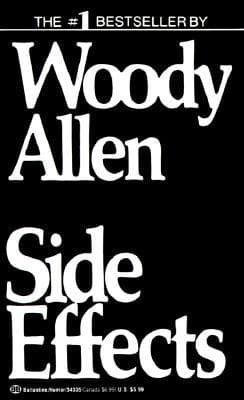
Sign in to track this book
Woody Allen's 'Side Effects' follows a man who uses a time machine to date Emma Bovary and a burglar's philosophical thoughts, offering a funny, anxious look at modern life.
Sidney Kugelmass, a humanities professor at City College, is unhappy with his marriage to Daphne and his unfulfilling life. He seeks help from a mysterious magician named Persky, who claims he can transport people into books. Kugelmass initially dismisses it but, desperate, agrees to try. Persky uses a 'magic realism' cabinet to send Kugelmass into Gustave Flaubert's *Madame Bovary*. Kugelmass finds himself in a scene with Emma Bovary, who is initially confused by his appearance. They quickly connect, and Kugelmass brings Emma out of the book into his world, causing chaos and a scandalous affair that makes headlines.
This piece tells the life story and thoughts of Mendel Needleman, a brilliant but melancholic thinker whose work never gained wide recognition. Needleman is shown as a man obsessed with the meaning of existence, constantly dealing with existential dread and life's absurdity. His insights, though deep, often lead to strange conclusions or paralyzing despair. The story follows his academic struggles, his attempts to find purpose, and his ultimate, somewhat uneventful, death. The tone mixes mock-serious biography and philosophical satire, highlighting the futility of his intellectual pursuits in an indifferent universe.
A condemned man, awaiting execution, thinks about his past crimes, his current situation, and the arbitrary nature of justice. He recounts his capture, trial, and interactions with prison guards and the chaplain. Despite his serious situation, his thoughts are filled with philosophical ideas, self-deprecating humor, and a detached view of his coming death. He discusses the ordinariness of evil, the pointlessness of punishment, and the existential dread that fills his final days, all with a dry, ironic tone, questioning free will and responsibility.
The narrator, a self-proclaimed burglar, recounts his unsuccessful criminal career. Far from a hardened criminal, he is an intellectual and anxious individual who approaches burglary with a philosophical view, constantly questioning the ethics and effectiveness of his actions. His attempts at breaking and entering are often ruined by his own anxieties, overthinking, or bad luck. He details his various mishaps, from getting stuck in windows to having existential crises in the middle of a heist. His 'confessions' show a character more suited to a university lecture hall than a dark alley, highlighting the absurdity of his chosen job.
This story presents a series of 'newly discovered' ancient scrolls, supposedly from biblical times, which, instead of containing deep religious revelations, detail surprisingly ordinary and out-of-place concerns. The scrolls discuss topics like ancient tax forms, dietary rules that seem more like fad diets, and personal complaints that mirror modern ones. One scroll might be a landlord's eviction notice, another a complaint about noisy neighbors, and another a philosopher's thoughts on finding a good tailor. The humor comes from putting an ancient setting with very relatable, trivial, and often anxious human problems.
The narrator gives an unusual commencement address to a group of eager graduates. Instead of offering encouragement and hope, he gives a brutally honest and darkly funny assessment of life's inherent meaninglessness, the futility of ambition, and the inevitability of suffering and death. He advises graduates to embrace nihilism, lower their expectations, and accept the absurd nature of existence. His speech is a funny reversal of traditional graduation speeches, using wit and irony to highlight the anxieties and disappointments that often lie beneath societal expectations of success and happiness.
Presented as a pseudo-academic paper, this piece humorously analyzes UFO sightings through a historical and philosophical lens. The narrator, an overly serious and pedantic scholar, meticulously details various alleged encounters, offering complicated and often ridiculous theories to explain them. He discusses the cultural impact of belief in extraterrestrials, the psychological need for such myths, and the inherent absurdity of human attempts to understand the unknown. The humor comes from applying a formal, scholarly tone to such a speculative and often silly subject, complete with footnotes and academic terms.
A patient in a mental asylum tells his story, convinced that he is the only sane person in a world gone mad. He describes his experiences in the institution, his interactions with doctors and other patients, and his attempts to understand the illogical behavior he sees around him. His 'sane' perspective is, of course, presented with a deeply ironic and self-aware humor, highlighting the thin line between sanity and madness. He offers his own eccentric theories on life, society, and the universe, all while maintaining a dignified and often profound, if ultimately deluded, self-perception.
This section is a collection of short, sharp observations, anecdotes, and one-liners that comment on various aspects of life, from relationships and work to existential dread and the nature of reality. Each entry is a miniature comedic sketch, often ending with a punchline or a sudden, absurd twist. The tone is consistently cynical and self-deprecating, reflecting on the frustrations, confusions, and inherent humor of the human condition. It is a rapid-fire sequence of comedic insights, showing the author's ability to find humor in both the ordinary and the profound.
This section features a selection of shorter, standalone humorous essays and sketches, like Woody Allen's early comedic writing. These pieces often explore anxieties, neuroses, and observations on daily life with a characteristic mix of intellectualism and self-deprecation. Topics range from the absurdities of modern society to personal insecurities, relationships, and the search for meaning. Each essay is a self-contained comedic exploration, showing Allen's distinctive voice and his ability to turn ordinary experiences into witty, often philosophical, humor. They are snapshots of his evolving comedic style.
The narrator details his experience with a strange and overly complicated diet plan, driven by an anxious obsession with health and appearance. He meticulously describes the restrictive rules, the strange food combinations, and the mental and physical toll it takes on him. The diet becomes an all-consuming force in his life, leading to increasingly absurd situations and interactions with others. Despite his efforts, the diet often backfires, causing more problems than solutions. The story satirizes the modern obsession with health fads and the lengths people go to for an ideal body image.
The Protagonist
Kugelmass starts as a bored academic seeking escapism and briefly finds it, only for his desires to lead to utter chaos and a final, ironic demise.
The Protagonist (of his own story)
Needleman's 'arc' is one of continuous struggle with existential dread, ultimately ending in an unremarkable death that mirrors the very meaninglessness he explored.
The Protagonist
His arc is a series of escalating failures in his chosen profession, consistently proving himself ill-suited for a life of crime.
The Supporting
Persky remains a consistent, mysterious figure, serving primarily as a plot device without significant personal development.
The Supporting
Emma briefly escapes her literary confines, experiences a taste of modern life, and then is abruptly returned to her original, unfulfilling existence.
The Protagonist
His arc is confined to his final moments, showcasing his consistent philosophical detachment even in the face of death.
The Protagonist
His narrative arc reinforces his unshakeable belief in his own sanity, demonstrating the subjective nature of reality.
The Protagonist
His 'arc' is contained within the speech, where he articulates his consistent, bleak worldview.
A main theme throughout the collection is the inherent absurdity of human existence and life's ultimate meaninglessness. Characters often deal with deep philosophical questions, only to reach conclusions that highlight the futility of their efforts or the arbitrary nature of the universe. This is clear in 'Remembering Needleman,' where the protagonist's deep philosophical inquiries lead only to despair and an unremarkable end, or in 'My Speech to the Graduates,' where the speaker advises embracing nihilism. Even in 'The Condemned,' the man facing execution finds irony and detachment in his dire situation, rather than deep remorse, emphasizing the arbitrary nature of his fate.
“More than any other time in history, mankind faces a crossroads. One path leads to despair and utter hopelessness. The other, to total extinction. Let us pray we have the wisdom to choose correctly.”
Many characters in 'Side Effects' are highly educated, introspective, and prone to anxiety and overthinking. They are intellectuals whose academic skills often contrast sharply with their inability to manage practical or emotional aspects of life. Sidney Kugelmass, the humanities professor, is a prime example, whose intellectual boredom leads him to seek a magical escape. The Burglar in 'Confessions of a Burglar' is another, constantly thinking about his crimes rather than committing them effectively. This theme shows the comedic potential of the gap between abstract thought and the messy realities of human experience.
“I had a terrible night. I couldn't sleep. I got up, I took a shower, I got dressed, I had a cup of coffee, I went to work. But I couldn't concentrate. I kept thinking about the meaning of life. I couldn't get it out of my head.”
Characters often try to escape their ordinary, unsatisfying lives, only to find that their attempts lead to more problems or eventual disappointment. Kugelmass's desire to escape his marriage and academic routine by entering *Madame Bovary* initially brings excitement but quickly becomes a scandal and a tragicomic ending. Even the idea of ancient scrolls in 'The Scrolls' subverts expectations, showing that ancient people were just as ordinary and concerned with trivialities as modern ones. This theme suggests that true escape is hard to find, and reality, no matter how it's presented, often disappoints.
“I yearned for a world of passion, of high drama, of romance, of intrigue. Instead, I had Daphne.”
The collection satirizes various aspects of contemporary society, from health fads and academic language to media sensationalism. 'The Diet' comically exaggerates the lengths people go to for health and appearance, resulting in ridiculous situations. The media frenzy around Kugelmass's affair with Emma Bovary highlights the triviality and sensationalism of news. Even the 'UFO Menace' piece, presented as an academic paper, mocks the intellectualization of ridiculous theories. This theme uses humor to expose the inherent silliness and irrationality within modern conventions and obsessions.
“I told the doctor I was afraid of flying. He said, 'Don't worry, the chances of a bomb on board are one in a million.' I said, 'What about two bombs?' He said, 'That's one in a hundred million.' I said, 'So I'll just bring my own bomb, and then the chances of two bombs will be one in a hundred million!'”
Especially clear in 'The Kugelmass Episode,' this theme explores the blurred lines between reality and fictional worlds. The ability to literally step into a book questions the nature of narrative, character agency, and fiction's impact on reality. When Emma Bovary enters Kugelmass's world, she disrupts both her literary existence and his real life, showing how stories can have a tangible, though chaotic, power. This theme playfully challenges the reader's perception of what is real and what is imagined.
“They were two people, separated by a century and a half, yet united by a common desire to escape the tedium of their respective lives.”
Stories that self-consciously refer to themselves as fictional constructs.
Metafiction is heavily employed, most notably in 'The Kugelmass Episode,' where a character literally enters a fictional novel and interacts with its characters. This device breaks the fourth wall and draws attention to the artificiality of storytelling. It also appears in 'The Scrolls,' where the presentation of 'ancient texts' is a fictional construct, and in 'The UFO Menace,' which is framed as an academic paper. This technique allows Allen to comment on the nature of narrative itself, blurring the lines between author, reader, and character, and often creating humor through the self-referential nature of the text.
Humorous critique of human folly, social conventions, or literary styles.
Satire and parody are central to Allen's comedic style in 'Side Effects.' He uses these devices to lampoon various targets, from academic pretension ('Remembering Needleman,' 'The UFO Menace') and societal obsessions ('The Diet') to the very act of writing and philosophical inquiry. 'My Speech to the Graduates' parodies traditional commencement addresses by offering a nihilistic alternative. The humor often comes from the exaggeration of real-world phenomena or the subversion of established literary or social forms, highlighting the absurdities of human behavior and institutions through imitation and ridicule.
A narrator whose credibility is compromised or intentionally misleading.
Many stories in 'Side Effects' feature narrators whose perspectives are skewed, exaggerated, or self-serving, adding layers of irony and humor. The Burglar in 'Confessions of a Burglar' presents himself as an intellectual, yet his actions are consistently inept. The Lunatic in 'The Lunatic's Tale' firmly believes in his own sanity while describing an undeniably mad world. Even Sidney Kugelmass's perception of his own desirability and literary prowess is questionable. This device forces the reader to question the narrative and find humor in the gap between the narrator's self-perception and the implied reality.
Humor derived from the juxtaposition of logical thought with illogical situations.
Absurdist humor is a cornerstone of Allen's style. It manifests through characters who apply overly serious, often intellectual, reasoning to completely irrational or bizarre circumstances. Kugelmass's pragmatic approach to having an affair with a fictional character, or the Burglar's philosophical musings mid-heist, are prime examples. This device creates comedy by highlighting the inherent irrationality of the world and human attempts to impose order or meaning upon it, often leading to farcical outcomes that underscore the meaninglessness or arbitrary nature of existence.
“I am not afraid of death, I just don't want to be there when it happens.”
— From the essay 'My Apology'
“Not only is there no God, but try getting a plumber on weekends.”
— From the essay 'My Apology'
“The chief prerequisite for a good life is to be a good animal.”
— From the story 'The Kugelmass Episode'
“Eternal nothingness is fine if you happen to be dressed for it.”
— From the essay 'My Apology'
“What if everything is an illusion and nothing exists? In that case, I definitely overpaid for my carpet.”
— From the essay 'My Apology'
“He was a man who knew the value of a dollar, and he knew it was worthless.”
— From the story 'The Kugelmass Episode'
“The human brain is a wonderful thing. It starts working the moment you are born and never stops until you stand up to speak in public.”
— From the essay 'My Apology'
“I don't mind being a little crazy, as long as I can still tell the difference between a real hallucination and a fake one.”
— From the story 'The Kugelmass Episode'
“If it turns out that there is a God, I don't think that he's evil. I think that the worst thing you can say about him is that he's an underachiever.”
— From the essay 'My Apology'
“I was mugged. I was walking down the street and this guy grabbed my arm and said, 'Give me your wallet!' I said, 'I don't have a wallet.' He said, 'Then give me your arm!'”
— From the story 'The Kugelmass Episode'
“My one regret in life is that I am not someone else.”
— From the essay 'My Apology'
“I'm such a good lover because I practice a lot on my own.”
— From the story 'The Kugelmass Episode'
“I believe that sex is a beautiful, natural, and wholesome thing that should be saved for marriage... between two people who really love each other. And then they should do it every day for the rest of their lives.”
— From the essay 'My Apology'
“He felt that the universe was a cosmic joke, and the punch line was him.”
— From the story 'The Kugelmass Episode'
Ready to see how well you understood this book? Take our interactive quiz with 10 questions.

Biography coming soon.

Ashley Antoinette
4.6

Mark McDonald
4.4
Luo Guanzhong
4.4

Mia McKenzie
4.3
Dorothy Parker
4.3

Joaquim Maria Machado de Assis
4.3
James Thurber
4.2

Terry Kay
4.2