“Sometimes you have to step outside of the person you've been and remember the person you were meant to be.”
— Ross reflects on his past and future.

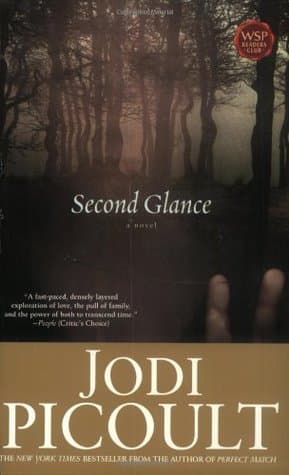
Jodi Picoult (2003)
Genre
Mystery / Romance
Reading Time
9-10 hours
Key Themes
See below
Sign in to track this book
A suicidal ghost hunter, hoping to reunite with his deceased fiancée, uncovers a town's spectral secrets and a dark chapter of American history, blending love, loss, and the lasting impact of eugenics.
Ross Wakeman, a cynical and suicidal ghost hunter, arrives in Comtosook, Vermont. His cousin, developer Shelby Wakeman, hired him to investigate and disprove claims of a haunting on land Shelby plans to develop. The land is important to the local Abenaki tribe, who believe it is a sacred burial ground and that strange events are happening because it is disturbed. Ross is deeply affected by the death of his fiancée, Aimee, in a car accident eight years earlier. He secretly hopes that engaging with the supernatural might offer him a glimpse of her or an explanation for why he survived. He meets Detective Ben Sterling, who initially doubts Ross's methods.
Ross begins his investigation, setting up equipment and interviewing residents who report odd events: moving objects, strange sounds, and cold spots. He meets Lia Beaumont, a private and mysterious woman who lives in a secluded cabin and seems sensitive to the spiritual world. Lia is also searching for answers about the afterlife, specifically concerning her deceased sister. Their first interactions are careful, marked by a shared understanding of loss and an unspoken belief in something beyond the physical. Ross finds himself drawn to Lia's quiet intensity and her unique view of the hauntings.
As Ross investigates further, he finds that the supernatural activity is centered around the old Beaumont property and seems linked to the town's dark past. He learns about Vermont's eugenics project from the 1920s and 30s, a period when people deemed 'unfit' were forcibly sterilized. The hauntings appear tied to the Beaumont family, especially a young Abenaki woman named Mara and her sister, Mary, who were victims of this program. Ross realizes the 'ghost' might not be a general spirit but a specific person seeking justice from a tragic past.
Ross uncovers a hidden set of diaries belonging to Mara, an Abenaki woman who endured forced sterilization and the loss of her child due to the eugenics program. These diaries describe Mara's love for a man named Caleb, their struggles, and the great injustice done to her and her family. The entries show that Mara's sister, Mary, also suffered greatly. As Ross reads, he starts to identify the ghost: it is Mara, trying to reveal the truth of her past. He also begins to suspect a strong link between Mara's story and Lia Beaumont.
Through increasingly intense supernatural experiences and his growing bond with Lia, Ross makes a surprising discovery: Lia Beaumont is not a living woman, but the ghost of Mara, stuck in a state of purgatory, unable to fully move on because of her unresolved past and the injustice she suffered. She has been trying to tell her story and bring peace to her restless spirit. Ross realizes that Lia's ethereal nature and her deep knowledge of the past were not just intuition but direct experience. This revelation deeply affects Ross, changing his understanding of life, death, and his own search for Aimee.
Mara's diaries and Lia's fragmented memories show that her unfinished business mainly involves her lost love, Caleb, and the child she was denied due to forced sterilization. Caleb, a white doctor who secretly loved Mara and tried to help her, also faced the societal prejudices of the time. The spirit is not evil but deeply sad, desperate to reunite with Caleb and find peace for her lost future. Ross feels a growing responsibility to help Mara find this closure, seeing the similarities between her lasting love and his own for Aimee.
Ross, guided by Lia, begins to confront the living descendants of those involved in the eugenics project, including some prominent families in Comtosook. This means looking into old records and challenging long-held silences. The goal is to bring the truth of Mara's story and the eugenics program to public awareness, seeking a form of justice and acknowledgment for the victims. This proves difficult, as many resist digging up the town's shameful past, but Ross is determined to help Mara find peace.
It becomes clear that for Mara's spirit to finally rest, she needs to be reunited with Caleb. Ross, with help from Ben Sterling and local historians, searches for Caleb's burial site. The diaries provide clues, but time and the secrecy around their relationship make it hard. The search becomes urgent as spiritual activity increases, reflecting Mara's growing desperation for resolution. Ross feels a strong connection to Mara's longing, mirroring his own desire for Aimee.
During his deep involvement with the supernatural and his connection with Lia/Mara, Ross has a powerful spiritual encounter that allows him to finally glimpse Aimee. This moment gives him the closure he has wanted for eight years, confirming that love lasts beyond death and that Aimee is at peace. This experience deeply changes Ross's view on life, death, and his own purpose, turning him from a suicidal drifter into someone ready to live again, even without Aimee physically present.
After a careful search, Caleb's unmarked grave is found. Ross, Ben, and others arrange for a proper reburial ceremony. During the ceremony, as Caleb's remains are reinterred, Mara's spirit, seen through Lia, is finally able to find peace. Ross witnesses her reunion with Caleb, a touching and powerful moment of transcendent love. The supernatural events in Comtosook stop, and a sense of calm settles over the town, marking Mara's journey to the afterlife and the resolution of her long-suffered injustice.
With Mara's spirit at peace and the truth of the eugenics project finally revealed, Ross finds new purpose in life. His experience with Lia/Mara and his glimpse of Aimee have healed his deep grief. He forms a close bond with Detective Ben Sterling, who, having seen the unexplainable, now respects the unknown. Ross decides to stay in Comtosook, no longer a drifter but a man with a place and a mission to help others find peace, both living and departed. Comtosook begins the long process of acknowledging its dark history.
The Protagonist
Ross transforms from a grief-stricken, suicidal man into someone who embraces life and finds purpose in helping others, having found closure regarding Aimee.
The Central Figure / Ghost
From a restless, suffering spirit, Lia/Mara finds peace and reunion with her lost love through Ross's efforts.
The Supporting
Ben's worldview expands from strict rationality to an acceptance of the unknown, becoming a trusted friend to Ross.
The Mentioned / Catalyst
Through Ross's journey, Aimee's memory transforms from a source of unbearable pain into a symbol of enduring love and peace.
The Mentioned / Supporting
His posthumous reunion with Mara brings peace to both their spirits.
The Supporting
Shelby's initial skepticism and focus on profit are challenged by the undeniable evidence of the haunting and the town's past.
The Mentioned
Her story, alongside Mara's, helps to expose the profound injustices of the past.
The Supporting / Collective
Their ancestral claims are validated, and their history acknowledged through the resolution of the haunting.
The novel looks at the many sides of grief, especially through Ross Wakeman's long despair over Aimee's death. His suicidal thoughts and constant search for a connection to the afterlife show his unresolved sorrow. The story suggests that real healing comes not from forgetting, but from finding closure and turning pain into acceptance. Ross's journey with Lia/Mara, and his eventual glimpse of Aimee, helps him move past his grief and embrace life again, showing that healing means accepting loss while finding new purpose. This is clear when he lets go of his wish to die after Aimee appears to him.
“Sometimes I wonder...Can a ghost find you, if she wants to?”
A main theme is the lasting power of love that goes beyond life and death. This is shown through two relationships: Ross's strong devotion to Aimee, which drives his quest, and the sad, yet eternal, love between Mara and Caleb. Mara's spirit remains restless for decades because she is separated from Caleb and because of the injustice that kept them from a life together. The novel suggests that deep love creates a bond that even death cannot fully break, and that reunion, even if spiritual, brings ultimate peace. The ending, where Mara reunites with Caleb, shows this theme beautifully.
“Love is not a finite emotion that can be used up. It is an infinite well, flowing for all eternity.”
The novel highlights the dark and often forgotten chapter of Vermont's eugenics project. This theme explores how historical injustices, especially against marginalized groups like the Abenaki, can leave lasting scars and 'haunt' the present. Mara's story shows the devastating impact of such policies on individuals and families. The narrative stresses the importance of facing uncomfortable truths from the past, acknowledging victims, and seeking justice or recognition to allow both the dead and the living to find peace. The town's reluctance to discuss its past shows how hard it is to deal with collective trauma.
“History is not a story for the dead; it is a lesson for the living.”
The story constantly questions the line between the rational and the supernatural, making characters and readers wonder what 'reality' is. Ross, initially a cynical ghost hunter, must face clear evidence of a haunting that defies scientific explanation. Detective Sterling's journey from doubt to belief further emphasizes this theme. Lia existing as Mara's ghost, interacting with the living world, blurs the lines between life and death, suggesting that forces and dimensions beyond our immediate perception exist. The book proposes that the 'unseen' might be just as real, if not more impactful, than the 'seen.'
“Sometimes the things you can't see are the most real.”
Both Ross and Mara deal with issues of identity and belonging. Ross, lost in his grief, feels disconnected from life, struggling to find his place without Aimee. His identity is defined by his loss. Mara, as a victim of eugenics, was stripped of her right to self-determination and belonging within her community and family. Her haunting is an attempt to reclaim her identity and the life she was denied. The Abenaki tribe's fight for their ancestral land also speaks to the importance of cultural identity and belonging to a place. The resolution brings a sense of belonging to both Ross and Mara.
“What is a life, if not a story you tell yourself, over and over?”
The plot's central setting, a piece of land with historical significance and supernatural activity.
The contested land in Comtosook, intended for development by Shelby Wakeman, serves as the primary catalyst for the entire plot. Its status as an Abenaki burial ground and the site of intense supernatural activity immediately sets the stage for conflict and mystery. The haunting itself is directly tied to the land's history, making it not just a backdrop but an active participant in revealing the past. It symbolizes the buried truths and injustices that need to be unearthed for peace to be found.
A collection of hidden journals that reveal the historical injustice and the ghost's identity.
Mara's diaries are a crucial narrative device, serving as the primary means by which Ross and the reader uncover the tragic story of Mara, Caleb, and the Vermont eugenics project. These diaries provide firsthand accounts of the historical injustice, Mara's love, and her suffering, transforming the abstract 'haunting' into a deeply personal and emotionally resonant narrative. They function as a bridge between the past and present, providing the specific details necessary to understand and resolve the haunting.
Scientific equipment and investigative techniques used to study and communicate with the supernatural.
Ross Wakeman's array of ghost-hunting equipment (EMF detectors, temperature gauges, audio recorders) and his methodical, albeit cynical, approach to investigating the supernatural serve as a plot device to ground the fantastical elements in a semblance of scientific inquiry. This creates a tension between the rational and irrational, allowing the reader to experience the gradual erosion of skepticism alongside Ross. The tools, while initially used to debunk, ultimately become instruments for validating and communicating with the spiritual world.
The intertwining of past and present romantic relationships and their unresolved nature.
The novel uses a dual 'love triangle' (or rather, a dual unresolved love story) as a significant plot device. Ross's enduring love for his deceased fiancée, Aimee, parallels Mara's eternal love for Caleb. Both relationships are tragically cut short, leaving lingering emotional and spiritual echoes. This parallelism deepens the emotional resonance of the story, allowing Ross to empathize with Mara's plight and providing him with a personal stake in resolving her haunting, as it mirrors his own quest for closure.
Subtle hints and recurring imagery of coldness to signify supernatural presence and emotional states.
The recurring motif of 'cold spots' is a classic ghost story trope that functions as a consistent foreshadowing device, signaling the presence of Mara's spirit and intensifying the eerie atmosphere. Beyond its supernatural implication, the cold also symbolizes Ross's emotional state—his numbness and despair after Aimee's death. As the haunting progresses and Mara's story unfolds, the cold becomes more pronounced, indicating the increasing proximity and desperation of the spirit, guiding Ross to the truth.
“Sometimes you have to step outside of the person you've been and remember the person you were meant to be.”
— Ross reflects on his past and future.
“The past is like a mirror, and you can spend your whole life staring at it, or you can turn around and see what's in front of you.”
— Ross struggles with moving on from Amelia's death.
“Love isn't finding someone you can live with. It's finding someone you can't live without.”
— Ross contemplates his feelings for Amelia.
“There are some things you can't undo, no matter how much you wish you could.”
— Ross deals with the irreversible consequences of past events.
“Sometimes the things you're most afraid of are the things that set you free.”
— Ross faces his fears about the supernatural and his past.
“We all have secrets. Some are small, some are big. But they all have the power to change everything.”
— The characters' hidden truths begin to unravel.
“Grief is a peculiar thing; it's a room you can never truly leave, only move the furniture around in.”
— Ross reflects on his prolonged mourning for Amelia.
“Even the most ordinary life can hold extraordinary secrets.”
— The seemingly normal lives of the characters hide deep mysteries.
“What if the person you thought you knew best was a stranger all along?”
— Ross uncovers shocking truths about Amelia's past.
“The hardest part of any journey is the first step, especially when you don't know where you're going.”
— Ross embarks on a quest to understand Amelia's death.
“Sometimes, the only way to heal is to reopen old wounds.”
— Ross must confront painful memories to find answers.
“The truth is rarely simple, and often, it's not what you want to hear.”
— The complex layers of the mystery are revealed.
“Every story has two sides, and the real truth usually lies somewhere in the middle.”
— Ross hears different perspectives on past events.
“There's a fine line between coincidence and destiny.”
— Ross observes patterns and connections that seem more than random.
Ready to see how well you understood this book? Take our interactive quiz with 10 questions.

Biography coming soon.