“The truth is out there.”
— A recurring theme in the narrative, reflecting the characters' quest for answers.

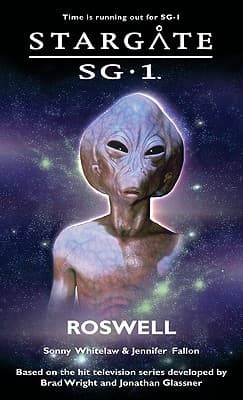
Sonny Whitelaw (2007)
Genre
Science Fiction
Reading Time
6-7 hours
Key Themes
See below
Sign in to track this book
A Stargate malfunction sends SG-1 to 1947, trapping them in the Roswell incident as they try to save an Asgard and prevent temporal changes that could erase their future, with Jack O'Neill and Vala Mal Doran unexpectedly joining them.
While returning to Earth from a mission, the Stargate malfunctions, sending Lieutenant Colonel Cameron Mitchell, Dr. Daniel Jackson, Lt. Colonel Sam Carter, and Teal'c back in time. They appear in the 1947 New Mexico desert, their bodies weakening from temporal displacement. Major General Jack O'Neill and Vala Mal Doran rescue them in a stolen Goa'uld cargo ship. O'Neill, now a Major General, says he and Vala were tracking temporal anomalies and expected SG-1. He explains the Stargate's temporal feedback loop is unstable, placing them in an altered timeline.
After they recover, O'Neill tells SG-1 their main mission in this new timeline is to find and rescue an Asgard named Thor, who was also displaced and crashed near Roswell, New Mexico, in 1947. This links their situation to the Roswell incident. O'Neill gives them period clothing, fake IDs, and a cover story to enter the area. They learn the Asgard's ship is damaged, and he is in danger of human discovery. The team splits: Jack, Daniel, Sam, and Teal'c go to Roswell, while Cam and Vala stay with the cargo ship to monitor the timeline and find a way back to their own time.
Jack, Daniel, Sam, and Teal'c arrive in Roswell, New Mexico. The town is busy with rumors and military activity after the alleged UFO crash. They use their cover identities: Jack as a military intelligence officer, Daniel as a linguist, Sam as a scientist, and Teal'c as Jack's aide. Their initial checks show a heavily guarded crash site and fear among locals. They quickly realize the military has already secured the Asgard ship and its occupant, making their rescue harder. They plan to infiltrate the military base where Thor is held, knowing any mistake could change history.
Inside the temporary military facility, Thor is held captive, weakened by the crash and temporal displacement. US military personnel, including General Ramey and Dr. Jesse Marcel, try to communicate with him, but his advanced technology and language are beyond them. Thor, though weak, tries to explain the urgency of his situation and the threat of temporal interference without revealing too much. He knows SG-1 is in the timeline and subtly tries to guide his captors toward understanding, but they see his efforts as cryptic alien behavior. The military's fear and scientific curiosity create a tense situation for the Asgard.
Meanwhile, back at the cargo ship, Cameron Mitchell and Vala Mal Doran experience a sudden temporal shift. The ship's systems show they have moved into a slightly different, but equally dangerous, alternate 1947. This new timeline is subtly but significantly different from Jack's team's timeline, making it much harder to find their way back to their original time or rescue the others. They are isolated, with no contact with Jack's team, and must rely on their wits and the Goa'uld ship's limited resources. Cam grows frustrated by their helplessness, while Vala searches the ship's old databases for temporal mechanics that might offer a solution.
Using their skills, Jack, Daniel, Sam, and Teal'c infiltrate the military base where Thor is held. Sam's technical skills bypass security, and Daniel's language skills help them understand local documents. They find Thor's cell and make contact, to his relief. Thor quickly explains the serious temporal ripple effects caused by their presence and the need to return to their original timeline soon. He also reveals that another, more dangerous entity, a Goa'uld, was also displaced in time and is now trying to use the altered timeline for its own gain, threatening Earth's future.
Thor confirms that a Goa'uld, the cunning System Lord Zipacna, was also caught in the Stargate's temporal malfunction and landed in 1947. Zipacna, a master manipulator, is already working to establish a presence on Earth, subtly influencing military and government figures. His goal is to ensure that when the Stargate program begins, Earth will already be under Goa'uld control, preventing human resistance. This adds urgency and danger to their mission. They must now rescue Thor, fix the timeline, and neutralize a Goa'uld threat that could permanently change the future, turning Earth into a Goa'uld domain.
As Jack's team works to rescue Thor and stop Zipacna, the temporal disturbances worsen. Sam begins to have fragmented visions and memories of a bleak future. The changes ripple through time, starting as subtle alterations and becoming more noticeable. They see glimpses of a future where Earth is not part of the Stargate Alliance but a subjugated world under Goa'uld rule, with enslaved humans and advanced technology used against them. Their reality is unraveling, showing the catastrophic results of their interference and Zipacna's growing success. Fixing the timeline becomes critical, as their existence and Earth's fate are at risk.
After much effort, Vala finds a way to recalibrate the Goa'uld cargo ship's temporal drive, allowing her and Cam to return to the specific 1947 timeline where Jack's team is. Their reunion is brief but important; they share their experiences and the dire state of the timeline. With Cam and Vala's arrival, the full team is reunited. They combine Thor's temporal understanding, Sam's scientific skill, Daniel's historical knowledge, and Jack's tactics. They plan to retrieve Thor, neutralize Zipacna, and use the Stargate's temporal feedback loop with Thor's help to send themselves and the timeline back to its original state before the Goa'uld's influence becomes permanent.
The final confrontation is a high-stakes battle against Zipacna and his human loyalists within the 1947 military. SG-1, guided by Thor, targets Zipacna's emerging power base. They fight fiercely, using their training and technology against the Goa'uld's cunning and larger numbers. They incapacitate Zipacna and prevent him from gaining control. At the same time, they secure Thor and prepare him for the temporal jump. With the immediate threat stopped, they race to activate the Stargate, using its temporal anomaly with Thor's ship to create a massive temporal wave, hoping to reset the timeline. The process is dangerous and uncertain, with their entire existence at stake.
Despite the odds, SG-1 and Thor succeed. The temporal wave washes over them, and they feel time snapping back into place. They find themselves back on their original mission, exiting the Stargate on Earth, seemingly moments after they left. There are no signs of the Goa'uld invasion or the altered 1947. Their memories of the ordeal are hazy, but the knowledge of what they prevented remains. Thor, now safely back in his own time, sends a brief, appreciative message, confirming their success. SG-1 has saved Earth's future, but the experience leaves them with an understanding of time's delicate balance and the unforeseen results of even small interventions.
The Protagonist
Mitchell learns to adapt to extreme temporal uncertainty and recognizes the vast responsibility of preserving the timeline, even when it means making difficult choices.
The Protagonist
Daniel grapples with the ethical weight of temporal interference, reinforcing his commitment to preserving history while also protecting the future.
The Protagonist
Carter's scientific understanding is pushed to its limits, solidifying her role as the primary architect for complex temporal solutions.
The Protagonist
Teal'c's loyalty and combat skills prove indispensable in protecting the timeline and his team.
The Supporting
O'Neill demonstrates his enduring leadership and resourcefulness, operating independently to safeguard the future.
The Supporting
Vala proves her value beyond her roguish past, demonstrating her deep well of resourcefulness and loyalty when faced with a catastrophic threat.
The Supporting
Thor's vulnerability highlights the profound danger of temporal displacement, yet his intellect remains a beacon for SG-1.
The Antagonist
Zipacna's opportunistic manipulation of the past underscores the catastrophic potential of unchecked temporal interference.
The Mentioned
Ramey serves as a historical anchor and a symbol of the human institutions unknowingly caught in a larger cosmic conflict.
This theme explores how easily history can change from small actions. The Stargate malfunction and SG-1's presence in 1947 start events that lead to a future where Earth is enslaved by the Goa'uld. Sam Carter directly experiences these ripple effects through fragmented visions, showing the immediate and personal danger. The story highlights the responsibility that comes with time travel and the delicate balance that keeps history on its course, making even good intentions potentially harmful.
““Every choice we make, every step we take in this time, reverberates through history, threatening to shatter everything we know.””
The story examines the ethical questions of having advanced technology and knowledge, especially about time. SG-1, Thor, and O'Neill and Vala know what 'should' happen and the possible results of their actions. Their main goal becomes not just survival, but restoring the correct timeline, understanding that their interference, even accidental, has caused a catastrophic threat. This theme is clear in Daniel's moral struggle with changing history and Sam's efforts to find a scientific solution to repair temporal damage, showing the responsibility that comes with their unique abilities.
““We didn't ask for this power, but we have it. And with it comes the obligation to fix what we broke.””
As the timeline changes, the characters deal with the unsettling feeling that their pasts and futures are being erased or rewritten. This personal crisis makes them question who they are if their world disappears. Cameron Mitchell and Vala Mal Doran's experience in a different 1947 timeline further isolates them, forcing them to face a reality where their history is fundamentally different. This theme explores the psychological impact of temporal displacement, showing how our sense of self is tied to the continuity of our personal and shared histories, and the fight to preserve that continuity.
““If our future is gone, if Earth is enslaved, then who are we? What have we been fighting for?””
Despite facing a powerful Goa'uld enemy in the past and the threat of an erased future, SG-1 shows human resilience. They are out of their element, without their usual resources, and face a strong alien threat in a less advanced era. Yet, they do not give up. Their combined ingenuity, courage, and teamwork help them overcome difficult obstacles, proving that even when faced with a potentially catastrophic timeline, the human spirit, especially when united, can fight back and reclaim its destiny. Their desperate plan to reset the timeline and their eventual success show this.
““No matter how dark the future looks, we always find a way. That’s what we do.””
The primary mechanism for sending SG-1 and others into the past.
Temporal displacement is the central plot device, initiated by a Stargate malfunction. It hurls SG-1, Thor, and the Goa'uld Zipacna back to 1947. This device not only sets up the core conflict by placing modern characters in a historical setting but also introduces the immediate physical threat of temporal degradation to SG-1. It creates the 'fish out of water' scenario and drives the urgency to return to their original time, while simultaneously enabling the alteration of the future.
The consequence of temporal displacement, where changes in the past dramatically reshape the future.
This device manifests as the gradual degradation of the future, with Sam Carter experiencing visions of a Goa'uld-controlled Earth. The 'ripple effect' illustrates how the presence of SG-1 and Zipacna in 1947 subtly, then dramatically, alters historical events. It serves as the primary antagonist's goal (for Zipacna to ensure a Goa'uld future) and SG-1's ultimate challenge (to prevent that future). This device raises the stakes exponentially, showing the dire consequences of their predicament and creating an urgent race against time to prevent an irreversible catastrophe.
A versatile alien spacecraft used for travel and as a temporary base of operations.
The Goa'uld cargo ship, piloted by O'Neill and Vala, serves multiple crucial functions. It's the means of SG-1's initial rescue, providing a temporary safe haven from temporal degradation. Later, it becomes the isolated base for Cam and Vala, who use its advanced systems to navigate the divergent timeline and eventually reunite with the main team. Its advanced technology, particularly its temporal drive, becomes instrumental in Vala's efforts to find a way back, making it a vital tool for both survival and plot progression.
The malfunction that initiates the crisis and the key to its resolution.
The Stargate's temporal feedback loop is the catalyst for the entire plot. It's the mechanism that initially sends SG-1 back in time and is later understood to be the only way to reset the timeline. This device establishes the initial problem and also provides the potential solution. Its unpredictable nature makes the initial displacement dangerous, but its inherent temporal properties, when harnessed with Thor's knowledge and Sam's expertise, become the ultimate tool for reversing the catastrophic changes and restoring the original future.
“The truth is out there.”
— A recurring theme in the narrative, reflecting the characters' quest for answers.
“They came from beyond the stars, not to conquer, but to observe.”
— A character's realization about the true nature of the alien visitors.
“Fear is the greatest weapon against understanding.”
— A philosophical musing on humanity's initial reaction to the unknown.
“The desert holds its secrets well, until someone is brave enough to dig.”
— Referring to the Roswell crash site and the hidden evidence.
“What if everything we believe about our place in the universe is wrong?”
— A pivotal question posed by a scientist grappling with new information.
“They weren't trying to hide it from us, they were trying to protect us.”
— A reinterpretation of the government's initial cover-up.
“The most extraordinary events often occur in the most ordinary places.”
— Reflecting on how the Roswell incident happened in a quiet New Mexico town.
“We are not alone. We never were.”
— A profound statement made as the full scope of alien presence is revealed.
“Sometimes, the biggest lies are told by remaining silent.”
— Discussing the decades of official silence surrounding the incident.
“The debris was not of this Earth. That much was undeniable.”
— A witness's firm conviction about the nature of the crash materials.
“History is written by the victors, but truth waits for no one.”
— A reflection on how the official narrative was constructed versus the actual events.
“To deny what you see with your own eyes is to deny your own sanity.”
— A character's struggle with cognitive dissonance after witnessing alien technology.
“The greatest discovery is not just that they exist, but what their existence means for us.”
— Focusing on the philosophical implications of alien contact.
“The wind whispers secrets, if you only know how to listen.”
— A metaphorical hint about finding clues in the vast, empty spaces of the desert.
Ready to see how well you understood this book? Take our interactive quiz with 10 questions.