“The sky was not falling; it had already fallen, and we were just now learning to swim in the aftermath.”
— Describing the initial impact of the 'Rain' event.

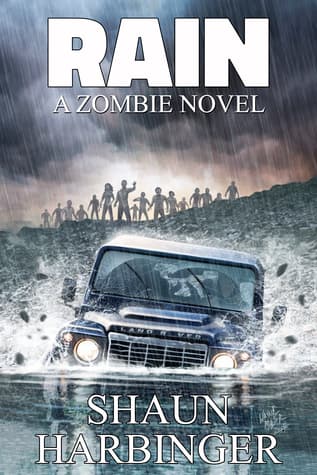
Shaun Harbinger (2014)
Genre
Science Fiction
Reading Time
380 min
Key Themes
See below
Sign in to track this book
As a deadly virus turns humanity into zombies, isolated hikers must face the undead, desperate soldiers, and a collapsing society to reach a rumored sanctuary.
Dr. Aris Thorne, a microbiologist, returns to the United States from a research trip in the remote mountains of India, unknowingly carrying a deadly, airborne pathogen. Almost immediately, people around him show strange symptoms: fever, aggression, and an insatiable hunger. The virus, later called 'The Great Rain,' spreads quickly through major cities. Initial reports are dismissed as a new flu strain, but the growing violence and reanimation of the dead soon reveal the outbreak's true, horrifying nature. Society begins to fall apart as hospitals are overwhelmed and authorities struggle to contain the pandemic.
Alex Harley, a resourceful young man, is on a hiking trip in a remote national park with his three friends: Sarah, his girlfriend; Ben, a loud but loyal friend; and Chloe, Ben's artistic girlfriend. Their trip ends abruptly when all radio and cell signals die. Eventually, their portable radio picks up a garbled Emergency Broadcast System message, warning civilians to stay indoors due to a fast-spreading contagion and civil unrest. Cut off from civilization and information, the four friends realize the seriousness of the situation. They decide their best chance for survival is to head back towards more populated areas, despite the warnings.
As Alex and his friends descend from the mountains, they see the first signs of the apocalypse: abandoned cars, ransacked stores, and eventually, the infected. Their first encounters are brutal and shocking, forcing them to quickly adapt to a world where the dead walk. Ben, initially skeptical, is traumatized after a close call. They scavenge for food, water, and weapons, realizing their survival depends on their ability to fight and outsmart the zombie hordes. Alex, with his natural leadership and practical skills, begins to take charge, making difficult decisions for the group's safety.
The United States military, under General Thorne (a distant relative of Dr. Aris Thorne), starts a drastic plan to fight the pandemic. Fortified 'Survivor Camps' are set up across the country to separate the uninfected from the infected. Broadcasts promise safety and resources within these camps, urging survivors to seek refuge. However, these camps are much grimmer than advertised, with strict martial law, scarce resources, and the constant threat of infection from within. The military's methods become increasingly authoritarian, blurring the lines between protection and oppression.
Driven by low supplies and the hope of finding a more permanent safe place, Alex, Sarah, Ben, and Chloe decide to go to a nearby city, rumored to have a functioning military-run survivor camp. Their journey through the city is full of danger. They see the full extent of the collapse: burning buildings, deserted streets with bodies, and hordes of the infected. They learn to navigate the city's abandoned infrastructure, using rooftops and sewers to avoid direct confrontation. They also encounter other desperate survivors, some of whom are more dangerous than the zombies.
After a harrowing journey, Alex and his friends arrive at 'Camp Hope,' one of the military's designated survivor zones. They are initially relieved to find shelter, food, and medical attention. However, their relief is short-lived. They quickly discover that Camp Hope is run with an iron fist by General Thorne's forces. Soldiers, often power-crazed and paranoid, enforce strict rules, and any disagreement is met with harsh punishment. Resources are tightly controlled, and the promise of safety comes at the cost of personal freedom. The friends realize their fight for survival is far from over, and a new enemy has emerged: the authorities themselves.
News of the American military's controversial methods and the dire situation reaches the international community. A United Nations rescue and relief mission, led by seasoned humanitarian workers and peacekeepers, is sent to the United States. Their arrival at Camp Hope creates immediate tension with General Thorne's forces, who resent the perceived interference. The UN mission aims to evacuate uninfected civilians to international safe zones and provide humanitarian aid. This directly challenges the military's absolute control and offers a glimmer of hope to the camp's residents, including Alex and his friends.
Within Camp Hope, Alex and his friends see the growing abuse of power by General Thorne's soldiers. They also learn of Dr. Aris Thorne's role in the virus's origin and the military's desperate attempts to find a cure, often through unethical means. Disillusioned and fearing for their lives, the group, along with a few trusted allies they've made in the camp, begins to plan an escape. Their goal is to reach the UN forces, who they believe offer a legitimate path to safety and freedom from both the infected and the tyrannical military.
Their escape plan begins during a chaotic mix of events. A massive horde of infected breaks Camp Hope's defenses, overwhelming the military. In the chaos, Alex and his group fight their way through both zombies and rogue soldiers. They confront General Thorne, who appears increasingly unstable, believing his extreme measures are the only way to save humanity. Chloe is gravely injured in the chaos. The UN forces, caught in the crossfire, struggle to maintain order and evacuate survivors, creating a desperate, multi-front battle for survival.
As the situation at Camp Hope becomes impossible, General Thorne, in a final act of desperation, starts 'Project Cleansing' – a plan to indiscriminately eliminate large areas of the infected, along with any remaining survivors, using a powerful, unrevealed weapon. Alex, Sarah, Ben, and the rest of their group, aided by the UN, manage to escape the camp just as the cleansing begins. Chloe, unfortunately, dies from her injuries. They are airlifted to a UN safe zone, leaving behind a world irrevocably changed but carrying the hope of rebuilding and a new understanding of human resilience.
The Protagonist
Transforms from an ordinary hiker into a resilient leader, adapting to a brutal new world while retaining his humanity.
The Supporting
Maintains her compassion and emotional strength amidst unimaginable horror, becoming a source of resilience for Alex.
The Supporting
Learns to channel his impulsiveness into effective action, confronting his fears and maturing through hardship.
The Supporting
Struggles to retain her humanity and sensitivity in a brutal world, ultimately becoming a tragic casualty.
The Antagonist/Mentioned
His initial scientific endeavor leads to global catastrophe, highlighting the dangers of unchecked research.
The Antagonist
Transforms from a military leader into a paranoid and ruthless dictator, driven by desperation and a distorted sense of duty.
The Antagonist
A constant, evolving threat, their increasing numbers and ferocity drive the plot and human desperation.
The novel shows how societal structures quickly fall apart after the outbreak. From initial confusion and overwhelmed hospitals to authoritarian military camps and lawless urban areas, the story explores what happens when civilization breaks down. This theme appears in the abandoned cities Alex and his friends travel through, their desperate search for supplies, and the military's shift from protection to oppression at Camp Hope, showing how quickly order can turn into chaos and tyranny.
“The broadcasts had stopped, the signals had died, and in the silence, the world had begun to scream.”
A main conflict of the story is the struggle to survive without losing one's humanity. Alex and his friends constantly face moral choices, from deciding whether to help strangers to confronting the brutal actions of other survivors and the military. General Thorne's turn to tyranny, believing extreme measures are necessary for survival, contrasts with Alex's attempts to protect his group while keeping their moral compass. The theme questions the cost of survival and what it means to be human in a monstrous world.
“We're not just fighting the dead anymore. We're fighting what the living are becoming.”
The novel looks at how authority figures respond to a global crisis and how unchecked power can corrupt. General Thorne's military, initially meant to protect survivors, quickly becomes an oppressive force within the 'Survivor Camps.' The arbitrary rules, harsh punishments, and the general's growing paranoia show the dangers of power concentrated in desperate times. The arrival of UN forces, challenging the military's absolute control, further explores the complexities of global governance and intervention during a catastrophe.
“They promised safety, but all they delivered was a different kind of prison.”
Throughout the story, characters experience deep loss – of loved ones, of their past lives, and of hope itself. Chloe's death is a clear example of the personal cost of the apocalypse. However, the story also highlights human resilience. Alex, Sarah, and Ben, despite their grief and trauma, continue to fight, adapt, and find reasons to move forward. This theme shows humanity's ability to endure great suffering and find strength in connection, even amid overwhelming despair, suggesting that even when destruction is complete, the human spirit can last.
“Every day was a goodbye, but every sunrise was a reason to keep fighting.”
A crucial, yet unreliable, source of information and a harbinger of doom.
The EBS serves as the initial, cryptic warning system for Alex and his friends, isolating them from the full scope of the disaster while simultaneously confirming their worst fears. Its intermittent and often garbled messages underscore the collapse of reliable communication and the government's struggle to control information. Later, it becomes a tool for the military to disseminate propaganda about 'Survivor Camps,' highlighting the manipulation of information in a crisis. Its eventual silence symbolizes the complete breakdown of official channels and the descent into anarchy.
Ostensibly safe havens that become oppressive military-controlled prisons.
The Survivor Camps are a significant plot device, initially presented as a beacon of hope and safety for the uninfected. However, their true nature as heavily fortified, authoritarian zones under General Thorne's control quickly becomes apparent. They serve to highlight the theme of power and control, demonstrating how a supposed sanctuary can become a new form of captivity. The camps also act as a microcosm of the larger societal collapse, showcasing the internal conflicts, desperation, and moral compromises that arise when resources are scarce and freedom is restricted.
The catalyst for the apocalypse and a constant, evolving threat.
The virus, 'The Great Rain,' is not just a disease but the central inciting incident and driving force of the plot. Its rapid spread and horrifying symptoms (reanimation of the dead) create the apocalyptic setting. It serves as a constant external threat, forcing characters to make impossible choices. The mystery surrounding its origin (Dr. Aris Thorne's research) and the military's desperate attempts to find a cure add layers of scientific and ethical conflict, making the virus a multi-faceted plot device that propels both the action and the thematic exploration of the story.
Initial isolation that delays awareness but offers a temporary reprieve.
The story begins with Alex and his friends isolated in a remote wilderness during their hiking trip. This setting serves as a device to initially shield them from the immediate chaos of the outbreak, delaying their awareness of the apocalypse. This delay allows for a build-up of tension as they slowly piece together what's happening. The wilderness also provides them with initial survival skills and a temporary, albeit false, sense of security, before they are forced to confront the full horror of the collapsed world, highlighting the contrast between nature's tranquility and humanity's destruction.
“The sky was not falling; it had already fallen, and we were just now learning to swim in the aftermath.”
— Describing the initial impact of the 'Rain' event.
“Hope is a strange currency in a world where the sun is a memory.”
— A character reflecting on the psychological toll of the perpetual twilight.
“We built our cities on the promise of tomorrow, never realizing tomorrow might be a different kind of day entirely.”
— A philosophical musing on humanity's hubris before the 'Rain'.
“The silence wasn't empty; it was full of what we had lost.”
— A character experiencing a moment of quiet reflection amidst the ruins.
“Survival isn't about strength, it's about stubbornness. About refusing to let the world win.”
— A grizzled survivor offering advice to a younger character.
“Every drop of rain was a whisper of the past, a reminder of what once was and would never be again.”
— Describing the constant, melancholic presence of the 'Rain'.
“We traded the stars for a ceiling of perpetual cloud, and in doing so, found new constellations in each other's eyes.”
— A poignant observation about finding connection in a darkened world.
“The greatest lie we ever told ourselves was that we were in control.”
— A character's realization about humanity's place in the universe.
“Even in the eternal twilight, there were shadows that danced, and in those dances, we found a fleeting joy.”
— Highlighting moments of unexpected beauty and happiness.
“The archives were not just records; they were ghosts, whispering forgotten names and lost dreams.”
— Exploring the historical records of the pre-Rain era.
“You don't truly know what light is until you've lived without it for a generation.”
— A character explaining the profound impact of the perpetual darkness.
“The new world didn't ask for permission; it simply arrived, uninvited and undeniable.”
— Reflecting on the sudden and irreversible nature of the 'Rain' event.
“We learned to measure time not by the sun's arc, but by the rhythm of the drops, each one a second in our new, unending day.”
— Describing the altered perception of time in the post-Rain world.
“What is a monster, if not a reflection of our own fear, amplified by the unknown?”
— A character contemplating the nature of the mutated creatures born from the 'Rain'.
Ready to see how well you understood this book? Take our interactive quiz with 10 questions.