“The wind is my brother, the sun my father, the earth my mother, and the stars my sisters. I am a child of them all, and they are a part of me.”
— Tecumseh's spiritual connection to nature.

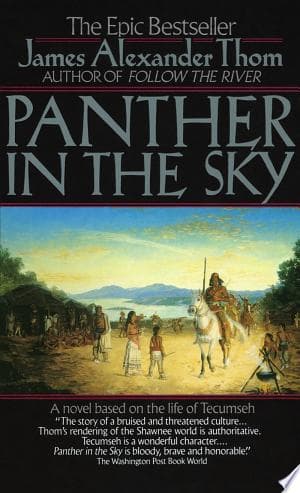
James Alexander Thom (2010)
Genre
Fiction
Reading Time
1200 min
Key Themes
See below
Sign in to track this book
Born under a shooting star, Tecumseh, the 'Panther in the Sky,' unites the Shawnee nation and leads a desperate fight to keep their ancestral lands and way of life from white settlers.
In 1768, a Shawnee woman named Turtle Mother gives birth to a boy, Tecumseh, under a streaking green-yellow comet, an 'unsoma' seen as a powerful omen. His father, Pucksinwah, a respected warrior, raises him with traditional Shawnee values. Tragedy strikes early when Pucksinwah is killed during an ambush by white settlers in the Battle of Point Pleasant. This event deeply affects young Tecumseh and fuels his growing anger towards the Americans. This loss, along with continued pressure on Shawnee lands, plants the seeds for his future dedication to resistance.
Tecumseh grows up with his younger brother, Lalawethika, later known as Tenskwatawa, 'The Prophet.' While Tecumseh focuses on hunting, warfare, and leadership, Lalawethika struggles with alcohol and a lack of purpose. Tecumseh, seeing the endless expansion of American settlers and the division among Native American tribes, begins to form his idea for a unified Native American confederacy. He believes that only by putting aside tribal differences and standing together can they resist American expansion and preserve their way of life. This idea becomes the main goal of his life.
Lalawethika has a spiritual vision after collapsing from drinking. He wakes up changed, claiming to have visited the Master of Life and received divine instructions to lead his people back to traditional ways, rejecting white goods, alcohol, and customs. He renames himself Tenskwatawa, 'The Open Door,' and preaches purification and spiritual renewal. His powerful sermons attract many followers, and he establishes Prophetstown on the Tippecanoe River. While Tecumseh supports his brother's spiritual revival to strengthen their people, he remains focused on the political and military parts of their resistance.
With Tenskwatawa's spiritual movement providing a basis for unity, Tecumseh travels across vast territories, visiting many Native American tribes, including the Wyandot, Ottawa, Potawatomi, Kickapoo, and Creek. He argues against individual land sales, stating that the land belongs to all Native Americans in common, and no single tribe has the right to sell it. He appeals to their shared history and the common threat from American expansion. His speeches and presence win over many, slowly building a fragile but growing confederacy dedicated to resisting further encroachment.
Tecumseh often confronts William Henry Harrison, the Governor of the Indiana Territory, accusing him of illegally acquiring large amounts of land through treaties signed with unrepresentative chiefs. The Treaty of Fort Wayne in 1809 especially angers Tecumseh, as it gave away three million acres of land without the consent of the broader Native American population. During a meeting at Vincennes, Tecumseh directly challenges Harrison's authority, stating his right to speak for all tribes and declaring the treaties invalid. Harrison, while impressed by Tecumseh's intelligence and resolve, remains committed to American expansion, setting the stage for conflict.
As Tecumseh is away on another mission to recruit southern tribes, Governor Harrison marches a force of over 1,000 men towards Prophetstown. Despite Tecumseh's strict orders to avoid fighting, Tenskwatawa, driven by spiritual fervor and a false prophecy of invincibility, orders an attack on Harrison's camp at dawn. The Battle of Tippecanoe is a disaster for the Native Americans. While the battle is fierce, Harrison's forces repel the attack, then burn Prophetstown. This defeat shatters the spiritual momentum of Tenskwatawa's movement and severely weakens Tecumseh's efforts at unity, causing many to question his leadership.
After the disaster at Tippecanoe, and with the War of 1812 starting between the United States and Great Britain, Tecumseh sees an opportunity. He travels to Amherstburg, Canada, and forms an alliance with Major General Isaac Brock, the British commander. Tecumseh and his warriors agree to fight with the British against the Americans, believing that a British victory would secure Native American lands and stop American expansion. This alliance gives Tecumseh needed military support and resources, revitalizing his confederacy, though it also puts him in a complex political position.
Tecumseh quickly proves himself a valuable ally to the British. His strategic skill, knowledge of the land, and ability to inspire his warriors are important in early British-Native American victories. He plays a key role in the Siege of Detroit, where his clever tactics, including having his warriors repeatedly march through a gap in the woods to make it seem like a much larger force, contribute significantly to General Brock's capture of the fort without bloodshed. Tecumseh's leadership during this time solidifies his reputation as a formidable warrior and respected commander, earning him Brock's admiration.
The alliance suffers a severe blow with the death of General Isaac Brock at the Battle of Queenston Heights. Brock's successor, Major General Henry Procter, lacks Brock's respect for Native American allies and his strategic insight. Procter's cautious and often retreating tactics frustrate Tecumseh, who believes in aggressive defense of their lands. Tecumseh often argues with Procter, urging him to stand and fight rather than abandon territory. This growing disappointment with British leadership, along with dwindling supplies and the American advance, begins to wear on Tecumseh and his remaining warriors.
As American forces under William Henry Harrison advance, Procter orders a retreat up the Thames River. Tecumseh strongly protests this decision, arguing for a decisive stand. He eventually convinces Procter to make a final defense near the Moravian town. On October 5, 1813, the Battle of the Thames begins. Tecumseh, knowing his time is short, reportedly dresses in traditional Shawnee war paint and leads his warriors with fierce courage. During the intense fighting, Tecumseh is killed, though the exact circumstances and the identity of his killer are still debated. His death marks the end of his confederacy and the dream of a united Native American resistance.
The Protagonist
Tecumseh evolves from a young warrior traumatized by loss into a powerful leader who dedicates his life to a pan-tribal resistance, ultimately sacrificing himself for his people's future.
The Supporting
He transforms from a lost alcoholic into a powerful spiritual leader, but his overconfidence and poor judgment ultimately contribute to the confederacy's downfall.
The Antagonist
Harrison consistently pursues American expansion and military dominance, ultimately achieving his goals through military victory and Tecumseh's defeat.
The Supporting
Brock establishes a strong, respectful alliance with Tecumseh, achieving significant early victories before his untimely death.
The Supporting
Procter's ineffective leadership and lack of respect for his allies lead to the weakening of the British-Native American alliance and ultimately contribute to its defeat.
The Mentioned
His early death serves as a catalyst for Tecumseh's lifelong struggle against American expansion.
The Mentioned
Her role is primarily in Tecumseh's birth and early upbringing, establishing his origins.
The Mentioned
His interpretation of Tecumseh's birth omen establishes the protagonist's destiny.
The central theme of the novel is the courageous and ongoing resistance of Native American peoples against the encroachment and injustices by white settlers and the American government. Tecumseh's entire life is an example of this struggle, from his father's death to his efforts to unite tribes against land cessions. The theme appears in Tecumseh's speeches to Harrison, his tireless journeys to rally tribes, and his ultimate sacrifice at the Battle of the Thames, all driven by the belief that his people have a right to their land and way of life.
“The Great Spirit gave this land to all the red men, and no tribe has the right to sell it, not even to each other, much less to the white man!”
Tecumseh's main idea and the driving force of his political actions is the belief that unity among Native American tribes is necessary. He understands that individual tribes are too weak to resist American expansion alone and that only a pan-tribal confederacy can present a strong challenge. This theme is clear in his difficult travels to recruit diverse tribes, his arguments against fragmented land sales, and his attempts to bridge cultural differences. The novel shows both the potential of such unity and the difficulties in achieving and maintaining it.
“A single twig breaks, but a bundle of twigs is strong.”
The novel clearly shows the devastating impact of the clash between Native American and Euro-American cultures. It presents the Shawnee's traditional, communal way of life, connected to the land and spiritual beliefs, against the individualistic, expansionist, and technologically advanced culture of the white settlers. The theme appears in the loss of land, the introduction of destructive forces like alcohol, the erosion of traditional customs, and the basic misunderstanding between the two peoples. Tecumseh's struggle is not just for land, but for the preservation of a way of life facing extinction.
“The white man's ways are like a great flood, washing away our traditions, our lands, our very souls.”
Tecumseh shows the theme of strong leadership and personal sacrifice. He is a leader who inspires loyalty, commands respect, and dedicates his entire life, including his personal comfort and safety, to his people's cause. His leadership is marked by strategic skill, moral integrity, and a firm commitment to his vision. The ultimate sacrifice he makes at the Battle of the Thames, knowing the odds are against him, highlights the depth of his devotion and the tragic weight of his responsibility. His life is an example of the burdens and nobility of true leadership.
“When a man's time comes, he must meet it. I shall not flee.”
Celestial events and spiritual visions guiding characters' destinies.
The novel frequently employs prophecies and omens to foreshadow events and deepen the spiritual context of the narrative. Tecumseh's birth under a shooting star, interpreted as an 'unsoma,' immediately marks him as a destined leader. Tenskwatawa's spiritual vision, leading to his transformation into 'The Prophet,' is another key instance. These devices not only add a mystical element to the story but also reinforce the Native American worldview, where the spiritual and natural worlds are deeply intertwined and often dictate human affairs, influencing choices and reactions to unfolding events.
Real historical individuals acting as central characters in a fictionalized narrative.
The novel centers its narrative around well-known historical figures like Tecumseh, Tenskwatawa, and William Henry Harrison. By portraying these individuals as fully fleshed-out characters with motivations, flaws, and personal relationships, Thom breathes life into historical events. This device allows for a deeper exploration of the psychological and emotional dimensions behind historical conflicts, making the complex political and military struggles more relatable and impactful. It grounds the fiction in verifiable fact while allowing for imaginative interpretation of their inner lives and dialogues.
Tecumseh's extensive travels to unite tribes.
Tecumseh's repeated and arduous journeys across vast territories to visit and persuade numerous Native American tribes serve as a significant plot device. This 'quest' motif highlights his dedication, the immense geographic scope of his vision, and the physical challenges he faces. Each journey represents a stage in the confederacy's formation, allowing the narrative to introduce different tribal perspectives and regional conflicts. It visually and metaphorically underscores the fragmentation Tecumseh strives to overcome and the sheer effort required to build unity against overwhelming odds.
Intense face-to-face meetings between Tecumseh and his adversaries.
The novel frequently features dramatic confrontations, particularly between Tecumseh and William Henry Harrison. These face-to-face meetings, such as the one at Vincennes, serve as pivotal moments of direct ideological and political clash. They allow for the articulation of opposing viewpoints, showcase Tecumseh's oratorical skills and unwavering resolve, and heighten the tension as the inevitable conflict draws nearer. These scenes are not just arguments; they are symbolic battles of wills and worldviews, driving the plot forward by clarifying stakes and solidifying character motivations.
“The wind is my brother, the sun my father, the earth my mother, and the stars my sisters. I am a child of them all, and they are a part of me.”
— Tecumseh's spiritual connection to nature.
“A man's worth is not in how much he has, but in how much he gives.”
— A reflection on true wealth and generosity.
“We are all born free, and we should live free. No man has the right to enslave another, or to take his land.”
— Tecumseh's fundamental belief in liberty and land rights.
“Unity is strength. A single twig can be broken, but a bundle of twigs is strong.”
— Tecumseh's constant plea for Native American tribes to unite.
“The white man comes with a smile and a gift, but his heart is full of lies and his hands are full of greed.”
— Tecumseh's distrust of American expansionist policies.
“My heart is a drum, beating for my people, for our land, for our way of life.”
— Expressing Tecumseh's deep devotion to his Shawnee heritage.
“A true warrior fights not because he hates what is in front of him, but because he loves what is behind him.”
— Defining the motivation of a warrior defending his home and people.
“The Great Spirit gave us this land, and it is ours to protect, not to sell or give away.”
— Tecumseh's firm stance on the communal ownership of land.
“Hope is a fire that must never be allowed to die, even in the darkest night.”
— A reflection on maintaining optimism in dire circumstances.
“To walk the path of peace, one must first understand the path of war.”
— A pragmatic view on the necessity of understanding conflict for true peace.
“The future belongs to those who believe in the beauty of their dreams.”
— A hopeful sentiment about vision and aspiration.
“My voice may be small, but it carries the echoes of many who have come before me, and many who will come after.”
— Tecumseh's sense of being a voice for his ancestors and future generations.
“The only good treaty is the one that is kept by both sides.”
— A cynical but realistic perspective on broken treaties with the Americans.
“Death is not the end, but a journey to the spirit world, where we will be reunited with our ancestors.”
— Tecumseh's belief in the afterlife and spiritual continuity.
Ready to see how well you understood this book? Take our interactive quiz with 10 questions.

Ashley Antoinette
4.6

Mark McDonald
4.4
Luo Guanzhong
4.4

Mia McKenzie
4.3

Dorothy Parker
4.3

Joaquim Maria Machado de Assis
4.3
James Thurber
4.2
Terry Kay
4.2