“We are looking for a significant other, not a perfect other.”
— Early stages of a relationship, managing expectations.

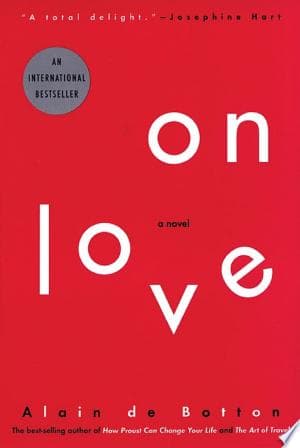
Sign in to track this book
A chance meeting on a flight turns into a love story, where every feeling and shared moment is examined through philosophy.
The story starts with Eric on a flight from Paris to London. He sits next to Chloe. Their first conversation is hesitant but quickly becomes a comfortable, intellectual exchange about their lives. Eric is drawn to Chloe's intelligence and wit, finding her attractive and engaging. They talk about their reasons for travel and their views on different subjects. By the end of the flight, they have a clear mutual interest, suggesting a future relationship. They exchange numbers, marking the start of their romantic journey.
After their first meeting, Eric and Chloe begin a fast romance. Their early days are marked by strong infatuation, where each sees the other as perfect. Eric carefully analyzes every gesture, word, and shared moment, building a perfect image of Chloe. They spend many hours together, exploring London, having deep conversations, and feeling the excitement of new love. This period has intense emotional highs, a feeling of absolute connection, and a belief they have found their soulmate, ignoring any flaws.
The early romantic phase begins to fade with their first big argument. A small disagreement about a plan or a misunderstood comment quickly grows, showing how fragile their perfect views are. Eric, used to Chloe's perceived perfection, is upset by her anger and the unfamiliar parts of her personality that appear during the conflict. This argument forces them to see that their partner is not perfect but a complex person with their own frustrations. The experience is unsettling, bringing doubt and discomfort into their once harmonious relationship.
As their relationship deepens, Chloe moves into Eric's apartment. This new stage brings both the comfort of constant closeness and the difficulties of everyday living together. The daily realities of sharing a home—chores, habits, and personal routines—test their compatibility in new ways. While they have moments of deep closeness and shared joy, they also have moments of irritation. Eric thinks about how living together shows both Chloe's delightful quirks and less appealing habits, making him reconcile the perfect image with the reality of their shared home life.
Eric begins to think about the paradox of love, specifically the tension between desire and familiarity. He notices that the initial thrill and strong longing he felt for Chloe seem to lessen as their relationship grows and they become more comfortable with each other. This realization leads to a philosophical look at whether lasting passion is possible or if it changes into a different, perhaps deeper, but less exciting form of love. He questions if the closeness that provides security also erodes the mystery that fuels initial desire, causing a subtle worry about their romantic spark.
Eric looks into how his and Chloe's past experiences affect their current relationship. He considers how previous heartbreaks, family dynamics, and personal insecurities show up in their interactions, sometimes subtly, sometimes openly. He recognizes that both he and Chloe bring emotional baggage into their shared life, which can either strengthen their bond through empathy or create unexpected problems. This self-reflection shows how love is not just about the present connection but also about understanding the echoes of the past that shape each person.
The story explores instances of jealousy and insecurity that arise in their relationship. Eric finds himself dealing with irrational fears and suspicions, often triggered by small events or perceived threats to Chloe's affection. These feelings, though often baseless, show deeper worries about self-worth and the stability of their bond. He thinks about how destructive jealousy is and the effort needed to trust and communicate openly, rather than giving in to possessive urges. These episodes test their mutual commitment and the strength of their emotional foundation.
Eric's philosophical journey leads him to question the societal pressure to achieve 'perfect' love. He criticizes the romantic ideals in literature, film, and popular culture, which often set unrealistic expectations for relationships. He struggles with the burden of trying to make his relationship with Chloe fit these unattainable standards, realizing that such a pursuit can be harmful. This introspection shows the difference between idealized romantic stories and the messy reality of human connection, leading him to a more realistic understanding of love.
After a period of growing tensions, unresolved issues, and a slow weakening of their initial connection, Eric and Chloe's relationship breaks. The cause for the final separation is not one dramatic event but a build-up of their individual struggles, different expectations, and their imperfections. The breakup is shown as inevitable, a painful but logical end to a love story that, despite its early intensity, could not last against the complexities of reality. It is a moment of deep sadness and thought for Eric.
After the breakup, Eric goes through a period of deep reflection and emotional processing. He reviews the entire course of his relationship with Chloe, analyzing their first meeting, the highs of infatuation, the lows of conflict, and the reasons for their eventual split. This time of looking back is painful but also gives important insights into love, loss, and human connection. He begins to accept the imperfections of their journey and the lessons learned, moving towards a more mature and realistic understanding of relationships, rather than holding onto perfect ideas. He acknowledges the beauty and the pain of what they shared.
The Protagonist
Eric evolves from an idealistic, analytical lover to someone with a more nuanced, realistic, and accepting understanding of love's complexities and imperfections.
The Supporting
Chloe remains somewhat static as a character in terms of her inner development, serving more as a mirror and catalyst for Eric's changing perceptions of love.
The Literary Device
The inner voice's perspective matures alongside Eric's experiences, moving from initial philosophical certainty to a more humble acceptance of love's inherent mysteries.
The novel tracks the path from the intense phase of idealization, where lovers see each other as perfect, to the inevitable realization that reality is different. Eric's early view of Chloe as flawless, a 'soulmate,' shows this. Scenes like the first argument or Chloe moving in with Eric show the friction between imperfect reality and perfect expectation. The theme suggests that real love means accepting the other's imperfections, rather than clinging to a fantasy.
“What makes love so difficult is that we expect it to be a source of happiness. But the greatest source of happiness is also the greatest source of pain.”
Alain de Botton uses Eric and Chloe's personal story to explore broader philosophical questions about love. The book is more a philosophical work on romantic relationships than a simple love story. Eric constantly analyzes his feelings, Chloe's actions, and societal expectations through different philosophical viewpoints, using ideas from psychology, sociology, and ancient philosophy. This theme appears in every chapter, as Eric's inner thoughts dissect the 'why' and 'how' of love, not just the plot's 'what'.
“To say that one is in love with love is not to say that one is in love with nothing. It is to say that one is in love with the idea of being in love, which is a powerful and very real thing.”
A main tension in the novel is the conflict between romantic expectations from culture and personal desires, and the often-messy reality of actual relationships. Eric's early belief in a 'perfect' love, without conflict or boredom, clashes with the daily routine of living together, small disagreements, and the fading of intense infatuation. This theme is explored through Eric's disappointment and his re-evaluation of what love truly means, suggesting that happiness in love comes from managing expectations and accepting imperfections.
“The problem with love is that we don't start at the beginning. We start in the middle, assuming that we know what love is, only to find out that we don't.”
The novel often shows how language shapes and sometimes distorts our understanding and experience of love. Eric analyzes words carefully, both spoken and unspoken. He dissects conversations, over-analyzes texts, and thinks about how language cannot fully capture complex emotions. The act of narration itself, with its detailed philosophical explanations, highlights this theme. It suggests that while language is essential for communication in a relationship, it also creates room for misunderstanding and the building of perfect stories.
“Language, we are told, is a tool for communication. But it is also a tool for deception, for self-deception, and for the construction of elaborate fictions.”
The book explores the natural decline of initial passionate infatuation and questions what remains to make up lasting love. Eric observes that the intense desire and excitement of the early stages inevitably give way to familiarity. This raises the question of whether love can truly last if passion fades, or if it changes into something deeper but less thrilling. The theme suggests that lasting love might be characterized by acceptance, shared history, and mutual understanding rather than constant romantic excitement.
“Perhaps it is a sign of true love not to be in love, but to be in a relationship, which is a far more complex and demanding thing.”
Extended reflections on the nature of love, psychology, and human behavior.
Instead of a straightforward narrative, the story is constantly interrupted and enriched by Eric's extensive philosophical digressions. These passages analyze the psychological underpinnings of love, drawing on various academic fields to explain emotions like infatuation, jealousy, and heartbreak. This device transforms a personal love story into a universal exploration of human relationships, providing intellectual depth and allowing the reader to understand the 'why' behind the emotional events, making the book a philosophical treatise disguised as a novel.
The entire story is filtered through the protagonist's analytical mind.
The narrative is told entirely from Eric's first-person perspective, providing direct access to his thoughts, feelings, and analytical interpretations of every event. This intense introspection allows the reader to experience the complexities of love as a deeply intellectual and emotional journey. It highlights the subjective nature of love and how personal biases, past experiences, and philosophical frameworks shape one's understanding of a relationship. Chloe is primarily understood through Eric's lens, emphasizing the internal, reflective nature of the book.
The narrator often explains and teaches about the mechanics of love.
The narrative frequently adopts a didactic, almost instructional tone, particularly during the philosophical digressions. Eric doesn't just experience love; he explains it, breaking down its components, historical context, and psychological effects. This device serves to educate the reader on de Botton's theories about love, making the book function as both a novel and a self-help guide or philosophical essay. It directly addresses common misconceptions about love and offers alternative, often more realistic, perspectives on romantic relationships.
The initial meeting on a flight symbolizes the transient and unpredictable nature of love.
The opening scene on an airplane, where Eric and Chloe meet, serves as a powerful symbolic device. A flight is a liminal space, a temporary journey between two points, detached from everyday life. This setting symbolizes the initial, almost suspended reality of new love – a period of intense connection that feels removed from the mundane world, yet is ultimately transient. It suggests that love, like a flight, has a beginning, a middle, and an end, and is subject to unexpected turbulence and eventual landing.
“We are looking for a significant other, not a perfect other.”
— Early stages of a relationship, managing expectations.
“The problem with love is that we imagine it to be a destination, rather than a journey.”
— Reflecting on the ongoing effort in a long-term relationship.
“We fall in love when we are ready to be, not when the perfect person arrives.”
— Examining the subjective and internal readiness for love.
“To be loved for what one is, is the greatest of all human desires.”
— Discussing the fundamental need for acceptance in love.
“Every new love, we hope, will be the love that finally makes us whole.”
— Exploring the often unrealistic hopes projected onto new partners.
“The greatest enemy of love is not hate, but indifference.”
— Highlighting the corrosive effect of apathy in relationships.
“We are all broken, that's how the light gets in.”
— A poignant reflection on imperfection and vulnerability in love.
“Love is a skill, not just an emotion.”
— Emphasizing the active and learned aspects of maintaining love.
“To understand is to forgive.”
— On the importance of empathy and understanding in resolving conflict.
“The tenderest thing in the world is love, and the toughest is to be in love.”
— Contrasting the sweetness of love with its inherent difficulties.
“We suffer in love not because we are bad, but because we are human.”
— Normalizing the pain and challenges inherent in romantic relationships.
“The test of love is not to see how long it lasts, but how well it endures the times when it almost doesn't.”
— Defining resilience as a key aspect of lasting love.
“Perhaps love is not about finding the right person, but about learning to see an imperfect person perfectly.”
— A profound redefinition of love, focusing on perspective and acceptance.
“The greatest pleasure in love is that of being desired.”
— Reflecting on the validating and intoxicating feeling of being wanted.
Ready to see how well you understood this book? Take our interactive quiz with 10 questions.

Alain de Botton is a Swiss-born British author and philosopher. His books discuss various contemporary subjects and themes, emphasizing philosophy's relevance to everyday life. He published Essays in Love (1993), which went on to sell two million copies. Other bestsellers include How Proust Can Change Your Life (1997), Status Anxiety (2004) and The Architecture of Happiness (2006).

Ashley Antoinette
4.6

Mark McDonald
4.4
Luo Guanzhong
4.4

Mia McKenzie
4.3

Dorothy Parker
4.3

Joaquim Maria Machado de Assis
4.3

James Thurber
4.2

Terry Kay
4.2