“Ah! I have guessed it! He has no heart! He has no heart!”
— Delphine de Nucingen's realization about Rastignac's cold ambition.


Honore De Balzac (2020)
Genre
Fiction
Reading Time
240 min
Key Themes
See below
Sign in to track this book
In 19th-century Paris, an old father sacrifices everything for his ungrateful daughters, while a young student tries to climb the city's ruthless social ladder.
In November 1819, the story begins at the Pension Vauquer, a Parisian boarding house run by Madame Vauquer. It houses various people, including elderly Jean-Joachim Goriot, a former pasta maker; the mysterious Vautrin; and young, ambitious law student Eugene de Rastignac. Eugene, from a poor aristocratic family, hopes to conquer Parisian society. He quickly sees the social dynamics and how residents are treated. Goriot, once rich, is now mocked, having seemingly spent his fortune on his two married daughters, Delphine de Nucingen and Anastasie de Restaud, who rarely visit him.
Eugene de Rastignac gets a letter from his cousin, Vicomtesse de Beauséant, a prominent figure in Parisian high society. He visits her and enters the glittering world of the aristocracy, where he meets Countess Anastasie de Restaud. Struck by her beauty and lavish life, Eugene is quickly charmed and decides to join this exclusive circle. However, his first attempts to court Anastasie are met with a cold response when he innocently mentions her father, Goriot, showing he doesn't know the social shame tied to the old man. This teaches Eugene a hard lesson about strict class distinctions and the ruthless nature of Parisian high society.
Watching Eugene's struggles and ambitions, Vautrin, the mysterious and experienced resident of the Pension Vauquer, teaches him about the world. Vautrin, a master manipulator, explains that real success in Paris requires ruthlessness, not virtue. He suggests a plan: Eugene should court Victorine Taillefer, another resident, whose wealthy father disinherited her for her brother. Vautrin offers to arrange for Victorine's brother to die in a duel, making Victorine the sole heir and, by extension, giving Eugene a fortune through marriage. Eugene is at first disgusted but also tempted by this easy path to wealth.
Eugene, through his connections, starts to understand the tragic extent of Goriot's fatherly love. He learns that Goriot made himself poor to provide dowries and support his two daughters, Delphine and Anastasie, in their aristocratic lives. Despite his sacrifices, both daughters treat him with disrespect, embarrassed by his humble origins and presence. They only seek him out when they need money or help with their own financial troubles and affairs. Eugene sees Goriot's deep suffering and his unwavering, almost obsessive, love for his ungrateful children, a love that blinds him to their cruelty.
Eugene decides to pursue Delphine de Nucingen, Goriot's younger daughter, after his cousin advises him. Delphine, married to a rich but stingy banker, longs for social acceptance and a better place in society. Eugene becomes her lover, hoping to use her connections to improve his own standing. Goriot, overjoyed that one of his daughters has found a suitor who truly cares for her (or so he thinks), moves into an apartment near theirs, sacrificing his last comforts to help furnish their new home. This brings Goriot a brief period of happiness, as he can be closer to Delphine, even if through Eugene.
The police, alerted to Vautrin's true identity as Jacques Collin, a master criminal known as 'Trompe-la-Mort' (Daredevil), arrive at the Pension Vauquer. Eugene, warned by a police informant, tries to alert Vautrin but is too late. Vautrin is drugged and arrested in a dramatic scene, revealing his true, dangerous nature to the shocked residents. His arrest breaks the pension's fragile peace and exposes the hidden underside of Parisian society, confirming his earlier cynical statements about crime and corruption. His capture temporarily removes a powerful, corrupting influence from Eugene's life.
As Goriot's health steadily worsens, made worse by his constant worries about his daughters' financial troubles and social standing, his daughters remain mostly uncaring. They are too busy with their own affairs – Anastasie's debts from her lover Maxime de Trailles and Delphine's desire for social advancement – to truly care for their sick father. Goriot, increasingly weak and poor, sells his last possessions to give them money, even as they refuse to visit him. Eugene, seeing this deep neglect, is deeply disturbed by their heartlessness and starts to feel more responsible for the old man.
Goriot's condition gets much worse, and he starts to suffer from delirium, calling for his daughters. Eugene desperately sends messages to Delphine and Anastasie, urging them to visit their dying father. However, they send excuses, choosing a ball and their own social events over their father's last moments. Goriot dies in poverty and despair, his final words a complaint about his daughters' ingratitude. Only Eugene and his medical student friend, Bianchon, are present for his death and funeral. Eugene, deeply affected by Goriot's tragic end, is left to arrange a pauper's burial for the old man.
After Goriot's lonely death and humble funeral, Eugene stands overlooking Paris from Père Lachaise cemetery. Seeing Goriot's deep suffering and his daughters' coldness leaves a lasting impression on him. He feels grief, disappointment, and a new, hardened resolve. He understands the brutal realities of Parisian society and vows to conquer it, but on his own terms, perhaps with a more cynical understanding of its workings. He says the famous line, 'À nous deux, maintenant!' (It's between you and me now!), directly challenging the city and its corrupting influences.
Immediately after Goriot's burial, Eugene attends a ball hosted by Madame de Beauséant, a final symbolic act of leaving the old world behind and embracing the new. This act shows his strong ambition and commitment to moving up the social ladder, even after recent tragedy. The novel ends with Eugene's first dinner with Delphine de Nucingen, confirming his relationship with her and his entry into the high society he so desperately wants. This final scene marks the start of Eugene de Rastignac's long and hard journey to power and influence in the unforgiving world of Parisian aristocracy, forever changed by the lessons from Old Man Goriot.
The Protagonist/Tragic Figure
Goriot begins as a ridiculed figure, gradually revealing the depth of his selfless love, and ultimately dies a heartbroken, abandoned man, a victim of his own devotion.
The Protagonist
Eugene transforms from an innocent, ambitious provincial into a hardened, cynical, but determined social climber, vowing to conquer Paris after witnessing Goriot's tragic end.
The Antagonist/Corrupting Force
Vautrin maintains his cynical worldview throughout, attempting to corrupt Eugene, and is ultimately unmasked as a criminal and arrested.
The Supporting
Delphine remains largely static, driven by her social ambition, and continues to neglect her father even on his deathbed.
The Supporting
Anastasie remains self-absorbed and neglectful, her actions directly contributing to her father's demise.
The Supporting
Madame Vauquer remains a static character, primarily concerned with her finances and the social standing of her pension.
The Supporting
The Vicomtesse serves as Eugene's initial guide, eventually becoming a cautionary tale of social vulnerability, and then retreats from society.
The Supporting
Bianchon remains a steadfast, morally upright friend to Eugene, representing a contrasting path to success through honest work.
The novel clearly shows how seeking wealth and social status corrupts people and relationships. Goriot's daughters abandon him for their social positions, while Eugene is constantly tempted to compromise his morals for advancement. Vautrin explains this theme, arguing that crime is simply a faster way to the same goals as 'legitimate' social climbing. Parisian society, from the shabby Pension Vauquer to the glittering salons, is driven by money and the desire for recognition, often at the cost of human decency and family ties. Goriot's sacrifice of his fortune directly causes his daughters' ingratitude and his own death.
“Crime has its heroes and its victories, like virtue itself.”
This is the novel's main tragic theme, shown by Old Man Goriot. His love for his daughters is endless and self-sacrificing; he gives them everything he owns. In return, they treat him with contempt, neglect, and exploitation, seeing him only as a source of money. Their ingratitude is a sharp criticism of the moral decay in the upper classes. Goriot's suffering highlights the terrible results of one-sided love and children abandoning parental duty to prioritize social standing. His dying moments, calling for his absent daughters, summarize this heartbreaking theme.
“Ah! if I were rich, if I had kept my fortune, I should have them here, they would fawn on me, they would cover me with kisses!”
Balzac carefully examines the complex and often brutal social hierarchy of 19th-century Paris. The novel exposes the superficiality, snobbery, and ruthless competition that define social interactions. Appearances are everything, and moral integrity is often sacrificed for reputation and position. The aristocratic world, as seen by Eugene and the Vicomtesse de Beauséant, is a battleground where people must constantly scheme and betray to survive. The contrast between outward glamour and inner corruption is a repeating idea, showing a society built on lies and self-interest. Goriot being shunned once his fortune is gone exemplifies this.
“You will never get anywhere if you do not have a woman to protect you.”
Eugene de Rastignac's journey is a deep look at this theme. He arrives in Paris with youthful idealism but quickly faces the harsh realities of a corrupt world. He sees Goriot's tragedy, experiences Vautrin's cynicism, and navigates the manipulative dynamics of high society. Each encounter forces him to lose some innocence and consider moral compromises. While he never fully gives in to Vautrin's outright criminality, he learns to play the social game, becoming more calculating and less scrupulous. His final challenge to Paris, 'À nous deux, maintenant!', shows his acceptance of this changed, hardened self.
“Paris is a vast field perpetually ravaged by storm, where there is no mercy for the fallen.”
Detailed depiction of 19th-century Parisian society across all classes.
Balzac employs extensive social realism, meticulously describing the Pension Vauquer, the opulent aristocratic salons, and the bustling streets of Paris. He populates these settings with characters from various social strata, from the impoverished student to the wealthy banker and the notorious criminal, providing a panoramic view of society. This detailed portrayal creates a vivid and believable backdrop against which the human dramas unfold, allowing the reader to understand the specific pressures and opportunities that shape the characters' lives. The physical environment often mirrors the moral state of its inhabitants.
Characters who highlight the traits of others through contrast.
The novel effectively uses foil characters to deepen the understanding of its protagonists. Vautrin, with his cynical and amoral philosophy, serves as a dark foil to Eugene's initial idealism, highlighting the moral choices Eugene faces. Goriot's boundless, self-sacrificing love stands in stark contrast to the cold, calculating ambition of his daughters, emphasizing their ingratitude. Bianchon, Eugene's honest and hardworking friend, acts as a moral compass, providing an alternative path to success that contrasts with Eugene's increasingly compromised journey into society. These contrasts illuminate the central themes of the novel.
Money as a driving force and a measure of worth and power.
Money is a pervasive symbol throughout the novel, representing not just wealth but also power, social status, and even love. Goriot's fortune is directly tied to his daughters' affection (or lack thereof), and his impoverishment correlates with his abandonment. Eugene's ambition is largely driven by the desire for money to gain social acceptance. The constant financial struggles of characters like Anastasie and Delphine highlight how money dictates their choices and moral compromises. The detailed accounts of financial transactions underscore its role as the ultimate arbiter of fate in this society.
Eugene's moral and social education as he navigates Parisian society.
Old Man Goriot functions as a bildungsroman, focusing on Eugene de Rastignac's psychological and moral growth. He arrives in Paris as a naive, ambitious young man and, through his experiences at the Pension Vauquer and in high society, undergoes a profound transformation. He learns about the harsh realities of the world, the corrupting influence of ambition, and the true nature of love and betrayal. His journey from innocence to a hardened, cynical understanding of society marks his 'coming of age' in a world where survival often requires moral compromise. Goriot's tragedy is central to Eugene's education.
“Ah! I have guessed it! He has no heart! He has no heart!”
— Delphine de Nucingen's realization about Rastignac's cold ambition.
“Paris is a veritable ocean. You may cast a line into it and never know what you're going to pull up.”
— Vautrin's cynical description of Parisian society and its opportunities.
“Behind every great fortune lies a great crime.”
— Vautrin's dark aphorism about the origins of wealth.
“Happiness is like a ball that we throw, and which, after having bounced, returns to us.”
— Madame de Beauséant reflecting on the nature of happiness and loss.
“The more coldly you calculate, the more surely you will succeed.”
— Vautrin's advice to Rastignac on how to navigate society.
“If you want to get on, you must make a friend of some rich man, and then you must marry his daughter.”
— Madame de Beauséant's pragmatic advice to Rastignac.
“He who makes himself a worm cannot complain afterwards if people tread on him.”
— Vautrin's commentary on those who lack ambition or assertiveness.
“There are no such things as principles; there are only events; there are no such things as laws, there are only circumstances.”
— Vautrin's relativistic view on morality and justice.
“The greatest pleasure of love is the pleasure of loving.”
— A more romantic sentiment, contrasting with much of the novel's cynicism, perhaps from a character like Madame de Beauséant or related to Goriot's pure love.
“A father's love is an immense thing.”
— A central theme of the novel, reflecting Goriot's boundless love for his daughters.
“When a man has no money, he can do nothing.”
— Rastignac's early realization about the power of wealth in Paris.
“To succeed, you must act as if you have no soul, no heart, no conscience.”
— An echo of Vautrin's or Madame de Beauséant's cynical advice to Rastignac.
“The world is a comedy to those who think, a tragedy to those who feel.”
— A philosophical observation about different perspectives on life, applicable to many characters.
“Tears are the opium of the heart.”
— A reflection on the temporary relief or indulgence of sorrow.
Ready to see how well you understood this book? Take our interactive quiz with 10 questions.
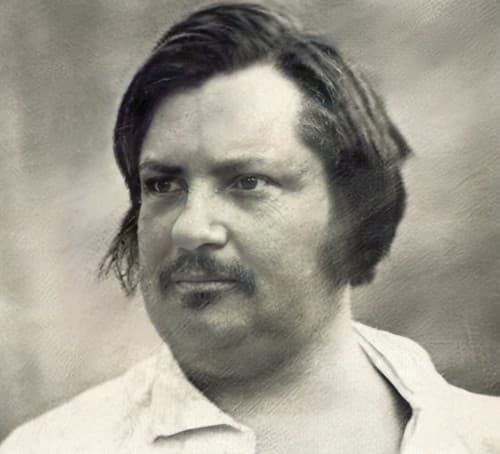
Honoré de Balzac was a French novelist and playwright. The novel sequence La Comédie humaine, which presents a panorama of post-Napoleonic French life, is generally viewed as his magnum opus.

Ashley Antoinette
4.6

Mark McDonald
4.4
Luo Guanzhong
4.4

Mia McKenzie
4.3
Dorothy Parker
4.3

Joaquim Maria Machado de Assis
4.3

James Thurber
4.2

Terry Kay
4.2