“Alas, how terrible is wisdom when it brings no profit to the man that has it!”
— Tiresias speaks this to Oedipus after Oedipus insults his prophetic abilities.

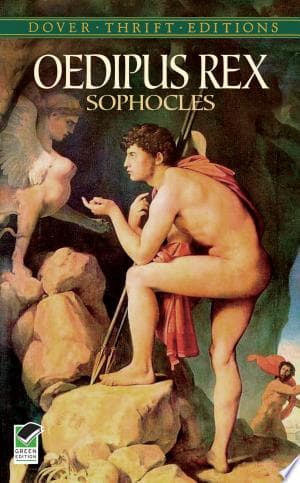
Sign in to track this book
A king's relentless search for truth to save his city reveals the horrific prophecy he unknowingly fulfilled, uncovering his identity as both murderer and incestuous son.
The play opens in Thebes, where a devastating plague is destroying the city. Citizens, led by a priest, ask King Oedipus for help, reminding him of his past success in solving the Sphinx's riddle. Oedipus, already aware of the suffering, says he has sent his brother-in-law, Creon, to the Oracle of Apollo at Delphi for a solution. Creon returns with the Oracle's message: the plague will end only when the murderer of the former king, Laius, is found and expelled from Thebes. Oedipus is horrified by the news. He promises to find the killer, vowing to curse and banish anyone who hides the culprit, even himself if he is involved.
Oedipus, eager to keep his promise, calls the blind prophet Tiresias, known for his prophetic gifts. At first, Tiresias is reluctant to speak, sensing the painful truth. Oedipus, growing frustrated and angry, accuses Tiresias of either being the murderer himself or conspiring with him. Provoked by Oedipus's insults and accusations, Tiresias eventually reveals the shocking truth: Oedipus is the one defiling Thebes, the murderer of Laius, and living in incestuous sin with his mother. Oedipus dismisses these claims as madness and a conspiracy by Creon, refusing to believe the prophet and further enraging Tiresias.
After Tiresias's pronouncements, Oedipus's paranoia grows. He confronts Creon, accusing him of plotting to overthrow him and seize the throne. Oedipus believes Creon manipulated Tiresias to make false accusations. Creon, deeply offended, defends his loyalty, arguing that he holds significant power without the burdens of kingship and has no desire for the throne. Their argument escalates, with Oedipus threatening Creon's life. Queen Jocasta, Oedipus's wife and Creon's sister, steps in to calm the conflict, urging Oedipus to consider Creon's words and not act rashly based on baseless suspicions.
To reassure Oedipus and dismiss the unsettling prophecies, Jocasta recounts an old prophecy given to Laius. The prophecy stated that Laius would be killed by his own son. To prevent this, Laius and Jocasta left their infant son on a mountainside, his ankles pinned. Laius was later killed by robbers at a place where three roads meet. Jocasta emphasizes that Laius was killed by many, not one, and that their son died as an infant, seemingly proving that prophecies are unreliable and can be avoided. However, her description of the location and manner of Laius's death deeply troubles Oedipus, stirring a growing fear within him.
Jocasta's description of Laius's murder, especially the detail of the crossroads, terrifies Oedipus. He clearly remembers an incident from his youth when, fleeing Corinth after hearing a prophecy that he would kill his father and marry his mother, he met an arrogant old man and his group at a crossroads. A dispute over right-of-way became a violent fight, and Oedipus killed the old man and his attendants. The details of the location and the number of people killed match Jocasta's account of Laius's death, causing Oedipus to wonder if he might be the murderer.
Overwhelmed by his increasing fear, Oedipus immediately sends for the only surviving witness to Laius's murder: a shepherd who worked in Laius's household. This shepherd reported that Laius was killed by a group of robbers, not a single person, a detail that has comforted Oedipus. Oedipus hopes that the shepherd's testimony will clear his name by confirming multiple attackers, thus disproving his involvement. Jocasta, though uneasy, supports the decision, hoping for a clear answer that will ease Oedipus's mind.
Before the shepherd arrives, a messenger from Corinth appears, bringing news that King Polybus, Oedipus's presumed father, has died of natural causes. This initially brings relief to Oedipus, as it seems to contradict the prophecy that he would kill his father. However, the messenger then reveals a deeper truth: Polybus and Merope were not Oedipus's biological parents. The messenger, a former shepherd himself, explains that he received Oedipus as an infant from another shepherd on Mount Cithaeron, his ankles pierced and bound, and then gave him to Polybus, who adopted him. This revelation shatters Oedipus's understanding of his identity.
As the messenger from Corinth recounts the details of Oedipus's adoption and discovery, Jocasta slowly puts together the horrifying truth. The pierced ankles, the location on Mount Cithaeron, the two shepherds — it all matches the story of her own abandoned infant son and the prophecy given to Laius. Realizing that Oedipus is her son and her husband, and thus Laius's murderer, she is overcome with despair. She frantically tries to stop Oedipus from seeking the truth further, but he misunderstands her pleas as fear for his humble origins. Distraught, Jocasta rushes into the palace and hangs herself.
The old Theban shepherd, the only survivor of Laius's attack and the one who gave the infant Oedipus to the Corinthian messenger, finally arrives. Oedipus, now desperate for the full truth, presses him for information. The shepherd is at first reluctant to speak, fearing the consequences. Under Oedipus's threats of torture, the shepherd confesses that he indeed gave an infant, marked by pierced ankles, to the Corinthian shepherd. He reveals that the infant was the son of Laius and Jocasta, given to him by Jocasta herself with instructions to abandon him and prevent the prophecy from coming true. The shepherd's confession confirms Oedipus's worst fears.
Upon hearing the shepherd's full confession, Oedipus understands the horrifying reality: he has killed his father, Laius, and married his mother, Jocasta, fulfilling the very prophecy he tried to escape. Overwhelmed by the monstrous truth and the weight of his unwitting crimes, Oedipus rushes into the palace. He finds Jocasta's body, hanging by her neck. In a fit of profound grief and self-loathing, he takes the golden brooches from her gown and uses them to gouge out his own eyes. He declares that he no longer wishes to see the world, his family, or the horrors he has committed.
A bleeding, blinded Oedipus emerges from the palace, lamenting his fate and the tragic fulfillment of the prophecy. Creon, now in charge, approaches him with pity. Oedipus, accepting his guilt and the Oracle's decree, begs Creon to banish him from Thebes and send him to die on Mount Cithaeron, where he was originally meant to perish. He also asks Creon to look after his daughters, Antigone and Ismene. Creon agrees to banish Oedipus but states he must first consult with the gods, asserting his newfound authority and emphasizing the importance of divine will.
The Protagonist
Oedipus begins as a confident, revered king, but as he uncovers his true identity, he descends into despair, self-mutilation, and ultimately, banishment.
The Supporting
Jocasta moves from a position of confident dismissal of prophecy to a horrified realization of its fulfillment, culminating in her tragic suicide.
The Supporting
Creon endures false accusations and rises to become the compassionate but firm ruler of Thebes after Oedipus's downfall.
The Supporting
Tiresias, initially hesitant, forcefully reveals the devastating truth, acting as the voice of inescapable fate.
The Supporting
The Chorus moves from hopeful reverence for Oedipus to sorrowful despair at his tragic fate, reflecting the city's changing fortunes.
The Supporting
The messenger unintentionally catalyzes Oedipus's discovery of his true parentage, shifting from a bringer of 'good' news to an agent of truth.
The Supporting
The Shepherd, initially withholding information out of fear, is forced to reveal the final, devastating truths of Oedipus's parentage and patricide.
The Mentioned
Laius's attempt to evade prophecy ironically sets in motion the very events that lead to its fulfillment.
The Mentioned
Antigone, along with her sister, becomes a symbol of the tragic consequences of Oedipus's fate, destined for a difficult life.
A central theme is the futility of human attempts to escape divine prophecy. Both Laius and Oedipus take extreme measures to avoid prophecies of patricide and incest. Yet, their actions inadvertently lead to the fulfillment of these prophecies. Laius's abandonment of his son causes Oedipus to be raised elsewhere, only to return and kill his biological father. Oedipus's flight from Corinth, meant to avoid killing Polybus, leads him directly to Laius. The play suggests that some destinies are predetermined by the gods and cannot be changed by human will, showing humanity's limited control over its own life.
“''You are all sick, each man of you, but sick as you are, not one is sick as I.''”
This theme explores the paradox of physical sight versus metaphorical insight. Tiresias, the physically blind prophet, has true knowledge and foresight. Oedipus, initially sighted, is metaphorically blind to the truth of his origins and actions. Oedipus's determined search for the truth, despite his initial 'blindness' to it, leads him to literally blind himself once he fully 'sees' his horrific reality. The play suggests that sometimes ignorance can be a form of bliss, and true knowledge can bring unbearable suffering, making literal blindness a fitting punishment for his unwitting transgressions.
“''You have your eyes, but see not where you are, nor what you are, nor what you live with.''”
Oedipus's downfall is largely due to his excessive pride, or hubris. He is initially shown as a confident and capable ruler, but his overconfidence leads him to dismiss Tiresias's prophecies, accuse Creon unjustly, and believe he can outsmart fate. His pride in his intellect, which solved the Sphinx's riddle, makes him unwilling to accept any truth that challenges his self-perception or authority. This hubris stops him from listening to warnings and considering other possibilities, ultimately driving him towards his tragic discovery and self-mutilation. This shows that even the greatest leaders are vulnerable to human flaws.
“''I came, I stopped the Sphinx, I hold the power.''”
The play raises complex questions about moral responsibility when one commits heinous acts unknowingly. Oedipus is technically innocent by intent, as he was unaware of his family relations when he killed Laius and married Jocasta. However, he is still held accountable for the acts themselves, and the consequences are devastating. The plague afflicting Thebes results directly from his 'unclean' presence, emphasizing that the gods judge actions regardless of intent. This explores whether guilt is solely a matter of conscious wrongdoing or if the objective consequences of one's actions also determine culpability, especially in a world governed by divine law.
“''I am by birth a Theban, and no stranger to the tale of Laius.''”
Oedipus's relentless and admirable pursuit of the truth, driven by his desire to save Thebes and his own curiosity, is a powerful force in the play. Despite warnings from Tiresias and Jocasta, he insists on uncovering every detail, believing that knowledge, no matter how painful, is better than ignorance. This quest, while noble, leads him to a horrifying self-discovery that shatters his identity and world. The play illustrates that while the pursuit of truth is a fundamental human drive, it can also lead to unbearable suffering and destruction, especially when that truth reveals a reality too terrible to comprehend.
“''I must know it all, whatever it is. I will not be dishonored.''”
The audience is aware of crucial information that the characters are not.
Dramatic irony is pervasive throughout 'Oedipus Rex'. The audience knows from the outset, or at least very early on through Tiresias's prophecies, that Oedipus is the murderer of Laius and husband of his mother. This creates a constant tension as Oedipus, full of righteous indignation and determination, vows to uncover the killer and curses him, unknowingly cursing himself. Every step he takes towards 'solving' the mystery only tightens the noose around his own neck, making his pronouncements and actions tragically ironic and deeply poignant for the knowing audience.
Divine pronouncements that foretell future events.
Prophecy is a fundamental plot device, initiating and driving the entire narrative. The Oracle's prediction that Laius would be killed by his son leads to the exposure of infant Oedipus. Later, the Delphic Oracle's declaration that Oedipus would kill his father and marry his mother causes him to flee Corinth. Finally, the Oracle's demand that Laius's murderer be found to end the plague sets Oedipus on his relentless, self-destructive quest for truth. Prophecy establishes the inescapable nature of fate and serves as the catalyst for all major character decisions and plot developments.
The moment a character makes a critical discovery.
Anagnorisis is the pivotal moment of recognition for Oedipus, occurring incrementally but culminating in the shepherd's confession. Initially, Oedipus recognizes a disturbing similarity between Jocasta's account of Laius's death and his own past actions. The Corinthian messenger's revelation of his adoption then provides a crucial piece. The final anagnorisis happens when the Theban shepherd confirms that Oedipus is the infant he abandoned, the son of Laius and Jocasta. This recognition transforms Oedipus from an ignorant king into a man fully aware of his horrific identity and crimes, triggering his tragic self-blinding.
A sudden and unexpected reversal of circumstances for the protagonist.
The play is structured around a profound peripeteia. Oedipus begins as a revered and powerful king, a savior of Thebes, confident in his abilities and destiny. His investigation, intended to bring justice and save his city, instead leads to a complete and devastating reversal of his fortune. He discovers he is the very plague-bringer he seeks, a patricide and incestuous husband, transforming from a celebrated hero into a reviled, self-mutilated outcast. This swift and total downfall exemplifies the classical Greek concept of peripeteia, highlighting the fragility of human prosperity.
“Alas, how terrible is wisdom when it brings no profit to the man that has it!”
— Tiresias speaks this to Oedipus after Oedipus insults his prophetic abilities.
“You are the murderer whom you seek.”
— Tiresias directly accuses Oedipus of Laius's murder.
“No man loves the messenger who brings bad news.”
— The messenger from Corinth is hesitant to deliver the news of Polybus's death and the truth of Oedipus's parentage.
“For time, which sees all things, has found you out.”
— The Chorus reflects on the unfolding truth and Oedipus's inability to escape his fate.
“Count no mortal happy till he has passed the final goal of life free from pain.”
— The Chorus offers this concluding thought on Oedipus's tragic downfall.
“Oh, oh, oh, they will all come out now! Light, let me look upon you no more! I am by birth a man of shame, by marriage a shameful husband, by motherhood a shameful son!”
— Oedipus laments his true identity and the horrifying revelations.
“Ah, what misery to be wise when wisdom profits nothing!”
— This is another translation of Tiresias's lament about his prophetic burden.
“I have been a stranger here in my own land; but I shall not be a stranger to my own fate.”
— Oedipus reflects on his past and accepts his destiny after the truth is revealed.
“The greatest griefs are those we cause ourselves.”
— Creon speaks this to Oedipus, highlighting the self-inflicted nature of Oedipus's suffering.
“Fear not, for even if I am a slave, I have a right to speak.”
— The old shepherd, initially reluctant, asserts his right to speak the truth to Oedipus.
“Blind, though you are, you see what misery haunts your house.”
— Oedipus, ironically, says this to Tiresias, foreshadowing his own blindness.
“How dreadful it is to see the truth, when the truth is suffering!”
— The Chorus reflects on the pain that comes with knowledge.
“Thus I will save myself, and save the city.”
— Oedipus declares his intention to find Laius's murderer at the beginning of the play, ironically sealing his own doom.
“What man can say that he is happy, if he has not known sorrow?”
— A philosophical reflection on the nature of happiness and suffering, often attributed to the Chorus.
Ready to see how well you understood this book? Take our interactive quiz with 10 questions.
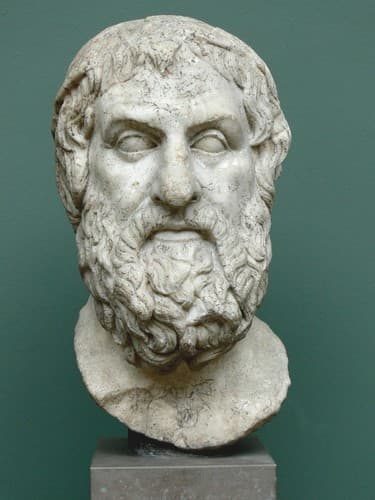
Sophocles was an ancient Greek tragedian, known as one of three from whom at least one play has survived in full. His first plays were written later than, or contemporary with, those of Aeschylus; and earlier than, or contemporary with, those of Euripides. Sophocles wrote over 120 plays, but only seven have survived in a complete form: Ajax, Antigone, Women of Trachis, Oedipus Rex, Electra, Philoctetes and Oedipus at Colonus. For almost fifty years, Sophocles was the most celebrated playwright in the dramatic competitions of the city-state of Athens which took place during the religious festivals of the Lenaea and the Dionysia. He competed in thirty competitions, won twenty-four, and was never judged lower than second place. Aeschylus won thirteen competitions, and was sometimes defeated by Sophocles; Euripides won four.

Ashley Antoinette
4.6

Mark McDonald
4.4
Luo Guanzhong
4.4

Mia McKenzie
4.3

Dorothy Parker
4.3
Joaquim Maria Machado de Assis
4.3

James Thurber
4.2

Terry Kay
4.2