BookBrief
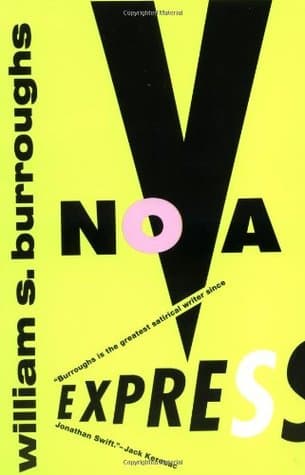
Nova Express cover
Archivist's Choice

Nova Express

William S. Burroughs (1964)

Genre

Science Fiction

Reading Time

180 min

Key Themes

See below

Track Your Reading

Sign in to track this book

In a universe where psychic parasites prey on humanity, Inspector Lee of the Nova Police must dismantle the reality-warping word machine of the Nova Criminals before they unleash ultimate destruction.

Synopsis

The Nova Mob, a group of intergalactic criminals including Sammy The Butcher and Iron Claws, is causing chaos across the universe. They use a "word and imagery machine" to control minds and manipulate reality. Their ultimate goal is to accelerate the universe towards total destruction, a "Universal Scrap Heap," by exploiting the desires and weaknesses of sentient beings. They turn these beings into beasts through various forms of addiction and control. Inspector Lee of the Nova Police, along with other agents, begins a desperate mission to dismantle the Nova Mob's operations. Lee's strategy involves understanding and countering the Mob's power: the 'virus of language' and the manipulation of perception and reality itself. The story follows Lee's fragmented, non-linear investigation, exposing the Mob's origins and their methods of control. This leads to a confrontation to prevent the complete collapse of existence, though the threat of the Nova Mob and their destructive influence always remains.
Reading time
180 min
Difficulty
Hard
Pacing
Variable
Mood
Surreal, Disorienting, Anarchic, Dark, Experimental
✓ Read this if...
You enjoy experimental, non-linear narratives, surrealist science fiction, and challenging literary works that deconstruct language and reality.
✗ Skip this if...
You prefer traditional plot structures, clear character arcs, and straightforward science fiction stories.

Plot Summary

Introduction to the Nova Mob

The novel begins by showing the main conflict: the Nova Police, led by Inspector Lee, are getting ready to stop the Nova Mob, intergalactic criminals who want to control the universe. The Nova Mob, including figures like Sammy The Butcher, Green Tony, and Izzy The Push, uses 'word and image' machines to control and distort reality. They trap sentient beings in cycles of addiction and control. Inspector Lee and his allies see these criminals not just as lawbreakers but as parasites feeding on existence itself. The first parts set a chaotic, fragmented tone, typical of Burroughs' cut-up technique, immediately putting the reader into a disorienting fight for reality.

The Nature of the Nova Express

Burroughs explains the 'Nova Express' itself. This is not a physical train but a metaphor for how the Nova Mob spreads its control. It is a system of addiction, language, and viral information that spreads like a disease, taking over minds and bodies. The Nova Mob uses various 'control addicts' and 'reality engineers' to carry out their plans, which involve hijacking human perception and creating false realities. The text describes this process with many metaphors, often grotesque, linking it to drug addiction, sexual perversion, and the subtle nature of mass media and political talk. Inspector Lee's mission is an attempt to free the universe from this widespread influence.

Confrontation with the Nova Criminals

The story moves through a series of fragmented encounters and conceptual battles between the Nova Police and members of the Nova Mob. These are not typical shootouts but rather ideological and linguistic confrontations. Inspector Lee uses his own 'word-and-image' weapons, trying to disrupt the Mob's control by exposing their lies and breaking down their constructed realities. Characters like The Brown Artist and Jacky Blue Note are shown as architects of these false realities, using art and sound to enslave populations. The battles are often depicted as psychic or informational warfare, with the goal being to free perception rather than to win physically.

The Virus of Language

A main focus is on language as a virus, a core part of Burroughs's philosophy. The Nova Mob does not just use language; they are language, or rather, the parasitic parts of it that hijack consciousness. They spread 'word-viruses' that infect and control individuals, turning them into extensions of the Mob's will. Inspector Lee's counter-strategy involves 'cut-ups' and 'fold-ins' – literary techniques meant to break the linear, controlling stories imposed by the Mob. By disrupting syntax and meaning, Lee aims to free minds from the predetermined thought patterns put in place by the Nova Criminals, allowing new, unscripted realities to appear.

Exposing the Nova Mob's Origin

Inspector Lee and his allies investigate the history and origins of the Nova Mob. They find them to be ancient, parasitic entities that have always tried to control life. They are shown as a cosmic virus, a harmful force that came before humanity and has caused countless cycles of destruction and enslavement across the universe. Their methods are adaptable, appearing in different forms throughout history, from religious dogma to political propaganda. This exploration adds a cosmic horror element to the conflict, suggesting that the fight against the Nova Mob is a struggle against an inherent flaw in existence itself, or at least, a deeply ingrained pattern of control.

The Nature of Reality and Perception

Throughout the story, Burroughs questions the idea of objective reality. He suggests that what humans see as real is often a carefully built illusion, a 'soft machine' designed to keep them docile and controllable. The Nova Mob are the ultimate builders of these illusions, but the novel also hints that humans help in their own enslavement by accepting these fabricated realities without question. Inspector Lee's mission becomes less about physical fighting and more about waking people up to how arbitrary their perceived world is. He encourages them to break free from the 'control addicts' who profit from their ignorance. The cut-up technique itself shows this idea in action.

The Role of Addiction and Control

Addiction is a widespread theme, presented not just as a physical need but as a metaphor for all forms of control. The Nova Mob thrives on creating and exploiting addictions – to drugs, sex, power, fame, and even specific thought patterns or emotional states. They are 'control addicts' themselves, getting their energy from the control they have over others. Inspector Lee realizes that breaking these cycles of addiction is essential to defeating the Mob. The novel suggests that true freedom comes from detoxifying not just the body, but the mind and spirit, from all outside sources of control and manipulation. This allows individuals to reclaim their own will.

The Nova Police's Counter-Offensive

Inspector Lee and his Nova Police force develop increasingly experimental methods to fight the Nova Mob. These include not just the cut-up technique, but also 'silence' and 'word-deletion' as weapons, aiming to create empty spaces where the Mob's controlling language cannot exist. They try to expose the Mob's operations by making 'reality-film' documentaries that show the underlying control mechanisms. The strategies are often non-linear and focus on disrupting the Mob's patterns rather than directly attacking them. The goal is to make their parasitic existence impossible by removing the consensual reality they depend on.

The Universal Scrap Heap

The climax of the conceptual battle shows the Nova Mob's ultimate goal: to reduce the entire universe to a 'universal scrap heap' – a sterile, controlled environment where all creativity, spontaneity, and independent thought are removed. They want absolute stillness, a reality where they are the only ones operating, feeding on the remains of life. This vision is deeply nihilistic and represents the ultimate win of control over freedom. Inspector Lee's fight is thus a defense of chaos, unpredictability, and the very potential for newness against a force that wants to end all evolution and turn existence into a predetermined, lifeless script.

The End Game and Lingering Threat

While the story does not have a clear, traditional 'ending,' it implies a conceptual victory for Inspector Lee and the Nova Police in disrupting the Nova Mob's immediate operations. However, the novel suggests that the 'Nova Express' is not a single entity that can be completely destroyed, but rather a pervasive, almost eternal principle of control inherent in the universe. The fight is continuous, a constant struggle against the forces that want to enslave consciousness. The final sections leave the reader understanding that staying watchful against 'control addicts' and the manipulation of reality is an ongoing, vital task, even if the immediate threat has been stopped.

Principal Figures

Inspector Lee

The Protagonist

Lee begins as an investigator and evolves into a conceptual warrior, constantly adapting his methods to combat the ever-changing tactics of the Nova Mob.

Sammy The Butcher

The Antagonist

Sammy remains a consistent force of destruction, serving as a recurring symbol of the Mob's unyielding cruelty.

Green Tony

The Antagonist

Tony's role is to demonstrate the pervasive, almost invisible nature of the Nova Mob's influence, remaining a constant, subtle threat.

Iron Claws

The Antagonist

Iron Claws remains a symbol of the Mob's entrenched power, a formidable obstacle for the Nova Police.

The Brown Artist

The Antagonist

The Brown Artist consistently illustrates how creativity can be perverted for control, serving as a recurring example of artistic manipulation.

Jacky Blue Note

The Antagonist

Jacky Blue Note highlights the sonic dimension of control, demonstrating the Mob's ability to manipulate through non-visual mediums.

Izzy The Push

The Antagonist

Izzy The Push consistently embodies the direct role of the Nova Mob in fostering addiction and dependency across the universe.

The Nova Police

The Supporting

The Nova Police collectively work to dismantle the Nova Mob, their methods constantly evolving to combat new forms of control.

Themes & Insights

Control and Addiction

This is the main theme, shown through the Nova Mob's efforts to enslave the universe using 'word and image' machines. Burroughs argues that all forms of control — political, social, psychological, and even linguistic — act like addiction. The Nova Mob are 'control addicts' themselves, continuing cycles of dependency. The novel suggests that real freedom comes from breaking these cycles, as seen in Inspector Lee's attempts to 'detoxify' minds from the Mob's influence by disrupting their controlling narratives and showing how manipulation works. The very structure of the Nova Express is built on exploiting weaknesses and encouraging reliance.

The Nova Mob is not human. It is a virus. It is the human virus.

Narrator

The Virus of Language

Burroughs proposes that language itself can be a virus, a tool for control rather than pure communication. The Nova Mob manipulates reality by infecting minds with 'word-viruses,' specific phrases and concepts that limit thought and perception. Inspector Lee's 'cut-up' technique directly counters this, aiming to break the linear, controlling patterns of language to free consciousness. The novel shows how rhetoric, propaganda, and even everyday speech can be used to build false realities and keep individuals enslaved. This highlights the power of words to shape, or distort, understanding. It suggests that liberation begins with deconstructing the language that holds us captive.

Language is a virus from outer space.

Narrator

Reality as a Construct

The novel constantly questions what objective reality is, suggesting that what we see as real is often a carefully built illusion or a 'soft machine' designed by outside forces. The Nova Mob are the ultimate builders of these false realities, using their technology to create and maintain illusions that serve their agenda. Inspector Lee's mission is to expose these constructs, showing how arbitrary and manipulative perceived reality is. This theme encourages readers to critically examine their own perceptions and the stories they are given, promoting skepticism towards 'truth' presented by authority figures or mass media.

Your reality is a soft machine, an image machine, a dream machine.

Narrator

The Nature of Evil and Parasitism

The Nova Mob is shown not just as criminals, but as a parasitic, almost cosmic evil that feeds on sentient life and consciousness. They are an ancient force, an inherent flaw in existence that wants to reduce all life to a sterile, controlled state. Their evil is not born of human malice, but of an insatiable drive for absolute control and the elimination of spontaneity. This theme explores the idea of a fundamental, almost biological, drive for domination, showing how such forces can appear in various forms throughout history, from political tyranny to the subtle manipulations of culture.

The Nova Mob are the ultimate control addicts, feeding on all forms of life.

Narrator

Plot Devices & Literary Techniques

The Cut-Up Technique

A literary method of deconstructing text to reveal hidden meanings or create new ones.

Burroughs famously employs the cut-up technique throughout the novel, where existing texts are physically cut into pieces and rearranged to form new narratives. This device is not just a stylistic choice but a thematic one: it mirrors Inspector Lee's efforts to dismantle the Nova Mob's 'word and image' machines. By breaking linear narratives and predetermined meanings, the cut-up technique aims to expose the underlying control mechanisms embedded in language and media, allowing for new, unscripted realities to emerge and freeing the reader's perception from programmed thought patterns. It is both a weapon against control and a method of creation.

Word and Image Machines

Conceptual devices used by the Nova Mob to control and manipulate reality.

These are not literal machines but metaphors for the systems of language, media, and propaganda that the Nova Mob uses to generate and control reality. They function by creating and disseminating 'word-viruses' and 'image-viruses' that infect consciousness, shaping perceptions, desires, and beliefs. The 'Nova Express' itself is the ultimate word and image machine, constantly broadcasting controlling narratives. This device highlights Burroughs' belief that modern society is heavily manipulated by pervasive, often invisible, systems that dictate what people see, hear, and think, thereby enslaving them to a fabricated reality.

Metaphorical Characters

Characters who embody abstract concepts or functions of control.

Many characters in Nova Express, particularly the members of the Nova Mob (e.g., Sammy The Butcher, The Brown Artist, Jacky Blue Note), function less as traditional individuals and more as personifications of specific forms of control, addiction, or manipulation. Sammy represents brute force, The Brown Artist represents aesthetic control, and Jacky Blue Note represents sonic manipulation. This device allows Burroughs to explore complex abstract ideas through tangible, albeit grotesque, figures, making the pervasive and multifaceted nature of the Nova Mob's influence more comprehensible and impactful. They are less psychological portraits and more symbolic representations of universal forces.

Non-Linear Narrative

A fragmented and disjointed storytelling approach that reflects the chaotic nature of reality.

The novel deliberately eschews a traditional linear plot in favor of a fragmented, kaleidoscopic narrative. This non-linear structure, often a result of the cut-up technique, mirrors the chaotic and unstable nature of the reality the Nova Mob creates. It also forces the reader to actively participate in constructing meaning, rather than passively receiving a predetermined story. This device serves to disorient and challenge the reader's assumptions about narrative and reality, immersing them in the very disjunctive experience Inspector Lee is trying to combat, thereby reinforcing the theme of reality as a malleable construct.

Critical analysis

Notable Quotes

The Nova Mob is a self-perpetuating, parasitic organism. It feeds on all forms of life and its ultimate aim is to reduce the universe to a state of total passivity.

Describing the overarching antagonist, the Nova Mob, and their destructive agenda.

Your mind is a looking glass. You only see what you are looking for.

A philosophical observation on perception and subjective reality.

Language is a virus from outer space.

A famous line, expressing Burroughs' view of language as an invasive, controlling entity.

Cut the word lines. Cut the image lines. Cut the control lines.

A recurring imperative, advocating for the dismantling of various forms of control and conditioning.

The Earth is a Nova Express terminal. All passengers are subject to random searches and seizures.

Suggesting Earth's role as a controlled point within a larger, oppressive system.

When you think of the Nova Mob, think of the ultimate in parasitic organizations. They don't just want your money, they want your thoughts, your feelings, your very being.

Elaborating on the depth of the Nova Mob's control and exploitation.

Rub out the word. Rub out the image. Rub out the sound. Rub out the human.

A more extreme version of the 'cut' command, suggesting total annihilation of control mechanisms.

The Nova Express is not a train or a rocket. It is a method of control, a way of moving time and space.

Defining the 'Nova Express' not as a physical object but as a conceptual tool of manipulation.

This is a war of the wills. A struggle for control of reality itself.

Framing the central conflict as a metaphysical battle over the nature of existence.

You can't fight the Nova Mob with conventional weapons. You have to use their own techniques against them.

Advising on the unconventional methods required to combat the pervasive enemy.

The human nervous system is an open city. The Nova Mob can walk in any time they like.

Highlighting the vulnerability of human consciousness to external manipulation.

All out for Nova Express! All out for total control!

A chilling slogan representing the ultimate goal of the Nova Mob.

The Nova Mob exists in the space between words, in the silence of thought, in the gaps of perception.

Suggesting the insidious and intangible nature of the enemy's presence.

The only way out is through. The only way to win is to become the enemy and then destroy yourself.

A radical and self-destructive philosophy for overcoming the ultimate oppressor.

Quiz

Test Your Knowledge

Ready to see how well you understood this book? Take our interactive quiz with 10 questions.

10
Questions
~5
Minutes
?
Best Score

Key Questions (FAQ)

'Nova Express' escalates the dystopian conditions introduced in 'The Soft Machine' by presenting a universe where the Nova Criminals have already seized significant control. The novel focuses on Inspector Lee's mission to dismantle their 'word and imagery machine,' which is the mechanism through which they exert their parasitic influence and enslave humanity through addiction and control.

About the author

William S. Burroughs

William Seward Burroughs II was an American writer and visual artist, widely considered a primary figure of the Beat Generation and a major postmodern author who influenced popular culture and literature. Burroughs wrote eighteen novels and novellas, six collections of short stories and four collections of essays, and five books have been published of his interviews and correspondences; he was initially briefly known by the pen name William Lee. He also collaborated on projects and recordings with numerous performers and musicians, made many appearances in films, and created and exhibited thousands of visual artworks, including his celebrated "Shotgun Art".