“I don't hate men, I hate myself.”
— Julie's internal struggle and self-loathing.

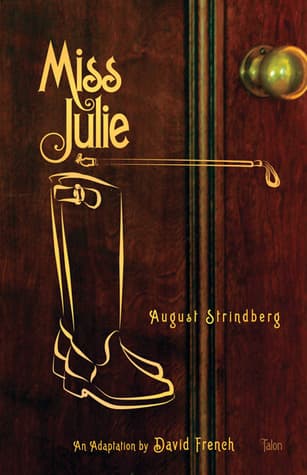
Sign in to track this book
On a single Midsummer's Eve, the aristocrat Miss Julie and her father's valet, Jean, start a class and gender struggle that leads to a devastating end.
The play starts in the Count's kitchen on Midsummer's Eve. Kristin, the cook, fries food and talks with Jean, the valet. She mentions Miss Julie's wild behavior, especially her dancing with the gamekeeper and acting below her station. Kristin disapproves of Julie's flirtation. Jean, though he pretends indifference, is aware of Julie's actions and subtly fascinated. He also hints at his own ambitions and desire to rise.
Miss Julie enters the kitchen, dressed festively, and immediately interacts with Jean. She is lively and capricious, aiming to provoke him. She demands he dance with her, despite his reluctance and Kristin's disapproval. Kristin leaves to change for church. Julie questions Jean's feelings, teases him, and dares him to drink beer. Their conversation is full of double meanings and power plays. Julie tries to assert her dominance but also seeks a closer connection. Jean subtly resists and manipulates her.
Kristin, now changed, returns to the kitchen and sees Julie and Jean's growing flirtation. She is uncomfortable and tries to intervene, warning Julie about the impropriety and potential scandal. Kristin also distrusts Jean, but Julie, caught in the thrill, ignores her. Before leaving for church, Kristin makes a final plea for Julie to be careful, but Julie dismisses her, asserting her freedom. Kristin's departure leaves Julie and Jean alone.
Alone, Julie and Jean's interactions intensify. Julie talks about her troubled past, her mother's unconventional upbringing, and her engagement to a fiancé she humiliated. Jean shares his dreams of social ascent, including a childhood fantasy of entering the Count's house and a story about seeing Julie as a child, which he claims sparked his desire. Their talk shifts between attraction and class conflict. Julie, feeling vulnerable and drawn to Jean's perceived strength, allows herself to be seduced. Their passionate encounter happens offstage, implied by a brief absence and a change in their mood.
As dawn breaks, Julie and Jean return to the kitchen. Their initial post-coital excitement is gone, replaced by shame, fear, and blame. Julie is horrified, recognizing the damage to her reputation and social standing. Jean, initially triumphant, becomes pragmatic and calculating. His dreams of rising seem closer but also bring complications. Julie is desperate to escape, suggesting they run away and start a new life, perhaps by opening a hotel. Jean focuses on practicalities and dangers, especially the Count's imminent return.
Julie, clinging to the idea of escape, suggests they take her canary, a symbol of her innocence. Jean, seeing the bird as a burden, coldly decapitates it, horrifying Julie. This act shatters Julie's remaining illusions about Jean and their future. Her despair deepens. She sees Jean's cruelty and the unbridgeable class divide. The incident shows Jean's ruthless ambition and his inability to understand Julie's emotional fragility.
Kristin returns from church and finds Julie and Jean in the kitchen, their disheveled state and the dead canary revealing the night's events. Kristin, devout and moral, is appalled. She denounces their actions, especially Julie's, as sinful and shameful, citing her religious beliefs. Kristin refuses to help with any escape plan and expresses loyalty to the Count. Her condemnation further isolates Julie, who is already in despair. Kristin acts as a moral compass, showing the societal and religious norms Julie and Jean have broken.
The sound of the Count's bell ringing upstairs signals his return. This immediately affects Jean, who snaps back into his role as loyal valet. All his bravado, ambition, and intimacy with Julie disappear. He begins preparing the Count's boots and coffee, his demeanor completely changed. Julie, seeing this transformation, realizes her situation is hopeless. Jean, her lover and co-conspirator moments before, is now a distant servant, leaving her alone. The class hierarchy reasserts itself with brutal force.
Overwhelmed by shame, guilt, and the ruin of her life, Miss Julie falls into deep despair. She begs Jean for a command, a way out, admitting she cannot think or act for herself. Jean, still under the influence of the Count's bell and social order, and perhaps protecting himself, suggests she take her own life. He describes a dream he had of climbing a tree and seeing her there, subtly manipulating her and placing a razor in her hand. His words and actions are a perverse form of control, pushing her to self-destruction.
With the razor in her hand and Jean's suggestions in her mind, Miss Julie is broken. She expresses a desire for freedom and peace, succumbing to her shame and hopelessness. She asks Jean to command her, and he repeats the suggestion of suicide. Julie, in a trance, leaves the kitchen. The play ends with Jean, back in his role, awaiting the Count's orders. The audience infers Julie's suicide, the tragic result of her defiance of social norms and her disastrous encounter with Jean.
The Protagonist
Julie descends from a position of aristocratic power and playful flirtation to utter despair and presumed suicide, completely undone by her transgression of social norms and her encounter with Jean.
The Antagonist/Supporting
Jean briefly rises in power and intimacy with Julie, only to revert to his subservient role, having used Julie for his own gain while maintaining his social position.
The Supporting
Kristin remains steadfast in her values and social position, serving as a moral anchor and ultimately rejecting the chaos brought by Julie and Jean's transgression.
The Mentioned
The Count's unseen authority remains absolute, serving as the unchanging backdrop against which the characters' struggles unfold.
The play explores the rigid class distinctions of 19th-century Sweden and the conflict between aristocracy and the working class. Miss Julie, despite her birth, is trapped by her position and destroyed when she crosses its boundaries. Jean, a servant, wants to rise but is bound by his station, returning to servility at the sound of the Count's bell. Kristin shows the stability and resignation of the working class. The play shows how class dictates behavior, opportunities, and destiny, making a true connection across the divide impossible, seen in Jean's cruelty to Julie after their transgression.
“A servant is a servant... I'm only a servant, and I can't think of anything but your master's boots.”
Strindberg examines power dynamics between men and women, especially in Victorian society. Miss Julie, raised to be 'half-woman, half-man' by her mother, struggles with her sexuality and identity, leading to her downfall. She tries to dominate Jean but ultimately falls to his manipulative power. Jean, despite his lower social status, gains control over Julie through his assertiveness and cunning. The play highlights the vulnerability of women, particularly those who defy traditional roles, in a patriarchal society, and the destructive results of such defiance, as Julie is left with suicide after her 'fall'.
“You are a woman, and a woman always falls.”
The play explores how heredity and environment influence character. Miss Julie's erratic behavior and fragility are linked to her mother's unconventional upbringing and her parents' dysfunctional marriage. Her mother's feminist ideals and dislike of men contributed to Julie's internal conflicts. Jean attributes his ambition and cunning to his working-class background and drive to overcome his circumstances. The play suggests that individuals are largely products of their birth and upbringing, with little ability to escape predetermined fates, leading to fatalism, especially in Julie's tragic end.
“That's what comes of letting women bring up children.”
Desire, both sexual and social, is a destructive force in the play. Miss Julie's desire for excitement, for connection outside her class, and for sexual liberation leads her to Jean. Jean's desire for social advancement and for Julie fuels his manipulative actions. This passion is predatory and destructive, not romantic. The brief, intense encounter between Julie and Jean shatters Julie's world and reveals the harsh realities of their incompatible desires and social positions. Their passion is a transgression that brings only shame, despair, and ultimately, death for Julie.
“I feel as if I were falling, falling... down, down, down...”
A strong sense of fatalism runs through 'Miss Julie'. From the start, characters seem driven by forces beyond their control – heredity, social class, and innate drives. The Midsummer's Eve setting, a time of ancient rituals and heightened emotions, adds to this sense of inevitable destiny. Julie's downfall feels predetermined, a tragic result of her birth, upbringing, and unyielding societal structures. Jean's actions, while cunning, also follow a predictable pattern for a lower-class man seizing an opportunity. The play suggests that humans are largely powerless against the combined forces of biology, psychology, and social order.
“It's awful! But there's no way out.”
An offstage sound that symbolizes patriarchal authority and the rigid class system.
The Count's bell is a powerful auditory symbol throughout the play. It signals the unseen Count's presence and demands, instantly forcing Jean back into his subservient role, regardless of his prior actions or ambitions. For Miss Julie, it represents the inescapable power of her father and the social order that ultimately crushes her. Its ringing at the climax underscores the reassertion of hierarchy and the finality of Julie's downfall, acting as a hypnotic command for Jean and a death knell for Julie's hopes of escape.
A traditional folk holiday that creates an atmosphere of heightened emotion, transgression, and blurred boundaries.
The setting of Midsummer's Eve, a night of revelry, superstition, and ancient pagan traditions, serves as a crucial plot device. It provides a natural justification for the servants to be celebrating and for Miss Julie to be more unrestrained than usual, blurring the lines of social propriety. This atmosphere of heightened emotion and temporary freedom allows the transgression between Julie and Jean to occur. It also adds a sense of fatefulness and inevitability to the events, as if the characters are acting under the influence of ancient, uncontrollable forces, rather than purely rational decisions.
Miss Julie's pet bird, symbolizing her innocence, fragility, and her last connection to her former life.
Miss Julie's canary represents her last vestige of innocence, her connection to her privileged past, and her emotional vulnerability. When she insists on taking it with them as they plan to escape, it highlights her naiveté and her inability to grasp the harsh realities of their situation. Jean's brutal act of decapitating the bird is a pivotal moment: it shatters Julie's remaining illusions about him, reveals his cruel and pragmatic nature, and symbolizes the complete destruction of Julie's former life, innocence, and any hope of a gentle future.
A recurring metaphorical image used by Jean to manipulate Julie and suggest her predetermined fate.
Jean recounts a dream of climbing a tall tree and seeing Julie lying at its base. This dream serves multiple functions. Initially, it's a romanticized memory of his childhood fascination with Julie. Later, it becomes a powerful, almost hypnotic, tool of manipulation. When Julie is in despair, Jean uses the image of her falling from a height and lying dead to subtly suggest suicide, effectively planting the idea in her mind. The tree itself can be seen as a symbol of the social hierarchy, with Julie at the top and Jean aspiring to climb, and her eventual 'fall' from it.
“I don't hate men, I hate myself.”
— Julie's internal struggle and self-loathing.
“The rich are always right.”
— Kristin's cynical observation about social hierarchy.
“You're a woman, and I'm a man. That's the difference.”
— Jean's assertion of traditional gender roles.
“It's horrible how one's will dissolves away.”
— Julie's feeling of losing control and agency.
“A servant is a servant.”
— Kristin's resigned acceptance of her social standing.
“If I can only get out of here, I'll go to Rome, buy a villa, and become a count.”
— Jean's ambitious dreams of social climbing.
“You are my enemy.”
— Julie's direct confrontation with Jean.
“Love is a game, and the one who plays best wins.”
— Julie's cynical view on romantic relationships.
“I've seen the world, and I know what it is.”
— Jean's claim of worldly experience.
“It's not good to think too much.”
— Kristin's pragmatic, anti-intellectual stance.
“The air is heavy with sin.”
— Julie's perception of moral decay and guilt.
“I'm not a man, I'm a lackey.”
— Jean's moment of self-awareness about his subservient role.
“We are all tied to the wheel.”
— Julie's sense of inescapable fate and societal constraints.
“There are no secrets between us anymore.”
— After their intimacy, revealing a new dynamic between Julie and Jean.
Ready to see how well you understood this book? Take our interactive quiz with 10 questions.

Johan August Strindberg was a Swedish playwright, novelist, poet, essayist and painter. A prolific writer who often drew directly on his personal experience, Strindberg wrote more than sixty plays and more than thirty works of fiction, autobiography, history, cultural analysis, and politics during his career, which spanned four decades. A bold experimenter and iconoclast throughout, he explored a wide range of dramatic methods and purposes, from naturalistic tragedy, monodrama, and history plays, to his anticipations of expressionist and surrealist dramatic techniques. From his earliest work, Strindberg developed innovative forms of dramatic action, language, and visual composition. He is considered the "father" of modern Swedish literature and his The Red Room (1879) has frequently been described as the first modern Swedish novel. In Sweden, Strindberg is known as an essayist, painter, poet, and especially as a novelist and playwright, but in other countries he is known mostly as a playwright.

Ashley Antoinette
4.6

Mark McDonald
4.4
Luo Guanzhong
4.4

Mia McKenzie
4.3

Dorothy Parker
4.3

Joaquim Maria Machado de Assis
4.3

James Thurber
4.2

Terry Kay
4.2