“Every now and then he would get a job, but he never kept it for long. He was a poet, he said, and poets did not work.”
— About B. Wordsworth, the enigmatic poet.

V. S. Naipaul (2000)
Genre
Fiction
Reading Time
240 min
Key Themes
See below
Sign in to track this book
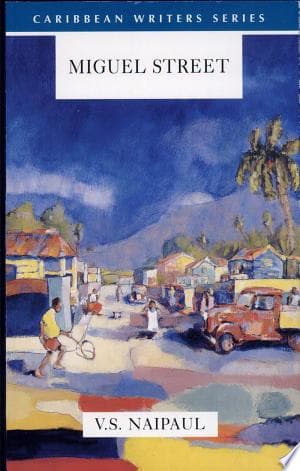
In Miguel Street, a boy grows up among Trinidadian neighbors during World War II, learning about their quirks and dreams in a 'slum' full of individual stories and a strong love for life.
The young, unnamed narrator grows up on Miguel Street and introduces Bogart. Bogart is a quiet man with mysterious habits, often sitting on his porch, watching the street. He is known for his strange statements and his seemingly aimless life. Neighbors guess about his past, some believing he was once rich, others seeing him as a philosopher. The narrator tells how Bogart would sometimes disappear for long times, only to return without explanation, making him more mysterious. His quiet presence sets a tone of observation and oddness for the street's residents.
Hat is a showy character on Miguel Street, known for his careful grooming and his idea of being a 'fancy-man.' He spends his life looking good, wearing stylish clothes, and keeping up a certain image, often ignoring practical duties. The narrator watches Hat's many romantic relationships and his attempts to impress women. But Hat's life worsens when he gets involved in selling illegal goods, leading to his arrest and time in jail. This experience deeply affects how he sees himself and his 'fancy-man' identity, showing how easily his constructed image can break when faced with harsh reality.
George is introduced as a quiet, modest man, very different from the louder people on Miguel Street. He is a hard worker and a family man, seemingly happy with his daily life. However, the street is shocked when George gets into a brutal fight with another man over a small issue. The fierceness and unexpectedness of his violence leave a lasting impression on the narrator and other residents. This event shows the hidden depths and unpredictable nature of even the most ordinary people, challenging the street's ideas about George's character and revealing a darker side beneath his calm outside.
Popo is an artist on Miguel Street, though his art often meets with doubt and jokes from his neighbors. He spends his days working with different materials, making sculptures and other objects that are rarely finished or understood. His wife, a practical and outspoken woman, constantly complains about his lack of a steady job and his impractical art. The narrator observes Popo's dedication to his art despite money troubles and his wife's disapproval. Popo's story explores the conflict between artistic passion and what society expects, as he deals with pressure to live a more conventional life while holding onto his creative dreams.
Laura is a well-known person on Miguel Street, known for her many marriages and the large number of children she has with different fathers. The narrator details her various relationships, each ending with a new husband and often more children. Laura's life is a constant cycle of new starts and departures, as she tries to find stability and happiness. Her story highlights the social norms and difficulties faced by women in the community, especially regarding marriage and family. Despite her unconventional family life, Laura remains tough, dealing with her complex relationships with a mix of practicality and deep emotion.
Man-man is perhaps the strangest character on Miguel Street. He believes he is the second Christ, a delusion that leads him to perform odd rituals and make wild statements. The narrator recounts Man-man's antics, including his attempts to convert others and his announcement of running for election. His behavior is a source of both amusement and confusion for the residents. Eventually, Man-man's delusions grow, ending in an incident where he throws stones at cars, leading to him being put in an institution. His story is a sad and funny look at mental illness and the community's different reactions to those who do not fit in.
The narrator becomes close with B. Wordsworth, a kind and thoughtful poet who lives in a small, run-down house. B. Wordsworth claims to be writing the 'greatest epic poem of the world,' which he describes as a thousand-page work about the life of a single bee. The narrator spends time with him, learning about his creative process and his ideas on life and art. B. Wordsworth eventually disappears, leaving only a single, unfinished poem. His story is about unfulfilled artistic ambition and the sad side of dreams, deeply influencing the young narrator's understanding of creativity and loss.
Titus Hoyt sees himself as the smart person of Miguel Street. He is a schoolteacher who constantly tries to introduce the residents to 'culture,' often through public readings of Shakespeare or talks about books. However, his efforts are mostly met with disinterest or jokes by the street's practical inhabitants. The narrator observes Titus's serious but often misguided attempts to enlighten his neighbors, showing the gap between his academic pursuits and the reality of Miguel Street life. His story is a funny comment on intellectual showiness and the challenges of forcing outside values on a self-contained community.
As the narrator gets older, he shows a strong talent for school, always doing well. His intelligence and hard work set him apart from many other children on Miguel Street, and his teachers see his potential. This academic success begins to open up opportunities beyond the street, suggesting a future different from that of the adults he observes. The narrator's growing intellect allows him to analyze and understand the lives around him with increasing detail, fueling his desire for knowledge and a broader understanding of the world, hinting at his eventual departure.
After finishing school in Trinidad with high marks, the narrator gets a scholarship to study abroad. This important decision marks his leaving Miguel Street, the only home he has known. The goodbyes are bittersweet, as he leaves behind the strange characters and familiar rhythms of the street that shaped his childhood. His departure means a move from innocence to experience, from a small world to a larger one. The final scene highlights the idea of escape and the bittersweet feeling of leaving one's origins, even as the memories and lessons of Miguel Street remain a lasting part of his identity.
The Protagonist
Starts as a naive observer, grows into a discerning chronicler, and ultimately leaves Miguel Street to pursue education and a broader world.
The Supporting
Remains largely static, his mysterious nature serving as a constant backdrop for the street's other dramas.
The Supporting
Experiences a fall from grace, losing his 'fancy-man' status after being imprisoned, leading to a more subdued existence.
The Supporting
Remains dedicated to his art despite constant criticism and financial hardship, never fully achieving recognition.
The Supporting
Repeatedly marries and has children, demonstrating resilience and a pragmatic approach to life's challenges.
The Supporting
His delusions escalate, leading to his institutionalization, a sad end to his eccentric public life.
The Supporting
Mentors the narrator and then mysteriously disappears, leaving his great poem unfinished, symbolizing the ephemeral nature of dreams.
The Supporting
Continues his attempts to educate and enlighten, largely without success, remaining a figure of good-natured ridicule.
Many characters on Miguel Street have big dreams that never come true, showing the difference between what they want and what happens. Popo dreams of being a great artist but struggles to finish his work and get noticed, always nagged by his practical wife. B. Wordsworth spends his life writing the 'greatest epic poem,' but disappears, leaving only a small piece. Even Hat's dream of being a perpetual 'fancy-man' breaks when he goes to jail. These stories together show the sad truth of dreams in a world where practical matters often outweigh artistic or personal goals, as seen in the narrator's observations of Popo's unfinished sculptures and B. Wordsworth's bee poem.
“You see, a writer writes about what he knows. And I know about love, and I know about bees.”
The idea of escape is central, mainly seen in the narrator's journey away from Miguel Street. While many residents are happy or resigned to their lives on the street, the narrator's success in school and growing awareness of a bigger world make him want to leave. This desire for a wider world is not just about moving but also about growing intellectually and personally. His eventual departure symbolizes breaking old patterns and seeking new chances, a clear contrast to characters like Bogart who seem forever tied to the street. The narrator's final trip abroad represents the ultimate escape from the isolated world of Miguel Street.
“I felt that I had been there too long, and that I was seeing the same things over and over again.”
Characters on Miguel Street often create detailed identities for themselves, sometimes bordering on self-deception, to deal with their lives. Hat carefully builds his 'fancy-man' image, believing it defines him, only for it to fall apart when he faces legal trouble. Man-man's belief that he is the second Christ is an extreme example of an imagined identity, leading to sad results. Even Titus Hoyt's self-appointed role as the street's intellectual savior speaks to a made-up identity that does not quite fit reality. These stories explore how people create and maintain their sense of self, often defying outside circumstances, and how these identities are challenged or kept within the community, as the narrator observes their often-fragile appearances.
“He was a fancy-man, and that was all he wanted to be.”
Miguel Street itself is a lively, self-contained community defined by its collection of unique characters. The street tolerates, watches, and sometimes judges its special inhabitants, forming a small version of society. Characters like Bogart, Man-man, and Popo, with their peculiar habits and beliefs, are not just individuals but main parts of the street's overall identity. The community's reactions to these oddities—from amusement to pity to occasional help—show the complex ways people accept or exclude others. The narrator's stories show how these different people, despite their differences, are connected by their shared space and their roles within the street's unique world, forming a rich collection of human experiences.
“A stranger could drive through Miguel Street and just say 'Slum!' because he could see no more. But to its residents this derelict corner of Trinidad's capital is a complete world, where everybody is quite different from everybody else.”
The narrative is composed of distinct, self-contained chapters, each focusing on a different character or event.
The novel is structured as a series of interconnected short stories or vignettes, with each chapter typically centered around a specific resident of Miguel Street. This episodic structure allows Naipaul to explore a wide array of characters and their individual narratives without the constraints of a single overarching plot. It mirrors the fragmented, yet cohesive, nature of community life, where individual stories contribute to the larger tapestry of the street. This device enables the narrator to provide deep dives into various personalities, offering a mosaic portrait of Miguel Street rather than a linear plot progression, emphasizing character over traditional plot development.
The story is told through the eyes of an unnamed, observant young boy.
The use of a child narrator provides a unique lens through which to view Miguel Street. The boy's initial innocence and curiosity allow for objective observation of the adults' eccentricities, while his gradual maturation introduces a more nuanced and critical understanding. His perspective blends wonder with growing disillusionment, capturing the humor and pathos of the street's inhabitants without heavy judgment. This device allows for a tone that is both intimate and detached, reflecting the narrator's evolving relationship with his community and foreshadowing his eventual departure.
Miguel Street serves as a miniature representation of broader societal issues and human nature.
Miguel Street functions as a microcosm, a small world that reflects universal themes and human experiences. The diverse cast of characters—the artist, the intellectual, the dreamer, the social climber, the mentally ill—represents a cross-section of humanity. Through their individual stories, the novel explores larger societal issues such as poverty, class, ambition, mental health, gender roles, and the search for identity. The confined setting allows for an intense focus on these themes, making the specific experiences of Miguel Street residents resonate with broader human concerns, demonstrating that even a 'slum' can contain a complete world of human drama.
“Every now and then he would get a job, but he never kept it for long. He was a poet, he said, and poets did not work.”
— About B. Wordsworth, the enigmatic poet.
“Is a man a man when he is not thinking?”
— Bogart ponders his existence and the nature of thought.
“What is a man without money? A man without money is a man without a country.”
— Man-man reflects on the importance of money.
“I had to go away, you see, to come back. And I couldn't have come back if I hadn't gone away.”
— The narrator's realization about leaving Miguel Street.
“He said that every morning he got up and looked at his wife and children and knew that he was a failure.”
— About Popo, the carpenter who never finishes anything.
“She was a woman who was always looking for something to do, and when she found it, she did it with all her heart.”
— About Mrs. Bhakcu, the energetic and meddling neighbor.
“The world was a place of infinite possibilities, but only if you were prepared to grasp them.”
— The narrator's youthful perspective on the future.
“He was a man who believed in things that were not there.”
— About Hat, known for his storytelling and tall tales.
“Life wasn't a straight road, it was a crooked one, full of twists and turns, and you never knew what was around the corner.”
— A general reflection on the unpredictability of life.
“But the truth was, everybody on Miguel Street was running away from something.”
— The narrator's observation about his neighbors.
“He didn't just write poems; he was a poet. He lived poetry.”
— Further description of B. Wordsworth and his dedication.
“It was a street where everybody knew everybody else's business, and everybody liked it that way.”
— Describing the close-knit and gossipy nature of Miguel Street.
“I felt that I had been cheated, that I had been given a glimpse of something wonderful and then it had been taken away.”
— The narrator's feeling after B. Wordsworth's death.
“You could never tell with people. They were always doing the unexpected.”
— A general observation on human nature and unpredictability.
Ready to see how well you understood this book? Take our interactive quiz with 10 questions.
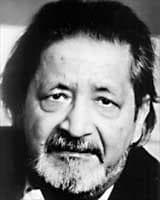
Sir Vidiadhar Surajprasad Naipaul was a Trinidadian-born British writer of works of fiction and nonfiction in English. He is known for his comic early novels set in Trinidad, his bleaker novels of alienation in the wider world, and his vigilant chronicles of life and travels. He wrote in prose that was widely admired, but his views sometimes aroused controversy. He published more than thirty books over fifty years.

Ashley Antoinette
4.6

Mark McDonald
4.4
Luo Guanzhong
4.4
Mia McKenzie
4.3
Dorothy Parker
4.3

Joaquim Maria Machado de Assis
4.3
James Thurber
4.2
Terry Kay
4.2