“The sea, the sea! Always the sea! The sea is a symbol of eternity, is it not? And of life too, for all life comes from the sea.”
— Cipolla's opening remarks, setting a philosophical tone before his show.

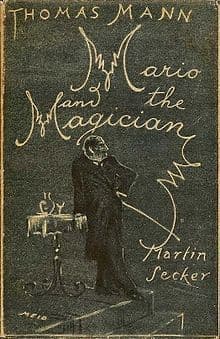
Thomas Mann (2017)
Genre
Fiction
Reading Time
45 min
Key Themes
See below
Sign in to track this book
In a chilling Italian seaside spectacle, the sinister magician Cipolla ensnares his audience, mirroring the seductive and coercive rise of fascism in Europe.
The narrator, his wife, and their two children arrive in Torre di Venere for their summer vacation. They are initially charmed by the town's beauty and relaxed atmosphere. However, they soon feel a growing unease and tension among locals and tourists. A minor incident involving a young Roman nobleman's accidental exposure at the beach causes a strong reaction from Italian authorities, suggesting a rigid social control in the idyllic setting. This early event hints at the suppression of individual freedom that will mark later events, shifting the holiday from pleasant to disquieting.
During a day at the beach, the narrator's daughter, Eleonora, is startled by a young Roman nobleman who, while changing, accidentally exposes himself. The incident, though minor, is met with an extreme response from the local community and authorities. The nobleman is publicly shamed and forced to leave the beach, while the narrator's family feels disapproval for witnessing the event. This overreaction shows the rigid social conservatism and oppressive atmosphere that has begun to infiltrate the charming Italian resort town, disturbing the family's peace.
As their stay in Torre di Venere continues, the narrator and his family find their holiday increasingly overshadowed by the town's stifling social climate. The initial charm gives way to discomfort. Locals show nationalistic fervor and suspicion towards foreigners, making the family feel unwelcome. The narrator observes growing intolerance and a lack of genuine joy among the people, contrasting with the carefree vacation they expected. This escalating unease sets the stage for the arrival of Cipolla, whose performance will embody the oppressive forces.
Flyers appear around Torre di Venere, announcing a 'cavalier-magician' named Cipolla. The advertisements are peculiar, suggesting a show less about traditional magic and more about personality and a test of wills. The narrator and his family, despite their unease with the town, decide to attend the performance, partly out of curiosity and partly because there is little else to do. This decision marks a turning point, as Cipolla's show will become the central event for exploring the story's themes of manipulation and power.
The narrator and his family attend Cipolla's performance in a packed, stuffy hall. Cipolla enters, a physically imposing and grotesque figure with a whip, a cigarette, and a hunchback. He begins his act not with tricks, but with monologues, boasting about his abilities and subtly insulting the audience. His manner is arrogant and captivating, establishing his dominance. The atmosphere in the hall becomes tense, as the audience is drawn into Cipolla's unsettling world, preparing for his hypnotic displays of power and manipulation.
Cipolla's act moves beyond showmanship as he demonstrates hypnotic powers. He singles out audience members, forcing them to perform ridiculous and humiliating acts against their will. A young man, for instance, is compelled to stick out his tongue repeatedly, to his embarrassment. Another is made to believe he is on a ship and suffers seasickness. Cipolla's power is undeniable, and the audience, though hesitant, falls under his spell, fascinated and disturbed by his ability to strip individuals of their autonomy. The narrator observes this with revulsion and curiosity.
In one striking display of power, Cipolla targets a proud Roman nobleman. Through hypnotic suggestion, Cipolla compels the nobleman to dance and make a fool of himself, amusing the crowd and visibly distressing the nobleman once he comes out of the trance. This incident shows Cipolla's sadistic streak and his desire to break the will of those who resist him. The narrator notes the chilling effectiveness of Cipolla's methods, as the nobleman, despite initial resistance, cannot defy the magician's command, deepening the sense of control in the hall.
Among the staff serving refreshments is Mario, a young, good-natured waiter from the town. He is simple, honest, and shy, with quiet dignity. Mario is known to the narrator's family from their stays in Torre di Venere and is fond of Silvestra, a hotel worker. His presence contrasts with Cipolla's manipulative personality, representing a more innocent form of human interaction. Mario's simple nature and unrequited affection for Silvestra set the stage for his tragic role in the story's climax.
Late in the evening, as the audience dwindles, Cipolla singles out Mario. Aware of Mario's affection for Silvestra, Cipolla, through hypnotic power, makes Mario believe he is Silvestra and that she has returned his love. He compels Mario to approach him, embrace him, and kiss him on the cheek. This cruel manipulation is a profound humiliation for Mario, who, in his trance, experiences joy only to be shattered by the realization of what truly happened once he comes to his senses. The audience, including the narrator, watches in horror and fascination.
As Mario awakens from Cipolla's hypnotic spell and realizes his humiliation, the waiter is overcome with shame, betrayal, and rage. The illusion of reciprocated love, cruelly offered and then snatched away, is too much for his innocent nature. In a sudden, desperate act of defiance, Mario pulls out a small pistol and fires it at Cipolla. The magician collapses, dead, amidst the stunned silence of the remaining audience. This violent act serves as a shocking, yet inevitable, conclusion to Cipolla's reign of manipulative power, a moment of rebellion against psychological oppression.
Immediately after Cipolla's death, the hall erupts into chaos, but the narrator and his family quickly leave. Later, the narrator reflects on the disturbing events. He understands Mario's act not as criminality, but as a desperate assertion of human dignity against an overwhelming, manipulative force. The beach incident, the oppressive atmosphere of Torre di Venere, and Cipolla's performance all combine into a meditation on unchecked power, the fragility of individual freedom, and how easily people can be led astray or subjugated. The family's holiday ends with unease and a loss of innocence.
The Protagonist
From seeking a peaceful holiday, he becomes a witness to disturbing psychological and political manipulation, leading to a profound re-evaluation of freedom and control.
The Antagonist
From a seemingly harmless entertainer, he reveals himself as a dangerous manipulator whose unchecked power ultimately leads to his violent demise.
The Supporting
From a simple, shy waiter, he is brutally humiliated by Cipolla, leading to a desperate act of violence that reclaims his dignity.
The Supporting
Shares the narrator's journey from holiday relaxation to intellectual and emotional disturbance.
The Supporting
Her initial innocence is challenged by the rigid social norms and unsettling atmosphere of Torre di Venere.
The Mentioned
Experiences public shaming for a minor transgression, revealing the town's authoritarian tendencies.
The Mentioned
The object of Mario's affection, unknowingly central to his humiliation and subsequent act of rebellion.
This is the central theme, criticizing the rise of fascism. Cipolla, with his hypnotic control, boasts, and humiliation of individuals, directly mirrors the tactics of fascist dictators. His power comes not from magic, but from psychological coercion and the audience's willingness to surrender their will. The town's earlier overreaction to the Roman nobleman's incident further emphasizes the pervasive nature of oppressive control, where individual freedom is sacrificed for a rigid, nationalistic order. Mario's final act is a desperate, violent assertion against total subjugation.
“For the freedom of the will is a ticklish thing, and it is easy to get in its way.”
The story explores how easily individual autonomy can erode, both by overt coercion and by a subtle, pervasive social atmosphere. The narrator's family initially seeks a carefree holiday, but their freedom is gradually curtailed by the town's nationalistic fervor and rigid social codes, ending in the complete subjugation of individuals under Cipolla's spell. The audience's fascination with Cipolla, even as they are humiliated, shows human susceptibility to charismatic authority, even when destructive. The incident with the Roman nobleman shows how quickly personal liberty can be suppressed by collective judgment and authority.
“It was as though the whole air were charged with a sort of nationalistic electricity, and one had to be careful not to draw a spark.”
Mann examines how power works, especially the kind wielded by charismatic figures like Cipolla. Cipolla's power is not mystical but psychological, based on his ability to read people, exploit their weaknesses, and project absolute authority. His 'magic' is a sophisticated form of mind control and intimidation. The audience, despite initial discomfort, is drawn into his performance, demonstrating the magnetic pull of a strong, sinister personality. This theme examines the psychological mechanisms that allow one individual to dominate and control a group, reflecting the political climate of the time.
“He was a phenomenon, an abnormal manifestation, a human paradox.”
The story uses public humiliation to strip individuals of dignity and reinforce Cipolla's power. From the Roman nobleman's shaming to various audience members forced into ridiculous acts, Cipolla systematically breaks down his victims' self-respect. Mario's humiliation is the most profound, as Cipolla exploits his deepest affections. Mario's subsequent violence can be interpreted as a desperate attempt to reclaim his lost dignity, suggesting limits to human endurance under oppression and that dignity's suppression can lead to violent rebellion.
“A man's dignity, a man's honor, a man's love, are things which one does not play with.”
The narrator's subjective observations and interpretations color the events.
While not overtly unreliable, the narrator's sophisticated intellectual perspective shapes the reader's understanding of the events. His interpretations of the town's atmosphere, Cipolla's performance, and Mario's actions are filtered through his own biases and intellectual framework. This device encourages the reader to consider the subjective nature of perception and the intellectual's role in interpreting political and social phenomena, making the story more of an allegorical commentary than a simple recounting of facts.
Characters and events symbolize broader political and social forces.
The entire novella functions as an allegory for the rise of fascism in Europe. Cipolla explicitly represents the charismatic, manipulative fascist leader (like Mussolini or Hitler), while the audience symbolizes the populace susceptible to such figures. Torre di Venere, with its nationalistic fervor and oppressive atmosphere, stands for a society under authoritarian rule. Mario's act of violence, though tragic, can be seen as a desperate, visceral rebellion against total psychological and political subjugation, symbolizing a last stand for individual freedom.
Early incidents hint at the later, more significant conflicts and themes.
The story employs foreshadowing to build a sense of impending dread and to prepare the reader for the climax. The incident with the Roman nobleman at the beach, for example, is a clear early sign of the town's rigid social control and intolerance, foreshadowing Cipolla's later, more extreme acts of humiliation. The growing discomfort of the narrator's family and the peculiar advertisements for Cipolla's show also build tension, hinting that the 'magic' will be more sinister than entertaining, thus preparing the reader for the manipulative and tragic events to come.
The physical and social environment reflects the story's themes.
The setting of Torre di Venere initially appears idyllic but quickly devolves into an oppressive, nationalistic environment. The stuffy, overcrowded hall where Cipolla performs further amplifies the sense of confinement and discomfort, mirroring the psychological suffocation experienced by the audience. The oppressive heat and the general sense of unease contribute to the story's overall mood, reflecting the political tensions and claustrophobia of the era. The setting thus becomes a character in itself, embodying the forces that restrict and manipulate.
“The sea, the sea! Always the sea! The sea is a symbol of eternity, is it not? And of life too, for all life comes from the sea.”
— Cipolla's opening remarks, setting a philosophical tone before his show.
“Freedom, in the last analysis, is only the will to be responsible for oneself.”
— Cipolla's pronouncements on freedom, subtly undermining genuine autonomy.
“One does not have to be a genius to be able to influence people. One only has to be a little more resolute than they are.”
— The narrator's observation about Cipolla's power over the audience.
“He was a man who, if he could not be admired, at least insisted on being taken seriously.”
— Description of Cipolla's demanding demeanor and his need for respect.
“But the truth is, the human spirit is a rebellious thing, and it does not like to be dictated to, even by its own will.”
— Narrator's reflection on the internal struggle against external control.
“Hypnosis is nothing more than the art of making another person's will subject to one's own.”
— Cipolla's blunt explanation of his craft.
“The atmosphere was charged, not with pleasure, but with a kind of tense, collective expectation.”
— Description of the audience's mood before Cipolla's more coercive acts.
“One must have the courage to choose, and the courage to bear the consequences of one's choice.”
— Cipolla's challenge to the audience, framing his commands as choices.
“What a strange blend of the comical and the terrifying, this man was!”
— The narrator's summary of Cipolla's dual nature and impact.
“The will, that mysterious, potent force, was being bent and twisted, not by argument or persuasion, but by sheer, insistent pressure.”
— Narrator's analysis of Cipolla's method of manipulation.
“It was a triumph, yes, but a triumph of the will over freedom, of compulsion over spontaneity.”
— The narrator's critical assessment of Cipolla's success.
“There was something deeply unsettling about seeing a human being reduced to a mere puppet, however willing.”
— The narrator's discomfort watching the audience members under Cipolla's spell.
“And the audience, in its collective humiliation, seemed to love it, or at least to be fascinated by it.”
— The paradox of the audience's reaction to their own subjugation.
“A sudden, sharp report... the crack of a pistol... then silence.”
— The climax of the story, Mario's act of rebellion against Cipolla.
Ready to see how well you understood this book? Take our interactive quiz with 10 questions.
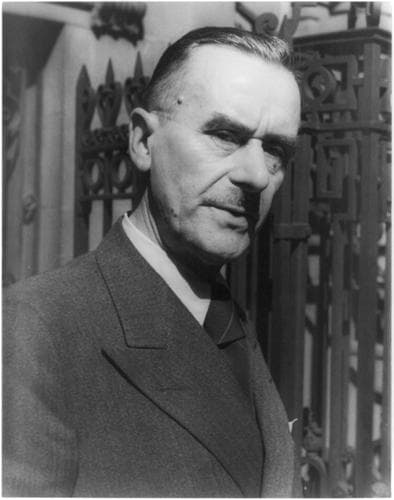
Paul Thomas Mann was a German novelist, short story writer, social critic, philanthropist, essayist, and the 1929 Nobel Prize in Literature laureate. His highly symbolic and ironic epic novels and novellas are noted for their insight into the psychology of the artist and the intellectual. His analysis and critique of the European and German soul used modernized versions of German and Biblical stories, as well as the ideas of Johann Wolfgang von Goethe, Friedrich Nietzsche, and Arthur Schopenhauer.

Ashley Antoinette
4.6

Mark McDonald
4.4
Luo Guanzhong
4.4

Mia McKenzie
4.3

Dorothy Parker
4.3

Joaquim Maria Machado de Assis
4.3

James Thurber
4.2

Terry Kay
4.2