“The Rime of the Ancient Mariner, in seven parts, was begun by Mr. Coleridge, and to be concluded by him, but he had not been able to finish it.”
— Introductory note to 'The Rime of the Ancient Mariner'


Samuel Taylor Coleridge (2013)
Genre
Fiction
Reading Time
480 min
Key Themes
See below
Sign in to track this book
Explore the poems where Wordsworth and Coleridge began English Romanticism, featuring their 1798 debut and the expanded 1802 edition with Wordsworth's famous preface.
An old Mariner stops a Wedding-Guest to tell a difficult story. He describes a trip into the icy south where his ship gets stuck. A friendly Albatross appears, guiding them, but the Mariner shoots it without reason. This act curses the ship: the wind stops, and the crew suffers from thirst, blaming the Mariner. The dead Albatross is hung around his neck. The crew dies, their souls leaving him, and he is left alone, haunted by the dead men and the slimy sea creatures. He looks at the beautiful sea snakes, and the curse starts to break, allowing him to pray. The Albatross falls from his neck, and spirits supernaturally move the ship homeward. A Hermit, a Pilot, and the Pilot's boy rescue him, but his ship sinks. The Mariner must wander the earth, telling his story and teaching the lesson of love and respect for all God's creatures.
Dorothy, the foster-mother, tells a visitor about Marmaduke, a boy she raised. He was a wild, imaginative child who preferred nature's solitude to people. He spent days in the woods, talking to nature, trees, and animals. His foster-mother worried about his solitary nature. Marmaduke later gets involved in a political plot, driven by his passionate spirit. This leads to his downfall and imprisonment, which the foster-mother partly blames on his unusual upbringing and his inability to fit in. The story is a warning about the dangers of unchecked romantic ideals and being isolated from others.
Wordsworth speaks to his sister, Dorothy, from near their home, thinking about the beauty of nature around them. He describes the calm morning, gentle breezes, and nature's sounds, inviting her to share this peace. He suggests that the peace and joy in nature can ease sorrow and bring renewal. He stresses nature's healing power, contrasting it with human anxieties and stresses. The poem emphasizes that nature offers a deep connection to a lasting happiness, available to those who open themselves to it.
Coleridge describes an evening walk with his friends (Wordsworth and Dorothy), listening to the nightingale's song. He argues against the common idea that the nightingale sings sadly, saying its song is joyful and spontaneous. He suggests that those who hear sadness in the bird are just reflecting their own feelings. He highlights the beauty and cheerfulness of the nightingale's music, especially in the peaceful, moonlit night. The poem ends with a tender scene of Coleridge's baby son, Hartley, sleeping peacefully under the trees, further supporting the idea of natural innocence and joy, contrasted with complex human emotions.
Wordsworth sits in a grove, listening to nature's sounds – birds singing, primroses blooming, periwinkle trailing. He feels deep pleasure and harmony from the natural world. However, this joy is mixed with sadness as he considers humanity's destructive habits and its distance from this natural happiness. He compares the apparent happiness and connection of birds and flowers with the suffering he sees in human society. The poem questions why humans cannot achieve nature's peaceful existence, regretting 'what man has made of man' and wishing for a simpler, more harmonious life.
The narrator meets Simon Lee, an old huntsman who was once strong but is now weak from age. Simon struggles to cut a root, his strength failing. The narrator, seeing his difficulty, offers to help. With one swing, the narrator easily cuts the root Simon had struggled with. This simple kindness deeply moves Simon Lee, who cries with thanks. The narrator thinks about this emotional response, noting that real human connection and kindness, even small acts, can have a deep effect, bringing out unexpected feelings and reminding us of our shared humanity. The poem highlights the dignity of the elderly and the power of empathy.
The poem describes a shepherd who lost most of his sheep in a harsh winter. He has only a few sheep left, including a lamb he carries close. He expresses his deep sadness and attachment to his animals, seeing them as companions and his livelihood. The shepherd's sorrow is not just for the lost sheep but also for a fading way of life. He feels a deep connection to nature and his pastoral life, which is now threatened. The poem creates a sense of sadness and acceptance, showing the vulnerability of those who live closely with nature and the impact of forces beyond their control.
The narrator meets a young, innocent cottage girl and asks how many siblings she has. She insists 'we are seven,' even though two siblings are buried nearby. The narrator tries to explain that if two are dead, only five remain. However, the child, in her simple and intuitive way, insists the dead siblings are still part of their family, often visiting their graves to knit or sing. Her firm belief shows a child's innocent acceptance of death as a different state, not a total absence, challenging the adult's logical, numerical view of life and family.
A father asks his young son if he prefers Kilve or Liswyn Farm, two places they visited. The father expects a simple answer based on his own thoughts about each place, but is surprised by the boy's seemingly odd response: he prefers Kilve because 'the primrose is there.' The father, trying to find a deeper, more logical reason, presses the child further, but the boy sticks to his simple truth. The poem explores the pure and direct way a child sees things, often without adult reasoning or hidden motives, and the father's struggle to understand this innocent honesty, showing the difference between adult complexity and childish simplicity.
Betty Foy sends her 'idiot' son, Johnny, on a horse to get the doctor for her sick neighbor, Susan Gale. Johnny gets distracted and wanders off. Betty becomes more anxious as the night goes on, eventually going out to find him. Meanwhile, Susan Gale, recovering on her own, also worries and goes to find Betty. The two women eventually meet, and Betty's distress over Johnny's disappearance is clear. Johnny is found, having spent the night watching an owl. When asked what he saw, he can only say 'The Owlet!' The poem, through its tender portrayal, celebrates the simple joys and unique views of those often overlooked, emphasizing a mother's unconditional love.
William, the narrator, is found by his friend Matthew sitting by a lake, looking at nature. Matthew scolds William for wasting time in 'dreams' instead of studying, urging him to 'quit your books' and learn actively from the world. William defends his quiet state, arguing that true wisdom comes from calm observation and letting nature affect the mind. He suggests that sitting and listening to nature's 'silent teaching' is a valid and deep way of learning, perhaps better than knowledge only from books. The poem supports intuitive, sensory learning over purely intellectual pursuits.
Following the previous poem, the narrator continues to argue for nature as a better teacher. He urges his friend to 'Up! up! my Friend, and quit your books' and instead go into the light of things, letting nature teach them. He argues that 'one impulse from a vernal wood / May teach you more of man, / Of moral evil and of good, / Than all the sages can.' The poem directly contrasts the 'toil and trouble' of studying with the easy wisdom gained from direct experience with nature. It champions intuition, emotion, and sensory engagement over pure reason and academic knowledge, stating that nature holds deep truths that books cannot fully convey.
The narrator sees an old man walking slowly along a road, his pace suggesting a deep connection to the earth. The narrator is struck by the man's calm manner and the purpose in his slow journey. He wonders about the old man's life, imagining him returning from far away, perhaps having seen important events or lived a quiet, dignified life. The poem focuses on the dignity and strength of the common man, finding deep meaning in an ordinary sight. It suggests that even in simple observations, one can find deep stories and universal human experiences, highlighting the value of empathy and imagining others' lives.
Goody Blake, a poor old woman, suffers terribly from the cold in her cottage. Unable to afford wood, she steals sticks from the hedges of Harry Gill, a rich farmer, to stay warm. Harry, determined to catch the thief, waits. When he catches Goody Blake, she, in her despair, curses him to 'never more be warm.' From that moment, Harry Gill is constantly cold, shivering no matter the weather or how many clothes he wears. The poem is a warning against being hard-hearted towards the poor, showing the serious results of lacking compassion for those truly in need.
Wordsworth revisits the Wye Valley near Tintern Abbey after five years. He thinks about how the memory of this beautiful natural place has helped him while he was away, offering comfort and inspiration. He describes his changing relationship with nature: from the 'thoughtless youth' who enjoyed its simple pleasures, to his current, more mature understanding, where nature offers a deeper, spiritual connection and a 'sense sublime.' He shares this experience with his sister, Dorothy, recognizing her own youthful energy and hoping that nature will give her similar comfort and wisdom in the future. The poem celebrates nature's deep, almost mystical, effect on the human spirit.
The Protagonist
He transforms from a thoughtless sinner to a repentant sage, eternally bound to share his story and teach reverence for all life.
The Protagonist/Speaker
His perspective evolves from youthful exuberance to a mature, philosophical understanding of nature's spiritual and moral influence.
The Supporting/Addressee
Her character remains largely constant, serving as a symbol of pure, intuitive connection to nature for the speaker.
The Supporting
He undergoes a spiritual awakening from a mundane focus to a deeper, more somber understanding of the world.
The Supporting
His character remains static, serving as a symbol of spiritual purity and absolution.
The Supporting
These characters do not have individual arcs but collectively represent a consistent theme of childlike innocence and uncorrupted perception.
The Supporting
His physical decline is presented as a fixed state, serving as a catalyst for the narrator's moral reflection.
The Supporting
Her character is static, representing the plight of the poor and the power of their desperation.
Nature is shown as a source of spiritual comfort, moral guidance, and beauty. Wordsworth, in particular, stresses nature's power to calm troubled minds, renew the spirit, and inspire deep thought. In 'Lines Written in Early Spring,' the speaker finds both joy and sadness in nature's harmony, regretting 'what man has made of man' compared to nature's peace. In 'Tintern Abbey,' nature's memory helps the speaker, and its presence offers a 'sense sublime' that goes beyond youthful pleasure. Coleridge's 'The Nightingale' also celebrates nature's joyful song, challenging sad interpretations. Nature is often shown as a kind teacher, offering wisdom beyond human intelligence.
“One impulse from a vernal wood / May teach you more of man, / Of moral evil and of good, / Than all the sages can.”
This theme explores the mysterious, awe-inspiring, and unexplainable, often blending the natural and supernatural. Coleridge's poems, especially 'The Rime of the Ancient Mariner,' are key here. The Mariner's journey is full of ghostly events, from the animated bodies of the crew to the spirit-driven ship and the Albatross's curse. This theme aims to create wonder and terror, pushing the limits of human understanding. The sublime also appears in Wordsworth's thoughts on nature in 'Tintern Abbey,' where the landscape inspires a 'sense sublime' that lifts the human spirit beyond everyday experience, hinting at a divine presence in nature.
“And a thousand thousand slimy things / Lived on; and so did I.”
Wordsworth supports the lives, language, and experiences of ordinary people, especially those in rural areas. He seeks deep truths and emotions in the daily struggles and simple joys of farmers, children, and the elderly. Poems like 'Simon Lee, the Old Huntsman' and 'Goody Blake and Harry Gill' focus on the poor's vulnerability and dignity, showing the effect of kindness or its absence. 'We Are Seven' celebrates the pure wisdom and view of a young child, contrasting it with adult logic. This theme reflects a democratic idea, stating that real human feeling and moral insight are found not in high society or complex thought, but in the plain realities of common life.
“I've heard of hearts unkind, kind deeds / With coldness still returning; / Alas! the gratitude of men / Has oftener left me mourning.”
Children in the Lyrical Ballads often have a pure, uncorrupted view of the world, free from social rules or logical thought. Their perceptions are shown as more real and closer to basic truths than those of adults. In 'We Are Seven,' the child's insistence on her dead siblings' presence challenges the adult's logical understanding of death, suggesting a deeper, intuitive connection to life and family. Similarly, the boy in 'Anecdote for Fathers' gives a simple, honest reason for his preference, highlighting childhood honesty. This theme explores the idea that childhood holds a deep wisdom often lost or hidden by adulthood.
“O Master! we are seven.”
The collection often explores the tension between imagination, intuition, and emotion versus cold, analytical reason. Romantic poets valued imagination as a way to see deeper truths and connect with the sublime. Coleridge's 'The Rime of the Ancient Mariner' shows imagination's power to create a supernatural world and explore deep moral lessons beyond rational explanation. Wordsworth, in poems like 'The Tables Turned' and 'Expostulation and Reply,' directly argues for leaving books and 'barren reason' for direct sensory experience and 'wise passiveness' that lets nature teach the soul. This theme supports a complete approach to knowledge and understanding, where feeling and intuition are most important.
“Sweet is the lore which Nature brings; / Our meddling intellect / Misshapes the beauteous forms of things:— / We murder to dissect.”
Many poems are told from the subjective perspective of a speaker.
This device immerses the reader directly into the thoughts, feelings, and experiences of the poet or a created persona. It allows for a deep exploration of subjective consciousness and emotion, central to Romanticism. In poems like 'Tintern Abbey,' Wordsworth's 'I' creates an intimate, reflective tone, sharing personal insights and memories. In 'The Rime of the Ancient Mariner,' the Mariner's first-person account lends immediacy and intensity to his supernatural tale, making his suffering and moral transformation deeply personal and compelling. This perspective fosters empathy and a direct connection between the reader and the speaker's internal world.
Traditional narrative poetry adapted to explore psychological and supernatural themes.
The ballad form, characterized by its simple language, regular rhythm, and narrative structure, is employed to make complex themes accessible and to evoke a sense of folk tradition. Coleridge's 'The Rime of the Ancient Mariner' is the most prominent example, using the ballad's direct storytelling to recount a fantastical and moralistic journey. Wordsworth also uses elements of balladry in poems like 'Goody Blake and Harry Gill' and 'We Are Seven,' focusing on character and plot to tell stories of common life. This device helps ground the extraordinary in the familiar, and make the philosophical accessible through narrative.
Attributing human qualities or actions to natural elements.
Nature is often presented as an active, sentient force capable of teaching, healing, and communicating. In 'The Tables Turned,' nature is a 'wise' and 'sweet' teacher, and in 'Lines Written in Early Spring,' the birds 'hopped and played' as if with a conscious joy. This device elevates nature beyond mere scenery, making it a dynamic character within the poems. It reinforces the Romantic belief in a spiritual connection between humanity and the natural world, suggesting that nature possesses its own agency and wisdom, capable of influencing human experience and offering profound moral lessons.
A story within a story, providing context and layers of narration.
This device is most notably used in 'The Rime of the Ancient Mariner.' The Wedding-Guest's encounter with the Mariner forms the outer frame, while the Mariner's recounting of his supernatural voyage constitutes the inner story. The frame story creates a sense of immediacy and draws the reader into the Mariner's compelling narrative, while also emphasizing the lasting impact of his tale on the listener. It allows for different perspectives and adds a layer of dramatic tension as the Wedding-Guest is unwillingly drawn into the Mariner's world, highlighting the transformative power of storytelling itself.
“The Rime of the Ancient Mariner, in seven parts, was begun by Mr. Coleridge, and to be concluded by him, but he had not been able to finish it.”
— Introductory note to 'The Rime of the Ancient Mariner'
“It is an ancient Mariner, And he stoppeth one of three. 'By thy long grey beard and glittering eye, Now wherefore stopp'st thou me?'”
— Opening lines of 'The Rime of the Ancient Mariner'
“Water, water, every where, And all the boards did shrink; Water, water, every where, Nor any drop to drink.”
— From 'The Rime of the Ancient Mariner', describing the Mariner's thirst
“Ah! well a-day! what evil looks Had I from old and young! Instead of the cross, the Albatross About my neck was hung.”
— From 'The Rime of the Ancient Mariner', after the bird's death
“He prayeth well, who loveth well Both man and bird and beast. He prayeth best, who loveth best All things both great and small; For the dear God who loveth us, He made and loveth all.”
— From 'The Rime of the Ancient Mariner', the moral of the tale
“A good Man is the best thing, a bad Man is the worst thing, in the world.”
— From 'The Idiot Boy', a reflection on human nature
“And when she saw the Dog, and when she saw The Moon in the clear sky, she thought of him, And what a beautiful night it was.”
— From 'The Idiot Boy', Betty Foy's simple thoughts
“My heart leaps up when I behold A rainbow in the sky:”
— From 'My Heart Leaps Up', expressing joy in nature
“The Child is father of the Man;”
— From 'My Heart Leaps Up', reflecting on the continuity of life
“Five years have past; five summers, with the length Of five long winters! and again I hear These waters, rolling from their mountain-springs With a soft inland murmur.”
— Opening lines of 'Lines Composed a Few Miles above Tintern Abbey'
“For I have learned To look on nature, not as in the hour Of thoughtless youth; but hearing oftentimes The still, sad music of humanity,”
— From 'Lines Composed a Few Miles above Tintern Abbey', reflecting on a mature view of nature
“A sense sublime Of something far more deeply interfused, Whose dwelling is the light of setting suns, And the round ocean and the living air, And the blue sky, and in the mind of man:”
— From 'Lines Composed a Few Miles above Tintern Abbey', describing a spiritual connection to nature
“Therefore am I still A lover of the meadows and the woods, And mountains; and of all that we behold From this green earth; of all the mighty world Of eye, and ear,—both what they half create, And what perceive;”
— From 'Lines Composed a Few Miles above Tintern Abbey', a declaration of love for nature
“And I could wish my days to be Bound each to each by natural piety.”
— Concluding lines of 'My Heart Leaps Up', a desire for spiritual connection
Ready to see how well you understood this book? Take our interactive quiz with 10 questions.
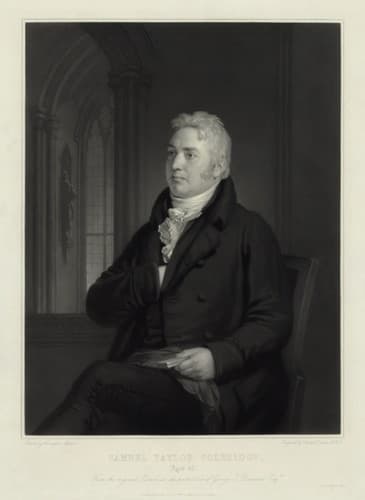
Samuel Taylor Coleridge was an English poet, literary critic, philosopher, and theologian who, with his friend William Wordsworth, was a founder of the Romantic Movement in England and a member of the Lake Poets. He also shared volumes and collaborated with Charles Lamb, Robert Southey, and Charles Lloyd.

Ashley Antoinette
4.6

Mark McDonald
4.4
Luo Guanzhong
4.4

Mia McKenzie
4.3
Dorothy Parker
4.3

Joaquim Maria Machado de Assis
4.3
James Thurber
4.2
Terry Kay
4.2