“O you, the most beautiful of all, the most cherished of all, I adore you!”
— From 'The Balcony,' a lover's adoration.

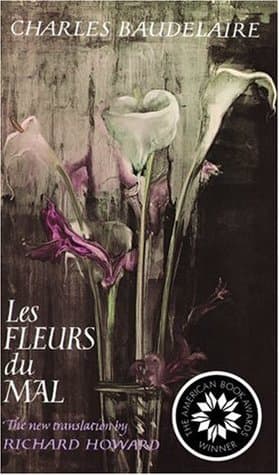
Charles Baudelaire (1855)
Genre
Fiction
Reading Time
365 min
Key Themes
See below
Sign in to track this book
Baudelaire's 1857 masterpiece, a work of decadent beauty and startling depravity, is now available in its first complete American translation, presented alongside the original French.
The introductory poem, 'Au Lecteur,' is a direct address from Baudelaire to his audience. It immediately sets a bleak, cynical tone. He describes humanity as corrupt, driven by vice, and burdened by 'Ennui'—a deep boredom and spiritual unease he considers the worst sin. Baudelaire includes himself and the reader in this shared human condition, creating a sense of shared responsibility for universal depravity. This opening piece invites the reader into the dark psychological world of 'Les Fleurs du Mal,' preparing them for a journey through the underside of human experience and morality.
The 'Spleen et Idéal' section, the largest in the collection, explores Baudelaire's main internal conflict: the struggle between seeking beauty, spiritual meaning ('Idéal'), and the heavy weight of existential despair and melancholia ('Spleen'). Poems like 'L'Albatros' show the poet's high, but isolated, place in society. 'Correspondances' suggests a spiritual unity in nature, hinting at a higher realm reached through the senses. However, this hope is constantly undercut by the pervasive 'Spleen,' seen in poems like 'Je suis comme le roi d'un pays pluvieux,' where the poet feels stifled by boredom, isolation, and decay. This reflects a deep inability to escape grim reality or find lasting comfort.
In 'Tableaux Parisiens,' Baudelaire looks from his inner world to the outer one, showing vivid, often grim, pictures of 19th-century Paris. He presents the city not as a romantic ideal, but as a place of modernity, full of both fleeting beauty and deep human suffering. Poems like 'Les Petites Vieilles' gently observe the city's forgotten elderly women, highlighting their past lives and current despair. 'À une passante' captures a brief moment of connection and loss in the anonymous city, showing how quickly beauty and desire pass. Baudelaire turns the dirt, crowds, and grand buildings into a scene that reflects his own inner turmoil, finding a somber grandeur in the city's decay and its many inhabitants.
The section 'Le Vin' explores the appeal and dangers of drinking as a way to escape life's harshness and the oppressive 'Spleen.' Baudelaire presents wine as a temporary comfort that can inspire poets, console workers, and even change a murderer's conscience. Poems like 'Le Vin des chiffonniers' show how wine offers a brief escape for the poor, letting them forget their misery and dream of glory. But this escape is always short-lived. Baudelaire suggests that these artificial paradises are deceptive. While wine can lift the spirit for a moment, it ultimately fails to provide true or lasting freedom from the human condition, often leading back to the original despair with greater intensity.
The section named 'Fleurs du Mal' directly addresses sin, corruption, and forbidden desires, embodying the collection's controversial title. Here, Baudelaire explores the twisted beauty found in vice, suffering, and the grotesque. Poems in this section often use images of decay, disease, and the demonic, challenging common ideas of morality and beauty. He finds a strange, dark appeal in things considered evil or taboo, suggesting that beauty can grow even from the most corrupt ground. This section is key to the collection's provocative nature, as Baudelaire openly explores the darker parts of human nature, seeking a unique aesthetic pleasure and truth within moral wrongdoing, often with both fascination and self-condemnation.
'La Révolte' is a short but powerful section where Baudelaire directly questions religious belief, social norms, and the perceived unfairness of the universe. In poems like 'Le Reniement de Saint Pierre,' he doubts divine justice and expresses deep disappointment with the Christian God, aligning himself with figures who defied heaven. This section has a stark, almost blasphemous, tone. The poet speaks of rebellion against a world he sees as flawed and oppressive. It shows a desperate desire for freedom and a refusal to passively accept suffering or moral limits, even if it means choosing a path of perceived damnation or intellectual defiance against a seemingly uncaring cosmos.
The final section, 'La Mort,' faces the ultimate human fate with dread, acceptance, and a hint of hope for the unknown. Baudelaire sees death not just as an end, but as a possible escape from the pain of 'Spleen' and life's disappointments. Poems here consider the different forms death takes—for lovers, for the poor, for artists—and the comfort it might offer. In 'La Mort des amants,' death is romanticized as a final union. However, in 'La Mort des artistes,' it is seen as the moment an artist's true vision might finally appear. The overall tone is one of tired acceptance, suggesting that death might be the final journey to an 'unknown' that could bring either oblivion or a revelation, the ultimate 'new' experience.
Six poems, including 'Les Bijoux' and 'Léthe,' were censored for obscenity soon after 'Les Fleurs du Mal' was published in 1857. They were removed from later editions during Baudelaire's lifetime. These poems, often explicit in their exploration of eroticism, physical desire, and the darker aspects of sexual relationships, were deemed offensive to public morals by French courts. Their later return in complete editions shows their important place in Baudelaire's larger artistic goal: to explore the full range of human experience, including its most rebellious and sensual parts. These poems deepen the collection's themes of sin, beauty, and the pursuit of intense, often forbidden, feelings as a response to the widespread 'Spleen.'
Throughout 'Les Fleurs du Mal,' especially in 'Tableaux Parisiens,' Baudelaire embodies or describes the 'flâneur'—the detached observer of city life. This figure walks the streets of Paris, taking in its sights, sounds, and smells. He sees both its grandeur and its squalor, its fleeting beauty and its deep misery, without necessarily joining in. The flâneur observes humanity closely, finding inspiration in the anonymous crowds, beggars, street performers, and solitary figures. This viewpoint allows Baudelaire to create vivid, impressionistic pictures of modern city life, reflecting on anonymity, isolation, and the temporary nature of beauty in a changing world, all through a melancholic and critical lens.
A constant theme throughout the collection is Baudelaire's persistent, often frustrated, search for an 'Absolute'—a transcendent truth, beauty, or spiritual ideal that exists beyond the ordinary and corrupt world. This search appears in different ways: the brief glimpses of the 'Idéal' in 'Correspondances,' the attempt to find comfort in art, the pursuit of intense sensory experiences, and even the embrace of vice as a way to a heightened state. Despite these efforts, the 'Absolute' often remains out of reach, constantly undermined by 'Spleen' and the limits of human life. This unending search, marked by both hope and despair, forms the core of Baudelaire's spiritual and aesthetic journey, defining much of the collection's emotional atmosphere and intellectual tension.
The Protagonist
The Poet's arc is not one of linear progression or resolution, but rather a cyclical descent into deeper despair and a more profound understanding of human depravity, without ever fully abandoning the yearning for the ideal.
The Muse/Supporting
Jeanne Duval's character, as depicted, remains a static, symbolic figure, a catalyst for the Poet's internal conflicts rather than undergoing a personal development.
The Antagonist/Symbolic
Satan's 'arc' is his consistent symbolic role as the embodiment of temptation and the counterpoint to the 'Idéal,' remaining a fixed force of opposition.
The Antagonist/Conceptual
Ennui remains a constant, oppressive force, its grip tightening as the collection progresses, ultimately suggesting its inescapable nature.
The Supporting/Collective
As a collective, the city dwellers do not have an arc; they serve as a static backdrop, illustrating the human condition in the urban environment.
The Conceptual/Supporting
The Ideal remains an elusive goal throughout, its presence providing a contrast to the pervasive 'Spleen' but never fully realized.
The Conceptual/Supporting
Death's role evolves from a feared unknown to a longed-for, albeit ambiguous, escape, becoming more central towards the collection's close.
The Mentioned/Implied
The Reader's 'arc' is meant to be an internal realization of shared human flaws, initiated by the Poet's direct accusation.
This is the main contrast of the collection, showing the ongoing struggle between spiritual goals and deep existential despair. 'Spleen' includes boredom, sadness, spiritual paralysis, and a feeling of being trapped by the ordinary and corrupt parts of life. It is a suffocating weight that keeps the soul from rising. In contrast, 'Idéal' represents the desire for beauty, purity, transcendence, and spiritual elevation. Baudelaire constantly moves between these two extremes, finding brief moments of the ideal in art, love, or even vice, only to be pulled back down by the overwhelming 'Spleen.' This tension appears in poems like 'L'Albatros,' where the poet's high spirit is brought down by earthly scorn, and 'Je suis comme le roi d'un pays pluvieux,' where 'Spleen' makes even a king miserable.
“Ô Mort, vieux capitaine, il est temps! levons l'ancre! / Ce pays nous ennuie, ô Mort! Appareillons!”
Baudelaire redefines beauty, finding it not only in the traditionally sublime but also in the grotesque, the decaying, the morally wrong, and urban squalor. He challenges common ideas of beauty by suggesting that true beauty can come from unexpected, often dark, places. This theme is central to the collection's title, 'Flowers of Evil,' meaning that something beautiful (flowers) can grow from something inherently corrupt (evil). Poems like 'Une Charogne' ('A Carcass') vividly describe a rotting corpse, yet turn it into a reflection on life and death's cycle, and a strange, unsettling beauty. Similarly, his descriptions of Parisian poverty and vice ('Les Petites Vieilles') find a tragic dignity and aesthetic value in human suffering and decay, making the reader confront uncomfortable truths about beauty's origins.
“Tu m'as donné ta boue et j'en ai fait de l'or.”
Baudelaire is often called the poet of modernity, capturing the essence of 19th-century city life and its psychological effects. The 'Tableaux Parisiens' section vividly shows the busy, anonymous, and often brutal scene of Paris. He explores alienation, isolation in crowds, the temporary nature of human connection in the city, and the rapid decay and renewal typical of modern cities. The 'flâneur'—the detached observer of city life—is central to this theme, allowing Baudelaire to absorb and reflect on the city's fragmented beauty and deep misery. Poems such as 'À une passante' show the brief encounters and loneliness in the urban maze, where deep connection is glimpsed but immediately lost, highlighting the dehumanizing aspects of modern city life.
“Fourmillante cité, cité pleine de rêves, / Où le spectre en plein jour raccroche le passant.”
Facing overwhelming 'Spleen' and life's bleakness, Baudelaire explores various forms of escape. These often lead to 'artificial paradises' that offer temporary relief but ultimately fail. These include intoxication (wine, drugs), exoticism, sensuality, and the pursuit of intense, often forbidden, experiences. The 'Le Vin' section directly discusses the appeal of alcohol as a way to forget suffering and achieve a fleeting sense of transcendence or inspiration. However, Baudelaire consistently shows these escapes as deceptive and unsustainable, leading back to a deeper sense of disappointment and despair. The artificial paradise, while offering momentary rest, cannot provide true or lasting freedom from the human condition, emphasizing the pointlessness of trying to outrun one's own inner pain.
“L'opium agrandit ce qui n'a pas de bornes, / Allonge l'illimité, / Approfondit le temps, creuse la volupté, / Et de noirs plaisirs les âmes informent.”
Baudelaire deeply examines sin, guilt, and moral wrongdoing, often with a confessional and self-critical tone. He explores not only common vices like lust and pride but also the more subtle 'Ennui' as the ultimate sin. He is fascinated by the appeal of forbidden acts and the beauty found in decay and corruption, challenging traditional Christian morality. Yet, despite his use of 'evil' as an artistic source, there is a pervasive sense of guilt, regret, and a longing for redemption that is never fully achieved. This internal conflict between attraction to sin and the pain of conscience is a constant thread, suggesting that even in rebellion, the shadow of moral judgment remains. The 'Fleurs du Mal' section explicitly explores these themes, finding dark beauty in depravity.
“C'est le Diable qui tient les fils qui nous remuent!”
Use of evocative objects, colors, and concepts to represent abstract ideas.
Baudelaire is a master of symbolism, using concrete images to evoke abstract ideas and emotions. For instance, the albatross symbolizes the poet's majestic but clumsy spirit in the mundane world. Colors like black and gold often represent decay and spiritual alchemy, respectively. Flowers, particularly the titular 'Fleurs du Mal,' symbolize beauty blooming from corruption. The city of Paris itself becomes a symbol of modern alienation and fragmented beauty. These symbols are not always straightforward, often carrying multiple, sometimes contradictory, meanings, enriching the poems with layers of interpretation and contributing to the collection's enigmatic and dream-like quality. This device allows Baudelaire to explore complex psychological states and philosophical concepts without explicit statement.
Blending of sensory experiences to create rich, multi-sensory imagery.
Synesthesia is a key device, particularly evident in 'Correspondances,' where Baudelaire describes 'perfumes, colors, and sounds respond[ing] to each other.' He frequently mixes sensory perceptions, such as describing a scent as 'sweet as oboes, green as prairies,' or a sound as having a color. This blending of senses creates a heightened, immersive, and often disorienting experience for the reader, reflecting the poet's own intense and sometimes overwhelming sensory perceptions. It suggests a deeper, underlying unity in the universe, where different sensory inputs are interconnected, and allows Baudelaire to evoke complex emotional and spiritual states that transcend conventional description, blurring the lines between the physical and the metaphysical.
Juxtaposition of contradictory ideas or a disconnect between expectation and reality.
Irony and paradox are pervasive in 'Les Fleurs du Mal,' reflecting Baudelaire's cynical worldview and his exploration of contradictions in human nature. The very title, 'Flowers of Evil,' is a prime example of paradox, suggesting beauty found in corruption. He often uses irony to critique society, religion, and even himself, presenting noble aspirations that lead to degradation, or finding profound truth in what is conventionally deemed ugly or sinful. For instance, the poet's yearning for the 'Idéal' often leads him into the depths of 'Spleen.' This device highlights the inherent tensions and hypocrisies Baudelaire perceives in life, morality, and art, challenging readers to question their preconceived notions and embrace complexity.
Direct address to the reader, revealing personal struggles and complicity.
The confessional tone, established most prominently in 'Au Lecteur,' draws the audience directly into the poet's internal world. Baudelaire speaks openly about his vices, his despair, and his spiritual struggles, blurring the line between the poetic persona and his own life. This directness creates an intimate, almost conspiratorial relationship with the reader, who is invited to share in the poet's 'sins' and 'ennui.' This device makes the themes universal, suggesting that the struggles depicted are not unique to the poet but are common to all humanity. It fosters a sense of shared culpability and forces the reader to confront their own potential for depravity, making the experience of reading both intensely personal and intellectually challenging.
“O you, the most beautiful of all, the most cherished of all, I adore you!”
— From 'The Balcony,' a lover's adoration.
“For it is the property of the devil to be a poet, and of the poet to be a devil.”
— From 'To the Reader,' setting the tone of the collection.
“The world is a hospital where every patient is possessed by the desire of changing his bed.”
— From 'Anywhere Out of the World,' expressing dissatisfaction and a desire for escape.
“In the blackness of the night, the eye of the poet is a lamp.”
— From 'The Lamp,' emphasizing the poet's unique vision.
“I am like the king of a rainy country, rich but impotent, young though old.”
— From 'Spleen (LXXVI),' a self-portrait of weariness and decay.
“Be always drunken. That's the point; nothing else matters. If you would not feel the horrible burden of Time weighing on your shoulders and crushing you to the earth, be drunken continually.”
— From 'Be Drunken,' an imperative to escape the burden of time.
“The poet is like the prince of the clouds who haunts the tempest and scorns the archer.”
— From 'The Albatross,' a metaphor for the misunderstood poet.
“We often say that the poet is an idler, but he is never more active than when he is doing nothing.”
— Reflecting on the nature of poetic inspiration and observation.
“Death is a ship that takes us to an unknown shore.”
— From 'The Voyage,' contemplating the final journey.
“Oh, bitter truth! Oh, sacred lie! Oh, beautiful poison! Oh, blessed knife!”
— From 'To the Reader,' illustrating the paradoxical nature of beauty and suffering.
“The gas-lamps make a bloody stain upon the pavement where a woman weeps and prays.”
— From 'The Little Old Women,' a vivid image of urban suffering.
“My soul is a cemetery where the moon, with its pale light, wanders like a ghost.”
— From 'Spleen (LXXVIII),' a powerful image of inner desolation.
“I have more memories than if I had lived a thousand years.”
— From 'Spleen (LXXVI),' expressing the overwhelming weight of memory.
“The devil holds the threads that move us!”
— From 'To the Reader,' suggesting humanity's susceptibility to evil.
Ready to see how well you understood this book? Take our interactive quiz with 10 questions.
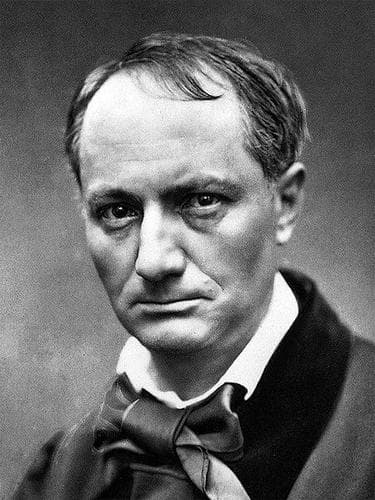
Charles Pierre Baudelaire was a French poet who also worked as an essayist, art critic and translator. His poems are described as exhibiting mastery of rhyme and rhythm, containing an exoticism inherited from Romantics, and are based on observations of real life.

Ashley Antoinette
4.6

Mark McDonald
4.4
Luo Guanzhong
4.4
Mia McKenzie
4.3
Dorothy Parker
4.3
Joaquim Maria Machado de Assis
4.3
James Thurber
4.2

Terry Kay
4.2