“What is the point of the press if it cannot create a moral panic?”
— Michael Owen's cynical view on the role of journalism.

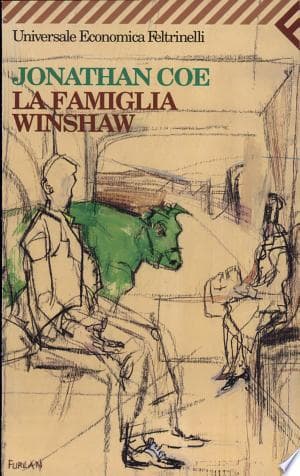
Jonathan Coe (2010)
Genre
Fiction
Reading Time
Given the depth and complexity, likely around 8-12 hours depending on reading speed.
Key Themes
See below
Sign in to track this book
Attraverso le vicende grottesche e brutali della famiglia Winshaw, questo romanzo dipinge un affresco socio-politico esilarante e agghiacciante dell'Inghilterra thatcheriana, rivelando sorprendenti analogie con la realtà contemporanea.
In the summer of 1990, Michael Owen, a young writer, is hired by Hilary Winshaw to write a history of her dysfunctional and influential family, the Winshaws. Michael, initially unsure due to the family's reputation, sees this as a chance for his career. He begins his research, looking into old records, news clippings, and memories of various Winshaw relatives, slowly putting together a web of ambition, greed, and political maneuvering that spans decades and reflects Britain's own socio-political state under Thatcher.
Michael's research uncovers the early generations of the Winshaw family, focusing on brothers Godfrey and Mortimer Winshaw. Godfrey is a ruthless industrialist who built the family's initial fortune through exploitation and a disregard for ethics. Mortimer is a more intellectual but equally self-serving figure, involved in shadowy political dealings during the inter-war period. Their lives establish the Winshaw dynasty's core traits: an insatiable hunger for power and wealth, passed down through generations, shaping their influence on British society.
Michael investigates Fenella Winshaw, a strong and cynical newspaper owner. Fenella represents the family's media manipulation and a strong anti-socialist stance. Her story details how she built a powerful media empire, often at the expense of journalistic integrity, using her publications to shape public opinion and further her own political and financial interests. Her ruthless methods and disregard for intellectualism show the damaging influence of unchecked media power, reflecting the sensationalism and political bias common in the Thatcherite era.
The story moves to Henry Winshaw, a Conservative MP whose career shows opportunism and a lack of moral conviction. Michael uncovers Henry's involvement in various political scandals, his support for unpopular policies, and his ability to profit from public office. Henry's character criticizes the political establishment of the 1980s, showing how personal gain and ideology often outweighed public welfare. His career is defined by self-serving decisions and controversial alliances.
Michael looks into the world of Dorothy Winshaw, an international arms dealer. Her story exposes the morally corrupt nature of the global weapons trade, detailing how she profits from conflict and human suffering. Dorothy's character is chilling, embodying the extreme end of Winshaw greed, where profit comes before any ethical concern. Her activities highlight the novel's commentary on how some groups help perpetuate violence for money, mirroring real-world controversies of the era, especially concerning the Gulf War.
As Michael continues his research, he begins to suspect that Hilary Winshaw, his employer, has motives beyond simply documenting her family's history. Hilary, initially shown as somewhat detached, reveals her deep resentment and disappointment with her family's legacy of greed and corruption. Her decision to hire Michael is not just for a biography, but a calculated act to expose the Winshaws' dark secrets, driven by a desire for justice and a subtle form of revenge against her morally corrupt relatives.
Michael investigates Mark Winshaw, a high-flying investment banker who represents the excesses and moral emptiness of the 1980s financial boom. Mark's story is one of reckless ambition, insider trading, and a complete detachment from the real-world consequences of his financial manipulations. His character highlights the deregulation and unchecked greed that defined the Thatcher era's financial sector, showing a system where immense wealth was accumulated through questionable means, further solidifying the Winshaw family's widespread influence.
Michael attends a Winshaw family reunion, which is a small example of their collective dysfunction. The gathering is full of thinly veiled animosity, old rivalries, and a shared sense of entitlement. Through Michael's observations, the reader sees the superficiality of their interactions and the deep-seated resentments that exist. This event offers a direct look into the Winshaws' characters, confirming Michael's research about their greed and self-interest, and solidifying his understanding of their collective impact.
As Michael nears the end of his book, he uncovers a surprising truth: he is not just an impartial biographer but has a personal, tragic connection to the Winshaw family. He discovers that his own family suffered greatly due to the ruthless actions of one of the Winshaw patriarchs, Godfrey Winshaw, whose industrial practices led to the death of Michael's grandfather. This revelation changes Michael's objective research into a deeply personal quest for understanding and a form of retribution, adding emotional urgency to his narrative.
With his biography complete, Michael arranges a final meeting with the surviving Winshaw family members. He presents his findings, revealing their collective history of corruption, exploitation, and moral decay. The confrontation is tense and emotional, as the Winshaws react with a mix of denial, anger, and a surprising lack of remorse. This climax is the ultimate indictment of the family's legacy, forcing them to confront the truth of their actions and the damaging impact they have had on many lives, including Michael's own.
Following the confrontation, Michael's book is published, sending shockwaves through British society and exposing the Winshaw family's dark secrets. The reception is mixed, with some praising its honesty and others dismissing it as a biased attack. The novel concludes with some ambiguity about true justice and accountability. While the Winshaws' misdeeds are brought to light, the systemic issues that allowed their power to grow remain, suggesting that while individual villains may be exposed, the underlying problems of greed and corruption persist.
The Protagonist
Michael evolves from an objective biographer to a seeker of personal truth and justice, using his writing as a tool for exposure and reckoning.
The Supporting
Hilary moves from a seemingly passive observer to an active agent in exposing her family's dark past.
The Antagonist
Fenella remains steadfast in her ruthless pursuit of power and influence, serving as a static symbol of media corruption.
The Antagonist
Henry's character remains consistent in his opportunism and lack of moral compass, symbolizing political decadence.
The Antagonist
Dorothy maintains her detached ruthlessness, serving as a stark representation of the consequences of unchecked greed in the global arena.
The Antagonist
Mark's character remains focused on financial gain, highlighting the corrosive effects of unchecked capitalism.
The Mentioned
As a historical figure, Godfrey's character serves to establish the origin of the Winshaw family's foundational greed and ruthlessness.
The Mentioned
As a historical figure, Mortimer's character contributes to understanding the early political machinations of the Winshaw family.
The novel shows how unchecked greed and the pursuit of power corrupt individuals and institutions. Each Winshaw family member embodies a different aspect of this corruption, from Fenella's media manipulation to Dorothy's arms dealing and Mark's financial exploitation. Their actions show how an insatiable desire for wealth and influence leads to moral bankruptcy, social injustice, and a disregard for human welfare, directly reflecting the perceived excesses of the Thatcher era. Michael's discovery of his family's suffering at the hands of Godfrey Winshaw makes this theme personal.
“Tutto quello che facevano, lo facevano per soldi. Ogni singola cosa.”
The novel is a sharp socio-political critique of Margaret Thatcher's Britain and the values of the 1980s. Through the Winshaw family, Coe satirizes deregulation, privatization, and the rise of individualism over collective well-being. Henry Winshaw's political opportunism, Mark Winshaw's financial recklessness, and Fenella Winshaw's biased media empire are all direct examples of aspects of the Thatcherite era, portraying it as a period of moral decline, where greed was celebrated and social responsibility was ignored. The book argues that the Winshaws' actions were not unusual, but rather symptoms of a wider societal shift.
“Erano gli anni in cui la rapacità era la virtù, i beni della nazione venivano depredati e Saddam Hussein era un uomo con il quale volentieri si facevano gli affari.”
A main theme is the connection between the private lives and ambitions of powerful individuals and their impact on public policy and society. The Winshaws' personal greed directly translates into public corruption, influencing media, politics, and the economy. The novel shows how their individual moral failings become systemic problems, blurring the lines between personal ethics and national governance. This is clear in how Henry Winshaw's ambition shapes legislation or how Fenella's biases dictate media narratives, showing that personal matters are indeed political.
“Non si poteva separare la storia della famiglia Winshaw dalla storia della Gran Bretagna stessa.”
The novel explores the weight of historical legacy and the difficult process of uncovering hidden truths. Michael Owen's journey as a biographer becomes a quest for understanding and justice, not just for the Winshaws, but for the victims of their actions. The past actively shapes the present, and ignoring it allows injustices to continue. Writing the family history becomes a way to confront, forcing both the Winshaws and the reader to face uncomfortable truths about power, responsibility, and the lasting impact of past decisions. The personal revelation for Michael emphasizes this theme.
“I segreti, come i corpi, hanno un modo di riemergere.”
A fictional biography serves as the narrative framework.
The entire novel is structured around Michael Owen's research and writing of the Winshaw family biography. This device allows for a fragmented, non-linear narrative, as Michael uncovers information piece by piece, jumping between different time periods and family members. It provides a natural justification for the detailed exposition of the Winshaws' history and their impact on society, while also creating an inherent sense of suspense as Michael's own connection to the family gradually comes to light. The 'research' aspect allows for a blend of historical context and personal narrative.
Humor is used to critique social and political issues.
Jonathan Coe employs a sharp, often dark, satirical tone throughout the novel. The Winshaw family, while terrifying in their ruthlessness, are often portrayed with grotesque exaggerations and comedic absurdity, making their villainy both shocking and darkly amusing. This blend of humor and serious critique allows the author to deliver harsh social commentary on Thatcherite Britain without becoming overly didactic, making the critique more palatable and memorable. The humor highlights the absurdity of their greed and the moral vacuum in which they operate.
Uncovering family secrets with a sense of dread and suspense.
As Michael delves deeper into the Winshaw family history, the narrative takes on elements of a gothic mystery. There are dark secrets, unexplained deaths, and a pervasive sense of dread surrounding the family's past. The uncovering of Michael's personal connection to the Winshaws further enhances this, transforming his research into a personal quest with high stakes. This device adds a layer of suspense and emotional intensity, elevating the story beyond a simple historical account and making the revelations more impactful.
Characters and events represent broader societal issues.
Each member of the Winshaw family, and their specific domain (media, politics, finance, arms), functions as an allegory for a particular aspect of British society and the perceived ills of the Thatcher era. Fenella represents media manipulation, Henry symbolizes political corruption, Mark embodies financial greed, and Dorothy stands for the unethical arms trade. Through these allegorical characters, the novel critiques systemic problems rather than just individual flaws, making the Winshaw family a microcosm of a larger societal critique.
“What is the point of the press if it cannot create a moral panic?”
— Michael Owen's cynical view on the role of journalism.
“The past is a foreign country; they do things differently there.”
— A classic opening line, establishing the theme of historical distance.
“There are some things that people simply do not want to remember, and the press is there to help them forget.”
— Another observation on the selective nature of public memory and media influence.
“The English are a nation of amateur historians, always looking back, always regretting.”
— A character's generalization about the British national character.
“History is not what happened, but what we remember.”
— A reflection on the subjective and constructed nature of historical narrative.
“The greatest trick the Devil ever pulled was convincing the world he didn't exist. The greatest trick the English establishment ever pulled was convincing the world it was meritocratic.”
— A cynical comparison highlighting perceived social inequalities.
“To be truly English is to have a deep, abiding suspicion of anything new.”
— Another comment on English conservatism and resistance to change.
“Journalism is literature in a hurry.”
— A humorous, yet insightful, definition of the journalistic craft.
“The past is never dead. It's not even past.”
— A famous quote, used to emphasize the enduring influence of history.
“Power is not just about what you can do, but what you can stop others from doing.”
— An observation on the nature of control and influence.
“Every family has its secrets, and the bigger the family, the bigger the secrets.”
— A universal truth applied to the sprawling Winshaw family.
“Nostalgia is a drug, and the English are addicts.”
— A critique of England's tendency to dwell on a romanticized past.
“The truth is a very inconvenient thing, especially in politics.”
— A cynical take on the relationship between truth and political expediency.
“To understand the present, you must first understand the past, no matter how uncomfortable that past may be.”
— A central tenet of the novel's historical exploration.
Ready to see how well you understood this book? Take our interactive quiz with 10 questions.

Jonathan Coe is an English novelist and writer. His work has an underlying preoccupation with political issues, although this serious engagement is often expressed comically in the form of satire. For example, What a Carve Up! (1994) reworks the plot of an old 1960s spoof horror film of the same name. It is set within the "carve up" of the UK's resources that was carried out by Margaret Thatcher's Conservative governments of the 1980s.
Ashley Antoinette
4.6

Mark McDonald
4.4
Luo Guanzhong
4.4
Mia McKenzie
4.3
Dorothy Parker
4.3
Joaquim Maria Machado de Assis
4.3
James Thurber
4.2
Terry Kay
4.2