“In the World State, the individual is nothing, the state is everything.”
— Leo Kall's reflection on the totalitarian society he lives in.

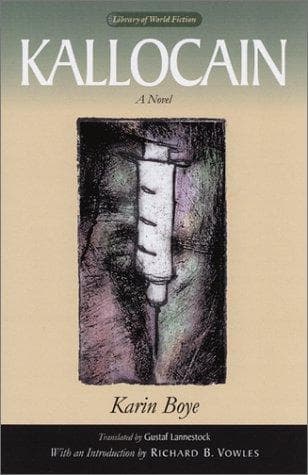
Karin Boye (2019)
Genre
Science Fiction
Reading Time
300 min
Key Themes
See below
Sign in to track this book
In a totalitarian World State where every thought is policed, a scientist invents a truth serum, only to discover the power of the human mind to resist total control.
The narrative begins with Leo Kall, a loyal citizen and chemist in the totalitarian World State, writing his memoirs from prison. He describes the omnipresent surveillance by 'police eyes' and 'police ears,' and the constant pressure to conform. He lives in Chemical City No. 4, a regimented industrial zone. Leo recounts his marriage to Linda Kall, a fellow chemist, and their strained relationship, marked by the State's interference and their own emotional repression. He works under Chief Chemist Karrek and wants to serve the State and achieve recognition. His main project is the development of a new synthetic drug, which he believes will be a tool for the State's control.
Leo synthesizes 'Kallocain,' a drug that forces subjects to reveal their innermost thoughts and feelings. He initially tests it on animals. Eager to prove its effectiveness for the State, he then moves to human trials. He volunteers to test it on himself, experiencing a brief, terrifying glimpse into his own suppressed inner world, which he quickly dismisses as a side effect. His first human test subject is an unnamed criminal, who under the influence of Kallocain, confesses to a desire for individual freedom, shocking Leo. This initial success and the unexpected revelations begin to subtly challenge Leo's loyalty to the World State.
Impressed by the initial results, the State rapidly implements Kallocain for widespread use in interrogations. Leo is in charge of administering the drug and recording confessions. During these sessions, he hears citizens express forbidden thoughts of individuality, love, and longing for freedom – concepts against the World State. Many confessions reveal informal 'voluntary service' groups, where citizens meet secretly to share private thoughts and offer mutual support, creating community outside State control. These revelations disturb the authorities, who see them as a threat to the World State's absolute power and ideological purity.
As the Kallocain interrogations continue, Leo's wife, Linda, is brought in for questioning. Under the drug's influence, Linda confesses to participating in a voluntary service group, where she found solace and belonging. More devastatingly for Leo, she also reveals her affection and admiration for Chief Chemist Karrek, expressing a desire for a different life with him, one that involves genuine emotional connection. This confession shatters Leo's perception of his wife and his marriage, leading to intense jealousy and feelings of betrayal. It also forces him to confront the emotional void in his own life, further eroding his certainty about the World State's ideals.
Linda's confession plunges Leo into a personal crisis. He begins to question the foundation of his life and his loyalty to the World State. The rigid doctrines he once embraced now seem insufficient to explain the complex human emotions revealed by Kallocain. He finds himself drawn to Karrek, not just as his superior, but as someone who appears to have a deeper understanding of human nature. Karrek, in turn, seems to subtly encourage Leo's doubts, engaging him in conversations that hint at a world beyond the State's control and the value of individual thought. This intellectual and emotional awakening for Leo is both terrifying and liberating.
During a Kallocain interrogation, a subject confesses to knowing about a hidden city in the desert, a place where people live freely, outside the control of the World State. This revelation sends shockwaves through the authorities, as it represents a threat to their total dominance. Leo is part of the expedition sent to investigate this 'desert city.' The existence of such a place, a tangible alternative to the World State's oppressive reality, further fuels Leo's internal conflict. He is torn between his ingrained loyalty to the State and a growing fascination with the possibility of true freedom and individuality.
The expedition locates the desert city. The inhabitants are unlike anyone Leo has ever encountered: they are open, expressive, and live without the fear and suspicion that define life in the World State. They openly discuss their philosophies of freedom, individual choice, and community, directly challenging every principle Leo has been taught. Leo is affected by their way of life, experiencing a sense of cognitive dissonance. He finds himself drawn to their ideals, even as his training compels him to view them as enemies of the State. This encounter forces Leo to confront the true nature of his own desires and beliefs.
Following the discovery of the desert city and the Kallocain interrogations, Chief Chemist Karrek is arrested by the State police. Although the specific charges are not detailed, it is implied that he had connections to either the voluntary service groups or the desert city itself, or harbored forbidden thoughts of his own. Karrek's arrest is a blow to Leo, who had begun to see him as a mentor and a kindred spirit in his doubts. This event isolates Leo further, forcing him to confront his own dissent without the guidance or subtle encouragement he had come to rely on from Karrek.
After Karrek's arrest, suspicion tightens. Leo himself is subjected to interrogation. Whether under Kallocain or simply broken by the pressure, Leo confesses to harboring forbidden thoughts – his doubts about the World State, his feelings of jealousy towards Karrek, and his longing for a more authentic existence. His confession is a culmination of his journey of self-discovery, revealing how Kallocain, designed to expose dissent, inadvertently fostered it within him. His admission of inner rebellion leads to his inevitable arrest and imprisonment, mirroring the fate of countless others.
The novel concludes with Leo Kall in prison, writing his memoirs. He reflects on his life, his work with Kallocain, and the changes it brought about in his understanding of humanity. He acknowledges that Kallocain, while intended to eradicate individuality, instead revealed its persistence, even in the most oppressive environment. He muses on the nature of truth, freedom, and the 'holy' inner world of human beings that the State could never fully conquer. Despite his imprisonment, there is a sense of quiet defiance and newfound understanding in his final thoughts, suggesting that even in defeat, the individual spirit can find a form of liberation.
The Protagonist
Leo transforms from an unquestioning, loyal citizen into a man who understands and even embraces the value of individual thought and freedom, ultimately leading to his downfall.
The Supporting
Linda moves from a seemingly compliant citizen to someone whose hidden inner life is exposed, challenging Leo's perceptions of her and the World State.
The Supporting
Karrek remains somewhat enigmatic but serves as a subtle mentor figure to Leo, ultimately becoming a victim of the State's paranoia.
The Supporting
The Chief of Police remains a static figure, representing the unchanging, oppressive force of the World State.
The Supporting
Evelyn's character remains static, representing the conformity expected of World State citizens.
The Supporting
Their existence and philosophy serve as a powerful external force that challenges Leo's worldview.
The Mentioned
His confession serves as a crucial turning point for Leo, initiating his journey of doubt.
The Mentioned
The children's presence is a static symbol of the State's control over family.
The novel explores how individuals form and perceive their identity, particularly under extreme societal pressure. Leo Kall, initially a conformist, undergoes a journey of self-discovery through the drug he invents. Kallocain, by revealing inner truths, forces characters like Leo and Linda to confront their authentic selves, often contradicting their outward personas. The theme questions whether true identity can be suppressed and how much of it is shaped by external forces versus an inherent inner core.
“For a moment I saw the holy, the inviolable, the untouchable within the human being, the place where all thoughts and feelings are born, where the 'I' lives and reigns.”
Kallocain portrays a totalitarian World State where every aspect of life is controlled, from work and family to thought itself. The omnipresent 'police eyes' and 'police ears' symbolize constant external surveillance, while Kallocain introduces an internal surveillance. The theme highlights the dangers of unchecked state power, the erosion of privacy, and the psychological toll of living in a society where independent thought is considered a crime. It explores the State's pursuit of absolute conformity and its failure to extinguish the human spirit.
“Our whole life was transparent. We had no secrets from the State. We had no secrets from each other.”
Central to the novel is the concept of truth – its nature, its revelation, and its consequences. Kallocain is a drug designed to extract 'truth,' but it paradoxically reveals the complexity and often contradictory nature of human thought and emotion. The State attempts to define and control truth, yet the drug exposes the widespread internal deception citizens practice to survive. The theme questions whether forced truth can truly lead to understanding or merely to further repression, and whether some truths are better left unsaid, or at least unforced.
“I had created a drug that stripped away the mask, that laid bare the innermost self. But what was that innermost self?”
In the sterile, utilitarian World State, genuine love and emotional connection are suppressed and viewed with suspicion. Relationships are primarily functional, aimed at procreation and duty. The novel explores the human need for intimacy, understanding, and belonging. Linda's confession of affection for Karrek and her participation in a 'voluntary service' group highlight this longing. Leo's jealousy and eventual recognition of his emotional void underscore the absence of love in his life, suggesting that true connection is a form of resistance against dehumanization.
“We were not supposed to have any private feelings, any private life. Everything was for the State.”
The novel examines the tension between conforming to an oppressive system and the human drive to resist. While most citizens appear to conform outwardly, Kallocain reveals widespread, often unconscious, internal resistance in the form of forbidden thoughts and desires for freedom. The 'voluntary service' groups and the 'desert city' represent more organized, secret, forms of resistance. The theme explores the psychological mechanisms of conformity, the subtle ways individuals rebel, and the ultimate futility or power of such resistance in the face of overwhelming state control.
“Could there be a world where one could think one's own thoughts, speak one's own words, without fear?”
A truth serum that exposes inner thoughts, driving the plot and character development.
Kallocain is the central plot device and a powerful symbol. It is a synthetic drug invented by Leo Kall, designed to force subjects to reveal their innermost, private thoughts. While intended by the World State to be the ultimate tool for control and the eradication of dissent, it ironically becomes the catalyst for self-discovery and a deeper understanding of human individuality for Leo. It exposes the hidden lives of citizens, revealing widespread inner rebellion, and ultimately leads to Leo's own awakening and downfall, thereby subverting its intended purpose.
Provides an intimate, subjective perspective of the dystopian world and the protagonist's internal conflict.
The story is told through the first-person perspective of Leo Kall, written as his memoirs from prison. This narrative choice offers an intimate and subjective view of the totalitarian World State and Leo's evolving internal struggle. It allows the reader to experience his initial unquestioning loyalty, his gradual disillusionment, and his final reflections firsthand. The retrospective nature of the narrative, written from prison, adds a layer of tragic irony and allows for a more contemplative tone, as Leo recounts the events that led to his downfall with newfound understanding.
A symbolic counterpoint to the World State, representing freedom and individuality.
The hidden 'desert city' functions as a symbolic plot device, representing a tangible alternative to the World State's oppressive reality. Its existence, revealed through Kallocain confessions, embodies the possibility of freedom, genuine human connection, and independent living. For Leo, it becomes a powerful external manifestation of the forbidden ideals he gradually comes to embrace. Its discovery and his encounter with its inhabitants serve to solidify his internal shift away from State ideology, acting as a beacon of hope and a profound challenge to his ingrained worldview.
Metaphorical representations of omnipresent surveillance and the erosion of privacy.
The phrases 'police eyes' and 'police ears' are recurring metaphors that symbolize the pervasive and inescapable surveillance system of the World State. They are not literal devices but represent the constant monitoring of citizens by the State, both physically and ideologically. These phrases instill a sense of paranoia and self-censorship, as citizens are aware that their every action and word might be observed and judged. They effectively convey the suffocating atmosphere of a society where privacy is nonexistent and individual expression is a dangerous act.
“In the World State, the individual is nothing, the state is everything.”
— Leo Kall's reflection on the totalitarian society he lives in.
“The drug Kallocain is the ultimate weapon against the enemy within.”
— Leo Kall describes the purpose of the truth serum he invents.
“I am a loyal citizen, but even I have thoughts I dare not speak.”
— Leo Kall's internal conflict about his own hidden feelings.
“Love is a weakness that must be eradicated for the good of the state.”
— A government official's statement on personal relationships.
“The only freedom left is the freedom to think, and even that is under attack.”
— Leo Kall's realization about the encroaching control over minds.
“Every word, every gesture, is recorded and analyzed for disloyalty.”
— Description of the pervasive surveillance in the World State.
“In revealing others' secrets, I have only exposed my own emptiness.”
— Leo Kall's regret after using Kallocain on his wife.
“The state demands not just obedience, but love for its tyranny.”
— Critique of the emotional manipulation by the government.
“We are all prisoners in a cage of our own making.”
— A character's lament about societal complicity in oppression.
“Kallocain does not find truth; it only finds what the state defines as truth.”
— A dissident's argument against the reliability of the drug.
“To be human is to have secrets, but in this world, that is a crime.”
— Reflection on the loss of privacy and individuality.
“The greatest rebellion is to remain silent when they expect confession.”
— A moment of resistance against forced interrogation.
“In the end, we are all alone with our consciences, even in a crowd.”
— Leo Kall's philosophical insight about isolation.
“Fear is the glue that holds this society together.”
— Analysis of the social dynamics in the World State.
Ready to see how well you understood this book? Take our interactive quiz with 10 questions.