“See, that's the thing about crazy... it's not a choice. It's a gift.”
— Joker reflects on his own nature and the perception of madness.

Sign in to track this book
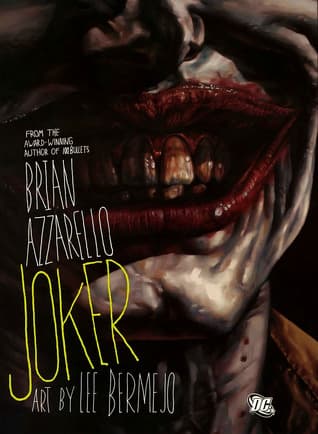
Fresh out of Arkham, the Joker begins a brutal, neon-soaked rampage across Gotham to reclaim his criminal empire, leaving chaos and blood.
Jonny Frost, a low-level thug, is sent by Harvey Dent (Two-Face) to pick up the Joker from Arkham Asylum. The Joker is calm but quickly shows his dominance. He asks about his territory and money during his time in jail. Jonny, a family man, feels drawn to the Joker's charisma and unpredictability. As they drive through Gotham, the Joker's unsettling manner and Jonny's growing unease set the stage for the night. The Joker's first stop is to reclaim what he believes is his, signaling his brutal return to Gotham's criminal world.
The Joker, with Jonny Frost, makes his first move to rebuild his empire by confronting Oswald Cobblepot, the Penguin. They arrive at the Iceberg Lounge, where the Penguin, initially dismissive, quickly understands the situation. The Joker brutally assaults one of Penguin's men, showing his renewed violence. He demands his money back, which Penguin had been 'holding onto.' The Penguin, intimidated, reluctantly hands over cash. This encounter shows Jonny the Joker's ruthlessness and the fear he causes among Gotham's criminals, solidifying Jonny's reluctant loyalty.
Next, the Joker and Jonny visit Edward Nygma, the Riddler, who has a strip club. The Riddler tries to use the Joker's return to his advantage, offering information. However, the Joker sees through his act and mocks his attempts to be a legitimate businessman. The Joker wants to reclaim his territory and make a statement. He humiliates the Riddler by forcing him to do a degrading act for his henchmen. This shows that even Gotham's intellectual criminals are not safe from his terror. This scene highlights the Joker's contempt for anyone who tries to profit from his absence or challenge his authority.
The Joker and Jonny arrive at an apartment building, where Harley Quinn waits. Her devotion to the Joker is clear, almost obsessive. Their reunion is a twisted display of affection, with Harley eager to join the Joker's violence. She has a hostage, whom the Joker brutally tortures and kills, with Harley's participation. Jonny sees their depraved relationship and the Joker's ability to corrupt others. This scene shows the Joker's manipulative power and Harley's complete submission to him, reinforcing the destructive nature of their bond and the night's escalating violence.
The Joker, with Jonny and Harley, goes into Killer Croc's territory, a brothel. Croc has been running a protection racket, and the Joker is there to take it back. The confrontation is violent. Killer Croc, a strong figure, believes he can stand up to the Joker. However, the Joker, using his mix of psychological manipulation and unexpected attacks, subdues Croc. The fight is intense, showing the Joker's willingness to use extreme violence to achieve his goals. This encounter further shows the Joker's ability to overcome even physically strong opponents through madness and cunning.
The Joker and his crew arrive at Harvey Dent's (Two-Face) headquarters. Two-Face, who arranged the Joker's release, expects cooperation or negotiation. However, the Joker has no intention of following anyone else's rules. The meeting is tense as the Joker dismisses Two-Face's attempts to reason or control him. The Joker mocks Dent's reliance on his coin, showing the random nature of his justice. This encounter highlights the difference between the Joker's chaotic nihilism and Two-Face's structured, though fractured, sense of order. It shows that even powerful criminals fear the Joker's unpredictability.
The Joker, instead of settling into a routine, plans a daring and chaotic bank robbery. This is not just about money; it is about making a statement and causing chaos. The robbery happens with the Joker's theatricality and extreme violence, leaving a trail of bodies and fear. Jonny Frost is forced to participate, seeing the Joker's destructive glee. The Joker's actions during the heist are not rational or profit-driven; they are purely for causing terror and proving his dominance. This event is a brutal show of the Joker's return and his contempt for societal norms.
During the Joker's rampage, Batman makes a brief, shadowy appearance. He does not directly confront the Joker in a long battle, but his presence is felt, a looming threat to the Joker's chaotic rule. Batman's intervention reminds both the Joker and the criminal underworld that there are limits to the chaos he can unleash. His appearance, even if short, disrupts the Joker's plans and forces him to react, highlighting the struggle between the two arch-enemies. This moment emphasizes the Joker's obsession with Batman and how Batman's existence defines much of the Joker's purpose, even when not directly present.
Throughout the night, Jonny Frost sees the Joker's growing madness and violence. He witnesses horrors, is forced to participate in crimes, and slowly loses his moral compass. The Joker's psychological manipulation and the terror Jonny experiences erode his identity as a family man. He feels both repulsed and fascinated by the Joker. This transformation shows how easily an ordinary person can be drawn into depravity when exposed to extreme evil. Jonny's internal struggle and eventual giving in show the Joker's corrupting influence.
The night's chaos ends at the Amusement Mile, a fitting backdrop for the Joker's final act. Here, the story's threads meet, leading to a violent confrontation that involves the Joker and Jonny, and possibly other Gotham criminals. The Joker's goal becomes clearer: not just money or territory, but an assertion of his chaotic philosophy and a confrontation with anyone in his way. The scene is a peak of violence and madness, leaving a lasting impact on Jonny and solidifying the Joker's terrifying return to Gotham.
In the aftermath of the Amusement Mile, Jonny Frost is in a desperate situation. Whether to protect the Joker, prove loyalty, or out of a twisted sense of belonging that has consumed him, Jonny makes a fatal decision. He is either killed or kills someone in a final act of violence, possibly by Batman or at the Joker's command. His journey from hesitant driver to implicated participant in the Joker's madness reaches its tragic end, showing the destructive power of the Joker's influence and the irreversible consequences of aligning with evil.
In the end, Batman surveys the damage and reflects on the Joker's latest rampage. His thoughts or a brief interaction summarize the endless battle against the Joker. Batman acknowledges the Joker's unique evil — not driven by greed or power, but by a desire for chaos and destruction of order. He understands that the Joker cannot be truly 'cured' or stopped permanently, only contained. This final scene reinforces the core dynamic between the two characters and the grim reality of Batman's war on crime in Gotham, always shadowed by the Joker's madness.
The Antagonist
The Joker has no traditional arc; he is a force of nature, unwavering in his chaotic philosophy, only seeking to reassert his dominance and spread his madness.
The Protagonist/Narrator
Jonny undergoes a tragic arc of psychological corruption, transforming from a reluctant observer into a desensitized, complicit participant in the Joker's madness.
The Supporting
Harley's arc is less about development and more about reaffirming her unwavering, destructive loyalty to the Joker, showcasing the depth of her psychological subjugation.
The Supporting
Two-Face attempts to assert control over the Joker but ultimately fails, reinforcing his position as a more 'rational' criminal against the Joker's nihilism.
The Supporting
The Penguin is forced to concede to the Joker's demands, demonstrating the Joker's immediate impact on Gotham's established criminal order.
The Supporting
The Riddler is humiliated by the Joker, underscoring the Joker's disdain for other criminals' attempts at 'order' or 'profit'.
The Supporting
Killer Croc is brutally defeated by the Joker, establishing the Joker's dominance even over the physically strongest criminals.
The Mentioned
Batman's presence is a constant, representing the enduring struggle against the Joker's chaos.
This theme is shown through Jonny Frost's journey. Initially a reluctant participant, Jonny is drawn into the Joker's madness, losing his moral compass. Scenes like the bank robbery, where Jonny is forced into violence, and his growing desensitization to the horrors, show this. The story suggests that prolonged exposure to evil can erode one's humanity, making an ordinary man capable of terrible acts. The Joker's ability to warp perception and morality is central to this theme.
“"He's a monster, Jonny. A monster who makes other monsters."”
The story's main conflict is the battle between chaos and order. The Joker embodies pure chaos, acting without logical motive beyond disruption. His actions against the Penguin, Riddler, and Two-Face, who represent structured criminality, highlight this. The Joker's contempt for their 'business' and 'rules' shows his nihilistic philosophy. Batman, though often unseen, represents order, constantly trying to contain the Joker's destructive force, creating a tension that drives the narrative.
“"Some men just want to watch the world burn."”
Fear is a constant element throughout the graphic novel, showing the Joker's ultimate weapon. He does not just cause physical pain; he instills psychological terror that paralyzes his victims and even his own associates. Jonny Frost's constant dread, the fear of the Penguin and Riddler when confronted, and the general apprehension among Gotham's criminal underworld all illustrate this. The Joker uses fear to assert dominance, break wills, and achieve his chaotic objectives, showing that true power for him lies in inspiring terror.
“"The only sensible way to live in this world is without rules."”
This theme is seen through several characters, especially Jonny Frost and the Joker. Jonny initially clings to his identity as a family man, but this crumbles under the Joker's influence, showing a darker side. The Joker, on the other hand, fully embraces his chaotic identity, but his existence is a form of self-deception, denying any underlying humanity. The Riddler's attempt to be a legitimate businessman, and Two-Face's reliance on a coin, also show how characters deceive themselves about their true nature in Gotham's underworld.
“"You want to know why I use a knife? Guns are too quick. You can't savor all the... little emotions."”
The story is told entirely from the perspective of a low-level criminal.
This device immerses the reader directly into the Joker's terrifying world through the eyes of an ordinary, relatable character. Jonny Frost's internal monologues provide a raw, unfiltered view of the Joker's madness and the psychological toll it takes. This perspective allows the reader to experience the fear, confusion, and eventual corruption alongside Jonny, making the Joker's actions even more visceral and disturbing. It also humanizes the criminal underworld, showing the struggles and vulnerabilities of those caught in its web, while simultaneously highlighting the Joker's profound otherness.
The Joker's actions and motives are consistently illogical and chaotic.
This device is central to the Joker's character and the narrative's tension. The Joker's lack of clear, rational motives (like greed or power) makes him profoundly terrifying. He might demand money one moment, then destroy it the next; he might kill a henchman for a minor infraction or spare an enemy for a perverse joke. This unpredictability keeps both the characters and the reader on edge, reinforcing the theme of chaos and ensuring that no one can truly anticipate his next move, making him an unstoppable force of nature within Gotham's underworld.
Gotham itself acts as a character, reflecting the story's dark themes.
Gotham City in this graphic novel is portrayed as a dark, decaying, and morally corrupt place that perfectly mirrors the Joker's madness. The dilapidated buildings, seedy clubs, and general atmosphere of despair contribute to the story's grim tone. It's not just a backdrop but an active participant, a city that breeds and is consumed by its villains. The city's decay symbolizes the erosion of hope and order, making it an ideal playground for the Joker's nihilistic philosophy and reinforcing the sense of an inescapable, oppressive environment.
The narrative focuses heavily on the mental and emotional impact of the events.
Beyond the physical violence, the story delves deep into the psychological torment experienced by Jonny Frost and the twisted psyche of the Joker. It uses Jonny's internal struggles, his growing fear, and his eventual desensitization to create a sense of dread and unease. The Joker's manipulations and mind games are as potent as his physical attacks, making the story a harrowing exploration of how a person's mind can be broken and reshaped by extreme circumstances and exposure to pure evil. This focus elevates it beyond a simple crime story into a study of mental degradation.
“See, that's the thing about crazy... it's not a choice. It's a gift.”
— Joker reflects on his own nature and the perception of madness.
“You want to know why I use a knife? Guns are too quick. You can't savor all... the little emotions.”
— Joker explains his preference for a knife over a gun to Jonny Frost.
“Smile. Because it confuses people. Because it's easier than explaining what is killing you inside.”
— Joker's philosophy on his iconic smile, shared with Jonny Frost.
“This city... it needs a villain. A monster. And I'm happy to oblige.”
— Joker's view on his role in Gotham City's ecosystem.
“Everyone's got a breaking point. Everyone. You just gotta find it.”
— Joker's belief in the inherent darkness within everyone, expressed to Jonny Frost.
“Some men just want to watch the world burn. I'm one of 'em.”
— Joker's simple, direct statement of his nihilistic motivations.
“The only sensible way to live in this world is without rules.”
— Joker's philosophy on anarchy and freedom from societal constraints.
“You really think you're different, don't you? You're not. You're just another one of them.”
— Joker taunts Jonny Frost, suggesting his lack of true individuality.
“Batman... he completes me. Without him, I'm just... a clown.”
— Joker's twisted acknowledgement of his symbiotic relationship with Batman.
“Why so serious? Let's put a smile on that face!”
— Joker's iconic line, used to provoke and terrorize.
“It's all a joke, Jonny. All of it. And the punchline... is you.”
— Joker reveals his ultimate manipulation and view of Jonny Frost's role.
“You know what the difference between you and me is, Batsy? I've had a bad day. You just keep having them.”
— Joker's personal take on his origin and Batman's perpetual struggle.
“Chaos... is fair.”
— Joker's justification for his actions, seeing chaos as an equalizer.
“I'm not a monster. I'm just ahead of the curve.”
— Joker's self-perception, believing himself to be an evolution rather than aberration.
Ready to see how well you understood this book? Take our interactive quiz with 10 questions.

Biography coming soon.

Ashley Antoinette
4.6

Mark McDonald
4.4
Luo Guanzhong
4.4

Mia McKenzie
4.3
Dorothy Parker
4.3

Joaquim Maria Machado de Assis
4.3
James Thurber
4.2

Terry Kay
4.2