“They all float down here. When you're down here with us, you'll float too!”
— Pennywise taunts Georgie Denbrough from the storm drain.

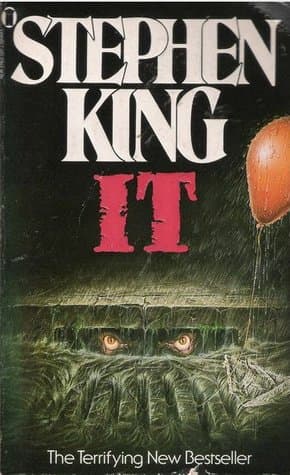
Sign in to track this book
Seven childhood friends in the haunted town of Derry must return as adults to confront the shape-shifting, sewer-dwelling evil they thought they'd defeated, forcing them to relive their deepest fears and the terrifying bond that links them to 'It'.
In October 1957, six-year-old George Denbrough, brother of stuttering Bill Denbrough, plays with a paper boat Bill made for him during a rainstorm in Derry, Maine. The boat falls into a storm drain. When Georgie looks inside, he sees a clown with a wide, terrifying smile and silver eyes. The creature introduces himself as Pennywise the Dancing Clown. Pennywise offers Georgie his boat back and a balloon. Despite his initial fear, Georgie is drawn in by the clown's apparent friendliness. When Georgie reaches for his boat, Pennywise seizes his arm, rips it off, and drags him into the sewer to his death. This event starts a new cycle of terror in Derry, which adults mostly ignore or explain away.
After Georgie's death and other strange events, Bill Denbrough, grieving and struggling with his stutter, begins to experience frightening encounters with 'It.' He forms a close bond with other outcasts in Derry: Ben Hanscom, an overweight new kid; Beverly Marsh, a poor girl abused by her father; Richie Tozier, a loud comedian; Eddie Kaspbrak, an asthmatic; Mike Hanlon, a Black boy whose family knows Derry's dark history; and Stan Uris, a Jewish boy with a meticulous nature. Each child has had a terrifying encounter with 'It,' which often appears as their deepest fears, most often as Pennywise the Clown. Their shared experiences and understanding that adults cannot see or will not acknowledge the evil strengthen their friendship and purpose.
Wanting to understand and confront the entity tormenting Derry, the Losers' Club goes to the abandoned house on Neibolt Street, a known haunt of 'It.' Inside, they encounter Pennywise in a terrifying form. Eddie Kaspbrak, despite his severe asthma and fear, manages to wound 'It' with an inhaler filled with what he believes is powerful medicine (but is actually a placebo). This first confrontation is a key moment, as it shows the Losers that 'It' can be hurt and that their collective belief and courage have power against the creature. Though 'It' escapes, the Losers realize their unity is their greatest weapon.
After more research and shared visions, Bill learns about the Ritual of Chüd, an ancient metaphysical battle of wills against 'It' in its true form, a cosmic entity. The Losers' Club goes into the sewers beneath Derry, where they confront 'It' in its spider-like true form. Bill engages 'It' in the Ritual of Chüd, a mental battle where he bites 'It's tongue and forces it to retreat. At the same time, the other Losers physically attack 'It', believing they have fatally wounded it. They make a blood oath to return to Derry if 'It' ever reappears, promising to face it again as adults, and then leave town, slowly forgetting the horrors they endured.
Twenty-seven years after their first battle, in 1985, a new cycle of child murders begins in Derry, like the pattern of 1958. Mike Hanlon, the only Loser who stayed in Derry and became the town librarian, keeps their shared history. He recognizes the pattern and knows 'It' has returned. Fulfilling their childhood oath, Mike calls the other six members: Bill Denbrough (now a successful horror novelist), Ben Hanscom (a renowned architect), Beverly Marsh (a fashion designer), Richie Tozier (a famous comedian), Eddie Kaspbrak (a limo driver), and Stan Uris (an accountant). The calls bring back repressed memories and a deep, unsettling fear, compelling them to return to their cursed hometown.
Upon receiving Mike's call, Stan Uris, now a successful and meticulous accountant, is overwhelmed by the resurfacing memories of 'It' and the terrifying oath. Unlike the others, Stan's way of coping with trauma was absolute repression. The thought of confronting the creature again is too much for his rational mind. He locks himself in his bathroom, writes 'IT' on the wall in his own blood, and slits his wrists in the bathtub. His suicide shows the immense psychological toll 'It' takes on its victims, even those who escape its physical grasp, and reminds the remaining Losers of the true danger they face.
The five remaining Losers—Bill, Ben, Beverly, Richie, and Eddie—arrive in Derry, each experiencing a disorienting sense of déjà vu and fragmented, terrifying memories. They gather at the Chinese restaurant where they had their last meal as children. As they talk, the memories slowly come together, bringing with them the overwhelming fear and trauma they had suppressed for decades. The reunion is tense, with old resentments and the weight of Stan's suicide, but their shared history and the immediate threat of 'It' begin to rebuild their powerful, almost telepathic bond. They realize how much 'It' influences Derry's adults, who remain willfully ignorant of the horrors around them.
Mike Hanlon, having spent years documenting Derry's dark history, shares his findings with the reunited Losers. He reveals that 'It' is an ancient cosmic entity, a shapeshifter that feeds on fear, and that its cycles of activity typically last around 27 years. To fully prepare for their final confrontation, Mike leads them to the 'smoke-hole,' a Native American sweat lodge. There, they perform a ritual that allows them to access collective memories and visions. During this, they recall their first encounter with 'It's true, cosmic form as a giant spider-like creature in the sewers, confirming their understanding of the true enemy.
With renewed courage and understanding, the adult Losers go into the sewers once more for their final confrontation with 'It.' They find 'It' in its monstrous spider form, weakened but still powerful. Bill attempts the Ritual of Chüd again, engaging 'It' in a psychic battle. During the intense struggle, Eddie Kaspbrak, overcoming his lifelong hypochondria, bravely uses his inhaler, not as a placebo this time, but as a weapon, spraying a powerful, corrosive substance into 'It's throat. This act mortally wounds 'It,' but in a final retaliatory strike, 'It' bites off Eddie's arm, leading to his death. The remaining Losers tear 'It's heart out, crushing it and ensuring its demise.
With 'It' finally defeated, the town of Derry begins to crumble and decay, as if the entity was its dark heart. Buildings collapse, the weather turns violent, and a general sense of unease fills the town. The remaining Losers—Bill, Ben, Beverly, Richie, and Mike—emerge from the sewers, physically and emotionally scarred but victorious. As they leave Derry for the last time, the memories of 'It' and their shared ordeal begin to fade once more, a protective mechanism of their minds and perhaps a final influence of 'It's death. Their bonds, however, remain subtly altered, and they carry an unspoken understanding of their shared experience.
The Protagonist
Bill transforms from a guilt-ridden child seeking revenge into a courageous adult who faces his deepest fears to protect his friends and finally lay his brother's ghost to rest.
The Protagonist
Ben grows from an insecure, bullied child into a confident and successful adult, overcoming his physical and emotional vulnerabilities to contribute significantly to 'It's defeat.
The Protagonist
Beverly overcomes a cycle of abuse and finds her voice and strength, breaking free from patriarchal oppression and confronting the ultimate evil.
The Protagonist
Richie learns to channel his comedic defense into genuine courage, facing his fears not with jokes, but with a profound commitment to his friends.
The Protagonist
Eddie transforms from a hypochondriac controlled by his mother into a brave, self-sacrificing hero who finds his true strength in confronting 'It'.
The Protagonist
Mike embraces his role as the keeper of Derry's dark history, becoming the anchor and catalyst for the Losers' Club's final stand against 'It'.
The Protagonist/Tragic Figure
Stan's arc is one of tragic failure; unable to reconcile his rational nature with the terrifying reality of 'It', he succumbs to fear and takes his own life rather than face the horror again.
The Antagonist
'It' remains a constant force of evil, its arc defined by its cycles of predation and its ultimate, hard-fought destruction by the Losers' Club.
The Supporting/Antagonist
Henry descends further into madness and violence, becoming 'It's human instrument of terror, ultimately meeting a gruesome end.
The enduring strength of the Losers' Club's friendship is the novel's core. Their bond, formed in shared trauma and mutual support, is the only force capable of defeating 'It.' As children, their collective belief and love give them the courage to confront the monster. As adults, their oath and the rekindling of these bonds allow them to overcome individual fears and trauma, proving that unity and loyalty can conquer even cosmic evil. This theme appears in the 'smoke-hole' scene, where collective memories solidify their purpose, and in the final battle, where they fight as one.
“Maybe there aren't any good or bad friends. Maybe there are just friends, people who stand by you when you're hurt and who help you up when you're down.”
The novel explores the painful shift from childhood innocence to adulthood, especially through memory. The Losers' Club's memories of 'It' and their childhood in Derry are repressed as they grow up, a defense against trauma. This loss of memory is also a loss of their unique perception, as adults in Derry are generally blind to 'It's evil. Remembering, however painful, is key to their ability to fight 'It' again. The book suggests that while adulthood brings forgetfulness, it also brings a deeper understanding and courage to face past demons.
“Adults are the real monsters, children are just their victims.”
Derry is a sick town, deeply affected by 'It's presence. Derry's adults are either willfully ignorant, complicit, or actively malevolent, reflecting 'It's own cruelty. The town's history is full of violence, accidents, and unexplained disappearances, all subtly influenced by 'It.' This theme shows how systemic evil can rot a community, making its inhabitants blind to atrocities and perpetuating cycles of abuse and violence. The town's physical decay after 'It's defeat further emphasizes this connection.
“Derry was a place of evil, a place where evil was quite at home.”
'It' doesn't just kill; it feeds on fear. This theme is central to the entity's nature and the Losers' struggle. 'It' appears as each child's deepest fear—a mummy, a werewolf, a leper, a giant bird, etc.—because fear makes them 'taste' better. The Losers' ability to overcome their fear, individually and collectively, is their most potent weapon against 'It.' The novel suggests that facing one's fears, rather than giving in to them, diminishes the monster's power. This is clear in scenes like Eddie using his 'placebo' inhaler against 'It' or Beverly's defiant act of cutting her hair.
“You can't fight what you can't see, but you can fight what you fear.”
A metaphysical, psychic battle of wills against 'It's true form.
The Ritual of Chüd is an ancient, esoteric battle of wits and courage, not a physical fight. It involves a mental confrontation with 'It' in its true, cosmic form, where the combatants literally 'bite' each other's tongues in a metaphysical sense. This device elevates the conflict beyond mere monster-fighting, introducing a spiritual and psychological dimension. It emphasizes that 'It' is not just a creature but a force that must be defeated on a deeper, conceptual level, primarily through belief and courage rather than brute strength. It also links the Losers to an ancient, cosmic struggle.
'It's extradimensional origin and true, terrifying essence.
The Macroverse is the cosmic realm from which 'It' originates, a place of ultimate chaos and unknowable horrors. The 'Deadlights' are 'It's true form, a swirling, orange, destructive light that can drive anyone mad or consume their soul. This device establishes 'It' as an entity far beyond human comprehension or conventional evil, making its defeat all the more monumental. It adds a layer of cosmic horror to the narrative, expanding the scope of the threat beyond a simple monster in the sewers to an ancient, almost god-like malevolence. The Deadlights represent absolute terror and oblivion.
A childhood promise to return and fight 'It' if it ever resurfaces.
The blood oath made by the Losers' Club as children is a crucial plot device that binds their future. It serves as the narrative engine for the adult timeline, compelling them to return to Derry despite their forgotten memories and adult lives. The oath symbolizes the unbreakable bond of their friendship and their shared responsibility. It also highlights the cyclical nature of 'It's evil and the idea that some promises, once made, transcend time and memory, forcing individuals to confront their past traumas.
A Native American sweat lodge used to unlock suppressed memories.
The smoke-hole is a Native American sweat lodge where Mike Hanlon leads the adult Losers to help them regain their repressed memories of 'It' and their childhood. This device serves as a catalyst for their collective remembering, allowing them to access shared visions and piece together the fragmented past. It is a spiritual and symbolic space that facilitates profound introspection and reconnection, emphasizing the importance of confronting and reclaiming one's past, however painful, to gain strength and understanding. It also grounds the supernatural elements in a form of ancient wisdom.
“They all float down here. When you're down here with us, you'll float too!”
— Pennywise taunts Georgie Denbrough from the storm drain.
“All children, except one, grow up.”
— The opening line of the book, setting a tone of lost innocence.
“Home is the place where when you have to go there, they have to take you in.”
— Mike Hanlon reflects on the meaning of home and belonging, especially in contrast to Derry.
“The most important things are the hardest to say. They are the things you get ashamed of, because words diminish them.”
— Bill Denbrough's internal monologue about the difficulty of expressing profound emotions and truths.
“Maybe there aren't any such things as good friends or bad friends – maybe there are just friends, people who stand by you when you're hurt and who help you feel better.”
— Ben Hanscom's thoughts on the nature of friendship.
“Maybe there was no such thing as a monster in the dark. Maybe there were only monsters in the mind.”
— Richie Tozier's reflection on the source of fear.
“It was the terror that was real, not the creature itself.”
— The Losers' Club realizes the true power of It lies in the fear it generates.
“Sometimes being a brother is even better than being a superhero.”
— A thought about the bond between Bill and Georgie, and later, the Losers.
“You can kill a dragon, but you can't kill a fairy tale.”
— Reflecting on the enduring nature of stories and evil.
“Memory, like a house, has many rooms. Some are dark, some are light, some are rarely visited.”
— The adult Losers struggle with their suppressed memories of Derry.
“Kids don't stay kids forever. But childhood... childhood lasts forever.”
— A reflection on the lasting impact of childhood experiences.
“Everything floats down here. Everything.”
— A recurring taunt from Pennywise, emphasizing the pervasive nature of It's influence.
“He who makes a beast of himself gets rid of the pain of being a man.”
— Richie Tozier, quoting Samuel Johnson, reflecting on the escapism of his comedic persona.
“The town itself was a monster, not just the clown.”
— The Losers realize Derry is infected by It's presence, making the town complicit.
Ready to see how well you understood this book? Take our interactive quiz with 10 questions.

Stephen Edwin King is an American author of horror, supernatural fiction, suspense, crime, science-fiction, and fantasy novels. Described as the "King of Horror", his books have sold more than 350 million copies as of 2006, and many have been adapted into films, television series, miniseries, and comic books. King has published over 65 novels/novellas, including seven under the pen name Richard Bachman, and five non-fiction books. He has also written approximately 200 short stories, most of which have been published in book collections.

Ashley Antoinette
4.6

Mark McDonald
4.4
Luo Guanzhong
4.4
Mia McKenzie
4.3
Dorothy Parker
4.3

Joaquim Maria Machado de Assis
4.3
James Thurber
4.2
Terry Kay
4.2