“The city is a place where you are born and die, but you never really live.”
— Anna reflects on the nature of the decaying city she inhabits.

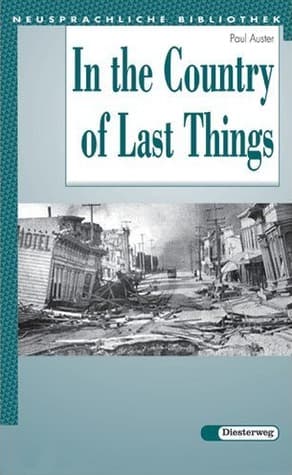
Paul Auster (1987)
Genre
Science Fiction
Reading Time
240 min
Key Themes
See below
Sign in to track this book
In a city where the living scavenge and the dead are fuel, a young woman searches for her vanished brother, documenting humanity's last stand in a world near collapse.
Anna Blume, a young woman from an unspecified 'East,' arrives in a sprawling, unnamed city that has fallen into decay and chaos. Her main goal is to find her older brother, William, a journalist who disappeared after entering the city years earlier to report on its decline. Anna quickly discovers that the city is a lawless wasteland where survival is a daily struggle. Basic needs like food and shelter are scarce, and the population mainly consists of scavengers, 'finders' who search for discarded objects, and 'runners' who commit suicide for money. Anna's first experiences are disorienting and dangerous, as she navigates a place where the rules of civilization no longer apply, and human life has little value. She immediately faces the harsh realities of this new world, realizing the immense challenge of finding William.
Soon after arriving, Anna meets Isabel, a tough and practical woman who becomes her first guide and protector in the desolate city. Isabel has learned to navigate the dangers and unwritten rules of this post-apocalyptic society. She teaches Anna essential survival skills, such as how to find food, avoid danger, and identify the various social groups and their uncertain lives. Isabel explains the different 'professions'—the 'scavengers' who sift through trash, the 'finders' who search for valuable discarded items, and the 'death-runners' who commit public suicide for money. Through Isabel, Anna begins to understand the deep desolation and moral decay of the city, slowly letting go of her naive expectations and adapting to the brutal demands of her new environment. Their bond is important for Anna's initial survival.
Anna's search for her brother William eventually leads her to Ferdinand, a man who says he knew William and worked with him as a journalist. Ferdinand offers appealing, yet often vague, details about William's last known whereabouts and his investigations into the city's collapse. He suggests that William was deeply involved in uncovering the true nature of the city's decline, possibly even its origins. Ferdinand's information, however, is unreliable and often contradictory, leaving Anna uncertain. Despite the ambiguity, Ferdinand represents Anna's most promising lead, and she holds onto his words, hoping they will guide her to William. This period is marked by growing frustration and a deepening sense of despair as the truth about her brother remains hidden.
To survive, Anna must take on roles common to the city's inhabitants. She first becomes a 'scavenger,' sifting through mountains of trash and human waste for anything useful or edible. This period is physically and emotionally draining, exposing her to extreme poverty and degradation. Later, she becomes a 'finder,' a slightly more specialized role where she searches for specific, discarded objects that can be resold or traded. This work, though still dangerous, offers a small improvement in her living conditions and exposes her to different parts of the city's underground economy. Her experiences as both a scavenger and a finder give Anna a close understanding of the city's economic and social structures, showing the cleverness and desperation needed for daily life.
During her desperate search for food and information, Anna meets Robert, a quiet, mysterious man who works as a librarian in one of the city's last remaining, though rundown, libraries. This meeting is a significant turning point for Anna, as Robert introduces her to a hidden world of books and knowledge—a strong contrast to the city's widespread illiteracy and disregard for culture. Robert is a guardian of the past, carefully preserving what remains of written history. He offers Anna not just a refuge from the city's brutality but also a connection to intellectual life, providing her with books to read and a sense of purpose beyond mere survival. Their growing relationship gives Anna emotional comfort and renewed hope amidst the pervasive despair, as she finds solace in literature.
Anna becomes acutely aware of the 'death-runners,' individuals who, driven by extreme poverty or despair, choose to commit public suicide for a fee. These spectacles are morbidly popular, drawing crowds who pay to watch the final moments of these individuals, with their bodies often sold for fuel or other uses. Anna observes several such events, which deeply disturb her and highlight the city's deep moral collapse and the devaluation of human life. The death-runners represent the ultimate act of desperation and a chilling example of how even death has become a commodity in this society. These experiences force Anna to confront the darkest aspects of the human condition and the lengths people will go to survive or escape their suffering, profoundly changing her view of the world.
Amidst the city's widespread death and decay, Anna discovers the 'Nurses,' a secret group of women who care for the sick and dying, often at great personal risk. Unlike the official authorities who mainly collect corpses for fuel, the Nurses represent a counter-force of compassion and humanity. They operate in secret, providing comfort, medical attention, and dignity to those abandoned by society. Anna is deeply moved by their selfless work, which stands in strong contrast to the city's prevailing indifference. The Nurses offer a glimmer of hope and show that even in the most desolate circumstances, altruism and the will to preserve life can endure. Their existence challenges Anna's growing cynicism about human nature.
Through fragmented clues, Ferdinand's reluctant confessions, and her own persistent investigations, Anna eventually puts together the tragic truth about her brother, William. It is revealed that William, in his eager pursuit of journalistic truth, delved too deeply into the city's secrets, uncovering uncomfortable truths about the ruling powers or the origins of the city's collapse. His investigations led to his death, either through direct confrontation with authorities or by succumbing to the city's dangers and deprivations. Anna learns that William died alone, a victim of the very chaos he sought to document. This revelation brings a painful end to her search, confirming her deepest fears and leaving her to deal with the profound grief of her loss and the pointlessness of her long journey.
With the mystery of William's fate resolved, Anna changes deeply. The initial hope and naive optimism that drove her into the city are replaced by a hardened practicality and a deep understanding of its brutal realities. However, instead of giving in to despair, Anna finds a new sense of purpose and belonging. She fully integrates into the city's life, no longer an outsider searching for a lost past, but a survivor building a future. Her relationships with Isabel, Robert, and her awareness of the Nurses solidify her connection to this new world. Anna accepts her place within the city's unique ecosystem, embracing its contradictions and finding meaning in the small acts of kindness and endurance that persist amidst the decay. She becomes a chronicler of her experiences, writing her letter to a childhood friend.
The entire narrative is a long, continuous letter written by Anna to an unnamed childhood friend in a world that is presumably still intact. This letter format highlights Anna's isolation and her attempt to bridge the vast gap between her past and present. As the letter progresses, it becomes clear that Anna is writing from within the city, carefully detailing her experiences, observations, and reflections. The letter serves as both a confession and a record of a world on the brink of oblivion. The novel ends with Anna still in the city, the letter itself an ongoing act of survival and communication. She does not escape; instead, she becomes a permanent resident, her story ending not with a definitive resolution but with the continuation of her struggle and her role as a witness to the 'country of last things.'
The Protagonist
Anna transforms from a hopeful outsider to a hardened, yet compassionate, survivor who finds a new sense of belonging and purpose within the desolate city.
The Mentioned/Catalyst
His fate is revealed to be tragic, providing closure for Anna but cementing the city's destructive power.
The Supporting
She remains a steadfast, pragmatic guide, embodying the enduring human capacity for survival and limited compassion.
The Supporting
He provides Anna with a sanctuary and a connection to intellectual life, representing enduring hope amidst despair.
The Supporting
He serves as a conduit for information, however unreliable, regarding William's fate, eventually providing a form of closure.
The Supporting/Collective
They represent a persistent force of humanity and compassion amidst the city's decay, offering a glimmer of hope.
The Supporting/Collective
Their existence underscores the profound moral and social collapse of the city.
The novel shows a city where all signs of civilization have collapsed. Law, government, economy, and morality have dissolved into chaos. People scavenge to survive, bodies are fuel, and public suicide is a profession. This theme is clear from Anna's arrival, where she immediately sees the lack of infrastructure, the widespread violence, and the desperate 'professions' like 'scavengers' and 'death-runners.' The city's authorities only collect waste and corpses, showing the complete breakdown of any social contract and the reduction of human life to its most basic, useful function. The absence of a functioning government or ethical framework highlights humanity's vulnerability without societal structures.
“In this country, it is impossible to die. You can only be killed.”
Anna's initial search for her brother, William, quickly becomes a deeper search for meaning and a sense of self in a world stripped of conventional values. As she adapts to the city, she sheds her old identity and deals with basic questions about existence, purpose, and human connection. Her relationship with Robert and her discovery of the library show her struggle to maintain intellectual and emotional identity amidst the widespread illiteracy and despair. Even after discovering William's fate, Anna chooses to stay, finding a new identity as a chronicler and a survivor, making her own meaning in the 'country of last things.'
“I was no longer looking for William. I was looking for myself.”
The novel, a letter, emphasizes the importance of memory and storytelling in preserving history in a world that actively forgets. Anna's letter itself is an act of memory, a desperate attempt to record and send the city's reality to an outside world. Robert's role as a librarian, carefully preserving books, further highlights this theme, as he guards against the complete erasure of knowledge and culture. The city's indifference to its past and its constant change make individual and collective memory fragile, yet Anna's persistent storytelling shows the lasting human need to document and understand, even when the future looks bleak.
“The past is a foreign country. They do things differently there.”
The city is a stark place for both the depths of human despair and the incredible capacity for endurance. Characters like Isabel, who has mastered survival, and the 'Nurses,' who provide care amidst overwhelming death, embody endurance. However, this endurance often comes from deep desperation, as seen in the 'death-runners' who choose suicide for profit. Anna herself shows this duality, moving from initial shock and despair to a hardened determination to survive and even find purpose. The novel explores the fine line between giving up and finding the will to continue, showing the complex range of human responses to extreme hardship.
“In this place, hope is a kind of illness.”
In a world where everything is scarce, the value of objects is both absolute and changing. Scavengers and 'finders' dedicate their lives to unearthing discarded items, which can be traded for survival. From a broken umbrella to a usable shoe, every object gains immense importance. This theme highlights the material reality of existence in the absence of abstract values. The city's economy is based entirely on repurposing trash, showing how human ingenuity, driven by necessity, can turn junk into life-sustaining resources. This focus on the material world emphasizes the sheer practicality needed for survival and the loss of any luxury or aesthetic appreciation.
“Nothing is worthless. Everything has a use.”
The entire novel is presented as a letter from Anna Blume to a childhood friend.
The epistolary format is central to 'In the Country of Last Things.' It creates an intimate, first-person perspective, allowing the reader direct access to Anna's thoughts, observations, and emotional state. This device emphasizes Anna's isolation and her desperate need to communicate her experiences to an outside world that may no longer exist or understand. The act of writing becomes an act of survival, a way for Anna to maintain her sanity and preserve a record of the city's horrors. It also adds a layer of unreliability, as the reader only has Anna's subjective account, filtered through her memory and emotional state.
The setting is an unnamed, decaying city at an unspecified point in time.
The decision to leave the city unnamed and the timeframe ambiguous creates a universal, allegorical quality for the narrative. By not grounding the story in a specific place or time, Auster suggests that the collapse depicted could happen anywhere, at any time, making the themes of societal breakdown and human survival more potent and broadly applicable. This ambiguity forces the reader to focus on the human condition and the systemic issues at play, rather than specific political or historical contexts. It enhances the sense of isolation and the feeling that this 'country of last things' exists outside conventional reality.
The city's inhabitants are defined by their unique, often morbid, survival 'professions'.
The various 'professions' like 'scavengers,' 'finders,' 'death-runners,' and 'collectors' (of human waste and corpses) serve as a powerful plot device for social commentary. They vividly illustrate the city's extreme economic and moral collapse, where traditional jobs have been replaced by roles directly tied to refuse, death, or desperate ingenuity. These 'professions' highlight the dehumanization of individuals, reducing them to their functional utility within a broken system. They also reveal the ingenuity and adaptability of humans in the face of unimaginable adversity, while simultaneously underscoring the profound loss of dignity and purpose in this dystopian society.
William Blume, Anna's missing brother, serves as a primary catalyst for her journey.
William Blume, Anna's missing brother, functions as a MacGuffin in the narrative. While his disappearance is the initial driving force behind Anna's perilous journey into the city, his actual presence or fate becomes less important than the experiences and transformations Anna undergoes during her search. The search for William propels the plot forward, forcing Anna to confront the city's realities and develop as a character. By the time his fate is revealed, the reader's focus has shifted from William to Anna's own survival and her evolving understanding of the 'country of last things,' making his initial purpose primarily a narrative catalyst.
“The city is a place where you are born and die, but you never really live.”
— Anna reflects on the nature of the decaying city she inhabits.
“Each day is a new beginning, a new chance to fail.”
— Anna's cynical outlook on the relentless struggle for survival.
“Things do not vanish. They are merely transformed.”
— A recurring thought about the recycling of objects and bodies in the city.
“We were all searching for something, but no one knew what it was.”
— Anna describes the aimless wandering of the city's inhabitants.
“Memory is a kind of wound, and the past is a foreign country.”
— Anna struggles with her memories of a world that no longer exists.
“To live is to be marked, to be scarred.”
— A reflection on the physical and emotional toll of living in the city.
“Hope is a dangerous thing, but it's the only thing we have.”
— Anna acknowledges the paradoxical role of hope in their grim reality.
“The world was a book, and we were trapped inside its pages.”
— A metaphor for the inescapable fate of the city's residents.
“We learned to live without, because there was nothing else.”
— Anna describes the pervasive scarcity and adaptation to it.
“The dead were more numerous than the living, and they were everywhere.”
— A stark observation about the high mortality rate and the visible presence of death.
“Words are not things, but they can make things happen.”
— Anna considers the power of language even in a broken world.
“Every object has a history, a story that it carries within itself.”
— Anna's perspective on the hidden narratives of discarded items.
“To be forgotten is to die a second death.”
— A fear expressed about the ultimate erasure in a world without records.
“The future was a word we no longer understood.”
— Anna reflects on the loss of foresight and planning in their day-to-day existence.
Ready to see how well you understood this book? Take our interactive quiz with 10 questions.
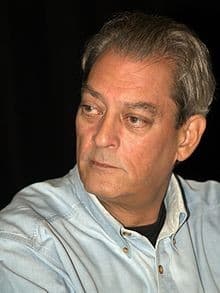
Paul Benjamin Auster is an American writer and film director. His notable works include The New York Trilogy (1987), Moon Palace (1989), The Music of Chance (1990), The Book of Illusions (2002), The Brooklyn Follies (2005), Invisible (2009), Sunset Park (2010), Winter Journal (2012), and 4 3 2 1 (2017). His books have been translated into more than forty languages.