“Because they were always there, and we were always here. And the forest was always ours.”
— A tribal character reflecting on the ancestral connection to the land.

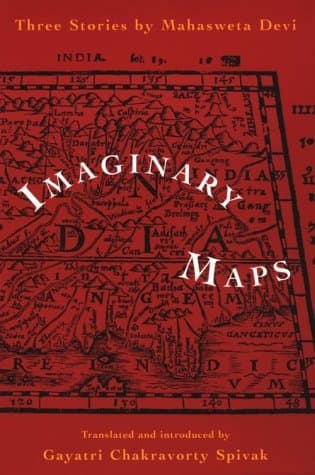
Mahasweta Devi (1994)
Genre
Fiction
Reading Time
213 min
Key Themes
See below
Sign in to track this book
Mahasweta Devi's "Imaginary Maps" shows the harsh lives and strong spirits of India's indigenous tribes, revealing how history, myth, and politics marginalize them but also fuel their fight to survive.
Puran Sahay, a journalist from Calcutta, travels to Pirtha, an isolated tribal village in the forest. He has heard rumors of a pterodactyl and plans to write a story. He meets the Munda and Santhal villagers, who are cautious and confused by his presence. Puran is a modern man with cameras and notebooks, but Pirtha's old ways and beliefs challenge his urban views. The village elder, Ganpat, and other tribals see the pterodactyl not as a scientific curiosity but as a symbol of their past and uncertain future, a creature representing their forgotten history and current marginalization. Puran at first struggles to understand their view, seeing their explanations as superstition.
As Puran spends more time in Pirtha, he starts to learn about the village's sad history of exploitation by outsiders—landlords, moneylenders, and government officials. He learns about their fight for land rights, their decreasing resources, and the loss of their traditional life. For the villagers, the pterodactyl is not just a creature but a living memory, a symbol of their ancient line and their possible extinction. It represents their lost glory, cultural identity, and resistance against the modern world that threatens to erase them. Puran sees their rituals and stories, which are deeply tied to the land and their ancestors. He begins to question his initial journalistic goal, realizing the deep meaning the pterodactyl holds for the community, beyond just an animal sighting.
Puran Sahay's understanding of Pirtha grows as he sees the injustices the tribals face. He sees their poverty, their strength, and their strong connection to the land. His first goal of a sensational story changes into a growing empathy and a realization of his own role, as an urban intellectual, in their marginalization. He starts to see the pterodactyl not as a real animal, but as a strong metaphor for forgotten history and the threat to tribal life. The villagers, especially the women, share stories of their ancestors and struggles, slowly changing Puran's ideas. He realizes that the 'pterodactyl' is a shared memory, a desperate call for recognition, and a symbol of their fight for survival against a world that wants to erase them.
Douloti, a young Uraon tribal woman, lives in extreme poverty and constant exploitation. She works as a bonded laborer in a brick kiln, a brutal life where she endures hard work and sexual abuse from the kiln owner and his overseers. Her life is a cycle of labor, hunger, and violence, with no escape. Despite her suffering, Douloti has an inner strength and a desperate hope for a better future, especially for her unborn child. The story clearly shows the dehumanizing conditions tribal laborers face, highlighting the systemic oppression and lack of power for women like Douloti. Her body, her labor, and her life are treated as goods, showing the extreme vulnerability of marginalized communities.
In Douloti's harsh life, a kind doctor, Dr. R.N. Lahiri, arrives, bringing medical help and a rare sense of humanity to the exploited laborers. His presence offers a short break from their daily suffering. During a local festival, Douloti, despite her tiredness and poor health, takes part in the celebrations. This brief moment of joy and community connection shows the deep cultural roots and resilience of the tribal people, even when facing great hardship. However, the festival also contrasts sharply with her daily life, showing how short-lived happiness is and the constant threat of exploitation. The doctor's brief help, while offering some relief, cannot change the systemic problems that trap Douloti and others.
Douloti's life ends in a sad and symbolic death. After repeated sexual assaults and enduring harsh labor, she gets a serious illness. Her body, already weakened by malnutrition and abuse, gives in to the sickness. Her death is not just a personal tragedy but a strong accusation of the systemic violence and exploitation tribal women face. Her last moments include a desperate plea for recognition and dignity, as she leaves behind a child who will likely share her fate. Douloti's death is a clear reminder of the devastating effects of social and economic injustice, and the deep vulnerability of those on society's edges, whose lives are seen as disposable by the powerful.
Mary Oraon, a spirited and defiant young tribal woman, faces a tense situation during a traditional communal hunt. The hunt, an important cultural event for her community, is interrupted by a powerful colonial officer, Mr. Sanyal, who represents the oppressive force of the British Raj and its lasting influence. Mary, unlike many others, refuses to be scared. She challenges Sanyal's authority and his attempts to exploit the tribals and their resources. Her defiance comes from a strong connection to her ancestral land and a fierce pride in her tribal identity. The hunt becomes a small example of the bigger fight for land, dignity, and self-determination against colonial and post-colonial exploitation.
The story looks at the historical and ongoing conflict between tribal communities and outside powers—represented by Mr. Sanyal and the systems he embodies. The land, which is sacred and central to the tribals' identity and living, is constantly threatened by logging, mining, and farming expansion. The hunt is not just about catching animals; it is a ritual that confirms their connection to the forest and their traditional way of life. Mary's resistance highlights the struggle to keep their cultural heritage and economic independence in the face of constant pressure. The story shows how losing land means losing identity and the erosion of their very existence as a distinct people, facing a constant battle for survival.
Driven by years of oppression and personal wrongs, Mary Oraon takes a decisive and violent stand against Mr. Sanyal. During the hunt, she uses her traditional skills and forest knowledge to outsmart him, eventually killing him. This act is not just revenge but a symbolic reclaiming of power and a desperate cry for justice. Her action, while sad in its immediate results, is a strong statement against the exploitation and dehumanization of her people. Mary then faces the unavoidable consequences, yet her act leaves a lasting mark, raising awareness and showing the lasting spirit of resistance among the marginalized.
Across all three stories, Mahasweta Devi carefully shows how suffering connects various tribal communities in India. Whether it is the threat symbolized by the pterodactyl in Pirtha, Douloti's brutal exploitation in the brick kiln, or Mary Oraon's defiant act in 'The Hunt,' the themes of land loss, economic exploitation, cultural erasure, and gender violence are always present. The 'imaginary maps' are not just about geography but also about ideas, charting the social and political situations of marginalized lives. The stories reveal how outside forces, from colonial legacies to modern capitalism, work together to dispossess and dehumanize these communities, creating a shared experience of struggle and resilience against great odds, connecting their fates.
The Protagonist (Pterodactyl, Pirtha, and Puran Sahay)
Puran transforms from an objective, somewhat cynical observer into an empathetic witness who recognizes the symbolic truth and systemic injustices faced by the tribal communities.
The Protagonist (Douloti the Bountiful)
Douloti's arc is one of sustained suffering culminating in a tragic, symbolic death that highlights the brutal realities of her community.
The Protagonist (The Hunt)
Mary moves from simmering resentment to a decisive, violent act of rebellion, becoming a powerful symbol of tribal resistance.
The Supporting (Pterodactyl, Pirtha, and Puran Sahay)
Ganpat remains a steadfast guardian of his community's heritage, serving as a bridge between ancient wisdom and the encroaching modern world.
The Supporting (Douloti the Bountiful)
Dr. Lahiri remains a compassionate observer, his good intentions highlighting the limitations of individual efforts against systemic oppression.
The Antagonist (The Hunt)
Mr. Sanyal remains a static embodiment of oppressive power, ultimately meeting a violent end at the hands of those he exploited.
The Antagonist (Douloti the Bountiful)
The kiln owner remains a static symbol of unrepentant exploitation, his power unchallenged within the narrative.
This is a main theme in all three stories, showing the systematic exploitation of indigenous tribal communities in India. 'Douloti the Bountiful' clearly shows economic exploitation through bonded labor and sexual abuse in the brick kiln. 'The Hunt' depicts the ongoing struggle against land loss and the taking of resources by outside powers like Mr. Sanyal. In 'Pterodactyl, Pirtha, and Puran Sahay,' the tribals' marginalization is clear in their forgotten history and the threat to their cultural identity. Devi consistently reveals how these communities are pushed aside, their lives and livelihoods seen as disposable by the dominant society.
“There are people like us, and there are human beings. We are people. They are human beings.”
The stories strongly convey the loss of tribal identity and culture under the constant pressure of modernization and outside control. In 'Pterodactyl, Pirtha, and Puran Sahay,' the pterodactyl symbolizes the vanishing past and the possible end of tribal memory and heritage. The villagers hold onto their myths and rituals to preserve their identity against a world that ignores them. 'The Hunt' shows how losing ancestral land directly leads to losing cultural practices and self-sufficiency. Devi stresses how their distinct languages, traditions, and spiritual ties to nature are systematically weakened, causing a deep sense of displacement and cultural emptiness.
“The pterodactyl is our past, our present, and our future. It is our memory, flying away.”
Despite huge challenges, the tribal characters show remarkable resilience and, at times, strong resistance. Mary Oraon in 'The Hunt' directly shows this theme through her violent act of defiance against her oppressor, a desperate but powerful assertion of control. Even Douloti, in her extreme suffering, has an inner strength and a will to survive for her child, representing a more passive but lasting form of resilience. The villagers in Pirtha, though seemingly passive, keep their cultural stories and beliefs in the face of outside misunderstanding, a quiet form of resistance against cultural erasure. Devi highlights that even when facing great tragedy, the spirit of these communities is not fully broken.
“If we do not fight, who will remember us? If we do not fight, we will cease to be.”
Devi uses storytelling and memory as important tools for understanding and preserving tribal experience. In 'Pterodactyl, Pirtha, and Puran Sahay,' the villagers' myths about the pterodactyl are not just superstition but important historical stories that capture their past struggles and current worries. Puran's journey is about learning to 'read' these indigenous stories. The oral traditions and shared memories of exploitation and survival are central to the tribals' identity and their resistance. The act of telling these stories, both within the fiction and by Devi herself, is an act of bearing witness and making sure these marginalized voices are heard, challenging official histories that often erase them.
“History is not just what is written. It is also what is remembered, what is felt in the blood.”
The pterodactyl represents the vanishing past, cultural memory, and impending extinction of tribal life.
In 'Pterodactyl, Pirtha, and Puran Sahay,' the mythical creature is not a literal animal but a potent symbol. For the Pirtha villagers, it embodies their ancient lineage, their forgotten history, and the looming threat of cultural erasure. It is a living memory, a reminder of what they once were and what they stand to lose. For Puran Sahay, it initially represents a sensational news story, but as he delves deeper, it becomes a metaphor for the profound injustices and existential crisis faced by the tribals. Its existence, or perceived existence, is a desperate cry from a marginalized people to be seen and remembered before they vanish entirely.
The narrative often begins with an outsider's perspective, which is then challenged and transformed.
This device is most prominent in 'Pterodactyl, Pirtha, and Puran Sahay,' where the story starts through Puran Sahay's urban, rational lens. His initial skepticism and journalistic detachment gradually give way to empathy and understanding as he is confronted with the realities of tribal life and their unique worldview. This shift in perspective allows the reader to experience the transformation alongside the character, moving from a superficial understanding to a deeper appreciation of the tribals' plight. It serves to critique the dominant narrative and highlight the validity of indigenous perspectives, inviting the reader to question their own preconceived notions.
Tribal myths, omens, and traditional stories often hint at future events or underlying truths.
Throughout the stories, particularly in 'Pterodactyl, Pirtha, and Puran Sahay' and 'The Hunt,' the traditional beliefs, myths, and interpretations of nature by the tribal characters often foreshadow the tragic outcomes or reveal deeper socio-political truths. The villagers' understanding of the pterodactyl as a harbinger of change or the significance they place on certain natural signs are not mere superstitions but reflections of their deep connection to their environment and their historical consciousness. These elements subtly guide the narrative, adding layers of meaning and reinforcing the idea that indigenous knowledge systems hold profound insights often dismissed by the 'modern' world.
Characters' physical bodies become powerful symbols of their oppression and their struggle.
In 'Douloti the Bountiful,' Douloti's body is a central plot device, serving as the primary site of her exploitation and suffering. It is subjected to relentless labor, sexual violence, and disease, making her physical state a stark testament to the dehumanizing conditions of bonded labor. Conversely, in 'The Hunt,' Mary Oraon's body, skilled and capable, becomes an instrument of resistance and revenge. Her physical prowess and knowledge of the forest enable her decisive act. In both cases, the female body, whether enduring or retaliating, becomes a powerful symbol through which Devi explores themes of gendered violence, resilience, and the fight for dignity.
“Because they were always there, and we were always here. And the forest was always ours.”
— A tribal character reflecting on the ancestral connection to the land.
“The maps they drew were imaginary for us. They did not show our rivers, our trees, our gods.”
— Critique of colonial cartography and its erasure of indigenous realities.
“A woman is not a field to be ploughed and left fallow at will.”
— A character asserting female agency and challenging patriarchal norms.
“History is written by the victors, but memory lives in the bones of the vanquished.”
— A poignant reflection on the enduring impact of historical injustice.
“The hunger in the belly is the only truth.”
— Highlighting the brutal reality of poverty and economic deprivation.
“They gave us names, but they could not name our spirits.”
— A character's defiance against attempts to strip away their cultural identity.
“When the forest dies, we die. We are the forest.”
— Emphasizing the intrinsic link between indigenous communities and their environment.
“Justice is a word for those who can afford it.”
— A bitter observation on the inaccessibility of justice for the marginalized.
“Even a small spark can burn down a whole forest if it's dry enough.”
— A metaphor for the potential for rebellion and change, even from seemingly small beginnings.
“Their religion was in their books. Our religion was in our lives.”
— Contrasting formal, institutionalized religion with lived, cultural spirituality.
“The earth remembers. The trees remember. And we remember.”
— A powerful assertion of collective memory and the land's role in preserving it.
“They built roads to take our wealth away, not to bring us anything.”
— Critique of development projects that exploit resources without benefiting local communities.
“What good is freedom if you're still hungry?”
— Questioning the true meaning of liberation without economic security.
“The wind carries stories. Listen to the wind.”
— Highlighting the importance of oral traditions and ancestral wisdom.
“We are not beggars. We are owners of this land.”
— A defiant statement asserting indigenous land ownership and rejecting the label of dependence.
Ready to see how well you understood this book? Take our interactive quiz with 10 questions.

Biography coming soon.

Ashley Antoinette
4.6

Mark McDonald
4.4
Luo Guanzhong
4.4

Mia McKenzie
4.3

Dorothy Parker
4.3

Joaquim Maria Machado de Assis
4.3

James Thurber
4.2
Terry Kay
4.2