“I was going to die. I'd almost died a hundred times, but this was the real thing. This was it.”
— Daisy is alone in England during the war, facing the reality of her situation.

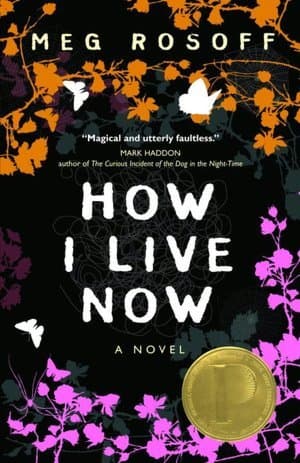
Meg Rosoff (2004)
Genre
Science Fiction / Young Adult / Romance
Reading Time
194 min
Key Themes
See below
Sign in to track this book
Amidst a sudden war that isolates them in rural England, a cynical New York teen finds an unexpected home and an unconventional love with her cousins, only to have it shattered by the brutal realities of survival.
Fifteen-year-old Daisy, a self-absorbed and anorexic New Yorker, is sent by her father to live with her Aunt Penn and four cousins she's never met in the English countryside. Upon her arrival at the isolated farm, she's greeted by her cousins Edmond, Isaac, Osbert, and Piper. The boys are wild and unkempt, and Piper is a sweet, observant little girl. Daisy initially finds them strange and the lack of modern conveniences unsettling. Her Aunt Penn, a driven activist, leaves almost immediately for a peace conference in Oslo, leaving Daisy and the children unsupervised. Daisy struggles to adapt to the rustic lifestyle, the absence of her familiar comforts, and her cousins' peculiar, almost telepathic bond, particularly with Edmond, who seems to see right through her.
With Aunt Penn gone, the children are left to their own devices, creating a free-spirited existence on the farm. They spend their days swimming in the river, exploring the woods, and tending to the animals. Daisy, initially resistant, slowly sheds her cynicism and embraces this unconventional life. She feels drawn to Edmond, sensing a deep, unspoken connection between them. Their relationship blossoms into an intimate love, marked by shared understanding and a powerful emotional bond. While the children are largely oblivious, news reports on the radio hint at escalating international conflicts and the threat of war, creating a subtle unease.
The idyllic summer is abruptly shattered by the outbreak of war. News reports describe devastating attacks on London and other major cities, including the use of an EMP (electromagnetic pulse) that cripples technology and communications. Electricity fails, and the farm is plunged into darkness and isolation. The children, initially shocked, struggle to comprehend the magnitude of the events. The immediate aftermath is marked by fear and uncertainty, but also a fierce determination to protect their home and each other. Daisy, despite her initial detachment, feels a deep sense of responsibility for her younger cousins and a powerful protective instinct over Edmond.
As the war intensifies, the children quickly adapt to a world without modern conveniences. They learn to ration food, collect rainwater, and rely on their wits for survival. The farm, once a place of carefree abandon, becomes a fortress. They listen to the radio for news, which is increasingly grim, detailing military occupation and humanitarian crises. The bond between Daisy and her cousins, especially Edmond, deepens under the pressure. They become a self-sufficient unit, their innocence slowly eroding as they face the harsh realities of a war-torn country, their only comfort being their shared love and loyalty.
The family's fragile peace is shattered when soldiers arrive at the farm, announcing that all children are to be evacuated and billeted separately for their safety. The cousins are forcibly separated by gender, a devastating blow. Daisy and Piper are taken to one location, while Edmond, Isaac, and Osbert are sent to another. The parting is agonizing, especially for Daisy and Edmond, who share a tearful and desperate farewell, promising to find each other. This separation marks a brutal turning point, as Daisy, stripped of her love and family, must now navigate the war-torn landscape with only Piper by her side.
Daisy and Piper are billeted with a stern, unfeeling woman and forced into hard labor, performing chores and working the land to contribute to the war effort. The conditions are harsh, food is scarce, and the constant threat of soldiers and the psychological toll of war weigh heavily on them. Daisy, driven by her love for Edmond and her responsibility for Piper, struggles to maintain hope and protect her younger cousin. They witness the grim realities of military occupation and the suffering of the civilian population. During this time, Piper's innocence is challenged, and Daisy's resilience is tested to its limits.
After enduring months of hardship and a traumatic incident where Piper is almost taken by soldiers, Daisy decides they must escape their billet and attempt to return to the farm, hoping to reunite with Edmond and the others. They embark on a dangerous journey through war-torn England, encountering abandoned villages, watchful soldiers, and the constant threat of starvation. Daisy, drawing on an inner strength she never knew she possessed, becomes fiercely protective of Piper, navigating treacherous landscapes and making difficult decisions to ensure their survival. This journey shows her transformation from a self-absorbed teenager to a resilient survivor.
Daisy and Piper finally make it back to the farm, which they find abandoned and desolate. Their hopes are dashed, and despair sets in. Eventually, Isaac and Osbert return, gaunt and traumatized, bringing news that Edmond is missing. Months later, a soldier brings Edmond back to the farm. He is severely traumatized, having been subjected to terrible experiences, and has lost his ability to speak. Daisy is heartbroken by his condition but dedicates herself to his care, trying to rekindle the spark of their past love. The reunion is bittersweet, marked by the profound changes and losses they have all endured.
The family slowly begins to heal, tending to the farm and each other. Daisy patiently cares for Edmond, her unwavering love a constant presence. With time and her dedicated attention, Edmond slowly starts to recover, his voice gradually returning, though he remains profoundly changed. The war eventually ends, and Aunt Penn returns, also deeply affected by her experiences. The family, though scarred, finds a way to move forward, rebuilding their lives and their home. The narrative emphasizes the enduring power of love, family, and resilience in the face of devastation, hinting at a future, however uncertain, that is built on their shared past and enduring bonds.
The story concludes with Daisy, now an adult, reflecting on the events of the war and its lasting impact on her and her family. She is still with Edmond, and they have children together, living a life shaped by their experiences. The war remains a potent memory, a defining period that forged their bonds and tested their spirits. Daisy emphasizes that while the physical scars of war may fade, the emotional ones remain, shaping who they are. Her narrative highlights the transformative power of love and survival, and how extraordinary circumstances can reveal the depths of human connection and resilience.
The Protagonist
Transforms from a detached, self-absorbed teenager into a deeply compassionate, resilient, and fiercely protective young woman, finding her true self through love and wartime hardship.
The Supporting/Love Interest
From a sensitive, intuitive boy, he is deeply traumatized by war, losing his voice, but slowly begins to heal through Daisy's unwavering love.
The Supporting
Begins as an innocent child, endures wartime hardships, and while scarred, maintains a resilient spirit.
The Supporting
A quiet and observant boy who endures the war's horrors, returning changed but still a stable presence.
The Supporting
A practical and resourceful boy who confronts the harsh realities of war, emerging scarred but capable.
The Supporting
Leaves the children to pursue peace, unknowingly setting them on a path of self-reliance, and returns after the war, also changed by her experiences.
The novel vividly portrays how war strips children of their innocence. Daisy, initially a self-absorbed teenager, is forced to mature rapidly, shedding her cynicism to protect Piper and survive. Piper, the youngest, experiences the direct trauma of hunger, fear, and separation, irrevocably altering her childhood. The boys also return from their billets visibly changed and traumatized. The carefree summer at the farm, a symbol of their innocence, is brutally contrasted with the harsh realities they face, forcing them to confront the darkest aspects of humanity and survival far too young.
“What they had done to Edmond, they had done to all of us.”
At its core, the novel is about the enduring power of love and family bonds in the face of devastation. Daisy's deep love for Edmond becomes her primary motivation for survival and her unwavering dedication to his recovery. The familial connection between the cousins, initially strange to Daisy, becomes their anchor. When separated, their longing for each other fuels their resilience. The reunion, though fraught with trauma, underscores that these relationships are the only true constant and the ultimate source of strength and healing in a broken world.
“Love is the only thing that's true.”
The narrative explores the human capacity for survival and resilience when faced with extreme conditions. From learning to ration food and water to navigating a war-torn landscape, Daisy and her cousins demonstrate remarkable adaptability. Daisy's journey with Piper, fraught with danger and hardship, shows her transformation into a fierce protector and resourceful survivor. The ability of the children to not only endure but also to rebuild their lives and their home after the war highlights the indomitable spirit of humanity to overcome adversity and find hope amidst despair.
“We were survivors, all of us. Even Piper.”
Meg Rosoff depicts war not through grand battles, but through its personal, devastating impact on civilians, particularly children. The enemy is unnamed, emphasizing the universal nature of conflict and its effects. The story focuses on the breakdown of society, the loss of basic amenities, forced evacuations, and the psychological trauma inflicted on individuals. The war is a backdrop that strips away modern comforts and forces a return to elemental survival, revealing the fragility of peace and the lasting scars left by conflict on both the landscape and the human spirit.
“War is like a fire. Once it starts, it is very hard to put out.”
The English countryside farm is both an idyllic haven and a harsh reality. Initially, it offers a liberating, almost primal freedom that allows Daisy to shed her urban cynicism and connect with her cousins. After the war begins, this connection to nature becomes vital for survival – foraging, farming, understanding the land. The natural world contrasts with the destructive forces of war, offering solace, sustenance, and a grounding presence. It also highlights the fragility of this peace when human conflict intrudes.
“The earth was our mother, the river our sister, the trees our brothers.”
The story is told by an adult Daisy looking back on her teenage experiences.
The entire novel is narrated by Daisy in the first person, but critically, it's a retrospective narration. An adult Daisy is recounting her experiences, providing a layer of reflection and emotional distance. This allows her to interject with adult insights and foreshadowing, giving weight to the events and highlighting the lasting impact of the war on her life and identity. It also lends credibility to the emotional intensity of her teenage experiences, as they are viewed through the lens of time and maturity.
The conflict and its aggressors are deliberately left vague.
The war and the enemy are never explicitly named or detailed. This deliberate vagueness serves to universalize the experience of conflict, making it less about a specific geopolitical event and more about the universal human experience of war's impact. It focuses the reader's attention on the psychological and emotional toll on the characters rather than the political specifics, emphasizing the arbitrary and devastating nature of conflict from a child's perspective. It creates a sense of immediacy and timelessness.
A technological event that cripples modern infrastructure.
The use of an EMP as a weapon is a pivotal plot device. It instantly cuts off electricity, communication, and modern transportation, effectively isolating the farm and plunging the characters into a pre-industrial state. This forces them to rely on their wits and the natural world for survival. The EMP serves to strip away the comforts and conveniences of modern life, accelerating Daisy's transformation and highlighting the vulnerability of technologically dependent societies in the face of conflict.
The isolated farm transforms from an idyllic haven to a place of desperate survival.
The farm initially functions as an almost paradisiacal setting, an unsupervised 'Eden' where the children experience freedom, love, and a deep connection to nature. This idyll is brutally shattered by the war, transforming the farm into a desperate refuge and later, a symbol of what was lost. Its isolation, initially a source of freedom, becomes a vulnerability. The farm represents both the innocence that is lost and the enduring hope for rebuilding and returning to a simpler, more connected way of life after the war.
“I was going to die. I'd almost died a hundred times, but this was the real thing. This was it.”
— Daisy is alone in England during the war, facing the reality of her situation.
“Sometimes I think I was born knowing about war. Sometimes I think I've been fighting it all my life.”
— Daisy reflects on her past and the constant presence of conflict in her life.
“It's funny how you can live your whole life and not really see the people around you.”
— Daisy considers her past relationships and her new perspective on her family.
“Love is just a chemical, no matter how much you want it to be more.”
— Daisy's cynical view on love, before her experiences in England change her.
“The world was ending, but I was in love. So it didn't matter.”
— Daisy finds solace and purpose in her love for Edmond amidst the chaos of war.
“We were all just trying to survive, and sometimes that meant doing things you didn't want to do.”
— Daisy acknowledges the harsh realities and compromises made during wartime.
“There was a war going on, but here, in this house, there was only peace.”
— Daisy describes the initial idyllic period at the farm before the invasion.
“He didn't need to say anything. I knew what he meant. We were connected.”
— Daisy's deep, unspoken understanding with Edmond.
“You can never really go home again, not if you've been to war.”
— Daisy reflects on the irreversible changes caused by her wartime experiences.
“It's like a dream, isn't it? Everything you thought was real, just isn't.”
— Daisy grappling with the surreal and devastating changes happening around her.
“I didn't know then that the world was about to change forever. I just knew I was falling in love.”
— Daisy's initial blissful ignorance of the impending war.
“War is a greedy beast. It eats your life, then it eats your memories.”
— Daisy's poignant reflection on the destructive nature of war.
“Maybe it was the war, maybe it was just being alive, but everything felt more intense.”
— Daisy describes her heightened senses and emotions during the conflict.
“The worst thing about war is that it makes you do things you never thought you would.”
— Daisy's realization about the moral compromises and difficult decisions forced by war.
Ready to see how well you understood this book? Take our interactive quiz with 10 questions.

Biography coming soon.