“The year was 2081, and everybody was finally equal.”
— Opening line, setting the dystopian scene.

Kurt Vonnegut Jr. (1961)
Genre
Science Fiction
Reading Time
15 min
Key Themes
See below
Sign in to track this book
In a dystopian 2081 where enforced equality cripples individual potential, a superhuman teenager named Harrison Bergeron defies the Handicapper General's handicaps, leading to his tragic end.
The year is 2081. Constitutional amendments make everyone equal in every way. George and Hazel Bergeron are watching television. Hazel, with her 'perfectly average' intelligence, has no handicaps. George, with above-average intelligence, wears a mental handicap radio in his ear. This device emits loud noises every twenty seconds or so, stopping him from thinking deeply or taking advantage of his intellect. He also wears physical handicaps, though their specific nature isn't detailed, to equalize his strength. While they watch ballerinas dance on television, George's thoughts about their son, Harrison, are interrupted by noise from his radio.
As George and Hazel continue to watch TV, George's mental handicap device often interrupts his thoughts. He thinks about the unfairness of handicapping, but the loud noises quickly erase any coherent thought. Hazel, in her simple-mindedness, suggests he could lie down and rest his handicaps. George explains that it's against the law, punishable by two years in prison and a two-thousand-dollar fine for every ball removed. He accepts his situation, having internalized the government's rhetoric about the dangers of competition. The television program continues with the heavily handicapped ballerinas, whose grace is constantly undermined by their weights and masks.
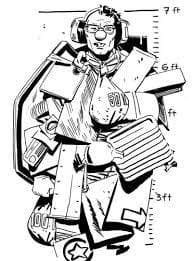
The ballet program is interrupted by a news bulletin. The announcer, struggling with a speech impediment handicap, is replaced by a ballerina who reads the news. She, too, is handicapped, wearing a mask to hide her beauty and heavy weights to impede her movement. The bulletin announces that Harrison Bergeron, aged fourteen, has escaped from prison. He is a genius and an athlete, seven feet tall, and considered dangerous. The news report details the immense handicaps he wore, including three hundred pounds of scrap metal and thick, wavy glasses to impair his vision and cause headaches. His physical and mental abilities were so extraordinary that the Handicapper General had to devise increasingly severe measures to bring him to equality.
Mid-broadcast, a crash shakes the television studio. Harrison Bergeron, having shed all his handicaps, bursts in. He is a magnificent, imposing figure, having easily overcome the immense weights and devices meant to suppress him. He declares himself Emperor and demands that everyone acknowledge his superiority. He tears off the handicaps of the musicians in the studio, ordering them to play music as they've never played before, without government constraints. The musicians, initially hesitant, respond with extraordinary, unhindered music, showing their true, suppressed talents. Harrison's presence electrifies the room, a stark contrast to the dull, equalized world outside.
After commanding the musicians, Harrison turns his attention to the handicapped ballerinas. He asks if any of them will claim his Empress. One beautiful ballerina, who had been hiding her true appearance and grace beneath a mask and heavy weights, steps forward. Harrison removes her handicaps, revealing her beauty and elegance. Together, Harrison and his Empress begin to dance. Their dance shows uninhibited movement, soaring leaps, and graceful spins, defying gravity and the oppressive laws of equality. They represent freedom and beauty, human potential unleashed, reaching towards the heavens.
As Harrison and his Empress reach the height of their magnificent, defiant dance, soaring almost to the studio ceiling, the Handicapper General, Diana Moon Glampers, enters the studio. She carries a double-barreled ten-gauge shotgun. Without hesitation, she fires two shots. Both Harrison Bergeron and the Empress fall dead to the floor. The musicians recoil in terror. Diana Moon Glampers reloads her weapon and orders the musicians to put their handicaps back on, threatening them with the same fate. The brief, glorious moment of freedom and beauty is extinguished instantly and brutally.
Back in their living room, George and Hazel Bergeron see the entire tragic event unfold on television. George is momentarily stunned, a tear welling in his eye, but his mental handicap radio emits a loud noise, erasing the memory and the emotion. Hazel, due to her intellectual limitations, has already forgotten what she saw. She asks George why he looks sad, and he can't quite remember. She remarks that something sad had been on TV, but neither of them can recall what it was. Life, in their equalized world, quickly returns to its enforced mediocrity, with no lasting impact from Harrison's brief, spectacular rebellion.
The Protagonist/Antagonist
Harrison goes from being an imprisoned, handicapped individual to a defiant, self-proclaimed Emperor who briefly liberates himself and others before being violently killed.
The Supporting
George remains largely static, unable to escape the psychological and physical constraints of his handicaps, despite brief moments of clarity.
The Supporting
Hazel remains static, her natural mediocrity preventing any personal growth or understanding of her circumstances.
The Antagonist
Diana Moon Glampers appears as a fully formed antagonist, an unyielding force of oppression who maintains the status quo.
The Supporting
She transforms from a suppressed, anonymous figure to a briefly liberated individual who embraces freedom before her tragic demise.
The Mentioned
N/A
The Supporting
They experience a brief moment of artistic freedom and excellence before being forced back into their handicapped state.
The central theme explores the dangerous consequences of absolute, enforced equality when it sacrifices individual freedom and human excellence. The society in 'Harrison Bergeron' gives up all unique talent, beauty, and intelligence to achieve a flattened, mediocre sameness. Harrison's rebellion and death show that true equality should not mean uniformity, but rather equal opportunity to pursue and celebrate individual differences. The story argues that freedom to excel and be unique is fundamental to human dignity, and suppressing it leads to a dull, uninspired existence.
“The year was 2081, and everybody was finally equal. They weren't only equal before God and the law. They were equal every which way.”
The story is a cautionary tale about unchecked governmental power and its ability to control every aspect of citizens' lives. The Handicapper General's office dictates not only physical and mental attributes but also emotional responses, effectively lobotomizing society. The government's justification for these extreme measures is 'fairness' and preventing a 'dark ages,' but it creates a stagnant, oppressive dystopia. Diana Moon Glampers' brutal execution of Harrison shows the state's willingness to use violence to enforce conformity and suppress any challenge to its authority. This highlights the dangers of a state that prioritizes control over human rights.
“And George knew at once that it was an emergency broadcast. The music stopped again and then came a screamy noise…”
Vonnegut critiques a society that actively promotes and enforces mediocrity. By handicapping the gifted, the government ensures that no one can excel, leading to a world where average is the highest aspiration. This theme is clear in Hazel's 'perfectly average' intelligence being the ideal, and in the musicians being forced to play 'mush' and 'crap.' The story suggests that when excellence is punished, society loses its potential for innovation, beauty, and progress. It settles for a lowest common denominator that diminishes the human spirit. Harrison's brief, magnificent dance contrasts with this enforced dullness.
“Hazel had a perfectly average intelligence, which meant she couldn't think about anything except in short bursts.”
The story explores how ignorance and apathy, whether natural or enforced, help maintain an oppressive system. Hazel's natural lack of intelligence stops her from understanding or remembering injustices, making her complicit through her obliviousness. George, though intelligent, is made apathetic by his mental handicaps, which stop him from critical thought or emotional response. This enforced ignorance ensures that the populace cannot effectively challenge the government. Even a dramatic event like Harrison's death is quickly forgotten, allowing the status quo to persist unchallenged.
“'That's all right—' said George. He was referring to the noise the radio had just made. '—I don't hear them any more. It's just a part of me.'”
Physical and mental devices used to enforce absolute equality.
The handicaps are the primary plot device in the story, serving as the physical manifestation of the government's oppressive control. These include mental handicap radios that emit jarring noises, heavy weights, hideous masks, and speech impediments. They are crucial for creating the dystopian setting and driving the conflict, as Harrison's rebellion involves shedding these devices. The handicaps highlight the absurdity and cruelty of forced equality, directly impacting character actions and the plot's resolution. They symbolize the suppression of natural human abilities and the systematic dismantling of individual excellence.
The medium through which the central conflict and its resolution are presented to the populace.
The television broadcast serves as a critical narrative device, allowing the reader to witness the dramatic events of Harrison's rebellion and its brutal end alongside George and Hazel. It makes Harrison's defiance public, amplifying its impact, and also ensures that the government's swift retaliation is seen by all, serving as a warning. The fact that the parents are watching this unfold, only for their memories to be erased, underscores the themes of apathy and governmental control over information and perception. It's a stage for both rebellion and its suppression.
Vonnegut's use of humor and absurdity to critique societal flaws.
Vonnegut employs heavy satire and irony to expose the flaws in the concept of absolute equality. The ridiculousness of handicapping the talented (e.g., beautiful ballerinas wearing weights and masks, intelligent people having their thoughts interrupted) creates a darkly humorous tone that underscores the story's serious message. The irony lies in the government's pursuit of 'equality' leading to a profoundly unequal and miserable existence, where the potential of humanity is systematically destroyed. This device allows Vonnegut to deliver a powerful critique of totalitarianism and the dangers of conformity.
“The year was 2081, and everybody was finally equal.”
— Opening line, setting the dystopian scene.
“They weren't only equal before God and the law. They were equal every which way. Nobody was smarter than anybody else. Nobody was better looking than anybody else. Nobody was stronger than anybody else.”
— Narrator explaining the extreme form of equality enforced.
“The law required them to wear handicaps. George, for example, had to wear a mental handicap radio in his ear.”
— Introducing the concept of physical and mental handicaps.
“Every twenty seconds or so, the transmitter would send out some sharp noise to keep people like George from taking unfair advantage of their brains.”
— Explaining the function of George's mental handicap.
“It was tragic, all right, but George and Hazel couldn't think about it very hard.”
— Reflecting on the parents' inability to process the tragedy of their son.
“She was a ballerina, too -- but she had to wear a mask that was so ugly that nobody had ever dared to look at her.”
— Describing a beautiful ballerina's enforced ugliness.
“He had outgrown hindrances faster than the H-G men could think them up.”
— Describing Harrison's exceptional abilities despite handicaps.
“It was Harrison Bergeron, of course, who broke into the studio -- that was the thing about Harrison, he was so big and strong.”
— Harrison's dramatic entrance onto the television broadcast.
“I am the Emperor! Everybody must do what I say at once!”
— Harrison declaring himself emperor on live television.
“He tore the straps of his handicap harness like wet tissue paper, tore off the great metal bar, tore the wires impeding his vision.”
— Harrison shedding his handicaps on live television.
“And then, in an explosion of joy and grace, Harrison and his Empress merely listened to the music for a while -- listened with their hearts and with their souls.”
— Harrison and the ballerina dancing freely, briefly.
“The music began again, louder and even more sweetly, in the ballroom of the mind.”
— George's brief moment of clarity and appreciation for the music.
“She fired twice, and the Emperor and the Empress were dead before they hit the floor.”
— The Handicapper General's swift and brutal suppression of the rebellion.
“George came back in. 'You've been crying,' he said to Hazel. 'Yep,' she said. 'What about?' he said. 'I forget,' she said. 'Something real sad on television.'”
— The quick return to normalcy and forgetfulness after the tragedy.
Ready to see how well you understood this book? Take our interactive quiz with 10 questions.
Biography coming soon.