“Oh, Harold, that's wonderful! You're going to have a party! Just think of it, a whole party just for you!”
— Maude's enthusiastic reaction to Harold's plan to throw himself a party, highlighting her joy in his embracing life.

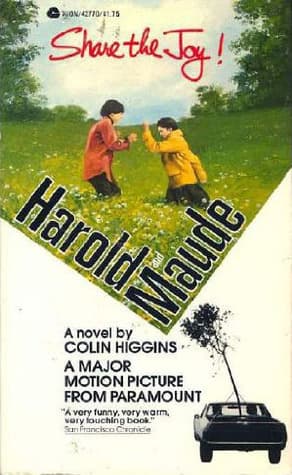
Colin Higgins (1971)
Genre
Romance
Reading Time
150 min
Key Themes
See below
Sign in to track this book
A young man obsessed with death finds joy in life through an unlikely romance with an eccentric, life-loving older woman.
Nineteen-year-old Harold Chasen is introduced as a young man with a morbid interest in death. He lives in a grand, but emotionally cold, mansion with his detached mother. He tries to get attention through elaborate, staged suicide attempts, from hanging himself to self-immolation. His mother, Mrs. Chasen, reacts with exasperation and mild annoyance, often more concerned with the inconvenience than her son's well-being. Harold's other hobby is attending strangers' funerals, driving his custom-built Jaguar hearse. At one such funeral, he first sees Maude, an elderly woman with an unmistakable love for life, who also seems to attend these somber events regularly.
Harold and Maude continue to meet at various funerals. Harold is intrigued by Maude's unusual behavior, which contrasts sharply with the somber atmosphere. He watches her from a distance, fascinated by her free spirit and disregard for social norms. Maude, aware of Harold's presence, eventually starts a conversation, unfazed by his reserved and melancholic nature. Their first interactions are brief but memorable, with Maude offering cryptic yet insightful comments about life and death. Harold, used to his mother's emotional distance, finds himself drawn to Maude's energy and genuine interest in him, a new experience in his isolated life.
Maude begins to include Harold in her daily adventures. She "borrows" cars, often from strangers, to experience the thrill of the moment, explaining that property is only temporary. She shows Harold her art studio, a bright space filled with sculptures and paintings that reflect her joyful outlook. In one event, Maude steals a tree from a city sidewalk, explaining her goal to free it and plant it back in nature, a symbol of her belief in life's freedom and resilience. Through these experiences, Harold, initially a passive observer, starts to see life from Maude's perspective, slowly breaking down his ingrained nihilism.
Harold's mother, increasingly worried about his morbid interests and lack of a conventional social life, enrolls him in a computer dating service. She arranges a series of dates with seemingly 'suitable' young women. However, Harold's attempts to impress or interact with these women are disastrous. He performs his fake suicide stunts for them, takes them to scrapyards, or discusses his morbid interests, effectively scaring them away. These dates highlight the gap between Harold's inner world and societal expectations, further isolating him and reinforcing his mother's exasperation, while also pushing him closer to Maude, who understands his unique sensibilities.
Harold and Maude spend more and more time together, deepening their unusual bond. Maude takes Harold to a fair, where she performs acrobatics and encourages him to be spontaneous. She teaches him to appreciate the beauty in everyday things, from the smell of flowers to the sound of music. She shares parts of her past, hinting at a life lived fully, including her experience as a political prisoner and a survivor of hardship, which has only increased her appreciation for life. Harold, influenced by Maude, begins to shed his death-obsessed shell, showing glimpses of genuine emotion and even joy, especially when he learns to play the banjo and share music with Maude.
As their relationship deepens, Harold realizes he is in love with Maude. He proposes marriage to her, an act that is both genuine and shocking to his conventional family. Mrs. Chasen is appalled, believing Maude to be a gold-digger or mentally unstable. She tries to have Maude committed and seeks the help of Harold's uncle, a military man, and a priest. All of them are bewildered by the unconventional romance. This societal disapproval only strengthens Harold's resolve, as he finds in Maude the only person who truly understands and accepts him, a stark contrast to the judgment he receives from others.
Harold arranges a surprise party for Maude's seventy-ninth birthday, a joyous occasion filled with music, dancing, and heartfelt connection. Maude, radiant and full of life, celebrates with Harold, surrounded by the quirky friends she has gathered over the years. During the celebration, Maude tells Harold that she will turn eighty at midnight, and that this will be her last birthday. She calmly tells him that she has taken a lethal dose of pills, explaining her belief in choosing the time of her own death, stating that eighty is the perfect age to leave the world gracefully, having lived a full and meaningful life.
Distraught but understanding, Harold rushes Maude to the hospital. Despite his desperate pleas, Maude remains firm in her decision, comforting Harold with her calm acceptance of death. She explains that she chose to die at her peak, rather than decline. Maude passes away peacefully, leaving Harold heartbroken but deeply changed. He leaves the hospital, initially appearing to return to his old ways by driving his hearse toward a cliff. However, in a key moment, he abandons the hearse just before it plunges, instead walking away with Maude's banjo, playing a joyful tune, showing his embrace of life and Maude's lasting impact.
After Maude's death, Harold has truly changed. He no longer stages suicides or attends strangers' funerals out of morbid interest. Instead, he carries Maude's banjo, playing its melodies as he walks away from the cliff, embodying the joyful spirit she gave him. He has learned to appreciate life's preciousness, the beauty in everyday things, and the importance of living authentically. Maude's influence has freed him from his family's expectations and his own emotional prison. Harold's journey ends not with a return to his old self, but with a strong commitment to living life fully, just as Maude taught him.
The Protagonist
Harold transforms from a suicidal, death-obsessed recluse into a life-affirming individual, embracing joy and connection thanks to Maude's influence.
The Deuteragonist/Mentor
Maude, already fully realized, serves as the catalyst for Harold's transformation, living her final days to the fullest and teaching him to do the same.
The Antagonist/Supporting
Mrs. Chasen remains largely unchanged, serving as a static representation of the societal pressures Harold rebels against.
The Supporting
Uncle Victor remains a static character, representing societal conformity that Harold ultimately rejects.
The Supporting
The Psychiatrist's arc is minimal; he serves as a foil to Harold's uniqueness and a symbol of society's inability to comprehend him.
The Supporting
Father Finnegan remains a static character, representing traditional religious judgment that Harold and Maude transcend.
The Mentioned
The dates serve as a collective static element, highlighting Harold's inability to conform to societal dating norms.
The main theme is about embracing life fully, even when faced with death. Maude shows this by living each moment with joy and spontaneity, openly defying societal norms. Her philosophy of 'living, really living' is infectious, as seen when she frees the tree or 'borrows' cars. Harold, initially obsessed with death, slowly learns to appreciate life's beauty through Maude's teachings and example, leading to his decision to choose life after her passing.
“"A lot of people don't seem to get it. They're just going through the motions. You gotta really live, Harold. Really live!"”
While Harold initially focuses on death in a morbid, self-destructive way, Maude offers a more integrated view of death as a natural part of life's cycle. Her calm acceptance of her own death, and her choice to die on her terms, changes death from a terrifying end into a conscious act of completion. She teaches Harold that acknowledging mortality can increase, not lessen, the appreciation for life. Harold's journey shifts from performing death to understanding its place in the larger scheme of existence, finally choosing life as a tribute to Maude's philosophy.
““I should like to change my will. I should like to leave my body to science fiction.””
Both Harold and Maude, from different generations, go against society's strict rules. Harold's fake suicides and choice of a hearse mock his mother's expectations of a 'normal' son. Maude, with her car 'borrowing,' tree liberation, and self-chosen death, challenges ideas of property, law, and morality. Their unusual romance is the ultimate act of defiance against ageism and societal judgment. The film shows the absurdity of these norms through the reactions of Mrs. Chasen, Uncle Victor, the psychiatrist, and the priest, all of whom fail to understand Harold and Maude's real connection.
““Vice, crime, and all that, you know. I'm against it. But I'm for it, too. I'm for anything that gets you out of the rut.””
The story's core is the deep and transformative love between Harold and Maude. This relationship goes beyond age, social expectations, and personal trauma, showing that true connection can grow in unexpected places. Maude offers Harold unconditional acceptance and understanding that his own family cannot provide, allowing him to shed his morbid facade. Their love is not about physical attraction but about shared spirit, intellectual stimulation, and mutual growth. It shows that love, in its purest form, has no boundaries and is a strong force for personal freedom.
““Well, a lot of people are like that. They’re just going through the motions. But you… you’re different. You feel things deeply.””
Harold's attention-seeking, morbid performance art
Harold's elaborate fake suicides serve as a primary plot device. Initially, they are a desperate cry for attention from his emotionally detached mother and a morbid fascination with death. They also function as a comedic element, highlighting the absurdity of his life and his mother's reactions. As the story progresses, these stunts become a measure of his transformation; their eventual cessation signifies his shift from a death-obsessed individual to one who embraces life, making the final 'suicide' of the hearse a symbolic act of leaving his old self behind.
Harold's custom vehicle, symbolizing his obsession with death
The customized Jaguar hearse is a powerful visual symbol of Harold's morbid fixation. It represents his isolation, his rejection of conventional life, and his comfort in the realm of death. Its presence in various scenes, from funerals to dates, constantly reinforces his macabre personality. The hearse's ultimate destruction at the end, as Harold walks away playing Maude's banjo, is a pivotal moment, symbolizing his final break from his past and his embrace of life and Maude's legacy, having literally driven his death obsession off a cliff.
A recurring act of rebellion and seizing the moment
Maude's habit of 'borrowing' cars, usually without permission, is a recurring plot device that showcases her rebellious spirit and her philosophy of living in the moment. It challenges societal notions of ownership and law, emphasizing that life is fleeting and experiences are more valuable than possessions. Each instance serves to pull Harold further out of his comfort zone, exposing him to Maude's carefree and adventurous nature, and demonstrating that rules can be bent in the service of joy and freedom, ultimately inspiring him to loosen his own rigid grip on life.
A symbol of joy, connection, and Maude's enduring spirit
The banjo, initially Maude's instrument, becomes a significant symbol of joy, creativity, and the life-affirming spirit she embodies. It represents a form of communication and expression beyond words, particularly for Harold, who learns to play it. The music they share together deepens their bond. Its final appearance, with Harold walking away from the cliff playing it after Maude's death, signifies his complete transformation. The banjo is a tangible representation of Maude's legacy, an enduring reminder for Harold to embrace life's melodies and carry her joyful spirit forward.
“Oh, Harold, that's wonderful! You're going to have a party! Just think of it, a whole party just for you!”
— Maude's enthusiastic reaction to Harold's plan to throw himself a party, highlighting her joy in his embracing life.
“I should like to change my form of life. I should like to be a tree.”
— Harold's melancholic and somewhat morbid wish, illustrating his desire to escape the complexities and pain of human existence.
“A lot of people enjoy being dead. But they don't know it.”
— Maude's darkly humorous and philosophical observation about life and death, suggesting a certain peace in the unknown.
“The earth is my friend. The wind is my friend. The sun is my friend. The rain is my friend. The birds are my friends. I am friends with everything.”
— Maude's declaration of her profound connection to nature and all living things, showcasing her embracing of the world.
“I don't think much of it. It's a waste of time.”
— Harold's dismissive response when asked about his opinion on life, reflecting his initial nihilistic outlook.
“What do you want to be when you grow up?”
— A recurring question posed to Harold by various adults, emphasizing societal expectations versus his unconventional path.
“I like to make things bloom.”
— Maude's simple yet profound statement about her joy in cultivating life and beauty, both literally and metaphorically.
“You know, at first, I didn't think I'd like you. But now I think you're rather sweet.”
— Maude's evolving affection for Harold, showing her ability to see beyond his initial morbid facade.
“Go and love some more. It's the only thing that makes sense.”
— Maude's final, poignant advice to Harold, encapsulating her philosophy of living life to the fullest through love.
“I never felt so alive!”
— Harold's exclamation after a particularly thrilling and rebellious adventure with Maude, marking a turning point in his outlook.
“I don't believe in rules. I believe in life.”
— Maude's defiant stance against convention and her embrace of an uninhibited, authentic existence.
“I like to be with you. You're different.”
— Harold's simple acknowledgment of his comfort and connection with Maude, despite their age difference and societal norms.
“It's not polite to stare.”
— A common reprimand Harold receives for his morbid fascinations, highlighting the societal disapproval of his behavior.
“I shall be eighty. And you shall be nineteen. And we shall be married.”
— Maude's playful and forward declaration of her intention to marry Harold, challenging societal expectations of age and romance.
Ready to see how well you understood this book? Take our interactive quiz with 10 questions.

Colin Higgins was an American screenwriter, director, and producer. He is best known for writing and directing the cult classic film 'Harold and Maude' (1971). Higgins also wrote the screenplay for the hit film 'Silver Streak' (1976). His work often blended dark humor with poignant themes.