“The town of Goblin was a collection of stories, each house a chapter, each person a paragraph.”
— General description of the town and its nature.

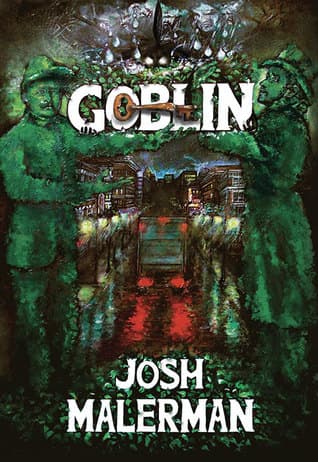
Sign in to track this book
Welcome to Goblin, a town where severed body parts are love letters, ghost traps are home décor, and a child's magic show ticket might be a one-way trip to another dimension, all under the terrifying eye of the North Woods.
Aaron, a young man deeply in love with his long-distance girlfriend, Lucy, becomes obsessed with proving their love is legendary, surpassing even historical romantic gestures like Van Gogh's ear. He begins a macabre project, meticulously severing parts of his own body and mailing them to Lucy in a series of packages. His first act of self-mutilation involves removing a finger, carefully preserving it, and sending it with a note expressing his boundless devotion. Lucy, initially confused and then horrified, tries to understand the meaning behind these grotesque gifts, while Aaron, driven by a twisted romantic ideal, continues his gruesome mission, believing each package brings them closer.
Silas is consumed by a paralyzing fear of ghosts. Convinced that a malevolent spirit is lurking in his apartment, waiting to ambush him, he dedicates his life to setting up an intricate network of 'ghost traps.' These are elaborate contraptions involving tripwires, pressure plates, strategically placed mirrors, and sound-activated alarms, all designed to detect and contain any spectral presence. Silas spends his days meticulously checking and re-checking each trap, his paranoia escalating with every creak and shadow. He believes that by catching a ghost, he can finally regain control over his fear and his life, but the constant vigilance only deepens his isolation.
Neal Nash, a renowned and arrogant big game hunter, is at his own meat-themed birthday celebration when he decides to pursue the legendary Great Owl of Goblin's North Woods. This owl is a mythical creature and also strictly protected, making hunting it a grave transgression. Driven by an insatiable desire for the ultimate trophy and a disregard for any rules, Neal leaves his guests and ventures into the dark, rain-soaked woods. He is accompanied by his loyal but increasingly uneasy guide. As they go deeper, the woods become more menacing, and Neal's hubris clashes with the unpredictable and dangerous environment, foreshadowing a perilous night.
Pete, a young boy with a strong fascination for magic, is ecstatic when he reads in 'Presto' magazine that his idol, the legendary magician Roman Emperor, is bringing his show to Goblin. Pete pores over every detail, dreaming of witnessing Emperor's illusions firsthand. Unbeknownst to Pete, Roman Emperor's magic is not mere trickery; it possesses a dark, supernatural reality. The magazine article also subtly hints at Emperor's signature act involving a child volunteer from the audience, a detail Pete overlooks in his excitement. He eagerly anticipates the show, unaware of the terrifying truth behind Emperor's stage presence and the personal danger awaiting him.
Dirk Rogers works two demanding and conflicting jobs in Goblin: one at the local slaughterhouse and the other at the Goblin Zoo. The constant exposure to death and animal cruelty at the slaughterhouse, juxtaposed with the care and preservation of animals at the zoo, takes a severe toll on his mental state. He becomes increasingly stressed and sleep-deprived, his mind struggling to compartmentalize the two worlds. One particularly grueling night, as he navigates his duties, the lines between the slaughterhouse and the zoo begin to blur in his mind. His grasp on reality frays, leading to a dangerous psychological breakdown where the horrific practices of one job threaten to seep into the other.
Maggie, a determined young girl, finally navigates her way through Goblin's famed and labyrinthine tourist attraction, The Hedges. After hours of twisting and turning through the towering green walls, she reaches the central clearing, expecting a reward or a simple endpoint. Instead, she discovers something deeply disturbing – a secret that the owner of The Hedges, Mr. Crowley, has meticulously hidden. The nature of this discovery is so shocking that it immediately puts Maggie in grave danger. Her presence and what she has seen trigger a desperate and violent response from Crowley, initiating a frantic chase through the rain-slicked streets of Goblin.
As more gruesome packages arrive at Lucy's doorstep – a toe, a hand, even an eye – her initial confusion gives way to terror and a desperate resolve. She tries to contact Aaron, to make him stop, but he is unreachable, lost in his self-destructive delusion. Lucy grapples with the ethical and emotional dilemma of what to do with the body parts and how to prevent further harm to Aaron, whom she still loves despite his horrifying actions. The police are bewildered, unable to comprehend the nature of the crime or how to intervene in such a bizarre, self-inflicted act of 'love.'
One night, Silas's elaborate ghost traps begin to trigger. Alarms blare, tripwires are sprung, and objects are mysteriously displaced. However, despite the undeniable evidence of a presence, Silas cannot see or directly interact with the ghost. The unseen entity seems to playfully, or perhaps maliciously, evade his detection, moving just beyond his perception. This inability to pinpoint or capture the ghost, despite his meticulously laid plans, pushes Silas further into the abyss of his paranoia. The feeling of being constantly watched and toyed with by an invisible force exacerbates his terror, making his own home a living hell.
Deep within the North Woods, Neal Nash's hunt for the Great Owl turns into a struggle for survival. The environment itself seems to conspire against him; the rain turns the terrain treacherous, and the nocturnal sounds and shadows play tricks on his mind. He encounters other, more dangerous creatures than anticipated, and his guide becomes increasingly fearful and uncooperative. Neal's arrogance and disregard for the woods' sanctity lead him into perilous situations, culminating in a confrontation that challenges his very identity as a hunter. The protected Great Owl remains elusive, but the woods exact their own form of justice upon the trespasser.
Pete, brimming with excitement, attends Roman Emperor's magic show. He is captivated by Emperor's mesmerizing stage presence and incredible illusions, unaware of the sinister reality behind them. During the grand finale, Emperor calls for a young volunteer from the audience for his most spectacular trick. Pete, eager and innocent, enthusiastically raises his hand and is chosen. He steps onto the stage, oblivious to the true nature of Emperor's 'magic' and the dark fate that awaits him. The trick involves a disappearance, but not one that relies on smoke and mirrors, rather a true, terrifying vanishing act.
Dirk Rogers's mental breakdown culminates in a night of horrifying confusion. Unable to distinguish between the animals at the zoo and the livestock at the slaughterhouse, he begins to apply the brutal methods of one job to the other. His actions become increasingly erratic and violent, reflecting the internal chaos of his mind. The once clear boundaries between his two worlds completely dissolve, resulting in a grotesque and tragic event where the innocent inhabitants of the zoo become victims of the slaughterhouse's cruel logic. The story depicts the devastating consequences of unchecked mental stress and the blurring of moral lines.
Maggie's discovery in The Hedges triggers a desperate flight. Mr. Crowley, the owner, immediately gives chase, determined to silence her and protect his secret. The pursuit spills out of The Hedges and into the rain-drenched streets of Goblin. The Goblin Police, alerted to the disturbance, also join the chase, initially unaware of the full scope of Crowley's dark secret. The chase becomes a frantic, perilous race through the urban landscape and eventually into the terrifying, unknown depths of the North Woods, where Maggie's survival depends on her quick thinking and resilience against both a deranged man and the unforgiving wilderness. The climax reveals the true horror of Crowley's hidden activities.
The Protagonist
Aaron descends from a lovestruck individual into a grotesque symbol of obsessive love, physically and mentally sacrificing himself for a delusional ideal.
The Supporting
Lucy transforms from a loving girlfriend into a traumatized individual desperately trying to stop a loved one's self-destruction.
The Protagonist
Silas's attempts to control his fear of ghosts through traps only intensify his paranoia and isolation, leaving him more terrified than before.
The Protagonist/Antagonist
Neal's arrogance and disrespect for nature lead him into a perilous situation where he becomes the hunted, facing the consequences of his hubris.
The Protagonist
Pete's innocent fascination with magic leads him into a terrifying encounter with a truly dark and dangerous force.
The Antagonist
Roman Emperor remains a consistently sinister force, revealing the true, terrifying nature of his 'magic' to his unwitting audience.
The Protagonist
Dirk's attempt to balance two morally conflicting jobs leads to a complete mental breakdown, with horrifying consequences.
The Protagonist
Maggie's innocent exploration leads to a terrifying discovery, forcing her to become a determined survivor in a desperate chase.
The Antagonist
Mr. Crowley's carefully constructed facade is threatened by Maggie's discovery, leading him to a desperate and violent attempt to maintain his secret.
This theme explores how intense, unchecked desires can warp perception and lead to destructive behavior. Aaron's 'legendary love' for Lucy in 'A Man in Slices' transforms into a grotesque act of self-mutilation, driven by a delusional need to prove his devotion. Similarly, Silas's fear of ghosts in 'Kamp' becomes an all-consuming obsession, dictating his entire life and pushing him into deeper paranoia, rather than providing safety. Neal Nash's obsession with hunting the Great Owl in 'Happy Birthday, Hunter!' blinds him to danger and ethical considerations, leading to his downfall. The stories show how obsession, whether born of love, fear, or pride, can consume individuals and lead to tragic or horrifying outcomes.
“He would show her what legendary love truly was. More than an ear, more than a finger, more than a heart.”
Many stories in 'Goblin' play with the line between what is real and what is perceived or imagined, often with terrifying results. In 'Presto,' Pete learns that Roman Emperor's magic is not illusion but a terrifying reality, shattering his innocent understanding of the world. Dirk Rogers in 'A Mix-Up at the Zoo' experiences a complete breakdown of reality as the horrific practices of the slaughterhouse merge with the innocent environment of the zoo in his mind. Silas's ghost traps, while real, are set for an entity whose existence blurs the line between his paranoia and an actual supernatural presence. This theme questions the stability of perception and the fragility of the human mind when confronted with the uncanny.
“Pete didn't know that Emperor's magic was real, and his latest trick involved audience participation...”
This theme highlights the consequences of excessive pride and arrogance, particularly when individuals believe themselves superior to natural laws or moral boundaries. Neal Nash in 'Happy Birthday, Hunter!' exemplifies this as his hubris drives him to hunt the protected Great Owl, believing his skill will overcome any obstacle. His disregard for the sanctity of nature and the rules of Goblin leads to his ultimate peril in the North Woods. Similarly, Mr. Crowley's arrogance in 'The Hedges' leads him to believe he can hide his dark secrets indefinitely, only for a young girl to expose his depravity and trigger his downfall. The stories suggest that such pride inevitably leads to a reckoning.
“He was Neal Nash, and nothing in the North Woods was off-limits to him. Especially not a bird.”
Several narratives feature innocent characters encountering profound, often grotesque, evil or terror. Young Pete in 'Presto' innocently volunteers for a magic trick, only to discover the horrifying reality of Roman Emperor's powers. Maggie in 'The Hedges,' a curious young girl, uncovers a dark secret that forces her into a desperate fight for survival against a sinister adult. This theme emphasizes the vulnerability of the innocent and the shock of their first encounters with the world's darker aspects, often leading to a loss of innocence or a fight for their lives against overwhelming odds.
“Problem is, Pete doesn't know that Emperor's magic is real, and his latest trick involves audience participation...”
This theme explores both the literal monsters encountered and the internal 'monsters' of human psychology. In 'A Man in Slices,' Aaron's monstrous acts stem from a distorted internal love, turning him into a self-destructive horror. Dirk Rogers's mental breakdown in 'A Mix-Up at the Zoo' unleashes an internal monster that blurs the lines between his jobs, leading to external acts of brutality. Conversely, Silas's fear in 'Kamp' focuses on an external monstrous ghost, while Roman Emperor in 'Presto' is an external, supernatural monster. The collection suggests that horror can come from both the deepest parts of the human mind and from malevolent forces existing outside of it.
“Will he be able to separate the two jobs on the night he finally breaks down, or will the slaughterhouse and the zoo overlap in his cracked, dark mind?”
Characters' internal states distort their understanding of reality.
This device is central to stories like 'A Man in Slices' and 'A Mix-Up at the Zoo.' Aaron's perception of love is so warped that his self-mutilation seems logical to him, making his actions horrifying from an external perspective. Dirk Rogers's mental breakdown fundamentally alters his ability to distinguish between his two jobs, leading to tragic confusion. In 'Kamp,' Silas's paranoia might be amplifying or misinterpreting actual ghostly activity. This device immerses the reader in a character's subjective, often fractured, reality, heightening the sense of dread and unease as the world around them becomes untrustworthy.
The environment and mood hint at impending danger or horror.
Malerman frequently uses the setting of Goblin itself—a rainy, mysterious city with ominous North Woods—to foreshadow the dark events. In 'Happy Birthday, Hunter!', the description of the North Woods as 'unkind at night' and the escalating tension during the hunt subtly warn of Neal Nash's fate. The labyrinthine nature of 'The Hedges' and the sinister reputation of Roman Emperor's magic in 'Presto' create an oppressive atmosphere that signals danger for the protagonists. This device builds suspense by making the environment an active, almost sentient, participant in the unfolding horror, influencing the characters' fates.
Contrasting elements create unsettling or tragic effects.
This device is powerfully used in 'A Man in Slices,' where the ultimate act of 'love' is depicted through grotesque self-mutilation, creating a horrifying irony. In 'A Mix-Up at the Zoo,' the contrasting environments of a slaughterhouse and a zoo become tragically intertwined in Dirk Rogers's mind, leading to a horrific outcome. 'Happy Birthday, Hunter!' opens with a 'meat-themed birthday bash' for a hunter, juxtaposing celebration with the brutality of his profession and foreshadowing his own potential demise. This irony highlights the perverse or tragic nature of the situations, often underscoring a character's delusion or downfall.
An object or goal drives the plot, but its true nature is horrific.
While typically a neutral plot driver, Malerman twists the MacGuffin. In 'A Man in Slices,' Aaron's 'legendary love' is the driving force, but its manifestation (the body parts) is the source of horror. In 'Happy Birthday, Hunter!', the Great Owl serves as Neal Nash's ultimate trophy, but pursuing it leads him to become the hunted. In 'Presto,' the 'magic trick' is the MacGuffin that draws Pete in, but its reality is far from innocent. This device propels the narrative by focusing characters on a seemingly desirable or understandable goal, only to reveal its sinister or destructive true nature.
“The town of Goblin was a collection of stories, each house a chapter, each person a paragraph.”
— General description of the town and its nature.
“It wasn't a monster, not really. It was just a thing that did what it did.”
— Referring to one of the strange entities or phenomena in Goblin.
“Fear was a currency in Goblin, and some people were richer than others.”
— Describing the pervasive atmosphere of dread and how it affects the residents.
“You could leave Goblin, but Goblin never truly left you.”
— A common sentiment among those who have experienced the town's oddities.
“The silence in Goblin wasn't empty; it was full of waiting.”
— Describing the eerie quietness that often precedes an event.
“Every secret in Goblin had teeth, and eventually, they all bit.”
— Highlighting the dangerous nature of hidden truths within the town.
“He didn't believe in ghosts, but Goblin had a way of making you believe in everything.”
— A character's internal struggle with the supernatural occurrences.
“The rules of the world bent in Goblin, they didn't break, but they certainly bent.”
— Explaining the subtle yet profound deviations from normal reality.
“Sometimes the greatest monsters were the ones you couldn't see.”
— A reflection on the unseen threats and psychological horror.
“Goblin wasn't just a place; it was an experience, a living, breathing thing.”
— Emphasizing the town's sentient-like quality and its impact on visitors.
“The whispers were just stories until they weren't.”
— Referring to how local legends and rumors often manifest into reality.
“He learned that in Goblin, the shortest distance between two points was often the most terrifying.”
— A character's realization about the unpredictable and dangerous nature of the town.
“The darkness in Goblin wasn't merely the absence of light; it was a presence unto itself.”
— Describing the oppressive and almost sentient darkness of the town.
Ready to see how well you understood this book? Take our interactive quiz with 10 questions.

Biography coming soon.

Ashley Antoinette
4.6

Mark McDonald
4.4
Luo Guanzhong
4.4
Mia McKenzie
4.3
Dorothy Parker
4.3
Joaquim Maria Machado de Assis
4.3
James Thurber
4.2
Terry Kay
4.2