“It was the first time I realized that there was a difference between knowing and understanding.”
— Paul looking back on his early experiences with the bohemian crowd.

Sign in to track this book
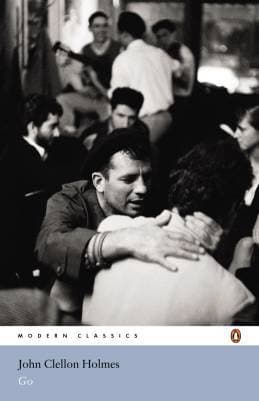
In 'Go,' set in post-WWII New York, aspiring writers and rebels launch the Beat Generation, fueling their search for meaning with parties, writing, drugs, and thrills.
The novel begins with Paul Hobbes at a loud party in a Greenwich Village apartment. The room is full of smoke, clinking glasses, and passionate talks among young intellectuals, artists, and hangers-on. Paul, an aspiring writer, watches the scene, both involved and distant. He sees his friends, including the charismatic Gene Pasternak (based on Jack Kerouac), the intense David Stofsky (Allen Ginsberg), and the free-spirited Hart Crane (Neal Cassady). Despite the lively atmosphere, Paul feels a sense of aimlessness and a desire for something deeper amidst the hedonism and intellectual talk. The party introduces the main group and their shared search for meaning in post-war America.
After the party, Paul spends much time with Gene, David, and Hart, having intense, late-night talks about art, philosophy, jazz, drugs, and life's meaning. These conversations often happen in smoky apartments, cheap diners, or while walking New York streets. Paul is drawn to Gene's raw energy and his search for real experience, as well as David's intellectual passion and Hart's wild spirit. They share their writing, dreams, and worries, forming a close group tied by a shared feeling of being outside mainstream society and a desire to live life fully, often in unusual ways. These interactions form the intellectual and emotional core of their bohemian lives.
Hart Crane, known for his impulsive nature and desire to travel, decides to leave New York and go west on a spontaneous road trip. His departure is sudden, driven by restlessness and a wish to escape city life and his personal problems. This decision greatly affects Paul, Gene, and David, who see Hart as a symbol of their shared desire for freedom and real experience, even as they stay in New York. Hart's journey west, though not fully described in his own story, sets an example for the restless movement that will define the Beat generation, leaving a gap and a longing for adventure among his friends.
Paul and Gene, inspired by Hart's recklessness and their own search for intense experiences, begin to use drugs more seriously, especially marijuana and benzedrine. They visit jazz clubs, dive bars, and late-night gatherings, looking for experiences that challenge social norms. This exploration of the city's darker side is not just for pleasure but also an attempt to find new insights and fuel their creative work. Paul watches Gene's growing pursuit of these experiences, seeing both the appeal and the potential dangers of their chosen path, as they live in a world far from the polite society they reject.
Amidst the constant parties, intellectual debates, and drug use, Paul's relationship with Virginia, a more stable woman, grows. Virginia offers a link to a more conventional life, giving Paul a sense of comfort and understanding that his friends' chaotic world often lacks. However, their relationship is constantly challenged by Paul's involvement with Gene, David, and the bohemian lifestyle, which Virginia struggles to understand or accept. Paul is torn between the stability Virginia offers and the exciting, though unstable, friendship and intellectual stimulation he finds with his male friends, showing his inner conflict about his life's direction.
Gene Pasternak's restlessness and inner struggles become more important to the story. He is constantly moving, both physically and intellectually, driven by an endless hunger for experience and a deep dissatisfaction with the ordinary. Gene's philosophical talks often seem manic, showing his intense desire to capture life's essence in his writing. His relationships are often brief and troubled, reflecting his inability to settle down. Paul sees Gene's self-destructive habits but also admires his courage to live life on his own terms, even if it means constant change and emotional pain. Gene embodies the raw, untamed spirit of the Beat generation.
After being away, Hart Crane unexpectedly returns to New York, bringing a fresh burst of chaotic energy and new stories from his travels. His return is met with excitement and a bit of worry by Paul, Gene, and David, as Hart's presence always stirs up their already turbulent lives. Hart quickly rejoins the group's activities; his wild stories and impulsive decisions rekindle their shared desire for adventure and non-conformity. His brief return acts as a spark, reminding them of the freedom they want and the unconventional paths they are drawn to, even as his presence often leads to more drama.
Throughout the story, Paul Hobbes grapples with the basic question of purpose and meaning. He watches his friends try to find truth through drugs, sex, jazz, and intellectual discussion, but he remains somewhat separate, seeking his own path as a writer. Paul's inner thoughts show his deep worries about conformity, the superficiality of mainstream society, and the challenge of creating real art. He is torn between the exciting freedom of the bohemian life and the desire for a more stable, perhaps conventional, existence. His journey is one of self-discovery, trying to combine the different parts of his life into a clear identity.
As time passes, a sense of disappointment starts to affect the group. The initial excitement of their bohemian life, fueled by endless parties and intellectual debates, begins to feel repetitive and sometimes empty. Some characters drift away, either seeking more conventional lives or giving in to the excesses of their chosen path. Paul observes this breaking apart of their once-united group, realizing that the intense energy that first brought them together cannot last forever. The romantic view of their lifestyle starts to give way to the harsh realities of addiction, emotional trouble, and the difficulty of keeping up such an unconventional life.
Toward the end of the novel, Paul Hobbes begins to find a clearer path for himself, separate from the more destructive habits of some of his friends. While he is deeply affected by his experiences and the people he has met, he starts to understand that true meaning and artistic creation will not come only from endless hedonism or intellectual posturing. He decides to commit more fully to his writing, using his experiences for his art, but also seeking a more balanced life. This decision marks a subtle but important change for Paul, as he moves toward a more thoughtful and mature understanding of his role as an artist and an individual in a complex world.
The Protagonist
Paul evolves from a somewhat passive observer to a more active participant in his own life, ultimately resolving to commit more fully to his writing and find his own path amidst the chaos.
The Supporting (based on Jack Kerouac)
Gene remains largely consistent in his restless, intense pursuit of experience, serving as a catalyst and a symbol of the Beat ethos.
The Supporting (based on Allen Ginsberg)
David's intellectual and artistic curiosity deepens, solidifying his role as a key voice within the nascent Beat movement.
The Supporting (based on Neal Cassady)
Hart remains a constant force of wild, uncontained energy, serving as a symbol of the freedom and recklessness the Beats sought.
The Supporting
Virginia's arc is largely tied to Paul's; she seeks stability but must contend with his attraction to the Beat lifestyle.
The Supporting
Albert remains a consistent, though less central, presence within the group's intellectual and social sphere.
The Supporting
Miriam remains a part of the social fabric, her presence reflecting the hedonistic aspects of the Beat scene.
The Mentioned
The landlord's role is static, serving as a symbol of the establishment.
The novel focuses on the characters' constant search for a real life in a post-war world they see as superficial and conforming. They reject traditional social norms, careers, and values for a life lived on their own terms, seeking real experience through art, drugs, jazz, and intense intellectual talks. Paul, Gene, and David constantly question social expectations, aiming to remove pretense and live with raw honesty, even if it leads to chaos. This is clear in Gene's manic talks about 'IT' and the characters' willingness to leave stability for the thrill of the unknown, as seen when Hart goes West.
““They were all trying to find something, to get somewhere, to make a statement that was their own, not a borrowed one.””
Beneath the Beat scene's lively energy is a deep feeling of being cut off from mainstream society and disappointment with the American Dream. The characters feel disconnected from the material wealth and suburban conformity of post-war America, seeing it as empty and spiritually lacking. This disconnection fuels their rebellion and their creation of a counter-culture. They are outsiders by choice, but this choice also brings loneliness and a struggle to find lasting meaning. The early excitement for their lifestyle eventually gives way to a creeping sense of emptiness for some, showing that constant hedonism is not sustainable.
““They were children of the war and the bomb, and they had seen too much, too soon, to believe in the old lies.””
Art, especially writing, poetry, and jazz music, is a main source of meaning and expression for the characters. They believe in creativity's power to show truth and build a personal identity. Their lives are often lived for their art, with experiences—whether from drugs or intense social interaction—seen as material for their creative work. The characters have passionate discussions about literature and music, seeing these forms as vital ways to understand themselves and the world. Paul's own journey is about becoming a writer, using his observations of his friends to create his own story.
““The only thing that mattered was the word, the line, the phrase that would cut through the bullshit and get to the core.””
The novel clearly shows the hedonistic parts of the Beat lifestyle, including heavy drinking, drug use (marijuana, benzedrine), and casual sex. These activities are first presented as ways to intense experience, expanded consciousness, and a rejection of social repression. However, the story also explores the darker side of this pursuit, hinting at the potential for addiction, self-destruction, and emotional trouble. The constant search for the next thrill can lead to emptiness and a lack of real connection, revealing the limits and dangers of a life lived only for immediate pleasure, as some characters begin to realize.
““They had gone too far, too fast, and now the world was starting to catch up with them.””
A key theme is the strong male bond and brotherhood among Paul, Gene, David, and Hart. Their relationships are marked by deep intellectual and emotional closeness, shared experiences, and a mutual understanding of their outsider status. This camaraderie forms the core of their world, often overshadowing traditional romantic relationships. They inspire, challenge, and sometimes enable each other's destructive tendencies. Their shared journey is one of collective rebellion and mutual support, where their identity is often shaped by their connections to one another, especially in the dynamic between Paul's observations and Gene's raw energy.
““They were brothers in arms, bound by a secret language and a shared contempt for the ordinary.””
The story is told through the subjective lens of Paul Hobbes.
The novel employs a first-person narrative perspective, with Paul Hobbes serving as the central consciousness through which the events and characters are filtered. This device allows for deep introspection and psychological realism, as the reader experiences Paul's observations, reflections, and internal conflicts directly. It also provides a degree of detachment, as Paul often acts as an observer even within the most chaotic scenes, offering a thoughtful, analytical perspective on the wildness around him. This narrative choice emphasizes the intellectual and philosophical underpinnings of the Beat movement, seen through the eyes of an aspiring writer.
Captures the unedited flow of characters' thoughts and conversations.
Holmes frequently uses stream of consciousness, particularly in the extensive dialogues and monologues of characters like Gene Pasternak and David Stofsky. This technique reflects the characters' intense intellectualism, their drug-fueled ramblings, and their passionate, often uninhibited, discussions about philosophy, art, and life. It creates a sense of immediacy and authenticity, mirroring the improvisational nature of jazz and the free-flowing ideas of the Beat generation. The lack of conventional structure in these passages immerses the reader in the characters' subjective experiences and their restless minds.
The act of travel and restlessness symbolizes freedom and escape.
The 'road' and the constant movement of characters, particularly Hart Crane's cross-country trips and Gene Pasternak's restless wanderings, serve as a powerful symbol. It represents not just physical travel but also a metaphorical quest for freedom, escape from societal constraints, and the pursuit of authentic experience. The road symbolizes the rejection of a static, conventional life in favor of a fluid, ever-changing existence. It embodies the Beat generation's desire to break free from the confines of post-war conformity and to discover new territories, both geographical and psychological.
Jazz music informs the rhythm, themes, and atmosphere of the novel.
Jazz music is not merely background noise; it functions as a significant motif and a structural influence throughout the novel. The improvisational nature of jazz, its raw emotion, and its rejection of rigid forms parallel the characters' own lives and their artistic aspirations. Descriptions of jazz clubs and specific musicians punctuate the narrative, reflecting the characters' search for truth and transcendence in art. The rhythm of the prose itself often mimics the spontaneous, free-flowing, and sometimes discordant nature of jazz, contributing to the overall atmosphere and thematic exploration of freedom and expression.
“It was the first time I realized that there was a difference between knowing and understanding.”
— Paul looking back on his early experiences with the bohemian crowd.
“We were all going somewhere, but we didn't know where, and we didn't care.”
— Describing the restless energy and aimlessness of the group.
“The only thing that mattered was the moment, and the moment was always now.”
— Reflecting on the group's focus on immediate experience.
“He seemed to live on some higher, more intense plane of existence, where every thought was an event and every feeling a revelation.”
— Paul's observation of Gene Pasternak (Neal Cassady's character).
“We were going to be famous, we were going to be great, we were going to change the world.”
— The youthful ambition and idealism shared by the artists and writers.
“The city itself was a kind of drug, a stimulant that kept you going, even when you had nowhere to go.”
— Describing the allure and intoxicating effect of New York City.
“There was a kind of desperate gaiety about them, as if they knew that the party couldn't last forever.”
— Observing the underlying melancholy beneath the group's revelry.
“He lived in a world of his own making, a world of words and ideas, where reality was merely a suggestion.”
— Paul's thoughts on Albert Ancker (Jack Kerouac's character).
“We were all searching for something, a truth, a meaning, a way to make sense of it all.”
— The underlying philosophical quest of the characters.
“The night was a vast, open mouth, swallowing us whole, spitting us out somewhere else.”
— A vivid description of a night out in the city.
“It was the kind of freedom that came from having nothing to lose, and everything to gain.”
— Reflecting on the liberating feeling of their bohemian lifestyle.
“We had to go, even if we didn't know where, even if we didn't know why.”
— Emphasizing the intrinsic wanderlust and need for movement.
“There was a loneliness in the midst of all the noise, a deep, abiding sense of being utterly alone.”
— Paul's internal feeling despite being surrounded by friends.
“The past was a dream, the future an illusion, and the present was all we had.”
— A concise summary of their temporal philosophy.
Ready to see how well you understood this book? Take our interactive quiz with 10 questions.

Biography coming soon.

Ashley Antoinette
4.6

Mark McDonald
4.4
Luo Guanzhong
4.4

Mia McKenzie
4.3
Dorothy Parker
4.3

Joaquim Maria Machado de Assis
4.3
James Thurber
4.2

Terry Kay
4.2