“The truth, like a good wine, needs time to breathe before it can be truly appreciated.”
— Detective Miller contemplating the slow unveiling of facts in the initial stages of the murder investigation.

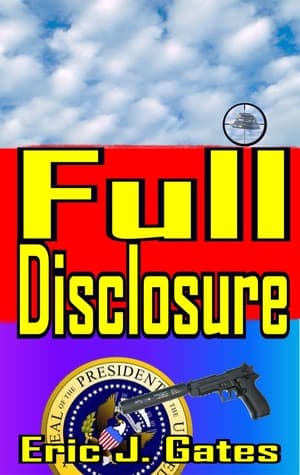
Eric J. Gates (2012)
Genre
Mystery
Reading Time
10-12 hours
Key Themes
See below
Sign in to track this book
A dying town becomes the battleground for a global conspiracy when the President's 'Full Disclosure' of humanity's biggest secret ignites a covert war, forcing its residents to confront a truth hidden for sixty years.
President Thompson gathers his closest advisors, including Secretary of Defense General Maxwell and NSA Director Sarah Jensen, to inform them of his intention to make a full disclosure about the existence of extraterrestrial life. This revelation, kept secret for over sixty years, is based on evidence recovered from a crashed UFO near Roswell, New Mexico, in 1947. Thompson believes the public has a right to know, despite severe warnings from his advisors about potential global panic, economic collapse, and the destabilization of religious and political institutions. He has already set a timeline for the announcement, unsettling those around him who have spent their careers maintaining the secrecy.
In the remote, economically depressed town of Copper Creek, Arizona, Sheriff Ben Carter struggles to maintain order. The town, once a thriving mining community, is now slowly dying. Unbeknownst to its residents, their town sits atop a secret, long-abandoned military facility connected to the Roswell incident. Strange occurrences begin to surface in the area, including unusual electromagnetic interference and mysterious lights in the sky. Ben initially dismisses these as local oddities, but they are signs of the covert war about to erupt around them.
News of President Thompson's impending announcement reaches 'The Directorate,' a deeply entrenched shadow government organization that has been guarding the alien secret for decades. Led by the enigmatic and ruthless 'Director,' they view Thompson's decision as an existential threat to global order and their own power. They immediately activate their vast network of operatives, both within and outside the government, to neutralize Thompson and anyone else who might aid in the disclosure. Their primary objective is to discredit the President, suppress all evidence, and maintain the status quo, setting the stage for a deadly confrontation.
Dr. Aris Thorne, a reclusive astrophysicist ostracized from the scientific community years ago for his theories on extraterrestrial life, is suddenly approached by agents working for President Thompson. They reveal to him the true nature of the Roswell crash and the alien artifact, a device known as 'The Key,' which he had theorized about in his discredited papers. Thorne is brought into the fold to help interpret the alien technology and prepare the world for the disclosure, given his insights. He sees this as a chance for redemption, but also understands the immense danger involved in challenging the long-held secrecy.
As President Thompson finalizes his plans for the disclosure, The Directorate launches a sophisticated and brutal attack on the White House. This is not just an assassination attempt but a coordinated effort to seize critical data and silence key personnel. Secret Service agents and military personnel loyal to Thompson engage in a fierce firefight, suffering heavy casualties. Thompson narrowly escapes the assault thanks to his security detail, but the attack sends a clear message: The Directorate will stop at nothing. This event escalates the conflict, turning a political struggle into an open, albeit covert, war.
Back in Copper Creek, Sheriff Ben Carter investigates a series of strange seismic tremors and unusual power fluctuations near the old mine. His investigation leads him to a long-sealed entrance to the abandoned military facility beneath the town. Inside, he discovers not just a relic of the Cold War, but evidence of advanced, non-terrestrial technology. He finds old files, photographs, and even a small, inert alien device, confirming the rumors and local legends. This discovery places him, and by extension Copper Creek, directly in the crosshairs of The Directorate, who are now aware of his intrusion.
Working under immense pressure in a highly secured, undisclosed location, Dr. Aris Thorne makes significant progress in understanding 'The Key,' the alien artifact from Roswell. He hypothesizes that it is not merely a communication device but a beacon or a key to activating a larger network or system. Through painstaking effort, he manages to activate a dormant function within the device. This activation sends out a powerful, unique signal, one that is not only detected by President Thompson's team but also immediately by The Directorate, and, more ominously, by something else far out in space.
The Directorate, having tracked the activated signal and learned of Ben Carter's discoveries, dispatches a highly trained paramilitary force to Copper Creek. Their mission is to secure the underground facility, eliminate any witnesses, and retrieve or destroy any alien technology. Ben Carter, realizing the gravity of his situation, rallies the town's residents, many of whom are ex-miners and veterans, to defend their home. What begins as a local sheriff's investigation quickly becomes a desperate battle for survival against a superior, ruthless enemy, with the fate of the alien secret hanging in the balance.
With The Directorate's forces clashing with Ben Carter and the Copper Creek residents, and the world on the brink of chaos, President Thompson refuses to back down. He prepares for his global broadcast, determined to make the full disclosure regardless of the personal cost. He records his message, detailing the history of the secret, the evidence, and the implications for humanity. His team works tirelessly to ensure the broadcast will go out, knowing that The Directorate will do everything in its power to prevent it. The world waits, unaware of the battles raging behind the scenes.
As President Thompson's broadcast begins to air, and the battle in Copper Creek reaches its climax, the signal from Dr. Thorne's activated 'Key' reaches its intended destination. The response is swift and undeniable. A massive, previously undetected alien spacecraft appears in Earth's orbit, visible to everyone on the planet. Its arrival silences all conflict, all doubt, and all political maneuvering. The full disclosure is no longer just words from a President; it is an undeniable reality. Humanity's place in the universe is irrevocably changed by this visual confirmation of extraterrestrial intelligence, forever altering the course of history.
The Protagonist
Thompson evolves from a cautious leader grappling with a monumental decision to a resolute figure who faces down immense opposition to fulfill his moral imperative.
The Protagonist
Ben transforms from a small-town lawman into an unexpected hero, defending his community and the truth against a powerful, clandestine enemy.
The Supporting
Thorne goes from a reclusive, discredited scientist to a pivotal figure whose expertise directly leads to humanity's first contact.
The Antagonist
The Director remains a steadfast antagonist, his resolve only hardening as President Thompson's efforts gain momentum, ultimately failing to prevent the inevitable.
The Supporting
Maxwell transitions from a staunch opponent of disclosure to a loyal, albeit reluctant, supporter of President Thompson, recognizing the necessity and inevitability of the truth.
The Supporting
Jensen's initial skepticism about disclosure gives way to a commitment to protecting the President and ensuring the truth is revealed, using her intelligence skills to counter The Directorate.
The Antagonist
They serve as a persistent, formidable force attempting to prevent disclosure, showcasing The Directorate's power and reach.
The Supporting
They transform from a struggling, isolated community into a united force, fighting for their survival and playing an unexpected role in a global event.
This is the central theme of 'Full Disclosure,' exploring the moral and ethical implications of withholding truths from the public. President Thompson's belief that humanity deserves to know about extraterrestrial life directly contrasts with The Directorate's conviction that the secret must be maintained for global stability, or for their own power. The narrative questions whether ignorance is bliss or a dangerous form of control, shown in the desperate struggle between Thompson's disclosure efforts and The Directorate's suppression tactics, such as the attack on the White House and the siege of Copper Creek.
“For over sixty years they kept a secret. The biggest secret in the history of Mankind.”
The novel explores humanity's capacity to adapt to radical shifts in understanding its place in the universe. President Thompson believes humanity is ready, while The Directorate fears panic, religious upheaval, and societal collapse. The reactions of various characters, from the initial shock of Thompson's advisors to the resilience of the Copper Creek residents, illustrate different facets of this theme. The arrival of the alien spacecraft tests this readiness, forcing humanity to confront a new reality, regardless of prior preparations or fears.
“Should the public be told?”
The struggle for power and control is a pervasive theme, shown in the clandestine operations of The Directorate. This shadowy organization represents a deep-seated fear of losing control over information and, consequently, over global affairs. Their ruthless pursuit of President Thompson and their efforts to suppress the truth show how power can be used to manipulate societal narratives and maintain an established order, even if it means resorting to violence and deception. The conflict is not just about aliens, but about who decides what humanity knows and believes.
“He knew that the Directorate would stop at nothing to silence him.”
Despite the overwhelming odds and the power of The Directorate, characters like Sheriff Ben Carter and the residents of Copper Creek show remarkable resilience. Faced with a global conspiracy and a direct military threat, they rise to the occasion, fighting for their lives and their community. This theme is also evident in President Thompson's determination and Dr. Thorne's persistent pursuit of scientific truth, showing humanity's capacity for courage, self-sacrifice, and adaptation in the face of existential challenges. Their fight against a superior force emphasizes the strength found in unity and conviction.
“A dying town finds itself on the front lines of a covert war...”
An alien artifact that serves as the central object of desire and conflict.
The Key is the alien artifact recovered from the Roswell crash, initially a dormant device whose true purpose is unknown. It serves as the primary MacGuffin, driving much of the plot. President Thompson needs it interpreted for his disclosure, Dr. Thorne is the only one who can activate it, and The Directorate wants to secure or destroy it to maintain secrecy. Its activation is a critical turning point, not only confirming alien existence but also directly leading to the dramatic arrival of the alien spacecraft, making it more than just a simple MacGuffin but also a catalyst for the climax.
A powerful, clandestine organization that operates outside official channels.
The Directorate functions as the primary antagonist, a classic shadow government trope. This organization has secretly controlled the alien narrative for decades, operating with immense resources and influence within global institutions. It provides a tangible, human antagonist against President Thompson's efforts, personifying the forces of secrecy and control. Its existence creates a constant sense of paranoia and high stakes, as its operatives can appear anywhere and its reach is seemingly limitless, making the covert war truly global.
An ordinary individual thrust into extraordinary circumstances.
Sheriff Ben Carter embodies the 'unlikely hero' trope. He is a small-town sheriff, initially concerned with local issues, who stumbles upon a secret far beyond his understanding. His character provides a relatable human element to the vast, global conspiracy. His transformation from a local lawman to a key defender of the truth, rallying his community against a powerful enemy, highlights the idea that heroism can emerge from unexpected places, reinforcing the theme of the resilience of the human spirit against overwhelming odds.
A ticking clock creating suspense and urgency.
The plot is driven by a clear countdown: President Thompson's set deadline for the full disclosure. This creates immense suspense and urgency, as every action taken by Thompson's team is against a ticking clock, and every counter-move by The Directorate is aimed at stopping the clock or disrupting the announcement before it can happen. This device ratchets up the tension, ensuring that the reader is constantly aware of the impending, irreversible event and the limited time available to both sides.
“The truth, like a good wine, needs time to breathe before it can be truly appreciated.”
— Detective Miller contemplating the slow unveiling of facts in the initial stages of the murder investigation.
“Every secret kept is a shadow cast, and shadows, no matter how small, can hide the biggest monsters.”
— Reflecting on the victim's hidden past and its implications for the present crime.
“You can't outrun your past, not when it's buried in the very ground you walk on.”
— A realization about the deep-rooted connections between the current case and historical events.
“Justice isn't always about what's legal; sometimes it's about what feels right, even if it breaks a few rules.”
— Miller grappling with ethical dilemmas while pursuing a suspect he believes is guilty.
“The most dangerous lies are the ones we tell ourselves, for they blind us to the truth that stares us in the face.”
— An internal monologue about self-deception and its role in human behavior.
“A perfect alibi is often the first sign of a very imperfect crime.”
— Miller's initial skepticism when presented with a seemingly flawless alibi from a person of interest.
“Sometimes, the quietest people hold the loudest secrets.”
— Observation about a seemingly unassuming character who later proves to be central to the mystery.
“The past isn't just history; it's a living, breathing entity that can reach out and strangle the present.”
— The detective understanding the profound impact of past events on the current murder.
“In the game of truth, everyone eventually shows their hand, willingly or not.”
— Miller's confidence that the perpetrator will eventually reveal themselves through their actions or omissions.
“Fear can make people do terrible things, but it can also make them confess to even worse.”
— During an interrogation, observing a suspect's reaction under pressure.
“The small details are never small when you're trying to piece together a shattered reality.”
— Focusing on minute clues that seem insignificant but are crucial to solving the case.
“Every family has its skeletons, but some houses are built entirely on bone.”
— Discovering a deeply dysfunctional and secretive family at the heart of the mystery.
“The greatest trick the devil ever pulled was convincing the world he didn't exist. The greatest trick a killer pulls is convincing you they're just like everyone else.”
— Reflecting on the deceptive nature of the murderer, who had seemed ordinary.
“Closure isn't always a neat bow on a perfectly wrapped package; sometimes it's just learning to live with the knots.”
— The emotional aftermath of solving the case, acknowledging that not all questions can be fully answered or pain fully healed.
Ready to see how well you understood this book? Take our interactive quiz with 10 questions.