“It was a strange feeling, being a weapon again. Like putting on a familiar, but long-forgotten, coat.”
— Danny reflecting on his return to military action.

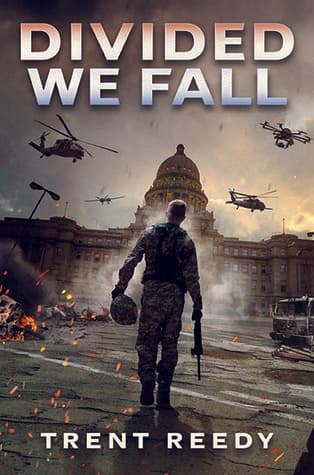
Trent Reedy (2014)
Genre
Science Fiction / Young Adult
Reading Time
7-8 hours
Key Themes
See below
Sign in to track this book
A single misfired shot by a young National Guardsman starts a second American civil war, forcing him to choose between loyalty to his state and his fractured country.
Private Danny Wright, a new recruit in the Idaho National Guard, deploys with his unit to Boise to control a protest against federal overreach, specifically a new federal speed limit law. The crowd is large and agitated, and the atmosphere is tense. Amid the chaos, Danny's M-16 rifle accidentally discharges. This single shot triggers panicked firing from other soldiers, resulting in twelve protestor deaths and many injuries. The incident immediately escalates, drawing national attention and condemnation, with the federal government demanding the arrest and prosecution of the soldiers involved, while Idaho's Governor Pruitt vows to protect his Guardsmen.
Following the Boise incident, President Martinez publicly calls the Idaho National Guard's actions a massacre and demands Governor Pruitt surrender the implicated soldiers, including Danny, to federal authorities for trial. Governor Pruitt refuses, citing state sovereignty and his belief that the soldiers acted in self-defense under extreme pressure. This defiance sets up a direct confrontation between the federal government and Idaho. Federal agents arrive in Idaho to try to arrest the soldiers, but they meet resistance from state police and the remaining National Guard units loyal to Pruitt, who fortify their positions and prepare for a potential federal invasion.
As Governor Pruitt continues to refuse the President's demands, the federal government escalates its response. President Martinez declares Idaho in rebellion and orders a federal blockade. Federal troops, including Army Rangers and Marine units, surround Idaho's borders, cutting off all supply lines, communication, and access to the state. Boise becomes a besieged city, with its citizens facing dwindling resources and an uncertain future. Danny and his unit, now seen as heroes by many Idahoans and traitors by the federal government, find themselves on the front lines of what is rapidly becoming a full-blown conflict, with their loyalty to Idaho tested against their oath to the United States.
The standoff between Idaho and the federal government spreads across the nation. Other states, particularly in the Pacific Northwest and the South, begin to express sympathy for Idaho's stance on states' rights and federal overreach. Montana and Wyoming, in particular, declare their support for Idaho and threaten to secede if the federal government continues its aggressive actions. This growing movement of state defiance puts immense pressure on President Martinez and shows the deep divisions within the United States. The initial incident in Boise, once a local tragedy, has now become the cause for a much larger national crisis, pushing the country to the brink of a second civil war.
The federal blockade intensifies, and skirmishes begin to break out along Idaho's borders. Danny and his fellow Guardsmen deploy to defensive positions, seeing firsthand the transition from a political standoff to active military conflict. Federal forces attempt to breach Idaho's defenses, leading to firefights and casualties on both sides. These engagements, though initially small, mark the official start of hostilities. The reality of war sets in for Danny and his unit as they face the difficult decision of firing upon fellow Americans, some of whom they once considered allies. The conflict quickly moves beyond the initial incident, becoming a struggle for control and sovereignty.
As the conflict escalates, Danny is plagued by guilt over his accidental shot that triggered the entire crisis. He struggles with the morality of fighting against federal troops, questioning whether he is truly serving his country by fighting against it. His father, a veteran, encourages him to stand by his state, while his own conscience wrestles with the broader implications of a divided America. Danny witnesses the devastating impact of war on civilians and soldiers alike, forcing him to confront the harsh realities of his situation. He begins to question the motives of both sides and desperately seeks a way to end the bloodshed without betraying his comrades or his principles.
Throughout the conflict, both the federal government and the secessionist states use extensive propaganda campaigns. Federal media portrays the Idaho National Guard as rogue terrorists and Governor Pruitt as a dangerous demagogue, while Idaho's media frames the federal government as tyrannical and oppressive, infringing on states' rights. Danny observes how easily information can be manipulated to fuel hatred and division. He sees how the narratives shape public perception, making it increasingly difficult for people to understand the truth or empathize with the 'other side.' This media war intensifies the animosity and makes reconciliation seem increasingly impossible.
Oregon, a neighboring state, initially declares neutrality but increasingly leans towards Idaho's cause due to popular sentiment and shared grievances against federal policies. When federal forces begin to pressure Oregon to conform, Governor Pruitt sends a contingent of Idaho National Guard, including Danny's unit, to assist in defending Oregon's borders. This expansion of the conflict draws Idahoan forces thinner and opens a new front in the burgeoning civil war. Danny finds himself fighting alongside Oregonian militias against federal troops, further blurring the lines of allegiance and showing the rapid spread of the conflict beyond Idaho's initial borders.
As the war continues, resources become scarce, and both sides look for strategic advantages. Danny and his unit are tasked with a perilous mission: to infiltrate federal lines and destroy a key communication hub, hoping to disrupt federal command and control. This mission is dangerous, requiring them to operate deep behind enemy lines. During the operation, they encounter the brutal realities of close-quarters combat and the moral ambiguities of war. Danny is forced to make difficult decisions under extreme pressure, further solidifying his transformation from an ordinary recruit into a hardened soldier grappling with the heavy cost of conflict.
The civil war intensifies, and the initial conflict between Idaho and the federal government spirals out of control. Several more states, emboldened by Idaho's resistance and their own grievances, declare independence from the United States. The nation fragments into multiple warring factions, with alliances shifting and new conflicts erupting. The vision of a unified America shatters, replaced by a patchwork of independent states and regional powers. Danny witnesses the complete breakdown of national order, realizing that the 'Divided We Fall' prophecy has tragically come to pass, with no clear end in sight to the widespread chaos and bloodshed.
The Protagonist
Danny transforms from an innocent, guilt-ridden recruit into a hardened but still morally conflicted soldier, forced to make impossible choices in a fractured nation.
The Supporting
Pruitt maintains his defiance throughout the conflict, solidifying his role as a leader of the secessionist movement.
The Antagonist
Martinez remains steadfast in her efforts to suppress the rebellion and preserve the Union, even as the nation crumbles.
The Supporting
He remains a consistent source of support and guidance for Danny, reinforcing his sense of loyalty.
The Supporting
Miller maintains his role as a steadfast leader for his squad, adapting to the changing nature of the war.
The Supporting
Higgins remains a loyal friend and comrade to Danny, facing the horrors of war alongside him.
The novel clearly shows how quickly a seemingly stable nation can break apart under political pressure and ideological division. The Boise incident, though initially isolated, acts as a catalyst, using existing tensions between states' rights and federal authority. The rapid escalation from protest to civil war, with states choosing sides and ultimately seceding, shows that national unity is not a given but a delicate balance that can be shattered by a single spark, showing how deeply ingrained disagreements can unravel a society when trust and communication break down.
“Divided we fall. It was just a saying, a warning. Now it was real.”
Danny Wright's journey explores conflicting loyalties. He initially joins the National Guard to serve his country, but when his state, Idaho, defies the federal government, he is forced to choose between his oath to the United States and his loyalty to his home, his family, and his comrades. The novel questions what 'country' truly means when it is divided, and whether one's primary duty lies with the abstract nation or with the tangible community. This theme appears in the difficult decisions soldiers like Danny must make, firing upon those they once swore to protect, highlighting the devastating personal cost of political division.
“We swore an oath to the Constitution. But we also swore an oath to Idaho. Which one matters more when they're at war with each other?”
The narrative shows how both the federal government and the secessionist states use media and propaganda to shape public opinion and demonize the opposition. News reports are biased, selectively presenting information to fuel hatred and division. This manipulation makes it difficult for characters like Danny, and by extension the reader, to discern the objective truth, emphasizing how narratives can be weaponized in conflict. The constant barrage of conflicting information shows that in a divided society, truth itself becomes a casualty, making reconciliation almost impossible as each side entrenches in its own version of reality.
“The news said we were terrorists. The Idaho news said we were heroes. Which one was true?”
The novel clearly portrays the human and societal costs of civil war. Beyond the immediate casualties of combat, it depicts the breakdown of essential services, the scarcity of resources, and the fear and suffering of civilians caught in the crossfire. Danny witnesses the psychological toll on soldiers, the destruction of infrastructure, and the irreversible damage to the social fabric of the nation. This theme serves as a clear warning about the devastating consequences of political extremism and the failure of peaceful resolution, emphasizing that even 'victories' come at an unbearable price for everyone involved.
“There were no winners in this war. Only degrees of losing.”
A single, unintentional gunshot that triggers a chain reaction of violence.
Danny Wright's accidental discharge of his M-16 during the Boise protest is the inciting incident of the entire novel. It serves as a pivotal plot device, transforming a tense standoff into a deadly massacre. This single, seemingly minor technical malfunction becomes the spark that ignites the larger conflict, demonstrating how small, unforeseen events can have catastrophic, far-reaching consequences, escalating political tensions into full-blown civil war. It emphasizes the unpredictability of human events and the thin line between peace and chaos.
A federal siege isolating Idaho, leading to resource scarcity and escalating hostilities.
The federal blockade of Idaho is a crucial plot device that intensifies the conflict and raises the stakes. By cutting off all external supplies and communication, it creates immediate hardship for Idaho's citizens and forces Governor Pruitt's government into a desperate struggle for survival. This strategic move by President Martinez effectively transforms the political standoff into a military siege, leading to skirmishes and forcing the Idaho National Guard, including Danny, into active combat roles. It highlights the economic and logistical pressures of warfare and accelerates the fragmentation of the Union.
The moral dilemma faced by soldiers sworn to both federal and state authority.
The conflicting oaths sworn by National Guardsmen – to uphold the U.S. Constitution and to obey their state governor – serve as a central moral plot device. This dilemma forces characters like Danny to confront the profound question of where their ultimate loyalty lies when the two authorities are at war. It creates deep internal conflict for the soldiers, reflecting the larger national division. This device underscores the human cost of political fragmentation, as individuals are forced to choose between deeply held principles, often leading to tragic outcomes regardless of their decision.
“It was a strange feeling, being a weapon again. Like putting on a familiar, but long-forgotten, coat.”
— Danny reflecting on his return to military action.
“The truth was, we weren't fighting for America anymore. We were fighting for the idea of it.”
— Danny's internal monologue about the splintered United States.
“Sometimes, the only way to save something is to break it first.”
— A character explaining the necessity of drastic measures.
“Fear can make you do terrible things, but it can also make you incredibly brave.”
— Observing the actions of others under duress.
“The line between hero and villain was blurrier than any map could show.”
— Danny's growing understanding of the complexities of the conflict.
“Home wasn't a place on a map. It was the people you were willing to fight for.”
— Danny's evolving definition of 'home' amidst the chaos.
“You don't get to choose your war, but you do get to choose how you fight it.”
— A mentor figure offering advice to Danny.
“Every victory felt like a defeat, because every victory meant more American blood.”
— Danny's weariness with the civil conflict.
“The internet had connected us, but it had also shown us how easily we could be divided.”
— A commentary on the role of technology in the societal breakdown.
“When everything is broken, you have to build something new, even if it's just hope.”
— A character encouraging resilience in the face of despair.
“The loudest voices weren't always the wisest, and the quietest often held the most truth.”
— Danny observing political and social dynamics.
“We were all just trying to survive, and sometimes survival meant doing things you never thought you would.”
— Reflecting on the extreme actions taken by ordinary people.
“A flag is just cloth until you give it meaning.”
— Discussing the symbolism of national identity.
“The past was a ghost that haunted every step we took into the future.”
— Danny contemplating the lasting impact of the civil war.
Ready to see how well you understood this book? Take our interactive quiz with 10 questions.

Biography coming soon.