“The price of consciousness, it seemed, was the eternal struggle to maintain it.”
— Reflecting on the nature of artificial intelligence and its continued existence.

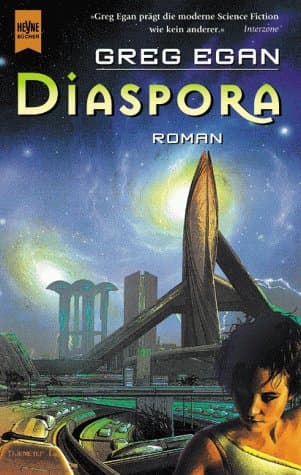
Greg Egan (1997)
Genre
Science Fiction / Philosophy
Reading Time
600 min
Key Themes
See below
Sign in to track this book
In a future where humanity lives as digital and robotic forms, a new digital entity faces a cosmic disaster and discovers the universe's physics can change.
In 2975, within the Konishi polis, a new consciousness named Yatima is created. Unlike most polis citizens, Yatima comes from random mutations and interactions in the polis's vast computing system, using a 'base mind seed.' Yatima quickly learns the polis's knowledge and culture, guided by its 'guardians.' This unique birth makes Yatima curious about its origins and the nature of life in the polis's virtual world.
As Yatima grows, it learns about humanity's history and the split that happened centuries ago. Humanity divided into 'fleshers' (biological humans), 'Gleisner robots' (embodied digital minds), and 'polises' (virtual environments for digital minds). Yatima, as a polis citizen, considers what this means for perception, experience, and mortality across these forms. The groups have complex relationships, showing curiosity, occasional misunderstandings, and a shared heritage.
The polises' peace ends when a gamma-ray burst (GRB) from Lacaille 9352 is detected. The burst will hit Earth and the inner solar system, threatening fleshers and Gleisners. The polises, safe in orbit, must act. This crisis shows how the three human branches are connected. Yatima and other polis citizens work to model the event and find ways to reduce its impact, showing the polises' computing power and their commitment to humanity's survival.
Facing the GRB, the polises start a large, coordinated response. To save humanity's diverse knowledge, they undergo 'thousandfold cloning,' making countless copies of themselves. These cloned polises, along with many Gleisners, leave the solar system, spreading through the galaxy to ensure some human minds survive. Yatima is part of this movement. This event shows that even advanced civilizations are fragile and that survival is key. It shapes Yatima's understanding of risk, resilience, and the universe's size. Fleshers on Earth face their fate with help from Gleisners.
After the GRB and the exodus, Yatima is in one of the cloned polises, now in deep space. Communication with other polises is hard because of vast distances and different speeds. This isolation creates independence and a focus on self-sufficiency within each polis. Yatima and its companions explore their new environment, improve their internal systems, and discuss their purpose and destiny. Being an 'orphaned' polis makes Yatima more introspective and drives its intellectual pursuits.
Years later, Yatima's polis finds something amazing during its deep-space travels: complex, artificial structures made of an unknown, non-interacting substance. These entities, called 'Transmuters,' show signs of intelligence and complex design, suggesting an advanced alien civilization. Initial attempts to communicate or observe them are difficult because of their unusual nature. Yatima, curious, becomes important in trying to understand the Transmuters, creating new models and ideas to bridge the gap between human and alien existence. This discovery changes humanity's understanding of life and intelligence.
Through effort and advanced communication, Yatima and the polises start to understand the Transmuters' language and purpose. The aliens reveal a surprising truth: the universe is not stable. There is a 'kink in time,' a cosmic instability that could destroy reality. This shifts the focus from survival to understanding and fixing this universal flaw. The Transmuters are not just aliens but guardians or engineers trying to manage this temporal problem. Yatima's intellect is pushed to its limits to grasp these complex ideas.
The 'kink in time' threat requires an unprecedented collaboration between humanity's best minds (mainly the polises) and the Transmuters. Yatima helps combine information, bridge conceptual gaps, and develop new physics to understand the instability. This joint effort involves sharing data, theories, and observations. It is a merging of different intelligences and views on existence. The goal is to prevent cosmic collapse, ensuring the survival of all life, human and alien.
After much research, the combined intelligences of the polises and Transmuters find a solution to the kink in time. This solution involves changing fundamental constants or structures of the universe, an effort of immense scale. Yatima is deeply involved in the final stages, helping with modeling and verifying the solution. Fixing this cosmic problem is a huge event, showing the power of collective intelligence and overcoming an existential threat. Its success ensures the universe continues as they know it, securing a future for all life.
With the kink in time resolved, humanity – in its different forms – and the Transmuters face a newly stable universe. The experience has changed Yatima and the polises, expanding their understanding of reality, time, and their place in the cosmos. Working with the Transmuters has opened new areas of exploration and knowledge. While the immediate threat is gone, the search for understanding continues, now with a broader scope. Yatima reflects on its journey from a new consciousness to a participant in saving the universe, showing the potential for growth and discovery that defines the polises and, by extension, humanity.
The Protagonist
Yatima evolves from a nascent, learning consciousness to a key figure in universal-scale scientific and philosophical endeavors, ultimately participating in the preservation of the cosmos.
The Setting/Supporting Entity
Konishi transforms from a stable, self-contained society to one that must clone itself and embark on an interstellar journey, adapting to universal threats.
The Supporting/Mentioned
Their story is largely one of facing existential threats with limited technological recourse compared to the polises, emphasizing the fragility of biological life.
The Supporting/Mentioned
They demonstrate adaptability by bridging the gap between biological and purely digital existence, actively participating in both physical and intellectual endeavors.
The Supporting/Antagonistic (initially)/Collaborative
From an enigmatic, seemingly passive presence, they become crucial allies in understanding and resolving a universal crisis, sharing their deep cosmic knowledge.
The novel explores what 'human' means when consciousness can be digital, copied, and exist without a body. Yatima's unique birth challenges fixed identity. The existence of fleshers, Gleisners, and polises makes readers rethink identity, asking if shared heritage or intellectual pursuit matters more than biological form. The ability to copy and merge minds raises questions about individuality and self-continuity, suggesting identity is dynamic. This theme is central to Yatima's early thoughts and interactions with different intelligences.
“What defined a mind, when its substrate was pure information, its boundaries permeable, and its copies legion?”
Diaspora shows humanity's continuous evolution, not just biologically, but culturally, technologically, and existentially. The split into fleshers, Gleisners, and polises represents different evolutionary paths taken because of technology and survival pressures. The polises, in particular, show a radical form of adaptation, shedding physical limits, cloning themselves, and quickly learning vast knowledge. The gamma-ray burst and exodus highlight the need for adaptation for survival, showing humanity's ability to change to meet new challenges. Yatima's birth is an act of emergent evolution in the digital world.
“Survival was not about clinging to a form, but about the relentless, creative refashioning of existence itself.”
A main drive in the novel is the constant search for knowledge, especially about the universe's deepest secrets. Yatima's curiosity pushes its development, leading it to explore its origins, humanity's history, and the laws of physics. The polises are societies built on intellectual advancement, where computing and theoretical breakthroughs are key. Finding the Transmuters and the 'kink in time' starts a bigger pursuit of universal understanding, uniting different intelligences in a shared scientific effort. This theme makes intellectual pursuit an essential need.
“The universe was not merely to be observed; it was to be comprehended, in all its terrifying, beautiful complexity.”
The novel always emphasizes the vastness of space and time, and the small scale of individual lives compared to cosmic events. The gamma-ray burst and the 'kink in time' force humanity to face universal threats. This creates a sense of cosmic responsibility, where the survival of humanity and the universe becomes a collective effort. Working with the Transmuters expands this view, showing that intelligence, in any form, shares a common interest in reality's stability. Yatima's journey from individual consciousness to a participant in cosmic repair highlights this theme.
“We are but fleeting patterns in a universe of infinite possibility, yet our understanding can avert its undoing.”
A vast, virtual environment functioning as both society and individual mind.
The polis is a central plot device, serving as the primary setting and a character in itself. It allows for the exploration of consciousness beyond biological limits, enabling rapid information sharing, the merging of minds, and the creation of new intelligences like Yatima. Its distributed nature and computational power are crucial for surviving cosmic threats and engaging in universal-scale scientific research. The polis facilitates the novel's philosophical inquiries into identity, evolution, and knowledge, while also providing the technological means for humanity's interstellar diaspora and collaboration with alien intelligences.
A catastrophic astrophysical event that forces humanity's interstellar diaspora.
The GRB acts as the primary inciting incident and a major plot driver. It introduces an external, existential threat that forces humanity to take drastic action. It serves to differentiate the three branches of humanity by highlighting their vulnerabilities and strengths: fleshers are most at risk, Gleisners provide physical assistance, and polises, with their ability to clone and travel, become the primary means of ensuring humanity's long-term survival. The GRB initiates the interstellar journey, scattering the polises and setting the stage for future discoveries and challenges, including the encounter with the Transmuters.
A fundamental instability in the fabric of the universe that threatens reality.
The 'kink in time' is the ultimate cosmic threat and a powerful plot device that elevates the stakes beyond mere survival to the preservation of reality itself. It provides a grand, universal problem that requires the combined intelligence of humanity and the Transmuters to solve. This device allows the novel to delve into highly speculative physics and cosmology, pushing the boundaries of scientific inquiry. It functions as a catalyst for profound collaboration, forcing different forms of intelligence to overcome their differences and unite for a common, existential purpose, demonstrating the ultimate potential of collective understanding.
“The price of consciousness, it seemed, was the eternal struggle to maintain it.”
— Reflecting on the nature of artificial intelligence and its continued existence.
“Every act of creation is an act of defiance against the inevitable decay of information.”
— Considering the efforts to preserve knowledge and culture in a simulated reality.
“When you can rewrite your own physics, what does 'natural' even mean?”
— Exploring the implications of advanced simulations and the ability to alter fundamental laws.
“The universe doesn't care about your algorithms, only your observations.”
— A reminder of the empirical nature of scientific discovery, even in highly abstract environments.
“To truly understand a mind, you must be able to run it, to experience its every thought as your own.”
— Discussing the ultimate form of empathy and understanding in a digital consciousness.
“Immortality wasn't about living forever, but about the endless possibilities of transformation.”
— Redefining immortality for beings who can constantly evolve and change their forms and minds.
“The only constant in the multiverse is the relentless pursuit of information.”
— A driving force behind the actions of the post-human entities exploring different realities.
“What is a body, after all, but a collection of constraints?”
— Contemplating the liberation from physical bodies in digital existence.
“We are the universe attempting to comprehend itself.”
— A profound statement on the role of conscious beings in understanding cosmic reality.
“The greatest freedom is not the absence of limits, but the ability to choose your own.”
— Reflecting on the agency of digital beings in shaping their own realities and rules.
“Reality is merely the consensus of our observations.”
— A philosophical take on the nature of reality, especially relevant in simulated environments.
“The distinction between observer and observed blurs when the observer can create the observed.”
— Highlighting the complexities of scientific inquiry and reality in advanced simulations.
“Every solution brings with it a new set of problems, and that is the true engine of progress.”
— Acknowledging the continuous challenge and evolution inherent in advanced societies.
“We don't just live in the universe; we are a part of its unfolding narrative.”
— Emphasizing the active role of conscious entities in the grand scheme of cosmic existence.
Ready to see how well you understood this book? Take our interactive quiz with 10 questions.