“I spoke to your father today, he's coming home.”
— Linda speaking to her sons, establishing Willy's return and their immediate concern.

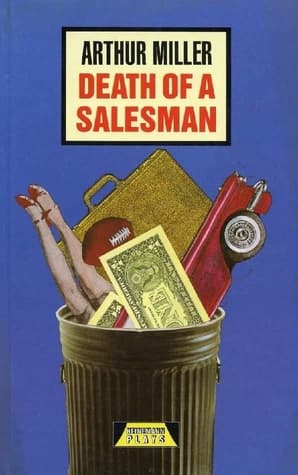
Arthur Miller (1949)
Genre
Fiction
Reading Time
90 min
Key Themes
See below
Sign in to track this book
Willy Loman, an aging salesman, confronts his failures and inflated self-worth, searching for a final, meaningful act in a world that has left him behind.
Willy Loman, a sixty-three-year-old traveling salesman, comes home to Brooklyn unexpectedly. He is very tired and recently had a near-accident. His wife, Linda, worries about his mental state, noticing his odd behavior and memory loss. Willy admits he can no longer drive long distances and is losing focus. Their two adult sons, Biff and Happy, are also home. Biff, thirty-four, has returned from working on farms out West, feeling lost. Happy, thirty-two, works as an assistant buyer but feels unhappy despite his womanizing. The family talks about Willy's falling sales and money problems. Willy holds onto his past successes and exaggerated stories.
Willy thinks about the past, remembering Biff's high school athletic skills and popularity, and compares it to Biff's current lack of drive. He often criticizes Biff for not having a steady job, but also encourages him to pursue big, unclear business ideas. Biff and Happy, hearing their parents, discuss their own worries. Biff feels he has wasted his life and resents his father's unrealistic expectations and 'fake' values. Happy, despite his job and apparent success, says he feels lonely and empty, constantly seeking approval through women and small work achievements. They decide to try and make their father proud.
Flashbacks show Willy's past talks with his neighbor, Charley, and Charley's son, Bernard. Willy often mocked Bernard's studiousness while praising Biff's athletic charm, believing it would lead to greater success. In the present, Charley visits, worried about Willy. He offers Willy a job, understanding his difficulties, but Willy's pride stops him from taking it. Instead, he borrows money from Charley every week, pretending it is his salary. Willy remembers a painful event where Biff found him with another woman in Boston. This shattered Biff's admiration for his father and changed their relationship.
Willy, wanting a change, visits his young boss, Howard Wagner, hoping for an office job that does not require travel. He tries to impress Howard with stories of his past sales and his close relationship with Howard's father, Frank Wagner, the company's founder. However, Howard is not interested, caring more about his new wire recorder than Willy's requests. Howard reminds Willy that the business has changed and his sales are no longer profitable. Despite Willy's emotional pleas and poor health, Howard fires him, telling him to take a leave of absence without pay, ending his career.
After being fired, a distressed Willy goes to Charley's office to borrow money, as he does weekly, but this time it is not for a salary. Charley tries to offer Willy a job again, which Willy again refuses due to pride. Willy is amazed by Charley's success and how Charley never needed to be 'liked' to achieve it, unlike Willy's own belief. While there, Willy sees Bernard, now a successful lawyer about to argue a case before the Supreme Court. Bernard gently asks Willy about what happened to Biff after high school, hinting at the Boston incident and Biff's later academic failure.
Biff and Happy meet Willy at a restaurant. They plan to tell him about Biff's failed meeting with Oliver. However, Biff cannot lie and admits that Oliver did not remember him and he stole Oliver's pen. Willy, already upset from being fired, cannot handle this failure and retreats into a delusional flashback to the Boston hotel room. Embarrassed and frustrated, Happy tries to distract Willy by introducing him to women, while Biff, seeing the pointlessness of their efforts, leaves angrily. Happy follows, leaving a confused and alone Willy in the restaurant.
The boys return home to find Linda very angry. She scolds them for leaving their father and reveals that Willy has been thinking about suicide, detailing the gas hose she found and removed. Biff, overcome by guilt and frustration, confronts Willy. He tries to make Willy face the truth about his life—that he is not a great salesman, that Biff is not meant for greatness, and that they are all 'low-men' who need to stop living a lie. Biff tearfully holds up the rubber hose, forcing Willy to confront his suicide attempts.
During the intense argument, Biff breaks down, crying and hugging Willy, saying he loves his father despite everything. This moment of real affection deeply moves Willy, who misinterprets Biff's emotional outburst as a sign that Biff still cares and will become a successful man. Willy believes that Biff will finally be 'magnificent' if he has an inheritance. Convinced that his life insurance policy will give Biff the money he needs to succeed, Willy imagines a final conversation with his beloved older brother, Ben, who tells him to make a 'diamond' out of his life. Willy then gets into his car and crashes it on purpose.
The play ends with Willy's funeral. Only Linda, Biff, Happy, Charley, and Bernard are there—a clear contrast to Willy's exaggerated claims of popularity. Linda, confused and heartbroken, wonders why Willy would die when they were finally out of debt. Biff says that Willy 'never knew who he was,' recognizing his father's mistaken pursuit of superficial success. Happy, however, promises to continue Willy's dream, believing it is the only way to honor him. Charley, offering the most thoughtful eulogy, says that 'a salesman has got to dream,' acknowledging the sadness of Willy's job and his great need to believe in something.
The Protagonist
Willy's arc is one of tragic decline, from a man clinging to fading illusions of grandeur to a broken individual who chooses suicide as a final, misguided attempt to secure his family's future.
The Supporting
Linda remains a steadfast, loving wife, enduring Willy's decline and the family's struggles, ultimately left with profound grief and confusion.
The Supporting
Biff moves from aimlessness and resentment to a painful but liberating acceptance of his own identity, rejecting his father's false dreams.
The Supporting
Happy remains largely stagnant, failing to learn from his father's mistakes and instead perpetuating the same cycle of ambition and superficiality.
The Supporting
Charley remains a consistent figure of support and pragmatism, his understanding of Willy's struggles deepening by the play's end.
The Supporting
Bernard's arc is one of consistent success and quiet dignity, proving the merits of hard work over superficial charm.
The Mentioned/Symbolic
Ben's character remains static as a symbolic figure, representing the 'wrong' path to success that Willy admired.
The Supporting
Her brief appearance serves as a catalyst for Biff's disillusionment and Willy's tragic decline.
The Supporting
Howard remains a static character, representing the impersonal nature of modern business.
The play criticizes the American Dream, especially the version that values material wealth, popularity, and superficial success over hard work, honesty, and self-knowledge. Willy Loman represents this flawed dream, believing that being 'well-liked' is the main way to succeed, rather than actual skill. His life shows the emptiness of this pursuit, as he dies poor and mostly alone, having chased an illusion. Biff, in contrast, eventually rejects this dream, seeking a more authentic, though less materially rich, life.
“He don't put a bolt to a nut, he don't tell you the law or give you medicine. He's a man way out there in the blue, riding on a smile and a shoeshine. And when they start not smiling back—that's an earthquake.”
The difficult relationships between Willy and his sons, Biff and Happy, are central to the play. Willy projects his own unfulfilled goals onto Biff, idealizing him and setting him up for failure by teaching him false values and unrealistic expectations. Biff's discovery of Willy's affair destroys his admiration for his father, leading to resentment and a lifelong struggle for identity. Happy, constantly seeking Willy's attention, is largely overlooked, which leads to his own superficial pursuits. The play explores how parental dreams, when misguided, can harm a child rather than help them.
“I'm not a leader of men, Willy, and neither are you. You were never anything but a hard-working drummer who landed in the ash can I'm a dime a dozen, and so are you!”
Willy's inability to tell truth from his own self-serving illusions causes much of the play's sadness. He constantly changes history, exaggerates his successes, and denies his failures, living in a fantasy world of past glories and future potential that never happens. Linda, aware of his delusions, tries to protect him, while Biff desperately tries to make his father face reality. The play suggests that living a lie, even a comforting one, eventually leads to destruction, as the truth eventually appears and breaks the fragile pretense.
“We're free and clear. We're free... We're free...”
Betrayal appears in many ways. Willy betrays Linda through his affair with The Woman, and he betrays Biff's trust, destroying his son's idealism. He also feels betrayed by the company he worked for his whole life, being fired without ceremony by his young boss, Howard. The Loman sons, in turn, abandon Willy at the restaurant, an act that deeply hurts him. This widespread sense of betrayal, both personal and professional, highlights how fragile relationships are and the harshness of a capitalist society that discards people once they are no longer useful.
“You can't just come to a business man and ask him for money. He don't know you. You're not his friend.”
Arthur Miller criticizes the dehumanizing aspects of unchecked capitalism, where people are valued only for what they produce and then discarded when they are no longer profitable. Willy Loman is a victim of this system, working tirelessly for decades only to be fired without feeling by his young boss, Howard. His identity becomes tied to his job, and without it, he loses his sense of self-worth. The play suggests that a society that prioritizes profit over human dignity leads to spiritual emptiness and sad outcomes for those who cannot adjust or compete.
“You can't eat the orange and throw the peel away—a man is not a piece of fruit!”
Willy's mind frequently shifts between past and present, blurring reality.
Miller employs a non-linear narrative structure where Willy's memories and hallucinations seamlessly blend with present-day events. These flashbacks are not chronological but rather triggered by current conversations, objects, or emotions. This device allows the audience direct access to Willy's fragmented mental state, revealing his idealized past, his deep-seated regrets (like the Boston affair), and the origins of his flawed worldview. It emphasizes his inability to escape the past and his struggle to differentiate between what is real and what he wishes were real, contributing to the play's dreamlike and tragic atmosphere.
The Loman house and its shrinking yard symbolize Willy's diminishing life and dreams.
The Loman house, once surrounded by open space, is now 'boxed in' by towering apartment buildings, casting shadows and preventing sunlight from reaching their yard. This physical encroachment mirrors Willy's psychological confinement and the suffocation of his dreams. The absence of a garden where Willy tries to grow seeds symbolizes his inability to cultivate anything lasting or successful in his life. The house itself becomes a character, representing the fragile facade of the American Dream the Lomans desperately try to maintain, and its eventual freedom from mortgage debt ironically coincides with Willy's death.
A literal object symbolizing Willy's suicidal ideation and his family's awareness.
The rubber hose, which Linda discovers attached to the gas heater, is a powerful and unsettling symbol of Willy's suicidal despair. It appears twice: first when Linda finds and removes it, revealing her knowledge of his attempts, and again when Biff confronts Willy with it. Its presence underscores the severity of Willy's mental breakdown and the silent suffering he endures. It represents his desperate attempts to escape his failures and, ultimately, the means by which he takes his own life, a stark and tangible manifestation of his tragic decision.
A recurring motif representing Willy's profession, his freedom, and his ultimate demise.
The car is central to Willy's identity as a traveling salesman; it is both his office and his means of livelihood. Initially, it symbolizes freedom and the open road, the promise of the American Dream. However, as Willy ages, the car becomes a source of exhaustion and frustration, contributing to his declining mental state and near-accidents. Ultimately, the car transforms into an instrument of his final, tragic act, as he intentionally crashes it to secure insurance money for his family. It represents the vehicle of his life's journey and its devastating end.
Willy's futile attempts to plant seeds symbolize his desire for tangible legacy and growth.
Throughout the play, Willy expresses a desire to plant seeds and grow a garden, particularly in the final act before his death. This act symbolizes his yearning for something tangible and lasting, something he can nurture and watch grow, in contrast to his ephemeral career as a salesman. His lament about not having anything 'to show for it' and his desperate attempt to plant seeds in the dark before his suicide highlight his unfulfilled desire for a legacy and a sense of rootedness. The barrenness of his yard reflects the barrenness of his life's achievements.
“I spoke to your father today, he's coming home.”
— Linda speaking to her sons, establishing Willy's return and their immediate concern.
“Willy Loman never made a lot of money. His name was never in the paper. He's not the finest character that ever lived. But he's a human being, and a terrible thing is happening to him. So attention must be paid. He's not to be allowed to fall into his grave like an old dog. Attention, attention must be finally paid to such a person.”
— Linda passionately defending Willy to Biff and Happy.
“He's liked, but he's not well liked.”
— Willy reflecting on his own career and the importance of being 'well liked' for a salesman.
“The only thing you got in this world is what you can sell. And the funny thing is that you're a salesman, and you don't know that.”
— Charley giving Willy a harsh dose of reality about the nature of business.
“I'm not a dime a dozen! I am Willy Loman, and you are Biff Loman!”
— Willy desperately trying to assert his and Biff's individuality and importance.
“He's got a job, Linda, he's making forty dollars a week!”
— Willy trying to convince Linda and himself of Biff's success, despite Biff's own admission of failure.
“We're free and clear. We're free... We're free...”
— Linda's final words at Willy's grave, reflecting the tragic irony of his death paying off the house.
“I don't say he's a great man. Willy Loman never made a lot of money. His name was never in the paper. He's not the finest character that ever lived. But he's a human being, and a terrible thing is happening to him. So attention must be paid. He's not to be allowed to fall into his grave like an old dog. Attention, attention must be finally paid to such a person.”
— Linda's powerful monologue to Biff and Happy, emphasizing Willy's inherent human worth.
“He's got a couple of bucks in his pocket. He's got a couple of dollars in his pocket. He's got a couple of dollars, and he's going to be a big shot!”
— Willy's deluded optimism about Biff's future, despite clear evidence to the contrary.
“I'm not a leader of men, Willy, and neither are you. You were never a salesman. You were a good carpenter.”
— Biff's raw and honest confrontation with Willy, stripping away their shared illusions.
“You can't eat the orange and throw the peel away—a man is not a piece of fruit!”
— Willy's outburst to Howard, protesting against being discarded after decades of service.
“Why must everybody conquer the world? You're not Ben. You're not a big man in Alaska, you're not a leader of men.”
— Biff trying to make Willy accept his ordinary life and let go of his grand ambitions.
“The woods are burning! I can't see the sky! There's no sun where you're going!”
— Willy's desperate and fragmented thoughts, symbolizing his mental collapse and lost hope.
“He had the wrong dreams. All, all wrong.”
— Biff's poignant summary of Willy's life and the source of his tragedy.
“I'm gonna show you and everybody else that Willy Loman did not die in vain. He had a good dream. It's the only dream you can have—to come out number one man. He fought it out here, and this is where I'm gonna win it for him.”
— Happy's final, defiant statement at Willy's grave, indicating his intention to follow in Willy's footsteps.
Ready to see how well you understood this book? Take our interactive quiz with 10 questions.
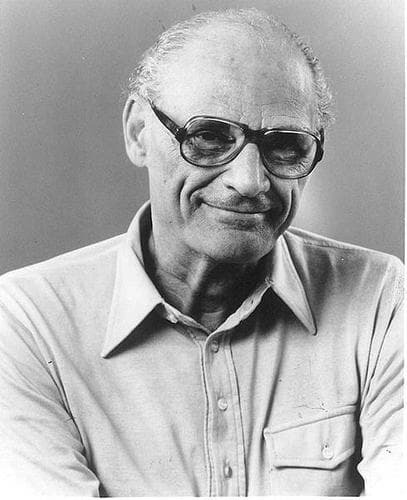
Arthur Asher Miller was an American playwright, essayist and screenwriter in the 20th-century American theater. Among his most popular plays are All My Sons (1947), Death of a Salesman (1949), The Crucible (1953), and A View from the Bridge (1955). He wrote several screenplays and was most noted for his work on The Misfits (1961). The drama Death of a Salesman is considered one of the best American plays of the 20th century.

Ashley Antoinette
4.6

Mark McDonald
4.4
Luo Guanzhong
4.4

Mia McKenzie
4.3

Dorothy Parker
4.3

Joaquim Maria Machado de Assis
4.3

James Thurber
4.2

Terry Kay
4.2