“The day begins. Glory to thee, O Lord! Glory to thee, O Lord!”
— The protagonist, Andrei Komiaga, wakes up and begins his day with a prayer.

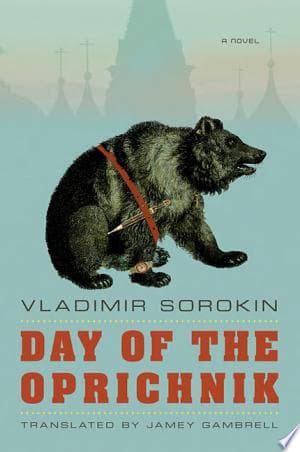
Vladimir Sorokin (2011)
Genre
Fiction
Reading Time
180 min
Key Themes
See below
Sign in to track this book
In 2028 Moscow, an elite enforcer navigates a day of executions, lavish parties, and drug-fueled excess, all while serving a czar who blends futuristic technology with the terror of Ivan the Terrible.
The novel opens in Moscow, 2028, with Andrei Danilovich Komiaga, a high-ranking oprichnik, waking to his phone's death rattle ringtone. He performs a ritualistic purification, bathing in the 'holy' waters of the Moscow River, now in a special tank. This act, a mix of ancient tradition and futuristic convenience, sets the tone for the paradoxical world Sorokin creates. Komiaga then puts on his oprichnik uniform, which includes a black kaftan and a dog's head emblem, showing loyalty and ferocity. His morning routine is interrupted by a call, signaling the start of his violent and morally ambiguous duties for the day, all for the autocratic Czar.
Komiaga leads his oprichnik squad to the opulent dacha of a boyarin, Yury Ivanovich, accused of anti-Czarist sentiments. The oprichniks, with their signature violence, ransack the estate, destroying artifacts and terrorizing the household. Yury Ivanovich is publicly executed by being impaled on a stake, a barbaric spectacle meant to instill fear and show the Czar's absolute power. Komiaga, while participating, observes the scene with a detached professionalism, showing the desensitization in his role. This act reminds readers of the regime's brutality and the oprichniks' commitment to enforcing it.
Following the execution, Komiaga travels to the Great Russian Wall, a massive, technologically advanced barrier that divides Russia from China. This visit shows the geopolitical reality of Sorokin's future Russia, isolated and paranoid. Komiaga inspects the wall's defenses, marveling at its scale and the advanced surveillance technology. The wall symbolizes Russia's self-imposed isolation and its fear of outside influences, especially from the East. During his visit, he reflects on Russia's 'Golden Age' under the Czar, a time of supposed purity and strength achieved through this isolation and strict adherence to traditional values.
Komiaga attends a lavish banquet hosted by a wealthy merchant, a gathering of the elite where excess is normal. The feast is described with grotesque detail, featuring exotic and traditional Russian dishes, much alcohol, and an array of futuristic psychoactive drugs. Komiaga partakes in all of it, showing the oprichniks' privileged position and their access to hedonistic pleasures. This scene contrasts sharply with the earlier brutality, showing the duality of their lives: enforcers of a harsh regime who also enjoy luxury. The drugs, especially 'Firebird,' cause hallucinatory experiences, further blurring reality for Komiaga.
Later in the day, Komiaga and his fellow oprichniks visit the 'Red Star' brothel, an establishment only for them. The women there are beautiful and submissive, trained to cater to the oprichniks' every whim. Komiaga engages in sexual acts, depicted with a disturbing blend of detachment and entitlement. This visit shows the oprichniks' unchecked power and the objectification of women in this society. It also shows another instance of their hedonistic lifestyle, showcasing the rewards they get for their loyalty and brutality.
Amidst the debauchery and violence, Komiaga experiences moments of unexpected emotion. During a gathering, he listens to traditional Russian folk songs, sung with heartfelt passion. These songs, often nostalgic and patriotic, move him deeply, bringing tears to his eyes. This scene offers a glimpse into a more complex side of Komiaga, suggesting that beneath the hardened exterior of the oprichnik is a capacity for emotion and a connection to cultural heritage, however twisted it might be within the regime. It shows the psychological manipulation that allows such brutal men to still feel 'human' emotions.
Towards the end of the day, Komiaga and his oprichnik brothers engage in a bizarre, homoerotic ritual, a communal act of bonding and purification. This involves a shared bath and a mutual anointing with a special oil, ending in a collective act of sodomy. This ritual, while shocking, symbolizes the intense loyalty and brotherhood among the oprichniks, reinforcing their devotion to each other and to the Czar. It represents a surrender of individual identity to the collective, a final act of purification and commitment to their shared, violent purpose, further cementing their detachment from conventional morality.
As the day ends, Komiaga returns to the estate of the executed boyarin. In a final act of obliteration, the oprichniks set fire to the dacha, ensuring no trace of the 'traitor' remains. The burning house is a symbol of the regime's ruthlessness and its desire to erase any dissent or memory of opposition. Komiaga watches the flames consume the opulent structure, a silent reminder of their terror's effectiveness. This act completes the cycle of destruction started earlier in the day, leaving a clean slate for the Czar's continued reign.
After the day's events, Komiaga finds a moment of quiet reflection, observing the city lights. Despite the brutality and excess, he feels a strange sense of purpose and contentment in his role. He thinks about the cyclical nature of his duties, the blend of violence and pleasure, and his loyalty to the Czar. This brief introspection shows the depth of his indoctrination and his acceptance of the oprichnik way of life as the only true path. He feels a sense of belonging and power, secure in his position within the Czar's grip on Russia.
As night falls, Komiaga prepares for sleep, knowing another day of service to the Czar awaits him. His final thoughts are of duty, loyalty, and the continuation of the oprichnik order. The novel implies that this cycle of violence, hedonism, and absolute power is continuous. Komiaga's readiness for the next day shows the dystopian reality where the oprichniks are not just enforcers but integral, self-perpetuating elements of the regime, ensuring its longevity through fear and control. The future of Russia, as depicted, is one of perpetual, brutal stability.
The Protagonist
Komiaga remains largely static, fully embodying the oprichnik ideal, though glimpses of internal conflict hint at a suppressed humanity.
The Antagonist/Off-screen Authority
The Czar's power is absolute and unchallenged throughout the narrative.
The Victim/Supporting
His arc is cut short by his execution, serving as a cautionary tale.
The Supporting
They maintain their collective identity and purpose, remaining steadfast enforcers.
The Mentioned/Supporting
They serve as a static element, maintaining the wall's integrity.
The Mentioned/Supporting
They remain in their subservient roles, embodying the societal oppression.
The novel shows a totalitarian regime where the Czar has absolute power, enforced through systematic violence and terror. The oprichniks, like Komiaga, are the main instruments of this state violence, carrying out brutal executions, ransacking homes, and instilling fear. The impalement of the boyarin Yury Ivanovich is a prime example, serving as a public spectacle to crush dissent. This theme explores how a regime maintains control not just through ideology, but through the constant threat and execution of physical harm.
““For the Czar, for Russia, for faith!””
Sorokin's future Russia is defined by extreme nationalism, characterized by a fervent belief in its own superiority and a complete rejection of outside influences. The 'Great Russian Wall' physically shows this isolationism, separating Russia from China and the rest of the world. Propaganda about a 'Golden Age' under the Czar reinforces a sense of national purity and strength. This theme highlights the dangers of xenophobia and how a nation can retreat into itself, leading to stagnation and a distorted sense of identity, as seen in Komiaga's reflections at the Wall.
““We are a pure people, a strong people, a Russian people. We don't need their West, their East.””
The novel blends archaic traditions with futuristic technology, creating a paradoxical and disturbing reality. Oprichniks, like Ivan the Terrible's historical enforcers, use advanced vehicles and communication devices. Rituals like Komiaga's 'holy' river bath are performed with modern conveniences, and ancient forms of execution coexist with sophisticated surveillance. This theme explores how historical authoritarian patterns can re-emerge, adapted with new tools, suggesting that human nature and the desire for power can transcend technological advancements, as shown by the oprichniks' blend of old and new.
““The past is our future. The future is our past.””
The oprichniks' lives are characterized by extreme indulgence in luxury, food, drugs, and sex, contrasting sharply with their brutal duties. The extravagant banquet and the visit to the 'Red Star' brothel show their unchecked privilege and the moral vacuum within the regime. This theme illustrates how power can corrupt completely, leading to a disregard for ethical boundaries. The oprichniks' hedonism is not just a reward but also a tool for control, keeping them loyal and desensitized to their own atrocities, as Komiaga's drug use and sexual exploits show.
““Pleasure is our right, our reward for purity.””
Symbolic attire that signifies loyalty, terror, and the blending of past and future.
The black kaftan and the dog's head emblem are powerful symbols. The kaftan evokes the historical oprichniks of Ivan the Terrible, while the dog's head represents their ferocity and unwavering loyalty to the Czar, ready to 'sniff out' and 'bite' traitors. These elements instantly identify the oprichniks as agents of fear and power. Their uniform also highlights the novel's blend of archaic tradition with modern authoritarianism, as these symbols are worn by men wielding futuristic technology, creating a striking visual and thematic paradox.
A physical and symbolic barrier representing Russia's isolationism and paranoia.
The Great Russian Wall is a colossal, technologically advanced barrier separating Russia from China. It functions as a literal plot device by defining the geopolitical landscape and restricting movement. Symbolically, it represents Russia's self-imposed isolation, its fear of external influences, and its nationalistic paranoia. It underscores the regime's desire to create a 'pure' Russia, free from foreign contamination, and serves as a constant reminder of the country's chosen path of insularity and self-sufficiency, despite its technological advancement.
Repeated acts of brutality and symbolic cleansing that reinforce the oprichniks' identity.
The novel is punctuated by various rituals, from Komiaga's morning 'holy' bath to the collective homoerotic purification ceremony. These acts are not merely symbolic; they are integral to the oprichniks' identity and loyalty. The violence, such as the impalement, is also ritualized, designed to be a public spectacle that instills fear and demonstrates absolute power. These rituals function as a form of social conditioning, reinforcing the oprichniks' brotherhood, their detachment from conventional morality, and their unwavering devotion to the Czar, blurring the lines between sacred and profane.
A futuristic psychoactive substance used by oprichniks to enhance their experiences.
The 'Firebird' drug is a fictional psychoactive substance that oprichniks, including Komiaga, consume. It enhances their sensory experiences, induces hallucinations, and likely contributes to their desensitization and detachment from reality. As a plot device, it highlights the hedonistic aspect of the oprichnik lifestyle and the regime's use of artificial means to control or 'reward' its enforcers. It blurs the lines between reality and illusion, reflecting the distorted moral landscape of Sorokin's Russia and the oprichniks' escape from the consequences of their actions.
“The day begins. Glory to thee, O Lord! Glory to thee, O Lord!”
— The protagonist, Andrei Komiaga, wakes up and begins his day with a prayer.
“Goldfish swim in the vodka. One, two, three. They swim and swim. And they don't get drunk.”
— Komiaga is drinking vodka infused with goldfish, a bizarre luxury.
“A good day, a profitable day, a joyous day awaits. For all of us. For all of Russia.”
— Komiaga reflects on the promise of the day and its implications for the country.
“The Border Wall is sacred. It is our shield, our sword, our future.”
— Komiaga is driving and observing the massive wall separating Russia from the West.
“Blood is a great cleanser. It washes away the grime, the doubt, the weakness.”
— Komiaga is participating in a brutal interrogation and execution.
“Silence is golden. Especially when it's the silence of fear.”
— Komiaga observes the terrified reactions of people in the city.
“The past is a foreign country. They do things differently there. And we will never go back.”
— Komiaga dismisses any nostalgia for the pre-Oprichnik era.
“They say Russia is a riddle wrapped in a mystery inside an enigma. But we, the Oprichniks, are the key.”
— Komiaga reflects on the role of the Oprichniks in understanding and controlling Russia.
“A man without a Tsar is like a fish without water. He gasps, he struggles, he dies.”
— Komiaga expresses his unwavering loyalty to the Tsar.
“The future is bright. It is clean. It is ours.”
— Komiaga looks forward to the continued dominance and prosperity of Oprichnik Russia.
“Poetry is the language of the soul. But sometimes, the soul needs a good beating.”
— Komiaga dismisses the value of art in favor of brute force.
“We are the gardeners of Russia. We weed out the weak, the rotten, the superfluous.”
— Komiaga views the Oprichniks as essential for maintaining the purity of the nation.
“The smell of burning books is the smell of a new dawn.”
— Komiaga observes the destruction of old, undesirable literature.
“God is with us. And with those who serve Him faithfully, with iron and fire.”
— Komiaga justifies the Oprichniks' brutal actions through divine sanction.
Ready to see how well you understood this book? Take our interactive quiz with 10 questions.
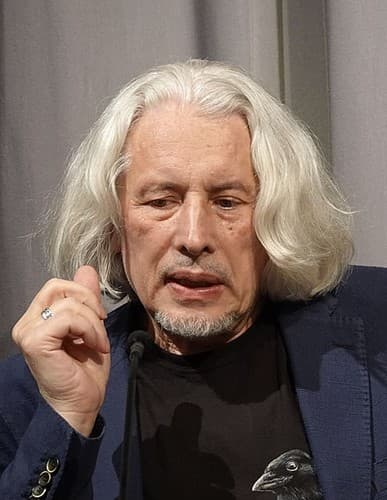
Biography coming soon.

Ashley Antoinette
4.6

Mark McDonald
4.4
Luo Guanzhong
4.4
Mia McKenzie
4.3
Dorothy Parker
4.3
Joaquim Maria Machado de Assis
4.3
James Thurber
4.2
Terry Kay
4.2