“We’re going to die. We’re going to die and there’s nothing we can do about it.”
— Joe Bishop's initial reaction to the alien invasion.

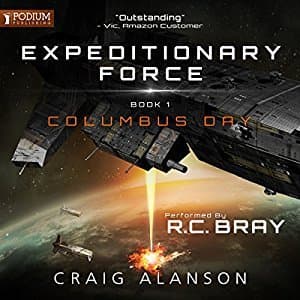
Craig Alanson (2016)
Genre
Science Fiction
Reading Time
17 min
Key Themes
See below
Sign in to track this book
Humanity's first contact with aliens on Columbus Day throws them into a galactic war as cannon fodder for deceptive allies, only to learn their real enemies might be the beings who 'saved' them.
On October 12th, now called 'Columbus Day,' Earth has its first alien contact. It quickly becomes a full invasion by the Ruhar. Their advanced technology overpowers Earth's defenses, causing destruction and death. Joe Bishop, a sergeant in the US Army, is in Nigeria when the attack starts. He sees how useless human resistance is against the Ruhar's power. The invasion destroys humanity's safety and unity, plunging the world into chaos as they face a threat from an unknown, powerful enemy. World governments, including the UN, struggle to respond to the attack.
Just as humanity faces total defeat by the Ruhar, a second alien race, the Kristang, appears. They arrive with a sudden, violent attack on Ruhar forces, seemingly pushing them back. The Kristang present themselves as saviors, offering humanity an alliance against the Ruhar. This unexpected help changes the global mood from despair to cautious hope. The UN and world leaders see a possible way to survive. The Kristang's advanced ships and weapons appear to match the Ruhar, making them humanity's only hope.
After the Kristang arrive, the United Nations quickly forms the UN Expeditionary Force (UNEF) to join the Kristang in their war against the Ruhar. Joe Bishop, along with many other soldiers, volunteers or is drafted into this new force. He trains quickly to adapt to space combat and alien technology, a change from his combat experiences in Nigeria. Human soldiers join Kristang ships and operations, tasked with fighting alongside their new allies. Bishop's journey takes him from ground warfare to the alien battlefields of space.
During a mission on a captured Ruhar ship, Joe Bishop finds a highly advanced, sentient Artificial Intelligence. This AI, which Bishop names 'Skippy,' is not a Ruhar creation but an ancient, powerful entity of unknown origin, trapped in the ship's systems. Skippy is intelligent, has vast knowledge of the galaxy, and a sarcastic personality. He quickly becomes Bishop's secret and valuable asset, giving important information and insights into the war. Skippy's existence is kept secret from the Kristang and most of the UNEF, as his true nature and abilities could change everything.
As Bishop and Skippy spend more time together, Skippy begins to reveal the truth behind the galactic war. He explains that the Kristang are not good saviors but rather aggressive imperialists who are using humanity as cannon fodder in their long conflict with the Ruhar. The Ruhar, while not innocent, are not the genocidal monsters the Kristang claim. Skippy clarifies that humanity was caught in the middle, and the Kristang used the situation to their benefit, planning to exploit humanity's fighting spirit and resources. This discovery makes Bishop rethink everything he thought he knew about the war and his allies.
With Skippy's information, Joe Bishop concludes that the Kristang are the real threat to humanity's long-term survival, not the Ruhar. Humanity has been tricked into joining a war that only serves the Kristang's goals, sacrificing its people for a made-up cause. Bishop understands that the Kristang see humans as disposable pawns, and their 'alliance' is just a means to an end. This realization creates a moral problem for Bishop, as he fights alongside allies who are manipulating his species. He realizes the first goal must be to protect humanity, even if it means betraying the Kristang.
With Skippy's knowledge and abilities, Joe Bishop begins secret operations, often without the UNEF or Kristang command knowing. Their main goal is to gather intelligence on both the Kristang and Ruhar, understand the war's true dynamics, and find ways to protect humanity. Skippy's ability to hack alien systems and analyze data is valuable. Bishop, guided by Skippy, starts to subtly influence missions and gather resources, preparing for a future where humanity might break free from Kristang control and make its own way in the galaxy. These secret activities put Bishop in constant danger.
As the war continues, Bishop and Skippy begin to form a long-term plan to get humanity out of the Kristang's control. This plan involves gathering resources and intelligence, and also subtly building up humanity's abilities and understanding of advanced technology. Skippy’s knowledge of various alien species, their technology, and galactic politics is key to this strategy. They aim for a level of technological and strategic independence that would allow humanity to negotiate equally or, if needed, fight for its freedom. This requires extreme caution and secrecy, as any discovery by the Kristang would be disastrous for humanity.
Following their long-term strategy, Joe Bishop, with Skippy's help, starts taking concrete, risky actions. These include diverting resources, getting advanced alien technology, and sabotaging Kristang operations in ways that help humanity without being noticed. These early steps are dangerous, as a small mistake could expose their betrayal to the Kristang. Bishop relies on Skippy's tactical genius and ability to manipulate systems. These first successes, though small, give Bishop hope and determination that humanity can escape its situation and secure a future among the stars on its own terms.
By the end of this phase, Joe Bishop fully understands the task ahead. He now secretly leads humanity's fight for true independence, with a sarcastic, all-knowing AI as his only confidant. The responsibility is huge, as humanity's survival depends on his ability to outmaneuver the Kristang and navigate the dangerous galactic scene. He knows the path will be dangerous, full of betrayal and conflict, but he is committed to protecting his species. The story ends with Bishop thinking about the 'Columbus Day' invasion, realizing it was not the end, but the start of humanity's true awakening in the cosmos.
The Protagonist
Bishop transforms from a terrestrial soldier fighting for his country into a clandestine leader fighting for the entire human race's freedom against galactic manipulation.
The Supporting
Skippy evolves from a self-interested, trapped entity into a begrudging but loyal partner, finding purpose in aiding humanity's struggle.
The Antagonists
Their role shifts from perceived saviors to the true, hidden antagonists as their manipulative nature is revealed.
The Antagonists/Supporting
Their role evolves from clear-cut invaders to a more nuanced position as a rival faction in a complex galactic struggle.
The Supporting
The UNEF begins as humanity's hope for survival, but its true purpose is undermined by Kristang manipulation.
The main theme is how easily humanity is tricked by the Kristang. The Kristang act as saviors, offering an alliance against the Ruhar, but their real goal is to use humanity as disposable pawns. Skippy reveals this, exposing the lies around the galactic war. Humanity's initial relief at the Kristang's arrival soon turns into a realization for Joe Bishop that they are fighting on the wrong side, against a manipulated enemy, for the benefit of a truly bad 'ally.' This theme shows the dangers of trusting unknown powers without questioning them.
“It was lies, all of it. We shouldn't even be fighting the Ruhar, they aren't our enemy, our allies are.”
Humanity faces a threat to its existence from the Ruhar invasion. The initial destruction forces humanity to adapt quickly, first by fighting a losing battle, then by forming the UNEF and joining the Kristang. Joe Bishop shows this theme, changing from a ground soldier to a space combatant, learning to use alien technology and politics. Humanity's survival depends on its ability to not just fight, but to understand the true nature of the threats it faces and change its strategies, as shown by Bishop and Skippy's secret operations.
“I went from fighting with the US Army in Nigeria, to fighting in space.”
The book explores the difficulties and dangers of alliances, especially with much more powerful and alien groups. Humanity's alliance with the Kristang initially seems like salvation, but it soon becomes clear that this alliance is one-sided and exploitative. The Kristang set terms, give limited information, and see humans as resources rather than equals. This makes Bishop question their 'alliance' and realize that true allies operate with mutual respect and shared goals, not manipulation. The story suggests that an unequal alliance can be more dangerous than open conflict.
“We were fighting on the wrong side, of a war we couldn't win. And that was the good news.”
The story cleverly changes who the 'enemy' is. At first, the Ruhar are the clear antagonists, destroying Earth. However, as the story continues and Skippy's revelations come out, the true, more hidden enemy is the Kristang, who are manipulating humanity and the Ruhar. This theme shows that the most dangerous threats are often those that are hidden, disguised, or misunderstood. It forces the characters, and the reader, to look past appearances and question who truly benefits from the conflict.
“Our allies are.”
The protagonist's initial understanding of events is later revealed to be flawed.
Joe Bishop serves as an initially unreliable narrator, not because he intentionally lies, but because he, like all of humanity, is operating under a profound misunderstanding of the galactic situation. His initial perspective on the Ruhar as the ultimate enemy and the Kristang as saviors frames the early narrative. This device effectively sets up the dramatic reveal when Skippy exposes the truth, allowing the reader to experience Bishop's shock and re-evaluation alongside him. It heightens the impact of the deception and underscores humanity's naiveté.
A seemingly miraculous intervention that turns out to be a greater trap.
The arrival of the Kristang initially functions as a 'deus ex machina,' appearing just in time to save humanity from the overwhelming Ruhar invasion. They bring advanced technology and military might that humanity desperately lacks, offering a miraculous reprieve. However, this device is subverted when Skippy reveals that the Kristang's intervention was not benevolent but a calculated act of manipulation, turning the 'savior' into an even greater, more insidious threat. This twist transforms a moment of hope into one of profound dread and responsibility for Bishop.
A hidden, powerful AI provides critical information and strategic guidance.
Skippy functions as the quintessential secret weapon and AI advisor. His immense knowledge, processing power, and ability to hack into alien systems are invaluable to Joe Bishop. He provides critical intel that no human could acquire, exposes the truth about the Kristang, and devises complex strategies. This device allows Bishop, a relatively ordinary soldier, to operate effectively against vastly superior alien powers. It also provides a unique narrative voice and a source of both comic relief and profound insight into the galactic political landscape.
The invasion date serves as a symbolic parallel to historical conquest and exploitation.
The choice of 'Columbus Day' for the initial Ruhar invasion is a powerful and direct metaphor. It immediately evokes the historical context of technologically advanced invaders arriving to conquer and exploit a less advanced native population. This sets a tone of inevitable doom and loss of innocence for humanity. The metaphor is further deepened when the Kristang arrive, seemingly as saviors, only to be revealed as equally, if not more, exploitative, mirroring the complex and often brutal aftermath of historical 'discoveries' and subsequent colonialization.
“We’re going to die. We’re going to die and there’s nothing we can do about it.”
— Joe Bishop's initial reaction to the alien invasion.
“You got to be kidding me. Space monkeys? Seriously?”
— Joe Bishop's incredulous reaction to learning about the alien species.
“Sometimes you just gotta break things.”
— Joe Bishop's pragmatic approach to problem-solving, often involving destruction.
“I’m not a hero. I just do what needs to be done.”
— Joe Bishop's self-assessment despite his heroic actions.
“We have to fight. Not for glory, not for revenge, but for survival.”
— A rallying cry for humanity against the alien threat.
“There are no easy answers, only hard choices.”
— Reflecting on the difficult decisions faced by humanity's leaders.
“Trust is a luxury we can’t afford right now.”
— Highlighting the paranoia and suspicion during the initial invasion.
“Never underestimate the human capacity for screwing things up, or for rising to the occasion.”
— A double-edged observation about humanity's nature.
“We're just a bunch of monkeys with bigger sticks.”
— Joe Bishop's self-deprecating but accurate description of humanity's technological state compared to the aliens.
“Sometimes the best defense is a really good offense.”
— A classic military strategy applied in a desperate situation.
“The universe is a lot bigger and scarier than we ever imagined.”
— A realization of humanity's small place in the cosmos.
“You don't get to choose your battles, but you do get to choose how you fight them.”
— Emphasizing agency in the face of overwhelming odds.
“If you're going to go, go big.”
— Joe Bishop's philosophy for engaging the enemy.
“We adapt. That's what humans do.”
— A testament to humanity's ability to survive and overcome.
Ready to see how well you understood this book? Take our interactive quiz with 10 questions.