BookBrief
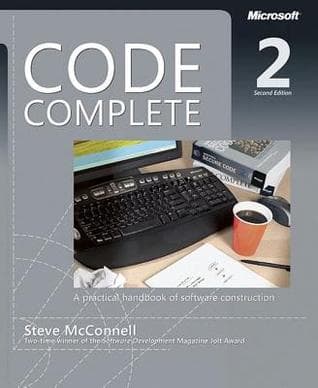
Code Complete cover
Archivist's Choice

Code Complete

Steve McConnell (1993)

Genre

Reference / Technology

Reading Time

1500+ min (for thorough reading and practice)

Key Themes

See below

Track Your Reading

Sign in to track this book

This is the definitive guide to software craftsmanship, updated to give developers timeless techniques, current practices, and practical advice for building high-quality, robust code.

Core Idea

Software construction, where developers write and debug code, is the most important and often overlooked part of software development. By using best practices in all construction activities—from detailed design and naming to defensive programming, refactoring, and systematic debugging—developers can significantly improve code quality, reduce defects, make code easier to maintain, and increase productivity. The book is a complete, practical guide to mastering these construction techniques, promoting disciplined, thoughtful coding that values clarity, correctness, and manageability over shortcuts.
Reading time
1500+ min (for thorough reading and practice)
Difficulty
Hard
✓ Read this if...
You are a software developer at any experience level looking to significantly improve your coding practices, understand the 'why' behind effective construction techniques, and build a robust foundation for writing high-quality, maintainable software. Also ideal for team leads wanting to establish best practices.
✗ Skip this if...
You are primarily interested in high-level architectural design, project management methodologies, or specific programming language tutorials without a focus on the fundamental craft of writing and improving code.

Core idea

The central argument and framework that powers the entire book.

Software construction, where developers write and debug code, is the most important and often overlooked part of software development. By using best practices in all construction activities—from detailed design and naming to defensive programming, refactoring, and systematic debugging—developers can significantly improve code quality, reduce defects, make code easier to maintain, and increase productivity. The book is a complete, practical guide to mastering these construction techniques, promoting disciplined, thoughtful coding that values clarity, correctness, and manageability over shortcuts.

At a glance

Reading time

1500+ min (for thorough reading and practice)

Difficulty

Hard

Read this if...

You are a software developer at any experience level looking to significantly improve your coding practices, understand the 'why' behind effective construction techniques, and build a robust foundation for writing high-quality, maintainable software. Also ideal for team leads wanting to establish best practices.

Skip this if...

You are primarily interested in high-level architectural design, project management methodologies, or specific programming language tutorials without a focus on the fundamental craft of writing and improving code.

Key Takeaways

1

The Primacy of Construction

Software construction is the core of development, not just coding.

Quote

The construction phase has the greatest influence on the overall quality and success of a software project.

McConnell emphasizes that 'construction' is more than just writing code; it includes detailed design, coding, debugging, and unit testing. He states that the quality of these construction activities directly affects the final product's quality and, importantly, overall project success. Many organizations underestimate this phase, focusing instead on high-level architecture or post-release maintenance. However, most defects are introduced during construction, and this is where the best chances for efficiency and correctness lie. By giv...

Supporting evidence

McConnell cites numerous studies indicating that defects injected during construction are the most common and expensive to fix if discovered late in the lifecycle. He references Boehm's findings on the exponential cost increase of fixing defects as the project progresses.

Apply this

Treat coding as a detailed design activity, not just transcription. Allocate sufficient time for unit testing and code review within the construction phase. Prioritize clear, maintainable code over quick, hacky solutions.


software-lifecyclequality-assurancedefect-prevention
2

Mastering the Art of Naming

Clear, precise naming is fundamental to code readability and maintainability.

Quote

The greatest single cause of complexity in software is poor variable names.

McConnell pays close attention to the seemingly small but very important act of naming variables, functions, classes, and files. He argues that well-chosen names are not just helpful comments; they are the documentation. Good names make code self-explanatory and reduce the mental effort for anyone reading it (including the original author weeks later). Bad names, such as ambiguous, abbreviated, or generic ones (e.g., temp, data, doit), hide the code's purpose, cause bugs, and make refactoring difficult. He provides many naming...

Supporting evidence

He provides numerous 'before and after' code examples, illustrating how renaming variables like `x` to `customerAccountNumber` or `process()` to `processOrderPayments()` dramatically improves understanding and reduces the likelihood of misuse.

Apply this

Spend extra time on names. Prioritize full words over abbreviations unless universally understood. Use prefixes for scope (e.g., `m_` for member variables). Ensure names clearly state purpose and units if applicable. Be consistent with naming conventions across the codebase.

code-readabilitymaintainabilitynaming-conventions
3

Defensive Programming is Paramount

Anticipate and handle errors gracefully to build robust software.

Quote

Defensive programming is the practice of writing code that is able to handle unexpected input and behavior gracefully.

McConnell strongly supports defensive programming, a mindset where developers actively expect errors and build ways to detect, report, and recover from them. This is not about blaming users; it is about creating reliable software. Key techniques include checking input parameters, validating return values, using assertions for internal consistency checks, and handling exceptions smoothly. The goal is to stop bad data from spreading through the system and causing major failures. While some might see this as over-engineering, McConnell s...

Supporting evidence

He details examples of common errors, such as invalid array indices, null pointers, or division by zero, and shows how simple checks or assertions could prevent crashes or corrupt data. He also distinguishes between assertions (for internal logic errors) and error handling (for external, anticipated problems).

Apply this

Use assertions generously for conditions that 'should never happen'. Validate all input from external sources. Implement robust error logging. Design clear error messages for users. Consider 'fail-fast' strategies where appropriate to prevent error propagation.

error-handlingassertionsexception-managementrobustness
4

The Power of Pseudocode Programming Process (PPP)

Design at a detailed level before writing actual code.

Quote

The Pseudocode Programming Process (PPP) provides a disciplined way to design at a detailed level before you write a single line of code.

PPP is a core method McConnell suggests to connect high-level design with actual coding. It involves writing the logic for a routine in high-level pseudocode, refining it, then writing the actual code, and finally reviewing and iterating. This structured approach makes developers think through the algorithm, data structures, and error handling before getting stuck in syntax. It helps find design flaws early, improves code quality, and often speeds up the overall coding process by reducing rework during coding. It is a practical appl...

Supporting evidence

McConnell demonstrates PPP with examples of complex algorithms, showing how sketching out the steps in pseudocode allows for easier refactoring of logic and identification of edge cases before committing to a specific language implementation. He contrasts it with 'code-and-fix' development, which is less efficient.

Apply this

Before writing any function or method, outline its logic in pseudocode. Focus on clarity and correctness of the algorithm. Refine the pseudocode until it's clear and concise. Only then translate it into actual code, using the pseudocode as comments if helpful. Review and iterate.

detailed-designalgorithm-designsoftware-designpseudocode
5

The High Cost of Complexity

Strive for simplicity; complexity is the enemy of quality and maintainability.

Quote

Complexity is the single greatest enemy of quality. Any technique that reduces complexity will improve quality and maintainability.

McConnell consistently repeats that complexity is the main cause of most software problems. Complex code is harder to understand, more likely to have bugs, difficult to test, and expensive to maintain. He explores various sources of complexity, including complicated logic, too many dependencies, bad naming, and unnecessary features. The book promotes active strategies to reduce complexity, such as high cohesion, loose coupling, clear interfaces, small routines, and avoiding 'clever' but unclear code. The ultimate goal is to make code ...

Supporting evidence

He refers to studies on cyclomatic complexity and its correlation with defect rates. He provides examples of overly complex conditional logic or deeply nested loops and then refactors them into simpler, more manageable structures, demonstrating the immediate improvement in readability and reduced error potential.

Apply this

Break down large routines into smaller, single-purpose functions. Minimize global variables and shared state. Design for clear, minimal interfaces between modules. Refactor complex code whenever encountered. Ask 'Is there a simpler way?' constantly.

code-complexityrefactoringmaintainabilitycohesioncoupling
6

The Iterative Nature of Refactoring

Continuously improve code quality through small, controlled changes.

Quote

Refactoring is the process of improving the internal structure of code without changing its external behavior.

Refactoring, as McConnell advocates, is not a one-time event but an ongoing practice. It is the act of making small, continuous changes to the code's internal structure—improving its design, readability, and efficiency—without changing its observable behavior. This continuous cleanup prevents technical debt from building up, makes the codebase easier to understand and extend, and reduces the chance of introducing new bugs. McConnell emphasizes that refactoring should be done often, in small steps, and always with automated tests to en...

Supporting evidence

He provides detailed examples of common refactoring patterns, such as 'Extract Method' or 'Rename Variable', showing how each small change contributes to overall code quality. He stresses the importance of unit tests as a prerequisite for safe refactoring.

Apply this

Refactor code whenever you touch it, even if just to fix a bug. Look for opportunities to improve names, extract methods, or simplify logic. Ensure a robust suite of unit tests is in place before refactoring. Treat refactoring as an integral part of development, not an optional luxury.

technical-debtcode-qualityunit-testingcode-maintainability
7

The Power of Collaboration & Reviews

Collective intelligence significantly enhances code quality and knowledge sharing.

Quote

Pair programming and formal inspections consistently produce higher quality code than individual efforts alone.

Beyond individual coding practices, McConnell highlights the great value of collaborative development techniques, especially code reviews and pair programming. He presents strong evidence that having multiple people look at code catches defects earlier, improves design, and helps transfer knowledge within a team. Code reviews, whether formal inspections or informal walk-throughs, make developers explain their design choices and reveal potential blind spots. Pair programming offers real-time feedback and shared ownership, leading to st...

Supporting evidence

He cites studies showing that formal code inspections can find a significantly higher percentage of defects than testing alone, often at a lower cost. He also discusses the benefits of pair programming for knowledge sharing and reducing individual errors.

Apply this

Implement regular code reviews as part of your team's workflow. Encourage pair programming for complex features or bug fixes. Foster a culture where constructive feedback is welcomed and seen as a path to improvement. Utilize automated tools to streamline the review process.

code-reviewspair-programmingteamworkknowledge-sharing
8

Debugging as a Systematic Process

Approach bug finding with a methodical, scientific mindset.

Quote

Debugging is not just an art; it is a systematic, logical process that can be learned and improved.

McConnell changes debugging from a frustrating trial-and-error activity into a systematic, almost scientific method. He supports a methodical approach: understanding the problem, reproducing it reliably, finding the defect, fixing it, and then testing the fix. Importantly, he stresses forming hypotheses about the bug's cause and then designing tests to prove or disprove those hypotheses. Relying only on intuition or random changes often creates more problems. Effective debugging requires patience, logical reasoning, and the ability to...

Supporting evidence

He provides a detailed checklist for effective debugging, including techniques like 'divide and conquer' to narrow down the problem space, using print statements or debuggers effectively, and understanding common bug patterns. He contrasts this with less effective 'shotgun debugging' where random changes are made.

Apply this

When a bug appears, first ensure you can reliably reproduce it. Form a clear hypothesis about its cause. Use debugging tools strategically to test your hypothesis. Isolate the problematic code. Once fixed, write a test case to prevent its recurrence. Don't rush to fix without understanding.

debugging-techniquestroubleshootingproblem-solvingerror-analysis
9

The Importance of Self-Documenting Code

Prioritize clear code over excessive commenting.

Quote

Good code is its own best documentation.

While not completely dismissing comments, McConnell strongly argues that the code itself should be the main form of documentation. Self-documenting code is clear, readable, and shows its purpose without needing outside explanations. This comes from practices like meaningful variable names, small and focused functions, clear control flow, and consistent formatting. Comments, when used, should explain why something is done, not what is done (which the code should already make obvious). Too many or outdated comments can be worse than...

Supporting evidence

He provides examples of verbose, redundant comments that merely reiterate what the code plainly states, contrasting them with well-named functions and variables that make such comments unnecessary. He also shows how a complex algorithm can be made understandable through good structure and naming.

Apply this

Focus on writing clear, concise code first. Use descriptive names for variables, functions, and classes. Break down complex logic into smaller, understandable units. Only add comments when the 'why' is not immediately apparent from the code. Keep comments concise and up-to-date.

code-readabilitydocumentationmaintainabilityclean-code
10

Right-Weight Practices for Your Project

Tailor development practices to the project's size, risk, and context.

Quote

There is no single 'best' way to develop software. The best practices depend on the characteristics of the project.

McConnell understands that not all projects are the same. He rejects a rigid 'one-size-fits-all' approach, instead promoting 'right-weight' practices. This means adjusting the level of formality, documentation, and process to the specific needs of a project, considering factors like its size, complexity, importance, team experience, and company culture. A small, low-risk internal tool might do well with agile, informal practices, while a large, critical aerospace system would need more rigorous design, documentation, and testing. The ...

Supporting evidence

He discusses a spectrum of project types, from 'toy' projects to 'life-critical' systems, and suggests different levels of rigor for design, testing, and documentation for each. He emphasizes that blindly applying heavy processes to a small project is as detrimental as neglecting essential rigor for a critical one.

Apply this

Assess your project's characteristics (size, risk, criticality). Choose development practices that are appropriate for these characteristics. Be prepared to adapt practices as the project evolves. Regularly evaluate if your current processes are truly adding value or just overhead.

agile-developmentsoftware-methodologyproject-managementprocess-tailoring

Critical analysis

Notable Quotes

The single most important practice in software development is to write code that is easy to understand.

Emphasizing the importance of readability in code.

Good code is its own best documentation.

Arguing that well-written code often explains itself, reducing the need for excessive comments.

The most important consideration in a routine's name is that it accurately and completely describes what the routine does.

Discussing effective naming conventions for functions and methods.

A good programmer is someone who always looks both ways before crossing a one-way street.

Highlighting the need for defensive programming and anticipating potential issues.

Debugging is twice as hard as writing the code in the first place. Therefore, if you write the code as cleverly as you possibly can, you are, by definition, not smart enough to debug it.

A warning against overly complex code, emphasizing the difficulty of debugging.

The programmer's primary goal is to create a program that works correctly.

Stating the fundamental objective of software development.

Comments should explain *why* the code does something, not *what* it does.

Distinguishing between effective and ineffective commenting practices.

A bad design can be made to work by a good programmer, but a good design can be destroyed by a bad programmer.

Underscoring the importance of good design, but also the impact of programmer skill.

The best kind of error message is one that never appears.

Advocating for robust error prevention rather than just error handling.

Don't comment bad code—rewrite it.

A strong recommendation to fix problematic code rather than trying to explain its flaws with comments.

Software development is a marathon, not a sprint.

Emphasizing the long-term nature of software projects and the need for sustained effort.

You can't hurry software development, but you can hurry software death.

A cautionary note about rushing development and its negative consequences.

If you don't actively attack the complexity in your software, it will surely attack you.

Highlighting the need to proactively manage and reduce software complexity.

The most effective debugging tool is still careful thought, coupled with well-placed print statements.

Suggesting that fundamental problem-solving skills are paramount in debugging.

Quiz

Test Your Knowledge

Ready to see how well you understood this book? Take our interactive quiz with 10 questions.

10
Questions
~5
Minutes
?
Best Score

Key Questions (FAQ)

'Code Complete' serves as a comprehensive guide to software construction, aiming to help developers write higher-quality code more efficiently. It synthesizes best practices from research and industry into pragmatic advice for various programming scenarios.

About the author