“Rosebud.”
— Kane's dying word, which sparks the journalist's investigation into his life.

Sign in to track this book
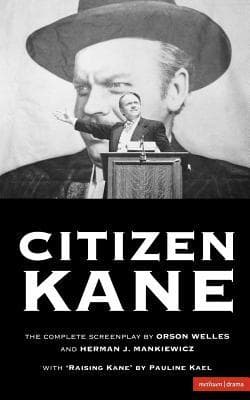
Explore the making of Orson Welles's 'Citizen Kane' through Pauline Kael's essay and the original script, showing the conflicts and art behind Hollywood's most talked-about film.
The film begins with Charles Foster Kane, an old and very rich newspaper owner, dying alone in his huge, unfinished Florida home, Xanadu. He whispers "Rosebud" as he dies, dropping a snow globe that breaks. A newsreel then quickly shows Kane's public life: how he rose from a simple start to become a powerful newspaper owner, his political goals, his two marriages, and his later years living alone. The newsreel leaves many questions about Kane's private life and "Rosebud" unanswered. This makes the editor, Rawlston, tell reporter Jerry Thompson to find out what it means.
Jerry Thompson starts by going to the Thatcher Memorial Library to read the private writings of Walter Parks Thatcher, Kane's strict and rich guardian. From Thatcher's view, we learn about Kane's childhood in Colorado. In 1870, young Charles is playing in the snow while his mother, Mary Kane, gives his guardianship to Thatcher, a banker. This happens after a gold mine is found on her land. She wants him raised well, away from his abusive father. Charles is taken from his home, crying, and sent to live with Thatcher. This event deeply affects him and makes him dislike authority and want control for the rest of his life.
Thompson then talks to Mr. Bernstein, Kane's former general manager and closest helper. Bernstein tells about Kane's early career. After becoming an adult and getting his money, Kane buys the struggling New York Inquirer. He buys it not for money, but to use it to show corruption and help ordinary people, which Thatcher does not like. He works with loyal staff like Bernstein and Jed Leland. Kane marries Emily Norton, the niece of a U.S. President. Their marriage starts well but soon gets difficult because of Kane's constant work, his public campaigns, and his growing self-centeredness. Their marriage becomes a struggle of wills.
Jed Leland, Kane's former best friend and theater critic, gives the next part of the story. He talks about Kane's growing political aims, which lead to his run for governor of New York. Kane looks set to win, but his affair with Susan Alexander, a young singer he met, is made public by his political rival, Boss Jim Gettys. The scandal happens just before the election, forcing Kane to choose between his political career and Susan. He refuses to leave Susan, loses the election, and upsets his wife and the public. This ends his political hopes.
Thompson finds Susan Alexander Kane, now an older, alcoholic woman who runs a nightclub. She reluctantly tells about her life with Kane, especially his strong desire to make her a famous opera singer, even though she had no talent or interest. Kane builds her an opera house, hires the best teachers, and uses his newspapers to promote her. Susan suffers from stage fright and public jokes. Her bad debut and later shows highlight Kane's inability to accept failure and his need to control those he loves. This makes both of them more isolated.
Susan describes how their marriage slowly got worse. After her opera career failed, they went to Xanadu, Kane's huge, unfinished estate filled with art and items from all over the world. Life at Xanadu was hard and lonely for Susan. Kane became more distant and controlling. She tries to kill herself and eventually leaves Kane, unable to stand the loneliness and his controlling ways. Her leaving leaves Kane completely alone in Xanadu's large rooms, surrounded by his belongings but without real human connection.
Thompson interviews Raymond, Kane's butler at Xanadu, who gives a detached view of Kane's last, lonely years. Raymond remembers Kane becoming more reclusive and his habit of always sorting through his many belongings, as if looking for something. He tells about when Kane, angry after Susan leaves, breaks up her room, but stops when he finds a small snow globe, like the one he dropped when he died. Raymond says Kane often talked about 'Rosebud' but never said what it meant, suggesting it was something he lost.
After interviewing everyone close to Kane, Jerry Thompson finishes his search. He meets with the other reporters, saying that 'Rosebud' is still a mystery. He thinks it was probably a missing part of a puzzle, something Kane lost or never had, and that no single word could define such a complex man. The reporters leave Xanadu, still confused by the rich man's last word, thinking about how mysterious lives are and how hard it is to sum them up with one symbol.
As the reporters leave Xanadu, the camera moves through the large piles of Kane's old belongings being burned. A sled is thrown into the fire. On its old surface, the word 'Rosebud' is clear. This is the sled young Charles Foster Kane was playing on when his mother gave him to Walter Thatcher. The sled, a sign of his lost childhood and the only real love and safety he knew, burns. Its secret meaning is shown only to the audience, showing the film's main idea of a man looking for something he lost when he was very young.
The Protagonist
From an idealistic young man seeking to right wrongs, Kane transforms into a lonely, tyrannical figure consumed by his own ego and inability to genuinely connect with others.
The Supporting
Thompson begins as a detached investigator and ends by realizing the futility of reducing a complex life to a single symbol.
The Supporting
Bernstein remains steadfastly loyal to Kane, offering a consistent perspective on his employer's life.
The Supporting
Leland evolves from an idealistic friend to a disillusioned critic, becoming estranged from Kane due to his moral compromises.
The Supporting
Susan transforms from a naive, hopeful young woman into a bitter, alcoholic recluse, broken by Kane's relentless ambition and control.
The Supporting
Thatcher remains consistently disapproving of Kane's life choices, never reconciling with his ward's rebellious nature.
The Supporting
Emily's initial affection for Kane turns into weary disillusionment as his public and private lives clash.
The Supporting
Raymond remains a steady, observant presence, witnessing Kane's final, lonely years without personal involvement.
The film shows that a person's true self is complicated and cannot be fully known from others' stories. Each person interviewed gives a different, often conflicting, view of Kane, showing their own biases. Thompson, the reporter, cannot define Kane with 'Rosebud,' realizing one symbol cannot sum up a life. This idea is clear in the fragmented story, where the audience must put together the man from different memories. Even with all the facts, a full picture is hard to get.
“''Rosebud.' It's just a piece of a jigsaw puzzle, a missing piece.'”
Kane's great wealth and power, which he got when young, let him do whatever he wanted, which led to his downfall. He uses his newspaper business not just for public good but to control others and make himself feel important. His money lets him build Xanadu, a sign of his loneliness, and force Susan to try an opera career, even though she has no talent. This idea shows how too much power can make people isolated, turning good intentions into control and real connections into a way to get what they want.
“'You're fired. You're fired and don't think I can't do it! I'm Charles Foster Kane!'”
The film strongly shows the painful loss of Kane's childhood when he is taken from his family and his sled. 'Rosebud,' his sled's name, stands for this lost innocence and the only time in his life he felt true love and freedom. As an adult, Kane tries to get this feeling back through possessions, power, and relationships, but he never gets back the simple joy of his early years. This leads to a deep feeling of emptiness and a lifelong search for what he lost.
“'I guess 'Rosebud' is just a name of a sled he had when he was a kid.'”
The story is made up of many personal memories of Charles Foster Kane from different characters. Each person's story is shaped by their relationship with Kane and their own views, leading to different descriptions. Bernstein remembers a loyal, driven friend; Leland, a friend who was let down; Susan, a controlling husband; and Thatcher, an irresponsible rebel. This shows that memory is not just facts but a personal view, and truth is often a mix of many viewpoints, making it hard to fully understand anyone.
“'I don't think any word can explain a man's life.'”
The story of Kane's life is told through multiple, overlapping flashbacks from different characters' perspectives.
The film does not follow a chronological timeline. Instead, it begins with Kane's death and then uses reporter Jerry Thompson's investigation as a framing device. His interviews with Kane's former associates (Thatcher, Bernstein, Leland, Susan, Raymond) trigger extended flashbacks, each presenting a different period and perspective of Kane's life. This fragmented, non-linear approach mirrors the elusive nature of Kane's identity and allows the audience to piece together the narrative from various subjective viewpoints, rather than a single, authoritative account.
A mysterious object/word that drives the plot forward but is ultimately less important than the journey.
'Rosebud' serves as the central MacGuffin of the film. It is the enigmatic last word uttered by Kane, prompting reporter Jerry Thompson's entire investigation. While the quest to discover its meaning propels the plot and provides a structure for exploring Kane's life, the ultimate revelation of 'Rosebud's' identity (a child's sled) is not as significant as the fragmented portrait of Kane that emerges from the interviews. The MacGuffin focuses the audience's attention while the film explores deeper themes of identity, memory, and the human condition.
A visual technique that keeps all planes of the image (foreground, middle ground, background) in sharp focus.
Orson Welles and cinematographer Gregg Toland extensively utilized deep focus, allowing multiple elements within a single frame to remain clear and visible. This technique often provides multiple layers of action and information simultaneously, inviting the viewer to actively engage with the frame and interpret the relationships between characters and their environment. For instance, in the scene where young Charles is playing in the snow while his guardianship is decided indoors, both actions are sharply in focus, visually linking his childhood loss to the adult decisions being made about his future.
Camera placed low, looking up at the subject, often emphasizing power or dominance.
Welles frequently employs low-angle shots, often making characters appear imposing and monumental, particularly Charles Foster Kane. This technique is enhanced by the use of ceilings in many indoor sets, a then-uncommon practice in Hollywood, which grounds the characters within their environment and adds a sense of grandeur and sometimes claustrophobia. These shots visually reinforce Kane's powerful status, his larger-than-life persona, and his desire to dominate, even as his personal life crumbles, creating a visual metaphor for his public image versus his private self.
A fictional newsreel provides a condensed, public overview of Kane's life, setting up the central mystery.
The 'News on the March' newsreel immediately after Kane's death serves as a brilliant, rapid-fire exposition of his public life. It introduces the audience to Kane's rise and fall, his public image, and his key relationships, all from a seemingly objective, documentary-style perspective. However, it also highlights the superficiality of public knowledge and the many unanswered questions about Kane's personal life, thereby establishing the central mystery of 'Rosebud' and prompting the subsequent investigative narrative. It's a highly efficient way to convey a vast amount of biographical information quickly.
“Rosebud.”
— Kane's dying word, which sparks the journalist's investigation into his life.
“I think it would be fun to run a newspaper.”
— Kane's youthful declaration when he inherits the New York Inquirer.
“You provide the prose poems, I'll provide the war.”
— Kane's cynical remark to his friend Leland about sensationalist journalism.
“Old age. It's the only disease, Mr. Thompson, that you don't look forward to being cured of.”
— Bernstein's reflection on aging and mortality.
“If I hadn't been very rich, I might have been a really great man.”
— Kane's self-aware lament about his wealth and unfulfilled potential.
“A toast, Jedediah, to love on my terms. Those are the only terms anybody ever knows—his own.”
— Kane's toast revealing his self-centered view of relationships.
“I am, have been, and will be only one thing—an American.”
— Kane's political declaration during his gubernatorial campaign.
“You know, Mr. Bernstein, if I hadn't been very rich, I might have been a really great man.”
— Kane's repeated regret about his wealth's impact on his character.
“I don't think there's one word that can describe a man's life.”
— Thompson's conclusion after failing to fully understand Kane.
“He was a man who got everything he wanted, and then lost it.”
— Raymond the butler's summary of Kane's life.
“You're right, I did lose a million dollars last year. I expect to lose a million dollars this year. I expect to lose a million dollars next year.”
— Kane's defiant response to criticism about his newspaper's finances.
“I'm not a gentleman. I don't even know what a gentleman is.”
— Kane's rejection of social conventions during an argument.
“It's not going to be a picnic, you know. It's going to be a fight.”
— Kane's warning about the challenges of running a newspaper.
“I'm Charles Foster Kane. I'm no cheap, crooked politician trying to save himself from the consequences of his crimes.”
— Kane's proud declaration during his political campaign.
Ready to see how well you understood this book? Take our interactive quiz with 10 questions.
Biography coming soon.

Ashley Antoinette
4.6

Mark McDonald
4.4
Luo Guanzhong
4.4
Mia McKenzie
4.3
Dorothy Parker
4.3

Joaquim Maria Machado de Assis
4.3
James Thurber
4.2

Terry Kay
4.2