“I was but a slip of a boy when the old lady died.”
— Thady Quirk, the narrator, begins his story, establishing his long service to the Rackrent family.

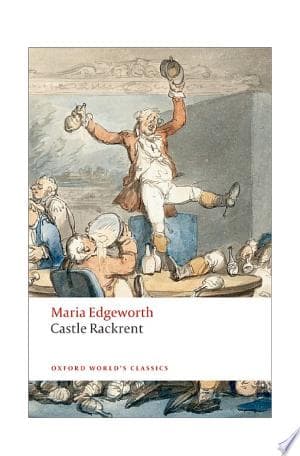
Maria Edgeworth (2008)
Genre
Fiction
Reading Time
180 min
Key Themes
See below
Sign in to track this book
Maria Edgeworth's satire follows four generations of Anglo-Irish landlords as their extravagant ways lead to decline, seen through the eyes of their loyal steward, and predicts the rise of a new class during Ireland's political unrest.
Thady Quirk, the old and loyal steward of the Rackrent estate, introduces himself as the recorder of his masters' fortunes, or rather misfortunes. He starts by explaining the family name, from their practice of 'rack-renting' tenants. Thady's informal narration, full of Irish sayings, immediately creates a sense of authenticity. He sets the stage for the Rackrent landlords' story, hinting at their wasteful habits and the eventual fall of their once-grand estate. Thady's deep personal link to the family, despite their faults, is clear from the start, as he approaches their story with pride, sorrow, and some resignation.
Thady describes the time of Sir Patrick O'Shaughlin, the first baronet, whom he calls 'Sir Patrick, my grandfather's master.' Sir Patrick is shown as a man of great hospitality and extravagance, known for his endless feasting and drinking, especially his 'wake-houses' for the living. He is the classic 'old Irish gentleman' who values fun and generosity over financial sense. Thady explains how Sir Patrick's open-handedness, while making him popular, steadily reduced the family's wealth. His disregard for legalities and his choice of immediate pleasure over long-term stability set a bad example for future Rackrent generations, leading to their eventual ruin.
After Sir Patrick's death, his nephew, Sir Murtagh Rackrent, inherits the estate. Sir Murtagh is very different from his uncle, known for his extreme thriftiness and constant lawsuits. Thady details how Sir Murtagh, instead of enjoying his wealth, spends his days in endless legal battles, often over small matters. His lawsuits, though sometimes successful, drain the estate's money and create widespread bad feelings among his neighbors and tenants. Thady recounts how Sir Murtagh's life is consumed by legal papers and court dates, eventually causing his death from a stroke brought on by a particularly annoying lawsuit. His legacy is one of conflict and financial stress.
Sir Kit Rackrent, Sir Murtagh's nephew, takes over the estate and brings a new kind of recklessness. He marries an English heiress, a Jewish woman, mainly for her money, which he quickly wastes through gambling and lavish spending in London. Sir Kit is an absentee landlord, neglecting his Irish estate and treating his wife very cruelly, locking her in her room for seven years on suspicions of unfaithfulness, though Thady suggests it was more to control her money. Thady recounts the sad death of the 'Jew Lady,' and Sir Kit's later death in a duel over a gambling debt. His time as landlord greatly speeds up the family's financial and moral decay.
The last baronet is Sir Condy Rackrent, Sir Kit's distant cousin. Sir Condy is shown as a kind but completely wasteful man, easily influenced by others and bad at business. Thady describes his master's attempts to keep up the old Rackrent traditions of hospitality, despite dwindling funds. Sir Condy's kindness often leads to his being taken advantage of. He is especially open to the influence of Thady's shrewd and ambitious son, Jason Quirk, who becomes Sir Condy's agent and slowly gains control over the estate. Sir Condy's true affection for his people contrasts sharply with his inability to manage his affairs, making his eventual ruin more sad.
As Sir Condy's financial state worsens, Thady's son, Jason Quirk, a sharp and ambitious lawyer, becomes the agent. Jason, unlike his father, has no emotional tie to the Rackrent name and cares only about his own advancement. Thady, while seemingly loyal to Sir Condy, subtly reveals Jason's clever plans. Jason systematically buys up the Rackrent debts and mortgages, slowly but surely taking over the estate. He uses Sir Condy's good nature and financial ignorance, presenting himself as a helpful administrator while secretly working to dispossess his master. Thady tells this process with a mix of fatherly pride in Jason's cleverness and implicit sorrow for Sir Condy's fate.
To restore his family's standing and money, Sir Condy Rackrent decides to run for Parliament. This venture, however, further drains his already low resources, as he spends heavily on campaigning and entertaining. Thady describes the chaotic and often silly nature of Irish elections, where votes are bought with drinks and promises. Sir Condy, despite good intentions, lacks the political skill and money to succeed. His political hopes ultimately fail, leaving him deeper in debt and more open to Jason Quirk's schemes. This period highlights Sir Condy's inability to adapt to changing times and his reliance on old customs.
The inevitable happens: Sir Condy Rackrent, through Jason Quirk's legal actions and his own wastefulness, loses Castle Rackrent and its lands completely. Thady recounts the sad scenes of Sir Condy's final days as the landlord, trying to keep up appearances even as his property is sold off. He is left with nothing but his good humor and a few loyal servants, including Thady. Sir Condy must live in a small cottage, a stark contrast to his former grand life. His decline shows the results of unchecked extravagance and poor management, the end result of generations of Rackrent folly.
Sir Condy Rackrent's death is a somber but typical Rackrent event. Thady describes the preparations for Sir Condy's wake, a traditional Irish custom. In a final act of old Rackrent generosity, Sir Condy, even in death, arranges for a grand wake, paid for by the last bits of his credit. The wake is a scene of both mourning and lively celebration, with drink, food, and laments, much like Sir Patrick's 'wake-houses.' This event marks a symbolic end to the Rackrent line as landlords, the passing of an era and a way of life. Thady's description of the wake is full of finality and a nostalgic goodbye to his beloved master.
After Sir Condy's death, Jason Quirk fully takes ownership of Castle Rackrent. Thady, with a mix of pride and a subtle hint of disapproval, describes his son's change from a humble lawyer to the estate owner. Jason immediately begins to modernize and 'improve' the property, a sharp contrast to the Rackrent family's traditional, often chaotic, management. He brings in efficiency and financial prudence, though at the cost of the old hospitality and the personal link the landlords had with their tenants. Jason's takeover shows the rise of the hardworking, practical Catholic middle class and the end of the Anglo-Irish gentry's careless rule, signaling a big change in Irish society.
Thady ends his story, showing a mix of loyalty to the old family and a practical acceptance of the new order under his son, Jason. He thinks about the changes he has seen and his own lasting presence at Castle Rackrent. After Thady's story, an 'Editor' (likely Maria Edgeworth) provides an introduction, footnotes, and a glossary. This editorial frame explains Thady's dialect and Irish customs, making the story accessible to an English audience. The Editor also gives a more objective, critical view of the Rackrent family's behavior and the wider social and economic effects of their decline, adding a layer of scholarly comment to Thady's personal account.
The Narrator and Supporting Character
Thady remains largely static in his loyalty, but his narrative subtly charts the rise of his own family alongside the fall of the Rackrents.
The Protagonist (final baronet)
He declines from a well-meaning but feckless landlord to an impoverished, dispossessed figure, clinging to dignity until his death.
The Antagonist/Supporting Character
He rises from a humble lawyer to the wealthy owner of Castle Rackrent, embodying the shift in power.
The Supporting Character (First Baronet)
His character serves as an origin point for the family's characteristic flaws, establishing the initial trajectory of their decline.
The Supporting Character (Second Baronet)
He demonstrates a different, equally destructive, path to financial ruin than his predecessor, through legal battles rather than extravagance.
The Supporting Character (Third Baronet)
He introduces absenteeism and personal cruelty, escalating the family's decline from mere improvidence to active malevolence.
The Mentioned/Supporting Character
Her story is one of tragic exploitation and confinement, ending in her death without resolution.
The Supporting Character
She attempts to manage Sir Condy's affairs, but ultimately succumbs to the family's overall decline.
The novel carefully details the fall of the Rackrent family, an Anglo-Irish landlord class, because of their wastefulness, neglect of their estates, and outdated adherence to old traditions of hospitality and extravagance. Each baronet shows a different part of this decline, from Sir Patrick's wasteful feasting to Sir Murtagh's lawsuits, Sir Kit's absence and cruelty, and finally Sir Condy's kind but completely ineffective management. Their inability to adapt to changing economic and social realities, along with a basic lack of responsibility, leads to their certain loss of property, symbolizing the fading power of their class in Ireland.
“''Tis a pity of them, for they were good-for-nothing, but they were good-hearted.”
In contrast to the Rackrents' decline, the novel shows the rise of the hardworking and practical Irish Catholic middle class, personified by Jason Quirk. Jason, Thady's son, is a clever lawyer who systematically acquires the Rackrent estate through legal means, taking advantage of the baronets' debts and financial mismanagement. His rise represents a major shift in power and wealth in Ireland, from the old, often wasteful, Protestant gentry to a new class of financially smart and ambitious Catholic professionals. Jason's efficiency and focus on profit, though lacking the 'charm' of the old ways, are ultimately more effective in the changing economy.
“And so the law takes its course, and what can a poor man do against the law?”
Loyalty is a central theme, mainly through Thady Quirk, who remains devoted to the Rackrent family despite their many faults and the hardships they cause him. His narration is full of a deep, almost familial, attachment to his masters. However, this loyalty is subtly complicated by the ambition of his son, Jason, who, while working for Sir Condy as an agent, arranges his financial ruin. Thady's pride in Jason's success, even as it dispossesses his beloved master, highlights the complex interaction between personal faithfulness, family advancement, and the harsh realities of economic survival in a changing society. Thady's narration itself, while seeming loyal, also exposes the Rackrents' failures.
“I was always for the old family, for all I knowed them to be as bad as the worst.”
The novel explores Ireland's distinct cultural identity in the late 18th century, especially the complex relationship between the native Irish and the Anglo-Irish gentry. Thady's narration, rich in Irish dialect, customs, and viewpoints, offers an authentic 'insider's' look at Irish life. The Rackrents, though Anglo-Irish, show many traditional Irish traits like excessive hospitality and a somewhat chaotic approach to life, contrasting with the more 'English' practicality and legalism that ultimately wins through Jason Quirk. The 'Editor's' footnotes and glossary further emphasize the cultural uniqueness and the need to explain Irish realities for an English audience, highlighting the divide and potential misunderstandings between the two cultures.
“These Rackrents were a family that had been for ever and a day upon the land in Ireland.”
The Rackrent family's story is a warning about the corrupting effect of unearned power and unchecked wealth. Each baronet, in their own way, misuses their position, leading to the decay of their estate and their moral standing. Sir Patrick's extravagance, Sir Murtagh's lawsuits, and Sir Kit's cruelty all come from a sense of entitlement and a lack of accountability inherent in their landlord status. Sir Condy, though kind, is equally corrupted by his inability to manage his affairs, leading to the exploitation of his tenants and his own eventual ruin. The novel suggests that without responsibility and prudence, inherited wealth and power inevitably lead to destruction.
“Ah, what times those were! The like will never be seen again; for the good old times are gone, and the new times are come.”
Thady Quirk's subjective, biased, and often subtly ironic perspective.
Thady Quirk serves as the novel's unreliable narrator. While he presents himself as a simple, loyal retainer, his narrative is rife with his personal biases, affections, and a subtle, often unconscious, irony. His descriptions of the Rackrents, while seemingly admiring, frequently expose their flaws and follies. He praises his son Jason's cunning while lamenting its consequences for Sir Condy. This unreliability forces the reader to critically interpret his account, inferring the true nature of events and characters beyond Thady's stated loyalties, thereby adding depth and complexity to the social critique.
An external 'Editor' provides context and a more objective perspective.
The novel is framed by an 'Editor's Introduction' and numerous footnotes and a glossary. This device serves multiple purposes: it authenticates Thady's narrative by presenting it as a found manuscript, explains Irish colloquialisms and customs for an English audience, and provides a more objective, critical, and historical context for the Rackrent family's decline. The Editor often corrects or elaborates on Thady's naive or biased statements, offering a more academic and politically informed analysis of the social changes depicted, thereby broadening the novel's scope from a personal chronicle to a socio-historical commentary.
Humorous and critical portrayal of the Anglo-Irish gentry's follies.
Edgeworth employs satire and irony throughout the novel to critique the Anglo-Irish landlord class. Thady's seemingly innocent recounting of the Rackrents' extravagant and irresponsible behavior often highlights their absurdity and self-destructiveness. The descriptions of Sir Patrick's endless feasting, Sir Murtagh's legal battles, and Sir Kit's cruelty are presented in a manner that, while humorous, also underscores the serious consequences of their actions. This satirical approach allows Edgeworth to expose the systemic flaws of the gentry without resorting to overt didacticism, letting the characters' own actions speak volumes about their unsuitability for their positions.
Jason Quirk and the Rackrents serve as contrasting figures.
The characters of Jason Quirk and the various Rackrent baronets act as foils to one another, highlighting their contrasting traits and the changing social landscape. The Rackrents, with their improvidence, emotional attachments, and adherence to outdated traditions, are starkly contrasted by Jason's pragmatism, legalistic cunning, and focus on financial gain. This juxtaposition underscores the novel's central theme of the decline of the old gentry and the rise of a new, more efficient, but less romantic, class. The foil relationship emphasizes the clash between sentimentality and practicality, and tradition versus modernity, in 18th-century Ireland.
“I was but a slip of a boy when the old lady died.”
— Thady Quirk, the narrator, begins his story, establishing his long service to the Rackrent family.
“It is a pity of them all that are not born to a good estate.”
— Thady often reflects on the misfortunes of those without inherited wealth, highlighting the importance of land.
“Sure enough, the Rackrents were a family that was famous for their hospitality.”
— Thady describes the family's reputation for generosity, which often led to their financial ruin.
“He was a good-natured, hearty gentleman, and loved a glass of anything that was strong.”
— Describing Sir Patrick O'Rackrent, the first landlord in the narrative, known for his revelry.
“Oh, to be sure, it was a fine sight to see the tenants all come in with their rents.”
— Thady recalls the traditional rent-day gatherings, a significant social and economic event.
“And so, in a word, the family was always behindhand.”
— Thady's concise summary of the Rackrents' perpetual financial mismanagement.
“He was always for improving, as he called it, but he never improved anything but his own ruin.”
— Referring to Sir Kit Rackrent's disastrous attempts at agricultural 'improvements' that only worsened his debts.
“It was a great pity that a gentleman of his birth should be so reduced.”
— Thady's lament for Sir Condy Rackrent's declining fortunes, emphasizing the loss of social standing.
“The law was a thing he never much minded, except to get out of it.”
— Describing the Rackrents' frequent disregard for legal obligations and their attempts to evade them.
“For my part, I never knew a Rackrent that was not a good landlord at heart.”
— Thady's unwavering loyalty and affection for his masters, despite their many flaws.
“He was a great hand at a bargain, and could turn a penny as well as any man.”
— Referring to Jason Quirk, Thady's son, who is much more shrewd and financially astute than the Rackrents.
“And so the old castle, after all, came into the hands of the right owner.”
— Thady's final reflection on the estate ultimately falling into Jason Quirk's possession, completing the narrative's cyclical nature.
“It is a great comfort to a poor man to have a good master.”
— Thady often expresses his contentment in service, reflecting a traditional view of social hierarchy.
“They were always for living beyond their means, God bless them!”
— A recurring theme in Thady's narration, explaining the Rackrents' perpetual financial difficulties.
Ready to see how well you understood this book? Take our interactive quiz with 10 questions.

Maria Edgeworth was a prolific Anglo-Irish novelist of adults' and children's literature. She was one of the first realist writers in children's literature and was a significant figure in the evolution of the novel in Europe. She held critical views on estate management, politics and education, and corresponded with some of the leading literary and economic writers, including Sir Walter Scott and David Ricardo. During the first decade of the 19th century she was one of the most widely read novelists in the British Isles. Her name today most commonly associated with Castle Rackrent, her first novel in which she adopted an Irish Catholic voice to narrate the dissipation and decline of a family from her own landed Anglo-Irish class.

Ashley Antoinette
4.6

Mark McDonald
4.4
Luo Guanzhong
4.4
Mia McKenzie
4.3
Dorothy Parker
4.3
Joaquim Maria Machado de Assis
4.3
James Thurber
4.2

Terry Kay
4.2