“Gangor, the mother, is a breast-giver. The baby sucks. The breast-giver is now the breast-holder. Gangor, the breast-holder, is now the breast-burner.”
— Describing the tragic transformation of Gangor, a tribal woman, after her photograph is taken.

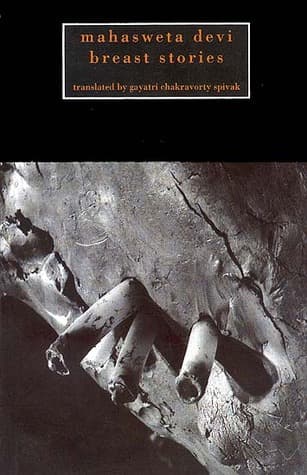
Mahasweta Devi (1997)
Genre
Fiction
Reading Time
166 min
Key Themes
See below
Sign in to track this book
Mahasweta Devi's three stories show how the female breast, stripped of its nurturing meaning, becomes a place for societal exploitation, resistance, and tragic sacrifice in the lives of marginalized women.
The story begins with the Joint Operation Command (JOC) in West Bengal, led by Senanayak, planning to capture the tribal revolutionary, Dopdi Mejhen. Dopdi, a Santhal woman, is a key figure in the Naxalite movement, known for her cunning and ability to evade capture. The JOC is frustrated by their inability to catch her and her husband, Dulna, who has already been killed. Senanayak orders 'shoot-at-sight' for Dopdi, emphasizing the urgency of her capture to stop the uprising. The military and police mobilize, creating tension in the jungle and nearby villages as they close in. Dopdi knows of the increased hunt and moves constantly, relying on her knowledge of the land and her community's support, though that support is weakening under pressure.
After a relentless pursuit, Dopdi Mejhen is cornered and captured by security forces. She is brought before Senanayak and his men, who want information about the Naxalite movement. Instead of a traditional interrogation, Dopdi is gang-raped by multiple officers throughout the night. Her body becomes a site of state-sanctioned violence, meant to break her spirit and punish her resistance. Despite the ordeal, Dopdi remains silent, refusing to betray her comrades or show weakness. Her physical suffering is immense, but her resolve is unbroken, fueling a silent defiance that begins to disturb her captors.
The morning after her assault, Dopdi Mejhen is presented to Senanayak. Instead of covering herself, Dopdi strips naked, exposing her mutilated and bleeding body, including her torn breasts. This act is not shame or submission, but a powerful, defiant gesture. She stares directly at Senanayak, challenging him to look at the results of his actions. Her body, meant to symbolize her defeat, becomes an indictment of the state's cruelty. Senanayak is disturbed by her unyielding defiance and the clear evidence of the atrocities committed under his command. Dopdi's refusal to be shamed or broken becomes a strong form of resistance, turning the situation on her oppressors.
Jashoda, a poor woman from a lower caste, finds work as a wet nurse. She begins her career with the wealthy Haldar family, known for their many male heirs. Her breasts, full of milk, become her main asset and identity. She breastfeeds generations of Haldar sons, becoming a surrogate mother to dozens of boys. This role raises her status in her community and provides her family with steady income, helping them escape extreme poverty. Jashoda takes pride in her ability to nourish, seeing her milk and service as sacred, believing that by feeding the Haldar sons, she ensures her own family's prosperity and salvation.
As the Haldar family prospers and modernizes, their need for a wet nurse decreases with the arrival of formula feeding. Despite this, Jashoda remains attached to the family, especially to the many 'sons' she nursed. She continues to live on their property, doing household chores, her identity still linked to her past role. The Haldars, while providing for her, treat her with growing distance, seeing her more as a servant than a beloved figure. Jashoda, however, idealizes her connection to them, believing in a mutual bond of loyalty and affection, even as the 'sons' she nurtured grow up and largely forget her, absorbed in their own lives and modern pursuits.
Jashoda develops painful breast cancer, a cruel irony since her breasts were the source of her livelihood and identity. As her illness worsens, her own family struggles to care for her, and the Haldar 'sons' she nursed offer little support. They are busy with their own lives and are uncomfortable with her worsening condition. Jashoda is left to suffer, increasingly isolated and in agony. The breasts that defined her, that brought her respect and income, now betray her, becoming the source of her pain and eventual death. Her death comments on the transactional nature of her relationships and the ultimate dispensability of her labor.
Gangor, a young, poor Santhal woman working as a stone-breaker in a quarry, has striking physical beauty, especially her 'statuesque' breasts. Her natural grace attracts the attention of Upin Puri, a celebrated photographer known for his artistic and often exploitative portrayal of tribal life. Puri sees in Gangor an idealized, exotic image of rural India, focusing on her breasts as a symbol of primal femininity and strength. He takes many photographs of her, reducing her to an aesthetic object, seemingly unaware of her poverty and the potential impact of his actions. Gangor, unaware of the implications, is flattered by the attention and the small payments she receives.
Upin Puri's photographs of Gangor, prominently showing her breasts, are published in a prestigious magazine, earning him acclaim. However, for Gangor, the exposure brings devastating results. Local men, including her husband, see the photographs as a violation of her modesty and a source of shame. Her husband, driven by ideas of honor and jealousy, brutally beats her, accusing her of infidelity and dishonoring their family. The community also ostracizes her, seeing her as 'loose' for being photographed in such a way. The 'art' that brought Puri fame directly leads to Gangor's physical and social degradation, turning her body into a battleground.
The violence against Gangor escalates, and she is eventually gang-raped by a group of men, further brutalized. The ordeal is too much for her, and she dies, a victim of the same gaze that initially celebrated her. Upon hearing of Gangor's death, Upin Puri faces the devastating impact of his art and his privileged position. He realizes that his aesthetic pursuit, separate from the reality of his subjects, contributed to her destruction. The story ends with Puri grappling with guilt and the ethical implications of his work, understanding that his act of 'capturing beauty' led to the annihilation of a human life. He is left with the burden of his involvement.
Gayatri Chakravorty Spivak's introductory essays offer frameworks for understanding Mahasweta Devi's 'Breast Stories.' Spivak emphasizes that the breast in these narratives is more than symbolism; it is a material site of exploitation, resistance, and identity within an oppressive social system. She examines the subaltern perspective, analyzing how Devi's characters, especially the women, are marginalized by class, caste, and gender. Spivak's analysis highlights the stories' critique of state violence, patriarchal control, and the commodification of the female body, urging readers to engage with the texts as political statements that challenge dominant narratives and expose injustices. Her introduction prepares the reader for the harsh realities in Devi's fiction.
The Protagonist
From being a hunted revolutionary, Dopdi transforms into an iconic symbol of resistance through her ultimate act of confronting her oppressors with her violated body.
The Antagonist
Initially confident and authoritative, Senanayak is shaken and disturbed by Dopdi's final act of defiance, hinting at a crack in his hardened resolve.
The Protagonist
Jashoda begins as a proud and essential figure, but her arc descends into tragic abandonment as her physical utility diminishes and her 'sons' betray her.
The Supporting/Antagonist
The family transitions from needing Jashoda's vital service to becoming indifferent and neglectful as society modernizes, revealing their self-serving nature.
The Protagonist
Gangor is transformed from an anonymous laborer to an exploited artistic subject, then to a victim of violence and ultimately, a tragic symbol of subaltern suffering.
The Supporting/Antagonist
Puri undergoes a shift from an unreflective artist to a man burdened by guilt and a dawning awareness of his complicity in Gangor's fate.
The Mentioned
Not a character in the narrative, but her critical perspective shapes the reader's understanding of the stories.
Across all three stories, the female body, specifically the breasts, goes beyond its biological role to become a focus for both exploitation and resistance. In 'Draupadi,' Dopdi's gang-raped and exposed body becomes a powerful weapon, shaming her oppressors and refusing to be broken. In 'Breast-giver,' Jashoda's breasts are commodified for economic survival, yet ultimately betray her through cancer, symbolizing the body's vulnerability and the transactional nature of her existence. In 'Behind the Bodice,' Gangor's breasts are aestheticized and exploited by the photographic gaze, leading to her brutalization and death. The stories show how women's bodies are policed, violated, and used by patriarchal and state structures, but also how they can become instruments of protest.
“What's the use of clothes? You will be stripped anyway.”
Mahasweta Devi consistently shows the struggles of the subaltern—those systematically excluded from power, voice, and historical representation—through her female protagonists. Dopdi, Jashoda, and Gangor are all tribal or lower-caste women, living at society's edges, subject to the state, the wealthy, and patriarchal norms. Their experiences reveal the realities of poverty, caste discrimination, and gender-based violence. The stories give voice to these marginalized figures, forcing the reader to confront injustices faced by those typically unheard. Their struggles are not just personal but represent systemic oppression, showing how their bodies and labor are exploited by dominant power structures.
“There are some people who are born to give. And there are others who are born to take.”
A central theme is the strong critique of patriarchal structures and state violence against its citizens, especially women. In 'Draupadi,' the state's military uses sexual assault as a deliberate tool of war and psychological warfare against a female revolutionary. In 'Behind the Bodice,' Gangor faces violence from her husband and community, enforcing patriarchal control over female sexuality and honor, made worse by the photographer's exploitative gaze. 'Breast-giver' shows a more subtle form of patriarchal exploitation, where Jashoda's value is tied solely to her reproductive and nurturing capacity, leading to her abandonment when that utility is gone. The stories expose how patriarchy, often backed by state power, controls, punishes, and destroys women.
“To the man, the woman is always something to be used, to be consumed, to be discarded.”
The stories detail various forms of exploitation—economic, sexual, and emotional—and the deep sense of betrayal experienced by the protagonists. Jashoda is exploited economically by the Haldar family for her labor and then emotionally betrayed when they abandon her in illness. Dopdi is subjected to state-sanctioned sexual exploitation to break her spirit. Gangor is exploited by the photographer, who commodifies her image for artistic gain, and by her community, who betray her trust and punish her for a perceived dishonor. These acts of exploitation are often linked with a betrayal of human dignity and trust, leaving the women isolated and suffering the consequences of others' self-interest.
“She had given her milk, her life, her all. And in return, she received... nothing.”
The breast as a multifaceted symbol of life, livelihood, identity, and violation.
The breast is the central and most potent symbol throughout the collection. In 'Breast-giver,' it represents livelihood, nurturing, and Jashoda's entire identity, yet it also becomes the site of her fatal illness, symbolizing her ultimate betrayal. In 'Draupadi,' the violated breasts become a symbol of state brutality and, paradoxically, Dopdi's unyielding defiance and power to shame her oppressors. In 'Behind the Bodice,' Gangor's 'statuesque' breasts are initially a symbol of natural beauty, then become a symbol of aesthetic exploitation, and finally, a trigger for violence and her tragic demise. The breast thus functions as a complex signifier of women's roles, their exploitation, and their capacity for resistance.
The act of looking as a tool of power, objectification, and control.
The concept of the 'gaze' is crucial, particularly in 'Behind the Bodice' and 'Draupadi.' In 'Behind the Bodice,' Upin Puri's photographic gaze objectifies Gangor, reducing her to an aesthetic form and stripping her of her agency. This artistic gaze, though seemingly benign, sets off a chain of events leading to her brutalization, as it intersects with the patriarchal gaze of her community. In 'Draupadi,' Senanayak's and his men's gaze during Dopdi's assault and subsequent confrontation is one of power, dehumanization, and an attempt to break her spirit. However, Dopdi subverts this gaze by forcing them to look at her violated body, turning their gaze into one of discomfort and shame. The gaze is thus a powerful instrument of control, but also a potential site of subversion.
The use of contrasting elements to highlight social injustice and tragedy.
Devi frequently employs ironic juxtaposition to underscore the harsh realities faced by her characters. In 'Breast-giver,' the irony lies in Jashoda's deep devotion to the Haldar sons, believing she is earning salvation, while they ultimately abandon her; her source of life (breasts) becomes the source of her death (cancer). In 'Draupadi,' the state's 'civilizing' mission is juxtaposed with its barbaric acts of torture and rape. In 'Behind the Bodice,' the acclaimed 'art' of Upin Puri, which brings him fame, directly leads to the brutal destruction of his subject, Gangor. These ironies serve to highlight the hypocrisy, injustice, and tragic outcomes inherent in the exploitative social systems depicted in the stories.
Centering the narrative on the experiences and perspectives of marginalized individuals.
Devi consistently provides a voice and perspective to those who are typically silenced and marginalized—the tribal, the poor, the lower-caste woman. While not always directly first-person, the narratives immerse the reader in the experiences, struggles, and internal worlds of characters like Dopdi, Jashoda, and Gangor. This device challenges dominant, often privileged, narratives by showing the world through the eyes of the oppressed. It forces the reader to confront the harsh realities of subaltern existence and to empathize with characters whose lives are shaped by systemic injustice, making their suffering and resistance palpable and undeniable. This is a core element of Mahasweta Devi's literary project.
“Gangor, the mother, is a breast-giver. The baby sucks. The breast-giver is now the breast-holder. Gangor, the breast-holder, is now the breast-burner.”
— Describing the tragic transformation of Gangor, a tribal woman, after her photograph is taken.
“The camera does not just take a picture; it takes a piece of the soul.”
— Reflecting on the impact of photography on vulnerable individuals, particularly tribal women.
“A woman's body is not a field for cultivation by the state or by men.”
— A powerful statement asserting bodily autonomy against patriarchal and state control.
“Their breasts were not just a source of milk; they were a source of life, of livelihood, of identity.”
— Highlighting the multifaceted significance of breasts for tribal women beyond mere biological function.
“The story of Gangor is the story of every woman whose body is made public without her consent.”
— Connecting Gangor's individual tragedy to a universal experience of objectification and violation.
“What is a woman without her breasts? She is still a woman, but the world will not let her forget what she has lost.”
— Exploring the societal perception and pressure on women regarding their bodies, even after physical trauma.
“The camera is a weapon. The lens is its barrel.”
— Metaphorically portraying photography as an instrument of violence and exploitation.
“They took her breasts, but they could not take her spirit.”
— Despite the brutal violence, emphasizing Gangor's enduring inner strength and resistance.
“In this land, women are born with a price tag attached to every part of their body.”
— Critiquing the commodification and devaluation of women in society.
“To be seen is to be vulnerable, to be exposed is to be violated.”
— Articulating the danger and risk faced by marginalized women when they become objects of public gaze.
“The story of a breast is the story of a life, the story of a struggle.”
— Broadening the scope of the narrative to encompass the entire life and struggles of women through their bodies.
“Silence is not consent. Silence is often terror.”
— Challenging the common misinterpretation of silence, especially from victims of violence.
“They wanted to erase her, but in doing so, they only made her story louder.”
— Highlighting the ironic consequence of attempts to suppress voices, leading to greater amplification.
Ready to see how well you understood this book? Take our interactive quiz with 10 questions.

Biography coming soon.

Ashley Antoinette
4.6

Mark McDonald
4.4
Luo Guanzhong
4.4

Mia McKenzie
4.3

Dorothy Parker
4.3

Joaquim Maria Machado de Assis
4.3

James Thurber
4.2

Terry Kay
4.2