“War was always here. Before man was, war waited for him. The ultimate trade awaiting its ultimate practitioner.”
— The Judge's reflection on the inherent nature of war.


Cormac McCarthy (2015)
Genre
Fiction
Reading Time
920 min
Key Themes
See below
Sign in to track this book
In the desolate 1850s American West, a teenage drifter known as 'the Kid' joins a ruthless gang of scalp hunters, descending into unprovoked violence and moral decay, which reveals humanity's inherent savagery.
The story begins with 'the Kid,' a nameless fourteen-year-old from Tennessee, leaving his abusive home and heading west. He first encounters violence and lawlessness in various towns, eventually joining a group of filibusters led by Captain White. This group plans to invade Sonora, Mexico, supposedly to claim land for the United States. Their journey is marked by extreme hardship and a brutal fight with Comanche warriors. The filibusters are almost completely destroyed, leaving the Kid among the few survivors. This early experience hints at the constant violence and moral desolation that will define his journey through the American Southwest and Northern Mexico.
After surviving the Comanche attack and a brief imprisonment in Chihuahua, the Kid is released and soon joins a new, even more brutal group: Glanton's gang. This group, led by the charismatic and ruthless John Joel Glanton, is hired by the Mexican government to hunt and scalp Apache Indians. The gang includes many hardened killers, most notably Judge Holden, a monstrously intelligent and unsettling figure. The Kid, initially an observer, quickly becomes a participant in their increasing acts of violence, adapting to the brutal rules of the desert and the gang's constant search for scalps and loot.
Glanton's gang goes on several expeditions, constantly tracking and killing Apache Indians. Their methods are incredibly savage, often involving surprise attacks on unsuspecting camps, followed by the systematic scalping of men, women, and children. The Kid participates in these massacres, seeing extreme brutality firsthand. The gang enjoys their bloody work, collecting scalps as trophies and a way to get paid by Mexican authorities. The landscape itself seems to aid their violence, offering no comfort or escape from the increasing bloodshed and moral decay that fills their lives.
After completing their contract with the Mexican government, Glanton's gang, driven by insatiable greed and a desire for violence, targets others. They begin scalping Mexican citizens, often without distinction, and presenting these scalps as those of Indians to collect more bounties. This act of betrayal shows the gang's complete moral bankruptcy and their disregard for any human life that hinders their desires. The Kid remains part of these atrocities, his initial innocence long gone due to constant exposure to savagery. Judge Holden's influence grows, subtly guiding the gang toward darker acts.
The gang crosses vast, unforgiving desert landscapes, meeting various individuals and groups. These include American soldiers, other scalp hunters, and isolated settlers, all struggling to survive on the brutal frontier. During these journeys, the gang's internal dynamics become clearer, especially Judge Holden's chilling intellectual dominance. He engages in philosophical discussions, often about the nature of war and human will, while also showing immense physical strength and an almost supernatural ability to survive. The Kid observes these interactions, learning the lessons of a world defined by power and violence.
Glanton's gang eventually arrives at the Colorado River, near what is now Yuma, Arizona, and takes control of a ferry operation run by the Quechan (Yuma) Indians. They exploit the ferry, charging high tolls and robbing travelers, further increasing their criminal activities. This action brings them into direct conflict with the Quechan people, who resent the gang's intrusion and exploitation. The Kid, now an experienced killer, takes part in the gang's control of the ferry, seeing the rising tension and the inevitable conflict their actions create. The ferry becomes a small example of the gang's lawless rule.
The Quechan Indians, unable to tolerate Glanton's gang's brutality and exploitation, launch a coordinated attack on the ferry crossing. This ambush is swift and devastating. Most of Glanton's gang, including Glanton himself, are killed in a brutal fight. The Kid, along with a few other survivors, escapes the massacre, severely wounded. This event marks a turning point, ending the gang's reign of terror and forcing the Kid to again become a solitary wanderer, though profoundly changed by his experiences. Judge Holden, as always, mysteriously survives the carnage.
Wounded and alone, the Kid continues his journey through the harsh desert. He meets various individuals, some hostile, some indifferent, and struggles to survive. His experiences with Glanton's gang have left a lasting mark, and he is now a hardened, quiet man. During this time, he often thinks about the violence he has seen and participated in, though his thoughts remain mostly internal and unspoken. He carries the weight of his past, a product of the brutal frontier that shaped him. His path is one of continued hardship and a relentless pursuit of survival.
Years later, now an adult, the Kid (sometimes called 'the man' or 'the ex-priest' in some editions, though 'the Kid' is typically used for consistency) is in a saloon in a Texas border town. There, he meets Judge Holden once more. The Judge appears not to have aged and continues his philosophical thoughts on war, dance, and human existence, often singling out the Kid for his perceived resistance to the Judge's worldview. The atmosphere between them is tense, full of unspoken history and a deep sense of dread. The Judge's presence is as unsettling and powerful as ever, suggesting his lasting, almost eternal, evil.
After their encounter in the saloon, the Kid goes to an outhouse. Judge Holden, having followed him, confronts him inside. The Judge's final speech is a chilling explanation of his philosophy, asserting his dominance over all creation and his belief that war is the ultimate god. What exactly happens in the outhouse is not explicitly detailed but strongly implied to be a brutal and fatal attack by the Judge on the Kid. The story ends with the Judge emerging from the outhouse, seemingly unharmed, and continuing his dance among the revelers, a monstrous, triumphant figure. The Kid's fate is sealed in the darkness, a final victim of the Judge's relentless evil.
The Protagonist
The Kid transforms from an innocent, naive runaway into a hardened, desensitized survivor, ultimately succumbing to the relentless evil embodied by Judge Holden.
The Antagonist
The Judge has no discernible arc; he is a static, eternal force of malevolence, existing outside conventional human development.
The Supporting
Glanton descends further into madness and depravity, ultimately leading his gang to their demise at the Yuma ferry.
The Supporting
Toadvine remains largely static, a consistent figure of brutality and survival within the gang, until his death.
The Supporting
Tobin survives the Yuma massacre and attempts to escape with the Kid, showcasing his survival instincts.
The Supporting
Captain White's arc is short and tragic, ending with the complete annihilation of his expedition.
The Mentioned
They successfully defend their territory and avenge their grievances against Glanton's gang.
The Supporting
The Delaware is a consistent, skilled member of the gang until his demise.
McCarthy shows violence not as an unusual event, but as an inherent, basic force in human nature and the natural world. It is widespread, casual, and often without clear reason beyond its own continuation. The novel details horrific acts of scalping, murder, and torture, depicting them with direct realism. The Judge's philosophy, especially his claim that 'war is the ultimate game because it is the ultimate test of the will,' elevates violence to a spiritual level, suggesting it is a fundamental part of human existence rather than a deviation. This theme is clear in every scene, from the initial Comanche attack on Captain White's men to the final, ambiguous confrontation in the outhouse.
“War was always here. Before man was, war waited for him. The ultimate trade awaiting its ultimate practitioner. That is the way it was and will be. That is the way of things.”
The world of *Blood Meridian* lacks conventional morality, justice, or the chance for redemption. Characters act in a moral void where good and evil are meaningless differences, and survival is the only necessity. There are no heroes, only varying degrees of villainy and victimhood. The Kid, despite his initial youth, quickly becomes desensitized and never truly seeks or finds redemption for his part in the atrocities. The landscape itself seems indifferent to human suffering, reinforcing the idea that no higher power will intervene or judge. This theme is clear in the gang's indiscriminate slaughter of men, women, and children, and the complete lack of consequences for their actions until their own destruction.
“The truth about the world, he said, is that anything is possible. Ideologies, philosophies, and even moral codes are merely constructs.”
The American Southwest and Northern Mexico frontier is shown not as a place of opportunity or freedom, but as a vast, indifferent, and brutal landscape that removes all pretense of civilization. It is a harsh environment where human nature is reduced to its most basic instincts. The harsh surroundings—extreme heat, dryness, vast distances—mirror and worsen the savagery of the human inhabitants. The lack of law and order allows violence to spread unchecked, turning men into predators. The landscape itself becomes a character, an active participant in the suffering, constantly challenging and ultimately defeating those who try to tame it. The constant journeys across deserts and mountains, and the struggles for basic survival, emphasize this theme.
“They rode on and the sun in the east flushed pale the western sky before them and they rode on still and the dark edges of the world receded right and left and the stars went out.”
The novel challenges the romanticized idea of Manifest Destiny by showing its violent, genocidal core. Captain White's initial, failed expedition is a sad and funny example of this idealism, but Glanton's gang embodies the true, brutal reality: the expansion of American influence through dispossession, slaughter, and the systematic killing of indigenous populations. The pursuit of land, resources, and power is shown to be deeply linked to extreme violence and moral decay, rather than noble conquest. The scalping bounties offered by both American and Mexican authorities directly show how this violence was made official.
“The judge spoke of the indigent nations and of their being eradicated from the earth, and of how this was God's will and how they were to be removed like a plague.”
Judge Holden is the embodiment of the unknowable and monstrous. He is a figure of supernatural intelligence, strength, and evil, seemingly ageless and always present. His origins are unclear, and his motives are beyond normal human understanding. He represents a force of pure, elemental evil that cannot be categorized or explained. His vast knowledge, artistic talents, and philosophical statements contrast sharply with his complete lack of empathy and his joy in destruction. The Judge constantly reminds us that some evils are not just human but exist on a cosmic scale, beyond the reach of reason.
“He never sleeps. He says that he will never die. He is dancing, dancing. He says that he will never die.”
The vast, brutal desert acts as a character and antagonist.
The landscape in *Blood Meridian* is far more than a mere setting; it is an active force that shapes the characters and their actions. The vast, unforgiving deserts, mountains, and rivers are described in stark, poetic detail, often mirroring the internal desolation of the characters. The environment presents constant challenges – thirst, hunger, exposure – that strip away human pretense and highlight the fragility of life. It provides no moral compass or solace, instead serving as a silent, indifferent witness to the atrocities committed, reinforcing the novel's bleak worldview. The sheer scale and harshness of the land dwarf human endeavors and suffering.
McCarthy employs biblical language and imagery to elevate the violence to mythic proportions.
McCarthy's prose is highly stylized, often employing archaic language, long sentences, and a tone reminiscent of Old Testament scripture. This literary device lends a mythic, epic quality to the narrative, transforming the brutal acts of the gang into a kind of dark, anti-creation story. The frequent use of 'and' conjunctions ('polysyndeton') creates a relentless, cumulative effect, mirroring the unending cycle of violence. References to 'the wrath of God' or 'the unholy' imbue the events with a sense of cosmic significance, even as they are devoid of conventional religious morality. This elevates the story beyond a mere historical account into a profound meditation on evil.
The Kid's lack of a name emphasizes his archetypal role and universalizes his experience.
The protagonist's anonymity, referred to only as 'the Kid' and later 'the man,' serves several purposes. It emphasizes his role as an archetypal figure, a representative of any young person drawn into the vortex of violence on the frontier. His lack of a specific identity makes his journey more universal, suggesting that his experiences could be anyone's in such a brutal environment. It also contributes to the novel's bleak, depersonalized tone, where individual identity matters less than one's capacity for survival or violence. This device forces the reader to focus on the events and themes rather than a specific character's personal narrative.
The Judge's speeches provide the novel's intellectual and philosophical core.
Judge Holden's frequent, often lengthy, monologues are a crucial plot device. They serve as the primary vehicle for exploring the novel's themes of violence, war, human will, and the nature of existence. Through his eloquent yet terrifying pronouncements, the Judge articulates a nihilistic philosophy that justifies the gang's atrocities and posits violence as the ultimate truth of the world. These speeches are not merely exposition; they are acts of intellectual seduction and intimidation, attempting to corrupt and dominate the other characters, particularly the Kid. They provide a chilling intellectual framework for the relentless physical brutality.
“War was always here. Before man was, war waited for him. The ultimate trade awaiting its ultimate practitioner.”
— The Judge's reflection on the inherent nature of war.
“The truth about the world, he said, is that anything is possible. Had you not seen it all from birth and thereby bled it of its strangeness it would appear to you for what it is, a hat trick in a medicine show, a fevered dream, a delusion of the gods.”
— The Judge's philosophical musings on reality and perception.
“Men of God. Men of war. Men of blood. Men of fire. Men of light.”
— A poetic and brutal categorization of men encountered by the kid.
“He never sleeps, the judge. He is dancing, dancing. He says that he will never die.”
— The final lines of the novel, describing the Judge's eternal dance.
“The wind was like a cold forge and the tumbleweeds were like bones.”
— Describing the harsh, desolate landscape.
“The only thing that can save you is a bullet in the head.”
— A grim and cynical statement reflecting the brutality of the world.
“Whatever in creation exists without my knowledge exists without my consent.”
— The Judge's assertion of his omnipotence and control.
“He rode where the sun had gone and where the sun would go. He rode where the wind had gone and where the wind would go.”
— Describing the kid's aimless journey across the landscape.
“The world is a grinder and we are the grist.”
— A fatalistic view of humanity's place in the world.
“They were but men, and there are no men on this earth who have not cannonaded their own blood into the blood of others.”
— A reflection on the universal capacity for violence in humanity.
“He would not wake. The world was there. He was there. And there was nothing else.”
— The kid's stark realization of his existence and the world around him.
“The question is not whether man is good or evil, but whether he is a god or a beast.”
— Another philosophical query about human nature.
“The Judge smiled. The Judge was smiling. He was smiling in a way that was not human.”
— Describing the unsettling and inhuman nature of the Judge's smile.
“He looked at the sky. It was the color of dried blood.”
— A vivid and disturbing description of the sky, reflecting the pervasive violence.
“He understood that the world was not a story, but a machine. A machine that ground up men and spit out their bones.”
— The kid's bleak understanding of the world's indifference to human life.
Ready to see how well you understood this book? Take our interactive quiz with 10 questions.
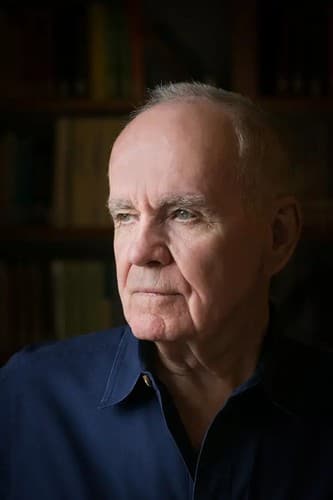
Cormac McCarthy was an American writer who authored twelve novels, two plays, five screenplays, and three short stories, spanning the Western and postapocalyptic genres. He was known for his graphic depictions of violence and his unique writing style, recognizable by a sparse use of punctuation and attribution. McCarthy is widely regarded as one of the greatest American novelists.

Ashley Antoinette
4.6

Mark McDonald
4.4
Luo Guanzhong
4.4

Mia McKenzie
4.3

Dorothy Parker
4.3

Joaquim Maria Machado de Assis
4.3

James Thurber
4.2
Terry Kay
4.2