“To see a World in a Grain of Sand / And a Heaven in a Wild Flower / Hold Infinity in the palm of your hand / And Eternity in an hour.”
— The opening lines, setting the theme of perceiving the infinite in the mundane.

William Blake (1914)
Genre
Fiction
Reading Time
5 min
Key Themes
See below
Sign in to track this book
Blake's 'Auguries of Innocence' shows how small natural wonders contain deep moral truths, encouraging people to see eternity in a grain of sand and heaven in a wild flower.
The poem starts with the famous lines, 'To see a World in a Grain of Sand / And a Heaven in a Wild Flower / Hold Infinity in the palm of your hand / And Eternity in an hour.' This sets the philosophical mood, suggesting that deep universal truths appear in small, everyday sights. Blake immediately challenges common ideas of size and time, asking the reader to look past the surface. This first stanza acts as a main point, implying that the 'auguries' to follow will show deep moral and spiritual insights from simple interactions in nature and human life. It is a call to be more aware and kind.
Blake moves to specific examples, saying that 'A Robin Red breast in a Cage / Puts all Heaven in a Rage.' He extends this to 'A Skylark wounded in the wing / A Cherubim does cease to sing' and 'A Dog starv'd at his Master's Gate / Predicts the ruin of the State.' These lines connect the mistreatment of innocent creatures to divine anger and societal breakdown. Animal suffering is not separate; it echoes through the spiritual world and affects human government and well-being. Blake suggests a direct link between human kindness (or lack of it) toward the vulnerable and the moral health of a community or nation.
Blake continues to explore how everything connects, stating that 'The poison of the Snake & Newt / Is the sweat of Envys Foot' and 'The poison of the Honey Bee / Is the Jealousy of Art.' He also notes that 'He who Torments the Goats & Sheep / Shall never learn to feel or sleep.' These lines suggest that bad forces in nature (like snake venom) are like human flaws (envy, jealousy). Also, the suffering of innocent animals like lambs and sheep relates directly to a human's inability to find peace or empathy. This reinforces the idea that cruelty harms the person doing it as much as it harms the victim, creating a cycle of pain and moral decay.
The poem shifts to human children, stating, 'A Crying Child is a fiend hid / And a Hell where none can be hid.' This strong image suggests that a child's suffering is a deep moral disaster, an evil that spreads to everything around it. Blake sees childhood innocence as sacred, and hurting it as a major sin against divine order. He implies that society's treatment of its weakest members, especially children, directly shows its spiritual health. The 'Hell where none can be hid' means that the pain caused to a child cannot be hidden or ignored by the universe or by a fair God.
Blake broadens his view to include other ignored people, saying, 'The Harlots cry upon the Street / Shall weave old Englands winding Sheet.' He also notes that 'The Beggars Rags fluttering in Air / Does to Rags the Heavens tear.' These vivid, almost end-of-the-world images show how societal neglect and the suffering of the poor and outcast lead to a nation's moral decay and eventual fall. The 'winding sheet' means death and ruin, while the 'rags tearing the heavens' suggests a cosmic outcry against unfairness. Blake argues that true goodness comes from kindness to all, especially those society usually avoids.
Blake looks at the symbolic meanings of creatures often linked with darkness or fear. He states, 'The Spider's web, an emblem of deceit, / Is spun where innocence does meet its fate.' He also mentions, 'The Bat that flits at close of day / Is Reason's shadow, gone astray.' And 'The Owl that calls upon the night / Is the voice of Doubt, obscuring light.' These lines use nature images to show human flaws and intellectual failures. The spider's web means trickery, the bat means wandering reason, and the owl means doubt. Blake suggests that even in natural things, one can see the spiritual struggles and moral wrongs that affect humanity, especially when innocence is threatened by hidden dangers.
Blake discusses the fear of sleep, writing, 'He who mocks the Infants Faith / Shall be mock'd in Age & Death.' He also touches on false comfort and moral compromises, stating, 'The Harlots Kiss, an emblem of deceit, / Does poison the soul, making life bittersweet.' These lines suggest that denying innocence and faith in childhood leads to a bitter end. The 'Harlots Kiss' means short-lived pleasures that cost one's spiritual well-being, showing how superficiality and moral compromise corrupt. Blake stresses the long-term results of actions that betray innocence and real human connection.
Blake explores the nature of truth and lies, stating, 'A Truth that's told with bad intent / Beats all the Lies you can invent.' He also uses farm images: 'The Thistle & the Briar & the Thorn / Are Truths that are for ever born.' This suggests that truth, even when told with bad intentions, has a destructive power greater than outright lies. The thorny plants mean harsh, undeniable truths that last despite human attempts to hide them. Blake implies that truth, in its rawest form, can be painful and unyielding, yet it is a natural part of life, always appearing and needing to be seen, unlike the fleeting nature of falsehoods.
Blake returns to the idea of the divine in humanity, declaring, 'Every tear from every eye / Becomes a Babe in Eternity.' He also states, 'And every Human Face we see / Is the face of God in Eternity.' These lines emphasize the sacredness of human suffering and the divine within each person. Each tear shed is not lost but becomes an eternal being, showing the spiritual meaning of empathy. Saying that 'every Human Face' is 'the face of God' is a strong call for universal love and respect, suggesting that harming another is harming God. This reinforces the poem's main theme of connection and moral duty.
The poem ends with advice, guiding the reader toward wisdom and away from error. Blake states, 'He who would see a World in a Grain of Sand / And a Heaven in a Wild Flower / Must learn to cast his fear away / And walk in Truth's eternal hour.' He repeats the first idea, linking it to moral courage and following truth. The poem ends by stressing that real understanding and spiritual enlightenment are not given but are earned through a clear commitment to kindness, honesty, and a deep appreciation for how all life connects. It urges the reader to fearlessly seek spiritual insight.
The Protagonist
The narrator's 'arc' is not personal development but a progressive revelation of interconnected truths, moving from general principles to specific examples of moral corruption and redemption.
The Symbolic Victim
The robin's static state of suffering serves as a constant moral benchmark throughout the poem, unchanging but deeply impactful.
The Symbol of Vulnerable Innocence
The child's innocence remains constant, but its suffering reveals the depth of human depravity and the need for compassion.
The Symbol of Societal Outcast/Victim
The Harlot's static position as an outcast serves to illustrate the enduring societal failures that Blake condemns.
The Symbol of Poverty and Neglect
The beggar's unchanging state of destitution highlights the persistent nature of societal injustice.
The Symbol of Deceit
The spider's symbolic function is static, representing an ever-present force of deceit.
The Symbol of Misguided Reason
The bat's symbolic role is constant, representing the pitfalls of unbalanced reason.
The Symbol of Doubt
The owl's symbolic function remains consistent, representing the enduring challenge of doubt.
This is the main theme, stating that all beings—human, animal, and even natural things—are linked. Blake shows this by explaining how cruelty to a robin 'Puts all Heaven in a Rage,' or how a 'Skylark wounded' silences a 'Cherubim.' The suffering of one creature affects the whole cosmos, impacting the divine and society. In contrast, seeing the divine in 'every Human Face' is essential. This theme asks for empathy, suggesting that harming any part of creation harms the whole, and ultimately, oneself and God. It supports the moral arguments against cruelty and unfairness.
“To see a World in a Grain of Sand / And a Heaven in a Wild Flower / Hold Infinity in the palm of your hand / And Eternity in an hour.”
Blake values innocence highly, especially that of children and vulnerable creatures. The 'Robin Red breast in a Cage' and 'A Crying Child' are key examples. The poem says that harming innocence is a serious moral wrong that has cosmic effects, bringing divine anger and societal decay. Protecting innocence is a basic moral duty, and destroying it causes great spiritual suffering. This theme highlights Blake's belief in the natural goodness and purity of uncorrupted life, which society has a sacred duty to care for and protect.
“A Robin Red breast in a Cage / Puts all Heaven in a Rage.”
The poem directly links society's neglect and unfairness to a nation's moral decline. The 'Harlots cry upon the Street' and 'The Beggars Rags' are not just individual sad events but signs of a deeper societal sickness that will lead to 'old Englands winding Sheet' and 'to Rags the Heavens tear.' Blake argues that a society that ignores or harms its weakest members—the poor, the outcast, the abused—is corrupt and will fall apart. This theme criticizes institutional indifference and calls for social change based on kindness.
“The Harlots cry upon the Street / Shall weave old Englands winding Sheet.”
A main theme is that real wisdom comes from seeing the spiritual and endless in the seemingly ordinary and limited. The first lines set this idea, asking readers to see a 'World in a Grain of Sand.' This dual nature extends to moral perception: what seems like a simple act of cruelty (caging a bird) is shown to be a cosmic offense. Blake challenges shallow understanding, pushing for a deeper, empathetic view that recognizes the deep connection and divine presence in all things, contrasting this with a limited, purely rational or materialistic view.
“To see a World in a Grain of Sand / And a Heaven in a Wild Flower.”
Blake explains in detail how cruelty causes suffering, both for the victim and the person doing it, and how kindness leads to spiritual understanding. 'He who Torments the Goats & Sheep / Shall never learn to feel or sleep,' showing the inner pain of the cruel. In contrast, empathy and protecting the innocent are acts of divine meaning. The poem works as a moral record, showing that every action toward another being has a direct and deep spiritual consequence, shaping one's own soul and the universe. It is a clear warning against indifference and a strong support for active goodness.
“He who Torments the Goats & Sheep / Shall never learn to feel or sleep.”
The act of prophesying from omens, used to reveal moral truths.
The central plot device is the 'augury' itself, which Blake reinterprets. Traditionally, auguries were predictions based on omens. Here, Blake uses everyday observations of nature and human behavior as omens, not for future events, but for profound moral and spiritual truths. Each couplet or quatrain presents a seemingly simple observation (e.g., a caged robin, a crying child) and then reveals its deeper, universal, and often cosmic significance. This device allows Blake to connect specific instances of cruelty or compassion to overarching principles of justice, divine wrath, and human interconnectedness, making the abstract tangible and the mundane sacred.
The extensive use of concrete images to represent abstract moral and spiritual concepts.
Blake employs rich symbolism and metaphor throughout the poem. Animals (robin, skylark, dog, spider, bat, owl) are not just literal creatures but stand for innocence, suffering, deceit, misguided reason, and doubt. Natural phenomena (grain of sand, wild flower) symbolize universal truths and the infinite. Human figures (child, harlot, beggar) represent vulnerable innocence, societal neglect, and marginalized suffering. These symbols allow Blake to convey complex philosophical and moral ideas concisely and powerfully, making the poem's messages resonate on multiple levels. The 'Harlots cry' becoming 'Englands winding Sheet' is a potent metaphor for social decay.
The placement of contrasting ideas or images side-by-side to highlight profound truths.
Blake frequently uses juxtaposition to create striking contrasts and reveal deeper meanings. The opening lines, 'World in a Grain of Sand' and 'Heaven in a Wild Flower,' immediately present a paradox that challenges conventional scale and perception. He contrasts the innocence of creatures with human cruelty, the divine rage with human indifference, and the promise of eternity with the fleetingness of an hour. This device forces the reader to confront contradictions and rethink established notions, emphasizing the interconnectedness of seemingly disparate elements and the profound moral implications of everyday actions. It underscores the poem's call for a more nuanced and empathetic understanding of existence.
A teaching voice that delivers moral lessons in concise, memorable statements.
The poem adopts a didactic tone, explicitly aiming to teach moral and spiritual lessons. Blake frequently uses an aphoristic style, delivering profound insights in short, memorable, and often rhyming couplets or quatrains. Phrases like 'A Truth that's told with bad intent / Beats all the Lies you can invent' serve as moral maxims. This style makes the poem's messages impactful and easily recalled, resembling proverbs or prophetic declarations. It reinforces Blake's role as a visionary teacher, guiding humanity towards a more enlightened and compassionate way of perceiving and interacting with the world.
“To see a World in a Grain of Sand / And a Heaven in a Wild Flower / Hold Infinity in the palm of your hand / And Eternity in an hour.”
— The opening lines, setting the theme of perceiving the infinite in the mundane.
“A Robin Red breast in a Cage / Puts all Heaven in a Rage.”
— Illustrating the divine displeasure at cruelty to innocent creatures.
“A truth that's told with bad intent / Beats all the Lies you can invent.”
— Warning about the destructive power of malicious truth-telling.
“The poison of the Snake & Newt / Is the sweat of Envys Foot.”
— Attributing the origin of venom and evil to envy.
“The Catterpiller on the Leaf / Repeats to thee thy Mothers grief.”
— Connecting the suffering of insects to human sorrow, particularly maternal grief.
“He who mocks the Infants Faith / Shall be mock'd in Age & Death.”
— A warning against undermining innocence and belief.
“The Child's Toys & the Old Man's Reasons / Are the Fruits of the Two Seasons.”
— Contrasting the simple joys of childhood with the logic of old age.
“Every Tear from every Eye / Becomes a Babe in Eternity's Cry.”
— Suggesting that human suffering echoes into the eternal realm.
“The wanton Boy that kills the Fly / Shall feel the Spiders enmity.”
— Illustrating the principle of karma or poetic justice in nature.
“He who torments the Chafers Sprite / Weaves a Bower in endless Night.”
— Warning that cruelty leads to spiritual darkness and eternal damnation.
“The Bleatings of the Lambs pure throat / Deepens in the Wolves wild note.”
— Showing how innocence and vulnerability can provoke or be intertwined with predatory instincts.
“If the Sun & Moon should doubt / They'd immediately go out.”
— Emphasizing the power of belief and the destructive nature of doubt.
“Man was made for Joy & Woe / And when this we rightly know / Thro' the World we safely go.”
— Accepting the dual nature of human experience as a path to navigate life.
“God Appears & God is Light / To those poor Souls who dwell in Night / But does a Human Form Display / To those who Dwell in Realms of day.”
— Describing how God manifests differently to those in darkness versus those in enlightenment.
Ready to see how well you understood this book? Take our interactive quiz with 10 questions.
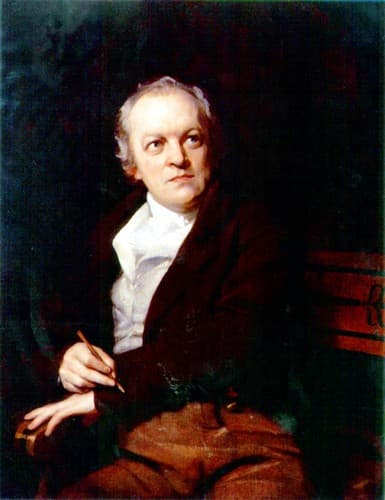
William Blake was an English poet, painter, and printmaker. Largely unrecognised during his life, Blake is now considered a seminal figure in the history of the poetry and visual art of the Romantic Age. What he called his "prophetic works" were said by 20th-century critic Northrop Frye to form "what is in proportion to its merits the least read body of poetry in the English language". His visual artistry led 21st-century critic Jonathan Jones to proclaim him "far and away the greatest artist Britain has ever produced". In 2002, Blake was placed at number 38 in the BBC's poll of the 100 Greatest Britons. While he lived in London his entire life, except for three years spent in Felpham, he produced a diverse and symbolically rich collection of works, which embraced the imagination as "the body of God" or "human existence itself".
Ashley Antoinette
4.6

Mark McDonald
4.4
Luo Guanzhong
4.4
Mia McKenzie
4.3
Dorothy Parker
4.3
Joaquim Maria Machado de Assis
4.3
James Thurber
4.2
Terry Kay
4.2