Aldous Leonard Huxley was an English writer and philosopher. His bibliography spans nearly 50 books, including novels and non-fiction works, as well as essays, narratives, and poems.

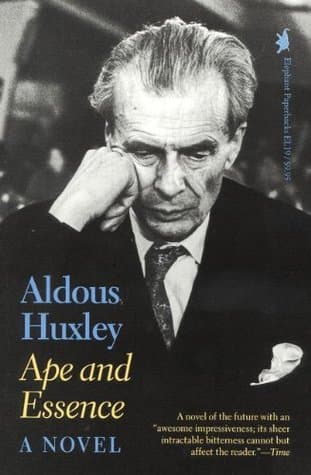
Aldous Huxley (1948)
Genre
Science Fiction / Philosophy
Reading Time
12 Minutes
Key Themes
See below
Sign in to track this book
A post-apocalyptic expedition to nuclear-ravaged California discovers that humanity's greatest destruction lies not in radiation, but in its own moral decay.
The novel starts with a frame story in February 2108, aboard the New Zealand Rediscovery Expedition's ship, the 'S.S. C.M.S. Ararat.' Two writers, the unnamed Narrator and his colleague Alfred Poole, find an old film script called 'Ape and Essence' in a deserted Hollywood studio. The script, dated 'February 2108,' describes a dystopian future after a global atomic war. The Narrator and Poole discuss the script's cynical tone and its author's bleak view of humanity. Poole thinks it's too pessimistic, while the Narrator believes it might be prophetic. This discussion introduces the main story, which is the content of the discovered film script.
The film script begins with a prologue featuring the Arch-Vicar of Belial, a figure representing evil. He tells his followers how humanity, through its own arrogance and scientific progress, caused its own destruction. The Arch-Vicar celebrates the atomic war and the resulting societal collapse, seeing it as a victory for Belial, the Prince of this World. This prologue sets up the theological and philosophical ideas of the post-apocalyptic society, where evil is not just a human flaw but an active, worshipped entity, and humanity's nature is tied to its destructive potential.
The main story starts when the New Zealand Rediscovery Expedition lands in a ruined, radioactive California in 2108. Dr. Poole, the botanist, and his crew expect to find ruins but are unprepared for the extreme societal decline and mutations they encounter. The land is barren, and the few remaining inhabitants are deformed by radiation. A group of these survivors, who are primitive, suspicious, and superstitious, quickly captures them. This first meeting shows the large cultural and biological gap between the relatively untouched New Zealanders and the devastated Californians, setting up a conflict of cultural differences and philosophical despair.
Dr. Poole is separated from his crew and taken to the main settlement of the Californian survivors. He undergoes a humiliating 'purification' ritual, where he is stripped, shaved, and forced to wear the locals' crude clothes. During this, he sees their deep fear of 'Hairy Apes' (those with mutations) and their strong worship of Belial. He witnesses the brutal killing of 'Hairy Apes' and the forced sterilization of women, all part of their rituals to appease Belial and prevent more mutations and disasters. This scene shows the moral and physical degradation of the survivors, where fear and superstition control every part of life.
Poole, now a captive, is indoctrinated into the Belialian society. He learns that the survivors believe the atomic war was Belial's punishment for humanity's pride and scientific arrogance. Their society aims to appease Belial through ritual violence, forced labor, and extreme misogyny. Women are considered the main source of evil and temptation, especially during the 'Rutting Season' (the annual period for procreation), and are severely controlled and punished. A Council of Elders and an Arch-Vicar rule the society, interpreting Belial's will and enforcing rigid, fear-based rules. Poole struggles to understand this complete reversal of moral and scientific values.
Despite the harsh realities of the Belialian society, Poole meets Loola, a young woman who, despite her upbringing, shows independent thought and compassion. She is assigned to work with Poole, and through their interactions, he discovers her quiet disagreement with the dominant beliefs. Loola, though afraid, questions the extreme cruelty and absolute nature of their beliefs. Their growing connection represents a small hope and humanity in the otherwise bleak setting. Loola's willingness to listen to Poole's stories of the pre-war world and her own doubts suggest the possibility of resisting the oppressive system.
The 'Rutting Season' is the most horrifying part of the Belialian society. During this time, all societal norms are reversed, and a chaotic, ritualized procreation occurs, approved by Belial. Women are treated as mere vessels for reproduction, with little dignity or choice. The ritual involves violence, public humiliation, and a complete loss of individual freedom. Poole is forced to participate symbolically, witnessing the raw, animalistic nature of the event. This season shows how much humanity has devolved, driven by fear, superstition, and a distorted understanding of its own biology and purpose.
Disgusted by the horrors of the Rutting Season and fearing for his life, Poole decides to escape and take Loola with him. He tries to persuade Loola to join him in finding a rumored group of 'Hairy Apes' who live outside the main settlement and are said to be less bound by Belialian dogma. Their escape attempt is short-lived, as zealous guards quickly find and capture them. This capture shows the widespread control of the Belialian society and how hard it is to challenge its deep-rooted belief system, highlighting the great risks involved in any act of rebellion.
Poole is brought before the Council of Elders and the Arch-Vicar for his escape attempt and for spreading forbidden ideas. He is condemned for challenging Belial's authority and for trying to corrupt Loola. In an act of defiance and love, Loola confesses to having seduced Poole and claims responsibility for his actions, hoping to lessen his punishment. Her sacrifice, though it doesn't prevent Poole's harsh sentence, shows her growing moral courage and the strength of her bond with Poole, offering a poignant moment of human connection amid the widespread despair and cruelty.
Poole is sentenced to forced labor, a life of servitude under the oppressive regime. However, his story takes an unexpected turn when a group of 'Hairy Apes,' the mutated outcasts of society, rescues him. These 'Hairy Apes' represent a different kind of survival, living outside the strict dogma of the Belialians, often in the wild. While still affected by their mutations, they have a more basic but perhaps more authentic form of humanity, free from the institutionalized cruelty and superstition of the main settlement. This shift introduces an alternative, though still bleak, vision of post-apocalyptic existence, hinting at different paths for human survival.
Among the 'Hairy Apes,' Poole discovers a community that, while primitive and struggling, lacks the systematic cruelty and religious fanaticism of the Belialians. They live a more natural existence, though still marked by the harsh realities of their mutated state and the constant threat from the Belialians. Poole begins to see a different kind of resilience and perhaps a more genuine, if imperfect, humanity among them. He finds a fragile hope in their simple connections and their lack of the destructive ideologies that consumed the Belialian society. This encounter suggests that perhaps true humanity can only survive by shedding the complexities that led to its downfall.
Despite the relative peace among the 'Hairy Apes,' Poole's past catches up with him. He learns the tragic news of Loola's ultimate fate: she was subjected to the Belialian rituals and eventually died due to the harsh conditions and the society's cruelty. This news shatters any lingering hope Poole had for a future with her or for the redemption of humanity. Overwhelmed by despair and the futility of resistance, Poole succumbs to a deep sense of hopelessness, realizing the pervasive nature of humanity's self-destructive tendencies and the seemingly insurmountable grip of ignorance and fear in the post-apocalyptic world.
The film script ends, and the frame story returns to the Narrator and Alfred Poole on the 'S.S. C.M.S. Ararat.' They resume their debate about the script's message and the nature of humanity. Poole, still optimistic, argues that humanity's essence is not inherently evil and that progress is possible. The Narrator, however, is more convinced by the script's bleak vision, suggesting that humanity's inherent flaws, particularly its capacity for violence and its susceptibility to irrational belief systems, make its ultimate self-destruction almost inevitable. The novel ends on this unresolved philosophical note, leaving the reader to ponder the true 'essence' of humanity.
The Protagonist
Poole begins as an innocent observer, is forced to confront humanity's darkest aspects, and ultimately succumbs to a profound despair regarding humanity's future.
The Supporting
Loola evolves from a fearful, conditioned survivor to a courageous individual who sacrifices herself for Poole, embodying a tragic human spirit.
The Supporting
The Narrator serves as a static philosophical voice, advocating for the script's cynical view of humanity's unchanging, destructive essence.
The Antagonist
The Arch-Vicar is a static representation of institutionalized evil and corruption, showing no development but rather enforcing the degradation of his society.
The Supporting
The Chief provides a brief, alternative vision of survival, highlighting a different response to post-apocalyptic conditions.
The Supporting
Alfred Poole remains a static figure in the frame story, consistently arguing for humanity's potential for goodness and progress.
The novel shows humanity's complete moral, intellectual, and physical collapse after a nuclear war. Survivors become a primitive, superstitious society where reason is replaced by fear-based rules, compassion by cruelty, and scientific progress by a rejection of knowledge. The physical mutations mirror the spiritual and moral decay, emphasizing that humanity has lost its 'essence' and become more 'ape-like' in its primal instincts and violence. This theme highlights Huxley's deep pessimism about humanity's capacity for self-destruction.
“The essence of Man is the essence of the Ape, only more so. More ape-like because more intelligent, more ape-like because more systematic, more ape-like because more moral – and so more ferociously, more fanatically, more diabolically moral.”
Huxley explores how power, especially with religious fanaticism, can lead to extreme oppression and cruelty. The Belialian society is ruled by an Arch-Vicar and Council who have absolute authority, enforcing their interpretation of Belial's will through terror, ritual violence, and the systematic subjugation of women. This theme critiques how rigid ideologies, whether religious or political, can remove individual autonomy, promote ignorance, and justify horrific acts in the name of a higher power, creating a dystopian society built on fear rather than progress.
“The Arch-Vicar was addressing his flock. He was reminding them of the Sacred Truths. 'The past was a time of pride and progress,' he proclaimed. 'And what did pride and progress bring? Belial's Fire!'”
A central part of the Belialian society's degradation is its extreme misogyny. Women are blamed for humanity's fall, seen as sources of temptation and evil, and reduced to mere reproductive vessels. They are subjected to forced sterilization, public humiliation, and violent control, especially during the 'Rutting Season.' This theme highlights how, in a collapsed society, fear and superstition can lead to the systematic oppression of a gender, stripping women of their humanity and dignity, and reflecting a primal, regressive social structure where their bodies and choices are entirely controlled.
“The women were led out, shaven and naked... 'Behold the vessels of Belial's temptation!' cried the Arch-Vicar. 'Behold the source of all our woe!'”
Dr. Poole, representing scientific reason and Enlightenment values, finds himself powerless and unable to understand the Belialian society's deep-rooted irrationality and superstition. His attempts to explain logic or history are met with hostility or blank incomprehension. This theme shows Huxley's concern that human reason, while powerful, is fragile and easily overcome by primal fears, unquestioning dogma, and collective delusion, especially during crises. It suggests that once a society abandons reason, it quickly descends into chaos and self-destruction, making rational intervention useless.
“How could one speak of the atom, of the universe, of the long slow ascent of life, to people who believed that Belial had thrown the bomb, and that all sickness came from his wrath?”
The novel directly asks if evil is an inherent part of human nature or a learned behavior. Through the worship of Belial and the complete moral reversal of Californian society, Huxley suggests that humanity's 'essence' is deeply tied to its capacity for destruction, cruelty, and irrationality. The frame story's debate further emphasizes this, questioning whether humans are fundamentally 'apes' with a veneer of civilization or capable of genuine progress. The widespread suffering and self-inflicted misery imply a basic flaw in humanity that leads to its repeated downfall.
“What is the essence of man? The ape's capacity for malice, for hatred, for unreasoning fear, for the systematic degradation of his own kind.”
A story within a story, providing commentary and context.
The novel uses a frame story, where the main narrative (the 'Ape and Essence' film script) is discovered and discussed by two characters, the Narrator and Alfred Poole, in a future setting (2108). This device allows Huxley to introduce the core philosophical questions of the book directly through the characters' debate, offering different perspectives on the script's cynical vision before the reader even begins the main story. It also creates a layer of meta-commentary, inviting the reader to engage in the same critical analysis as the frame characters, thus amplifying the novel's thematic impact and its warning about humanity's future.
The ape symbolizes humanity's regression to primal, destructive instincts.
The ape is a pervasive and central symbol throughout the novel, explicitly referenced in the title. It symbolizes humanity's devolution and regression to its most primal, violent, and irrational instincts, shedding the veneer of civilization and reason. The 'Hairy Apes' (mutated humans) are a literal manifestation, but the 'essence' of the ape refers to the barbaric, superstitious, and cruel behaviors exhibited by the 'civilized' Belialians. The ape represents the shadow side of humanity, the capacity for destruction, blind obedience, and unthinking aggression that Huxley argues is always lurking beneath the surface, ready to emerge when reason fails.
A twisted religion symbolizing institutionalized evil and fear.
The worship of Belial is a key plot device that satirizes and critiques organized religion and its potential for corruption. Belial, traditionally a demon or personification of evil, is elevated to the supreme deity in the post-apocalyptic Californian society. This inverted religion justifies all the society's atrocities—misogyny, violence, superstition, and the rejection of knowledge—as necessary to appease their malevolent god. It serves as a symbolic representation of how fear and ignorance can be weaponized by those in power, turning faith into a tool of oppression and demonstrating how humanity, in its desperation, can create a god in its own destructive image.
Huxley uses biting satire to critique modern society and human nature.
Huxley employs extensive satire and irony to highlight the absurdities and dangers of humanity's trajectory. The entire premise of the 'Ape and Essence' script, with its grotesque depiction of a post-atomic society, is a satirical exaggeration of Huxley's fears about technological hubris, unchecked nationalism, and the decline of reason. The Belialian rituals, the 'Rutting Season,' and the Arch-Vicar's pronouncements are presented with a chilling irony, exposing the grotesque logic of a society that has completely inverted its values. This device allows Huxley to deliver a harsh critique of contemporary society through the lens of a darkly humorous, exaggerated future.
Ready to see how well you understood this book? Take our interactive quiz with 10 questions.
Aldous Leonard Huxley was an English writer and philosopher. His bibliography spans nearly 50 books, including novels and non-fiction works, as well as essays, narratives, and poems.