“You fight the war with guns, you fight the peace with stories.”
— Sarat's uncle explaining the nature of conflict and memory.

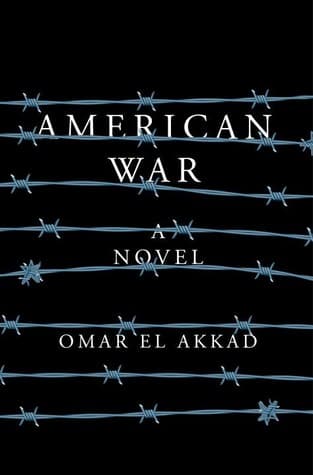
Omar El Akkad (2017)
Genre
Science Fiction
Reading Time
450 min
Key Themes
See below
Sign in to track this book
In a future America divided by a second Civil War and climate disaster, a young girl named Sarat becomes a weapon of revenge, her personal tragedy reflecting the nation's wounds.
The story starts in 2074, showing a future United States damaged by climate change, with much of Louisiana under water. The Second American Civil War has started after Southern states (Mississippi, Alabama, Georgia, and South Carolina) left the Union, forming the Free Southern State (FSS). The main reason for this was the federal ban on fossil fuels. The Chestnut family – father Joseph, mother Martina, oldest daughter Dana, son Simon, and youngest daughter Sarat – lives a difficult life in the rural, war-torn South. They struggle with few resources and constant threats of violence, trying to live normally during the conflict. Sarat, six when the war began, is mostly protected from its worst parts by her parents, but the tension and fear are clear.
Tragedy hits the Chestnut family when a Northern drone attack targets their home. Joseph Chestnut dies, leaving Martina to care for their three children alone. With their home destroyed, Martina and her children must leave their land. They move to Camp Patience, a large, crowded camp for displaced people in the Free Southern State. The camp is a harsh place, with dirt, disease, and constant watch. Life there is very different from their old rural life. The family struggles with the cramped, unclean conditions and the loss of their father. Sarat, deeply affected by her father's death and the move, starts to feel the war's unfairness.
In Camp Patience, Sarat sees the harsh facts of war and displacement. She witnesses her family's and neighbors' suffering, the random nature of power, and the growing anger toward the North. During her time in the camp, a mysterious person named Albert Gaines takes an interest in young Sarat. Gaines, who seems to be a kind aid worker, is actually recruiting for the Southern rebels. He quietly starts to influence Sarat, teaching her survival skills, history (from a Southern view), and giving her a deep hatred for the Union. He sees her strong spirit and vulnerability, preparing her for a future role in the conflict, though her family does not know his true plans or how much he influences her.
The difficulties of Camp Patience cause more pain for the Chestnut family when Simon, Sarat's older brother, dies from a serious illness, likely made worse by the camp's poor conditions. His death further traumatizes Sarat and Martina, making their grief and helplessness deeper. Soon after, Dana, Sarat's older sister, unable to stand camp life and wanting a better future, decides to leave Camp Patience. She goes north, hoping to find work and escape the conflict, separating the remaining family members. Sarat is left with only her mother, Martina, and her bond with Albert Gaines grows stronger as she feels more isolated and vulnerable, setting her path toward radicalization.
Under Albert Gaines's guidance, Sarat is eventually recruited into the Southern rebels. She is taken from Camp Patience and undergoes intense training, learning combat skills, propaganda, and how to deceive. Gaines uses her grief, anger, and desire for revenge, shaping her into a dedicated soldier for the Free Southern State. Her first important mission involves taking part in a bombing against a Northern target, perhaps a supply depot or military base. This act marks her irreversible change from a displaced child to someone who commits violence, a turning point that strengthens her commitment to the Southern cause and hardens her resolve against the Union.
Sarat's involvement in the rebellion grows, leading her to take part in one of the war's most destructive acts: using a biological weapon. The Southern forces, desperate, release a plague-like disease, called the 'Bouazizi virus,' meant to target the Northern population. Sarat directly helps distribute or activate this weapon. This act has terrible results, causing many deaths and panic across the Union. After this operation, or perhaps during a later mission, Union forces capture Sarat. Her capture ends her active combat role and starts her imprisonment, where she faces questioning and the results of her actions.
After her capture, Sarat is imprisoned for a long time and questioned intensely by Union authorities. She is held in various detention centers, including an island prison, where she is repeatedly asked about her part in the Southern rebellion and the biological attack. Despite the harsh conditions and psychological pressure, Sarat remains mostly defiant, refusing to fully cooperate or betray her comrades. Her time in prison further solidifies her worldview, strengthening her belief in the Southern cause and her hatred for the Union. The interrogations show the deep ideological divide that fueled the war and Sarat's strong commitment to her beliefs, even in captivity.
The Second American Civil War eventually ends, with neither side winning clearly. Instead, there is a stalemate and a period of difficult rebuilding. Years after her capture, Sarat is finally released from prison as part of a general pardon or prisoner exchange. She returns to a dramatically changed world, scarred by war and the lasting effects of the Bouazizi virus. Her release is not a victory but a return to a broken society. She is a veteran of a lost cause, carrying the psychological weight of her past actions and the trauma of her imprisonment. She finds herself an outcast in some circles, a symbol of resistance in others, struggling to find her place in the post-war world.
In her life after prison, Sarat tries to build a new existence, but the war's shadow remains large. She struggles with the physical and psychological scars of her past, including a missing arm. She tries to reconnect with her surviving family members, especially Dana, who has built a life in the North, and her nephew, who represents a new generation. However, the deep divisions and traumas of the war make reconciliation hard. Sarat's actions continue to have effects, and she remains a controversial figure. The story also follows her nephew, who, years later, tries to understand his aunt's story and the war's history. This provides a way to frame the whole novel and shows how conflict affects generations for a long time.
The novel ends with a historian's thoughts, written decades after the Second American Civil War. This historical view offers an analysis of the conflict, its causes, and its lasting effects. The historian examines Sarat Chestnut's life as an example, exploring how war shapes people and how their actions echo through history. The ending stresses that even though the war officially concluded, its ideological battles and cycles of violence continue in different ways. It leaves the reader with a somber understanding of the deep scars left on the nation and the human spirit, suggesting that lessons from the past are rarely fully learned, and conflict can always happen again.
The Protagonist
Sarat transforms from an innocent child to a radicalized soldier, then to a defiant prisoner, and finally to a survivor haunted by her past, representing the devastating human cost of war.
The Antagonist/Supporting
Gaines remains a consistent figure of radicalization, successfully transforming Sarat into a loyal combatant without significant personal change.
The Supporting
Martina's arc is one of sustained suffering and resilience, as she continually adapts to loss and displacement.
The Supporting
Dana's arc is one of survival and adaptation, successfully forging a new life away from the conflict's direct violence.
The Supporting
Simon's arc is tragically cut short, serving as a symbol of the innocent victims of war and a catalyst for Sarat's radicalization.
The Supporting/Mentioned
Joseph's arc is brief and tragic, serving as the inciting incident for the Chestnut family's downward spiral.
The Supporting
Benjamin embarks on a journey of historical discovery, aiming to understand his family's past and the broader implications of the American War.
The Supporting
General Lemuel remains a steadfast and unyielding military leader, pushing for increasingly aggressive tactics throughout the war.
The Supporting
The Interrogator's arc is largely static, focused on their professional duty to extract information, but they witness Sarat's unwavering resolve.
The novel explores how war shapes individual and group identity. Sarat's journey from a young girl to a radicalized soldier shows how conflict, displacement, and propaganda change a person's sense of self and purpose. Her identity becomes tied to the Southern cause, making it hard for her to find belonging outside of it even after the war. This theme also applies to the national identity of a divided America, questioning what it means to be 'American' when the nation fights itself. The lingering divisions and loyalties after the war highlight the lasting effect on personal and national identity.
““The South was not a country. It was a wound.””
A main theme is the continuation of violence and the destructive nature of revenge. Sarat's radicalization comes from wanting to avenge her father's death and the perceived wrongs against her people. Each act of violence, whether by the Union or the FSS, leads to another, creating an endless cycle of revenge. The novel shows how old grievances are passed down and reinterpreted, fueling future conflicts. Even after the war officially ends, the psychological scars and the desire for vengeance continue, suggesting that true peace is hard to find when the cycle is unbroken.
““They did it because they could, and because they had been hurt, and because they could not imagine not hurting back.””
El Akkad examines the moral questions of war, especially through the use of biological weapons and the manipulation of truth. Albert Gaines's role in influencing Sarat shows how propaganda can distort reality to justify terrible acts. Both sides do morally questionable things, blurring the lines between right and wrong. The novel makes readers confront difficult questions about what is allowed in war and how stories are made to dehumanize the enemy, making violence easier. The 'Bouazizi virus' clearly symbolizes the ultimate ethical violation.
““This is how you make a soldier: you make sure he knows what he’s fighting for, and you make sure he hates what he’s fighting against.””
Climate change deeply affects the novel's setting, making it a central theme. Rising sea levels have submerged much of Louisiana, and the federal ban on fossil fuels directly causes the Second Civil War. This theme shows the terrible results of ignoring the environment and how limited resources can worsen political tensions and cause conflict. The changed land is not just a setting but an active force, causing displacement, shaping economic realities, and showing humanity's vulnerability to its own environmental impact. The war itself becomes a desperate fight for control over shrinking resources and habitable land.
““The water was everywhere, a constant, creeping reminder that the land was no longer hers, no longer anyone’s.””
The story is framed by a future historian, Sarat's grand-nephew, who tries to put together the 'true' story of the American War. This structure shows how subjective memory is and how history is created. Different characters have different truths and interpretations of events, showing that a single, objective historical account is impossible, especially in a civil war. The novel questions who writes history, whose stories are remembered, and how personal accounts add to or challenge official versions of the past. It highlights the lasting power of individual experiences in shaping historical understanding.
““History, after all, is a series of choices.””
The story is told through Sarat's direct experiences, interspersed with future historical commentary.
The novel employs a dual timeline, primarily following Sarat Chestnut's life from childhood to old age, but also featuring an overarching narrative voice from her grand-nephew, a historian named Benjamin, decades in the future. Benjamin's commentary, often appearing as footnotes or introductory passages to chapters, provides a retrospective, analytical lens on Sarat's story and the broader context of the American War. This framing device allows the author to explore the subjective nature of history, the long-term consequences of conflict, and the act of constructing a historical narrative, while simultaneously immersing the reader in Sarat's immediate, visceral experiences.
The narrative shifts between Sarat's intimate perspective and a more detached historical analysis.
The narrative perspective alternates between Sarat's intimate, often brutal, first-person experience of the war and a more detached, analytical third-person perspective from her grand-nephew, Benjamin, writing as a historian in the future. Sarat's sections provide raw, emotional insight into the immediate impact of war on an individual, filled with sensory details and personal trauma. Benjamin's sections offer a broader, more academic view, reflecting on the causes, consequences, and historical significance of the events. This interplay of perspectives enriches the storytelling, allowing for both deep empathy and critical distance, and emphasizes the subjective nature of truth in conflict.
A fictional biological weapon used by the South, symbolizing the ultimate ethical breach in warfare.
The Bouazizi virus is a fictional biological weapon unleashed by the Free Southern State against the Union. Named after Mohamed Bouazizi, whose self-immolation sparked the Arab Spring, this disease symbolizes the desperation and moral degradation that can occur in total war. Its deployment marks a critical escalation of the conflict, leading to widespread death and a profound sense of horror. As a plot device, it not only serves as a major turning point in the war but also highlights the themes of ethical boundaries in conflict, the consequences of scientific misuse, and the lasting scars (both physical and psychological) that such atrocities leave on a society.
A displaced persons camp, serving as a microcosm of wartime suffering and a breeding ground for radicalization.
Camp Patience is a fictional displaced persons camp where the Chestnut family is forced to live after their home is destroyed. It functions as a powerful symbol and a crucial setting in Sarat's formative years. The camp embodies the squalor, despair, and dehumanization experienced by civilians caught in conflict. It is a place of scarcity, disease, and constant surveillance, but also where Sarat encounters Albert Gaines and begins her path toward radicalization. As a plot device, it effectively illustrates the immediate human cost of war and how such environments can become fertile ground for extremist ideologies, shaping future combatants out of desperate individuals.
“You fight the war with guns, you fight the peace with stories.”
— Sarat's uncle explaining the nature of conflict and memory.
“But in a world where the only certainty is uncertainty, the only safe place is the past.”
— Reflecting on the instability of the future in a war-torn America.
“War is the only thing we're good at anymore.”
— A character's cynical view of American society during the Second Civil War.
“They'll ask you what you were fighting for, and you'll tell them you were fighting for your country. But what you'll mean is you were fighting for your home.”
— Sarat's realization about the personal nature of conflict.
“The world is full of borders, but the only ones that matter are the ones in your head.”
— Commentary on psychological and ideological divisions.
“In the end, the only thing that survives is the story.”
— Emphasizing the lasting power of narratives over events.
“You don't get to choose the war, but you do get to choose the side.”
— A moral dilemma faced by characters in the conflict.
“The past is a ghost that haunts the present, and the future is a shadow we chase.”
— Philosophical reflection on time and memory in the novel.
“We are all refugees from something, even if it's just from our own past.”
— A broader observation on displacement and personal history.
“The only thing more dangerous than a man with nothing to lose is a man with everything to gain.”
— Describing the motivations driving characters in the war.
“Home is not a place, it's a memory.”
— Sarat's thoughts on the loss and reconstruction of home.
“In war, truth is the first casualty, but in peace, it's the last.”
— A twist on the classic saying, applied to the novel's themes.
“The river doesn't care who drinks from it.”
— A metaphor for nature's indifference to human conflict.
“We are what we remember, and we remember what we are told.”
— Exploring the construction of identity through stories.
Ready to see how well you understood this book? Take our interactive quiz with 10 questions.

Biography coming soon.