“The apple tree exists, and it is a fact that it is an apple tree.”
— Early in the book, establishing the literal yet profound observation of existence.

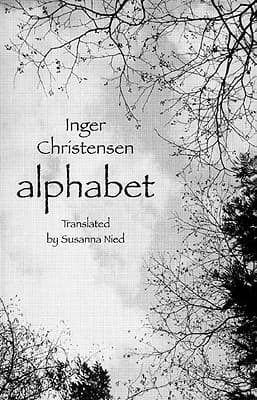
Sign in to track this book
Inger Christensen's "alphabet" uses the Fibonacci sequence and the alphabet to show the metaphysical in everyday things, creating psalm-like poems that celebrate life's beauty while lamenting its fragility.
The first section, for 'a' and the first Fibonacci number (1), introduces the core idea: 'apricot trees exist, apricot trees exist.' This statement repeats, highlighting a simple truth about nature. It sets a tone of quiet observation and affirmation. The language is simple and direct, focusing on the trees' physical presence. This initial statement builds the foundation for the poem's later, more complex philosophical explorations, rooting abstract ideas in tangible reality. It establishes the poem's structure, connecting alphabetical order with a numerical sequence, creating a sense of order and organic growth.
Moving to 'b' and the second Fibonacci number, the poem lists 'blackberries exist, and blind nettles exist.' This continues the declarative style but introduces a subtle contrast. Blackberries represent natural sweetness, while blind nettles suggest a less friendly side of nature, or at least one needing careful interaction. The repetition reinforces the idea of undeniable existence. This section broadens the scope of the natural world being listed, hinting at its complexity and varied textures, preparing the reader for deeper explorations of existence beyond mere presence.
With 'c,' the poem includes 'cicadas exist, and chlorophyll exists.' Here, the focus shifts from static objects to dynamic elements: the sound of cicadas and the process of photosynthesis. Cicadas bring an auditory dimension, a hum of life, while chlorophyll points to the essence of plant life and energy conversion. This deepens the poem's engagement with nature, moving beyond simple observation to an appreciation of underlying mechanisms and sensory experiences. The pairing of sound and biochemical process shows how life's various forms and functions connect.
The 'd' section is important, introducing 'doves exist, and death exists.' This is the first clear mention of mortality within the poem's growing list of existence. Doves, symbols of peace and life, are immediately followed by the reality of death. This sudden introduction of a destructive force contrasts sharply with earlier, more pleasant natural observations. It breaks the initial innocence and sets a darker tone for later sections, forcing a confrontation with the fragility in the beautiful world described. This contrast is central to the poem's evolving themes.
Under 'e,' the poem broadens its scope to include 'everything exists, and eternity exists.' This move from concrete natural elements to abstract concepts shows a profound shift. 'Everything' tries to capture the totality of existence, while 'eternity' introduces timelessness, hinting at a reality beyond temporal limits. This section elevates the poem's philosophical inquiry, prompting reflection on reality itself and the limits of human perception. It suggests that existence is not just a collection of separate objects but a continuous, boundless phenomenon, including both the tangible and the conceptual.
The 'f' section includes 'fear exists, and future exists.' This marks a significant turn towards human experience and time. Fear, a personal emotion, is directly linked to the future, suggesting an inherent anxiety about what lies ahead. This section grounds the poem in a more human perspective, moving away from purely objective observations of nature. It introduces vulnerability and uncertainty, hinting at potential suffering and the unknown, which will become more pronounced as the poem moves into darker reflections on destruction and war.
With 'g,' the poem notes 'gas exists, and the global village exists.' This marks a clear shift from natural phenomena to human creations and their consequences. 'Gas' can mean many things—from natural gas to poison gas—introducing a hidden threat and the potential for technological harm. 'The global village' acknowledges modern society's interconnectedness, but also its vulnerability and the widespread impact of destructive forces. This section places the poem more firmly in the context of human civilization and its advancements, but also its dangers, setting the stage for later reflections on war and environmental damage.
The 'h' section is a clear and chilling statement: 'hydrogen bomb exists, and horror exists.' This is a direct confrontation with humanity's ability to destroy itself. The hydrogen bomb, a symbol of ultimate technological annihilation, brings earlier hinted fears and destructive potentials into sharp focus. 'Horror' is the emotional response to such a threat, capturing the deep dread it causes. This section represents a major thematic shift, from the initial celebratory list of existence to a somber reflection on its fragility and the constant shadow of human-made disaster.
The 'i' section broadens the temporal scope to 'ice ages exist, and infinity exists.' This pairing places human concerns, including the hydrogen bomb, within a vast cosmic and geological framework. Ice ages represent natural cycles of destruction and renewal on an epochal scale, reminding the reader of forces beyond human control. Infinity, an abstract concept of endlessness, further lessens the perceived permanence of human efforts. This section offers perspective, suggesting that while human destruction is terrifying, it is also part of a larger, more enduring universe, capable of both immense creation and destruction.
With 'j,' the poem notes 'jellyfish exist, and jealousy exists.' This section shifts back to a more concrete, yet evocative, pairing. Jellyfish are ancient, short-lived sea creatures, embodying a basic form of existence. Jealousy, on the other hand, is a human, often destructive emotion, reflecting inner turmoil. The pairing is intriguing, perhaps suggesting the widespread nature of both simple life forms and complex psychological states. It subtly reinforces the idea that the world contains a vast range of phenomena, from the biologically basic to the emotionally intricate, all existing at the same time.
The 'k' section includes 'krypton exists, and knowledge exists.' Krypton, a noble gas, represents the tangible, scientific elements of the universe, discovered by human intellect. Knowledge, as an abstract concept, signifies humanity's quest to understand the world. This pairing highlights the interplay between the physical universe and the human mind's ability to grasp it. It acknowledges the power of scientific discovery but also implies the vastness of what remains unknown, or the potential for knowledge to be misused, especially given earlier mentions of destructive technologies like the hydrogen bomb.
With 'l,' the poem declares 'light exists, and language exists.' Light is basic to perception, allowing us to see and experience the world. Language is basic to communication, allowing us to express and share our understanding of existence. This pairing highlights the essential tools humanity uses to interact with and interpret reality. It implicitly acknowledges the poem itself as an act of language, trying to illuminate and organize the vastness of existence. This section reinforces the idea that these basic elements are not just present, but are also crucial for the act of knowing and being.
The 'm' section includes 'mushrooms exist, and memory exists.' Mushrooms represent a mysterious part of nature, growing from decay and having their own life cycles. Memory, a core human ability, allows for the retention and recall of past experiences, shaping identity and understanding. This pairing might suggest the cyclical nature of life and death, as mushrooms often thrive on decomposition, and memory allows the past to live on. It further enriches the poem's depiction of existence, blending biological phenomena with the workings of the human mind.
In the 'n' section, the poem states 'nitrogen exists, and nightingales exist.' Nitrogen is a basic chemical element, essential for all life, representing the unseen building blocks of the universe. Nightingales, on the other hand, are known for their beautiful song, embodying the audible beauty and vitality of nature. This pairing contrasts the microscopic, essential components of life with its most exquisite manifestations. It reinforces the idea that existence includes both the fundamental and the sublime, the invisible and the overtly beautiful, all connected.
The 'o' section, where the Fibonacci sequence becomes quite long, offers 'ozone exists, and oblivion exists.' Ozone, vital for protecting Earth's life from harmful radiation, represents a fragile, life-sustaining layer. Oblivion, the state of being forgotten or destroyed, stands as its opposite. This pairing resonates deeply with the poem's earlier discussions of destruction and fear. It shows the precarious balance between protection and annihilation, suggesting that the very elements that sustain life are constantly threatened by total erasure, both environmentally and existentially.
The Protagonist
The poetic voice evolves from simple affirmation of natural existence to a complex acknowledgment of both beauty and destruction, ultimately encompassing human fears and cosmic scale.
The Symbolic Element
Apricot trees remain a constant, foundational symbol of simple existence, even as the poem's scope expands to include destruction.
The Antagonist/Thematic Force
Death is introduced as an inherent part of existence and later amplified by the threat of human-made annihilation.
The Antagonist/Symbolic Element
The hydrogen bomb appears as the ultimate destructive force, representing humanity's self-destructive potential.
The Thematic Force
Fear emerges as a central human emotion, growing in intensity as the poem explores threats of destruction.
The Thematic Force
Oblivion serves as the ultimate potential outcome, contrasting sharply with the initial affirmations of existence.
The Symbolic Element
Light remains a fundamental constant, allowing for perception and understanding throughout the poem's journey.
The Thematic Force/Tool
Language is presented as the essential tool for articulating and understanding the multifaceted nature of existence.
The poem creates a world through a list of existing things, from apricot trees and cicadas to hydrogen bombs and oblivion. This dual nature of existence—its beauty and its vulnerability to destruction—is a main theme. Early sections celebrate the simple fact of being, but this beauty is shadowed by the introduction of death, fear, and human-made threats like the hydrogen bomb. The poem doesn't offer easy answers but holds these opposing forces in tension, suggesting that existence is a delicate balance, constantly on the edge of both flourishing and annihilation. The cyclical nature of the Fibonacci sequence and the alphabet itself might imply resilience, a continuous unfolding even when destruction occurs.
“apricot trees exist, apricot trees exist / ... / hydrogen bomb exists, and horror exists.”
Christensen's poem, through its thorough and often surprising pairings, emphasizes how the natural world, human experience, and abstract concepts are deeply connected. From chlorophyll to the global village, from jellyfish to jealousy, the poem suggests that all these different elements are part of one large, existing whole. The structural reliance on the Fibonacci sequence, where each number builds from the previous ones, mirrors this idea of inherent connection and growth. Even seemingly unrelated items are placed together, suggesting that the universe is a complex web where everything, from the microscopic to the cosmic, influences and relates to everything else, forming a coherent, if sometimes terrifying, whole.
“cicadas exist, and chlorophyll exists / ... / everything exists, and eternity exists.”
Language is not just the poem's medium; it is a central theme. The poem's structure—a declarative list of 'X exists' for each letter—highlights language's power to name, define, and bring things into conscious being. By asserting the existence of everything from 'apricot trees' to 'oblivion,' the poetic voice shows how language creates and organizes our understanding of the world. However, the vastness and complexity of existence, especially when facing concepts like 'infinity' or 'horror,' also reveal language's limits to fully capture reality. The poem's repetitive style suggests an attempt to grasp the ineffable through persistent naming, recognizing language as both a powerful tool and an imperfect vessel for truth.
“light exists, and language exists.”
While the poem begins with natural wonders, it gradually introduces humanity's role as both creator and destroyer. The shift from natural elements to human creations like 'the global village' and especially the 'hydrogen bomb' highlights this theme. Humanity can build complex societies and advance knowledge, but also create tools for its own annihilation. The poem presents this duality without judgment, simply stating the facts of existence. The 'horror' associated with the hydrogen bomb links human innovation to profound suffering, forcing a confrontation with the ethical implications of human power and the dangers within our own species.
“gas exists, and the global village exists / ... / hydrogen bomb exists, and horror exists.”
The poem deals with different scales of time, from the fleeting moment to geological epochs and eternity itself. The progression through the alphabet and the Fibonacci sequence creates a sense of unfolding time and accumulation. The introduction of 'future' and 'ice ages' expands the temporal scope, placing human concerns within a much larger cosmic context. 'Eternity' and 'infinity' represent concepts that go beyond human understanding of time, suggesting a boundless continuum that dwarfs individual lives and even civilizations. This theme invites reflection on our place in the universe, the impermanence of human endeavors, and the enduring, cyclical nature of existence beyond our immediate perception.
“everything exists, and eternity exists / ... / ice ages exist, and infinity exists.”
A mathematical sequence used to determine the length of each section, creating an organic, expanding structure.
The Fibonacci sequence (1, 1, 2, 3, 5, 8, 13, 21, 34, 55, 89, 144, 233, 377, 610, etc.) dictates the number of lines in each section of the poem, corresponding to the letters of the alphabet. For instance, 'a' has 1 line, 'b' has 1 line, 'c' has 2 lines, 'd' has 3 lines, 'e' has 5 lines, and so on. This mathematical progression creates a sense of organic growth and expansion, mirroring the unfolding of existence itself. It provides a rigid, yet natural, framework that allows the poem to accumulate complexity and depth as it progresses, moving from simple affirmations to vast, interconnected concepts. This device gives the poem its unique, almost architectural, form.
The use of the alphabet to structure the poem's thematic development and cataloging of existence.
Each section of the poem is dedicated to a letter of the alphabet, from 'a' to 'n' (or 'o' in some interpretations, though the full alphabet is not used). This device provides a clear, linear framework for the poem's cumulative exploration of existence. It allows for a systematic cataloging of disparate elements, moving from the concrete to the abstract, from the natural to the human-made. The alphabetical order creates a sense of encyclopedic ambition, attempting to encompass a vast array of existing things in an organized manner. This structure, combined with the Fibonacci sequence, underpins the poem's meticulous and expansive approach to its subject.
The repeated phrase 'X exists' that affirms the presence of each element, creating a declarative, incantatory tone.
The consistent use of the phrase 'X exists' or 'X exists, and Y exists' at the beginning of each line or stanza is a powerful anaphoric device. This repetition serves to relentlessly affirm the undeniable presence of each item, whether it's an apricot tree, a hydrogen bomb, or fear. It creates a declarative, almost liturgical or psalmic tone, lending authority and weight to each statement. This device is fundamental to the poem's cumulative effect, building a vast inventory of existence through simple, undeniable truths. It also highlights the act of naming as a form of creation or recognition, emphasizing the sheer fact of being.
The pairing of contrasting or seemingly unrelated elements to reveal deeper connections or tensions.
A core device in the poem is the juxtaposition of diverse elements within single lines or stanzas. For example, 'doves exist, and death exists' or 'jellyfish exist, and jealousy exists.' This pairing forces the reader to consider the relationship between seemingly disparate concepts or objects. It highlights the inherent dualities of existence—beauty and destruction, simplicity and complexity, nature and humanity. This device creates tension, reveals hidden connections, and underscores the poem's central theme of interconnectedness, suggesting that the world is a complex tapestry where contrasting elements coexist and inform each other.
The systematic listing of numerous items, building a comprehensive, yet selective, picture of existence.
The entire poem functions as a vast catalog or inventory of existing things. From flora and fauna to abstract concepts and human technologies, the poem systematically lists elements that constitute reality. This device creates a sense of comprehensiveness and an attempt to encapsulate the whole of existence within the poem's framework. However, the selection of items is deliberate and thematic, guiding the reader from idyllic nature to the horrors of human destruction. The cataloging is not merely a list; it's a carefully curated journey through the multifaceted nature of being, inviting reflection on what it means for something 'to exist.'
“The apple tree exists, and it is a fact that it is an apple tree.”
— Early in the book, establishing the literal yet profound observation of existence.
“Apricot trees exist, apricot trees exist.”
— Repetition emphasizing the undeniable presence and multiplicity of things.
“Barbed wire exists, it is a fact that it is barbed wire.”
— Introducing a darker, man-made element into the catalogue of existence.
“Butterflies exist, they are facts, they flutter over the fields of clover.”
— A moment of natural beauty and delicate life amidst the starker observations.
“Death exists, it is a fact that it is death.”
— The inevitable inclusion of mortality within the inventory of existence.
“Emptiness exists, it is a fact that it is emptiness.”
— Acknowledging the void and absence as part of what 'is'.
“Fear exists, it is a fact that it is fear.”
— Directly addressing an emotion as an undeniable aspect of reality.
“Grass exists, green grass, it is a fact that it is grass.”
— A return to fundamental, ubiquitous elements of the natural world.
“History exists, it is a fact that it is history.”
— Broadening the scope to include abstract concepts and human constructs.
“Ignorance exists, it is a fact that it is ignorance.”
— Acknowledging the limits of human understanding and knowledge.
“Joy exists, it is a fact that it is joy.”
— Balancing the darker observations with the presence of positive emotions.
“Knowledge exists, it is a fact that it is knowledge.”
— The counterpoint to ignorance, highlighting the existence of understanding.
“Love exists, it is a fact that it is love.”
— The inclusion of one of the most profound human experiences.
“Melancholy exists, it is a fact that it is melancholy.”
— A nuanced emotional state is given its place within the catalogue of reality.
Ready to see how well you understood this book? Take our interactive quiz with 10 questions.

Biography coming soon.
Ashley Antoinette
4.6

Mark McDonald
4.4
Luo Guanzhong
4.4
Mia McKenzie
4.3
Dorothy Parker
4.3
Joaquim Maria Machado de Assis
4.3
James Thurber
4.2
Terry Kay
4.2